
| Josh Carson |
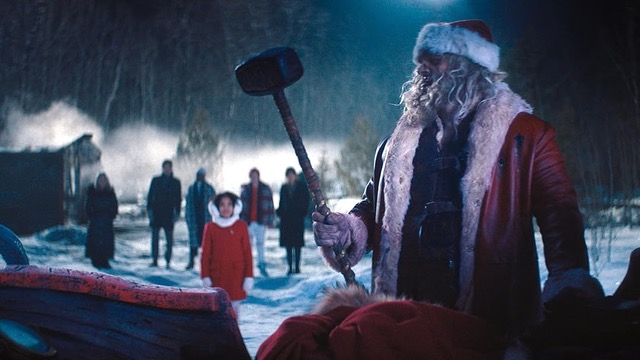
Santa’s got a brand new sledge hammer. David Harbour in Violent Night (Universal Pictures)
Violent Night plays for one night only at the Trylon Cinema on Thursday, December 25th. For tickets, showtimes, and other series information, visit trylon.org.
There is a seasonal debate borne directly out of and aged exactly alongside the internet. They even share the same lifecycles: At first it was wildly amusing. Next came innocuously controversial. Then it started to get annoying as too many people made it their entire personality. Finally it was somehow weaponized as it simultaneously radicalized one generation, while another rolled their eyes at its continued existence. And yet a majority of both blame it as the sole reason everything has been wrong since the nineties.
Is Die Hard a Christmas movie?
I’m not here to rehash this established debate. At this point, it’s the equivalent of debating if the meal between breakfast and dinner is *really* lunch.
“Is Die Hard a Christmas movie?” has been so definitively decided that the debate itself has become its own genre, as Violent Night makes clear.
Let me explain.
First, an extremely brief history on how Die Hard became iconic, twice.
Based on a late 70s pulp paperback “Nothing Lasts Forever” by Roderick Thorp, the legendary story of a reluctant hero forced to take on a small army of heavily armed baddies was a story that nobody actually wanted to tell. Studio after studio passed, prolific directors dismissed it as trash and the only actor they could get to say yes was a wise-cracking clown from (shudder) *television.* The project was doomed for abject failure and utter humiliation.
Except, oops: they ended up making the gold standard of action films that forever changed the genre.
Originally Hollywood didn’t want to make Die Hard. All of a sudden that’s ALL they wanted to make. It became the action movie pitch for the next 30 years. Die Hard on a bus (Speed), Die Hard on a plane (Passenger 57, Executive Decision), Die Hard on a mountain (Cliffhanger), Die Hard with a President (Several, actually). It was only two years later when Home Alone, effectively “Die Hard with a kid,” became its own Christmas staple.
Speaking of: Was Die Hard intentionally made as a Christmas movie? Plebians always consider this to be their deathblow as they attempt to dispute reality. This answer is… kinda.
The original novel was set around Christmas, though spread out over several days beyond the holiday. Director John McTiernan drew inspiration from A Midsummer Night’s Dream and chose to focus on one night amongst a celebration: Christmas Eve. Producer Joel Silver sarcastically remarked “At the very least we know it’ll play every December.”
Then cable happened.
Silver’s quip proved prophetic as Die Hard began to fill the airwaves every December, introducing itself to a fresh generation year after year. This is how you train the world to embrace Die Hard as a Christmas movie. This is how you launch a hundred seasonal thinkpieces. A thousand memes. And at least one highly successful stage show that ran for over a decade at the Bryant-Lake Bowl (Humblebrag).
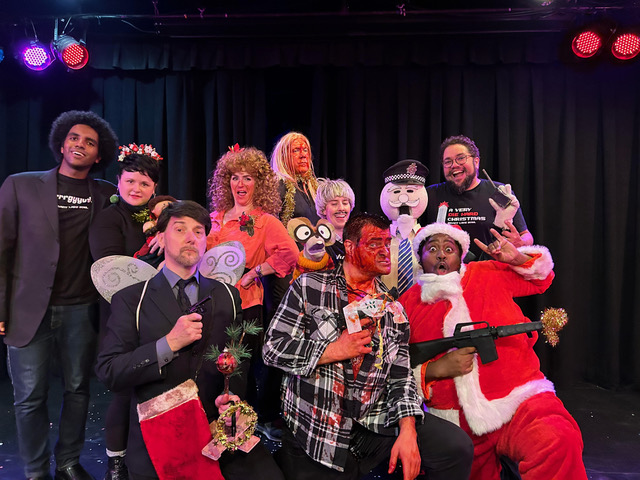
The 2023 cast of “A Very Hard Christmas” with special guest star Nurd-D as their Secret Santa.
Violent Night has shrewdly and logically combined both parts of the Die Hard mythos into one brilliant and how-the-hell-did-it-take-this-long-to-do-this premise: Die Hard with a Santa.
The film wears its Die Hard inspiration on its blood-spattered sleeve. David Harbour plays a blue-collar, fed-up Santa Claus who finds himself in the wrong place at the right time, when John Leguizamo’s exceptional thief and his elite team of mercenaries take a wealthy family hostage on Christmas Eve. Santa is forced into action to save both the hostages and the holiday itself. You can see traces of Die Hard’s supporting cast too: young Trudy steps into the Dad-From-Family–Matters role as Santa’s lone ally; Cam Gigandet plays the smug hostage who thinks he can talk his way out only to learn the hard way that he cannot; and there’s even a General Thorp, both a nod to novelist Roderick Thorp and a winking reference to a notorious plot twist in Die Harder.
And it doesn’t stop with Die Hard. Harbour’s drinking, puking, cussing St. Nick isn’t the first “Bad Santa” to hit screens. Trudy gets in on the action with Home Alone-style booby traps that play out with slightly more realistic consequences. Beverly D’Angelo—freaking Ellen Griswold herself—shows up as the family matriarch, having a much worse Christmas Vacation than usual.
Because the truth is Die Hard is far from the first entry in what’s now called the “Alternative Christmas Movie.” Gremlins. Scrooged. Batman Returns. Kiss Kiss Bang Bang. These are movies that mix their holiday imagery with a cocktail of violence, satire, sarcasm, and chaos. Violent Night is the full-throttle culmination of that lineage, gleefully slicing the “sub” out of the word subgenre and announcing that Alternative Christmas has officially become a genre of its own.
Why have these movies endured year after year, decade after decade in some cases, while the onslaught of new “traditional” offerings has slipped away into the streaming void never to be heard from again? Why are the arguments just to include these movies in the conversation so passionate? And of the new class, why does Violent Night already earn specialty screen status instead of a Hot Frosty retrospective? (Though I do have several questions about the science of Hot Frosty, most of them anatomy related.)
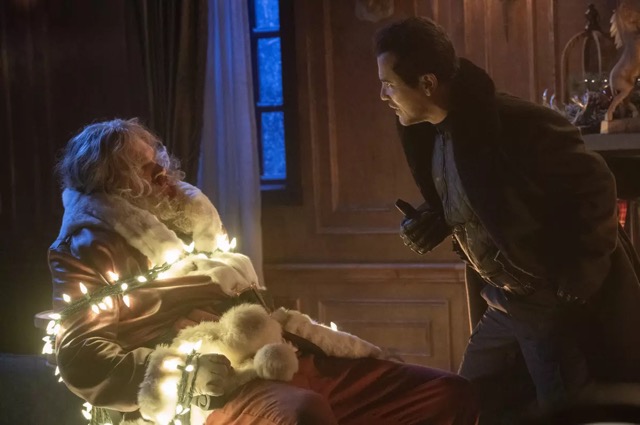
John Leguizamo ensuring his placement on the naughty list. (Universal Pictures)
Consider who started the Die Hard debate. Gen X. The elder millennials (or Xennials if you want to be a Muppet about it). Arguably the first generation to be raised in an era when Christmas stopped being a holiday and became a year-round corporate industry.
Holiday entertainment went from the classic morality play to drunken musical specials, to extended toy commercials, to the modern “Christmas movie.” Snowy, yet warm. Frantic, yet cozy. Every conflict ultimately an annoyance. Every lens ultimately soft. And above everything, every character is the best version of themselves, all willing to sacrifice their own happiness Gift of the Magi-style to ensure everyone has the best holiday possible.
Girl, that ain’t Christmas.
Christmas makes us our most petty, obligated, selfish, vindictive, exhausted, entitled, impatient, insecure, overwhelmed, performative, resentful, brittle, and overextended. If one more goddamn thing goes wrong, we’re either going to punch everyone or lock ourselves in a parked car and sob.
Traditional Christmas tells us how it should feel.
Alternative Christmas tells us how it actually is.
But, here’s the twist…
You can’t just hang some tinsel on some swears, stab someone with a candy cane, and coat your cookies with cynicism and call yourself an Alternative Christmas movie. None of these films are anti-Christmas. Every one of these characters wants the ideal holiday our childhood promised us. They just have to go through hell to get it. There’s always a beating heart beneath the chaos.
John McClane wants to reconcile with his wife.
Clark Griswold wants to create the perfect memories he thinks hold the holiday together.
Lil’ Kevin McCallister ultimately doesn’t want to spend Christmas home alone.
And in Violent Night, Santa just wants to believe again. In himself, in the holiday, in humanity. He just has to rip apart a few mercenaries to get there.
If you’ve ever hosted your family for the season, that graphic metaphor gets close—but honestly, it could get a little bloodier. If we’re being real.
Violent Night will never have to defend itself as a Christmas movie. It doesn’t need cable reruns or decades of online arguments to secure a place at the table. It was borne from the DNA of every Alternative Christmas story that came before it: the chaos of Gremlins, the cynicism of Scrooged, the bruised heart of Die Hard, the booby-trapped survival instinct of Home Alone. It knows exactly what it is, and more importantly, the audience knows exactly what they want from it. The people who grew up in the era of Christmas-as-corporate-season have already raised their hands and said, “Yes. This one’s ours.”
Violent Night doesn’t sneak into the canon. It kicks the door down, throws the tree lights on, and proudly declares itself part of the holiday with a flame-thrower.
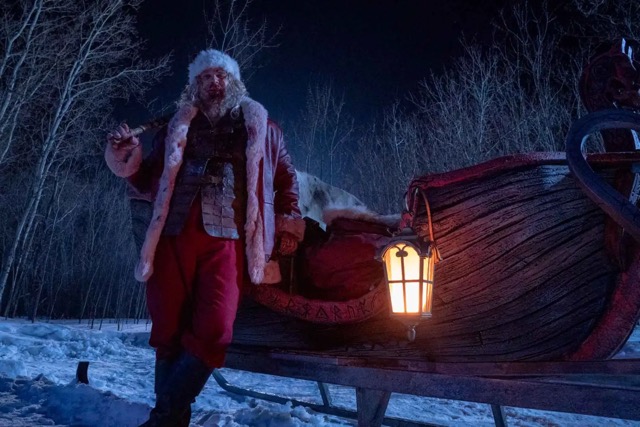
Go ahead. Tell him Die Hard‘s not a Christmas Movie. I dare you. (Universal Pictures)
And are you really going to try to tell that Santa he isn’t a “real” Christmas movie?
Edited by Olga Tchepikova-Treon