
| Noah Frazier |
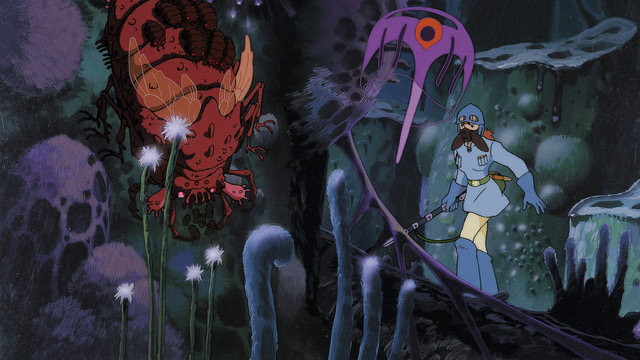
Nausicaä of the Valley of the Wind plays at the Trylon Cinema in glorious 35mm from Friday, January 30th, through Sunday, February 1st. For tickets, showtimes, and other series information, visit trylon.org.
Bugs are gross. They look scary. They’ve got creepy legs and weird pincer mouths. A lot of them have an alarming amount of eyes. They bite, they sting. Sometimes they…let me double check my notes here…drink! your! blood! Like it’s a tasty treat to them! Almost every association we have with bugs is worthy of a nose-scrunching “eugk.” Disease, parasites, rot. People aren’t just scared of bugs–they’re disgusted by them. People want to stomp ‘em, swat ‘em, smush ‘em, burn ‘em, or do whatever else it takes to keep them away. To put it simply, most of humanity thinks bugs are nasty little freaks. Most of humanity, except for Hayao Miyazaki.
When Hayao Miyazaki finally had an opportunity to make an original work after years of working on other people’s ideas and characters, he decided to tell a story with lots and lots of massive, freaky bugs. Yes, he included the rest of his staples as well—aircraft, war politics, environmentalism, and a noble-hearted young girl who navigates it all—but what I want to focus on is the bugs. Because bugs are a weird place to start for an artist making stories for children. Especially an artist whose films have such a reputation of coziness—hot cups of January soup, distilled into movie form. Nausicaä of the Valley of the Wind is the opening movement in the concerto of Miyazaki’s filmography, and his depiction of big, gross insects establishes the expansive empathy at the core of all his work.
Miyazaki’s use of bugs in Nausicaä is best understood by looking at the trends of bugs—specifically sci-fi bugs—in storytelling. Georges Méliès’s 1902 picture A Trip to the Moon is a totemic work of science fiction filmmaking, and is one of, if not the, first significant uses of bugs as aliens in film. Borrowing ideas and images from early speculative sci-fi writers like Jules Verne and H.G. Wells, along with popular pulp fiction magazines of the time, Melies depicted Selenites, the moon’s alien inhabitants, as insectoids: human-sized creatures with the features of bugs. Méliès weaponized the strange, repulsive imagery of bugs to create an alien race which would immediately be understood as adversarial to the protagonists of his film. This choice was effective. The larger-than-any-bug-should-be insectoid became a staple of design for science fiction aliens. The evolutionary aversion humans have towards bugs worked as a shortcut for storytellers, quickly establishing antagonists that you can root against with abandon, cheering as they die by explosion or laser beam without any second thought. The insect iconography established by Méliès metamorphosed across genres, from monster/kaiju films like Them, Tarantula!, and Mothra, to horror films like The Fly. Later, Ridley Scott’s Alien utilized an insectoid design from visual artist H.R. Giger in all of the life stages of its eponymous antagonist, and James Cameron’s sequel Aliens furthered the insectoid connection by making the alien’s social structure one with a hive queen, another frequent trope of insectoids in science fiction.
That was a shallow overview of the bug trends up until Nausicaӓ, but you can see how over time these stories condensed two simple ideas—first and foremost, that bugs are different (alien), and secondly, that bugs are bad. When the depiction of bugs grew to human size and beyond, their sinister traits grew as well, and translated to become representative of human fears. The use of insectoids became less about the human relationship to bugs, and more about the human relationship to other humans. Bugs spoke languages humans didn’t understand. They had cultures and social structures humans felt lost in, priorities that humans couldn’t agree with. The trope of the hive mind connected to the out-group homogeneity humans see in people that are not similar to them. As the world continued to globalize in the twentieth century, sci-fi bugs came to be used in stories that reinforced human tribalism as beneficial and necessary. They told audiences that what they understand is good, nice and respectable, and what they don’t understand is not. When the use of insectoids in fiction congealed into this set of ideas, there emerged an opportunity to use the negative disposition towards bugs to subvert these tropes, and explore the human disposition towards what is different from us.
The beginning of Nausicaӓ’s subversion from the sci-fi bug tropes is its location. It does not take place on a far away planet, but rather a post-apocalypse Earth that is reckoning with the suffering that humanity has caused to it. When the big bugs come into play, they are not aliens, despite using the imagery that we associate with the insectoid monsters of science fiction (almost more akin to kaiju in this case). They are a mutated extension of our own ecosystem. This choice serves Miyazaki’s focus on nature, questioning what we include and exclude in our definition of nature. Miyazaki recognized that the symbol of bugs morphing into a symbol of alien creatures didn’t just signal our disgust towards bugs. It also reflected humanity’s increasingly distant relationship with nature. We often speak of humanity as a separate entity from nature, rather than a component within it. Miyazaki dramatizes this by depicting a world in which our estrangement from, and aggression towards, nature has perverted our planet to become alien and hostile to us. The forest is poisoned, the air polluted, the plants tainted. Our central heroine, of course, sets out to reconcile this estrangement through displays of empathy and respectful understanding of nature’s boundaries. In the first sequence after the opening credits, Nausicaӓ gently collects resources from the environment, saves a friend from the misplaced anger of a stampeding Ohmu (mega-sized pillbug-looking beast) by calming it down, and then doesn’t flinch at the bite of her friend’s fox-squirrel as it gets familiar with her. Each step is harmonious with nature, even a nature that has grown dangerous to her. Across its runtime, Nausicaӓ is dedicated to deftly subverting the tropes of the insectoid image. Rather than an adversarial relationship with bugs, Nausicaӓ builds towards a cooperative relationship. Rather than depicting the hive mind as a malicious source of danger, the red-eyed synchronicity of the Ohm is shown to protect its vulnerable baby bug. Miyazaki repeatedly condemns human violence and hierarchy over nature, and instead shows a model of universal empathy from the first frame of Nausicaӓ to the last, as he’d continued to do throughout the rest of his filmography.
The use of insectoid aliens has continued to be an evocative, versatile image of film storytelling beyond Nausicaä. When Paul Verhoeven took to adapting Robert A. Heinlein’s novel Starship Troopers to film, he recognized a fascist underbelly within the source material’s militaristic society and turned his adaptation into a parody propaganda film. Humanity is depicted as enthusiastically bloodthirsty, and perfectly content to eviscerate alien bug populations without questioning how intelligent and sympathetic those bugs might be. In both the novel and film Ender’s Game, the alien bug is used similarly, initially presented as a clear enemy and later revealed to be more intelligent than initially suspected. Ender’s Game is especially significant for its deepening of the hive mind trope, truly exploring the values a culture built from a collective mind might have. Just this past year, two major auteurs prominently featured alien bugs in their films. Bong Joon Ho’s Mickey 17 takes a very Nausicaä-like approach to its narrative of human war-mongering on a planet with alien creatures who look half icky and half cute. Yorgos Lanthimos’s Bugonia attempts a double rug-pull in utilizing the tropes of a suspected insectoid alien invasion to depict the conspiratorial insanity of modern political discourse, and the build-up of resentment between socio-economic classes. Our inner-brain apprehension towards bugs continues to be played with in our storytelling, but is more often subverted in the end, continually reminding us of the need to evolve past our primal fears.
Bugs are about as different from people as a living thing could be. In a world of steepening differences, this makes the symbol of the bug valuable. It is easy to be disgusted by bugs (they’re disgusting!), but I hope films like Nausicaä of the Valley of the Wind remind us that nothing exists that is not a part of nature, just as no person exists that is not a part of humanity. Which is why we must learn to simply watch a bug do its weird buggy things, and let it be. It’s imperative. We don’t have to “get” them, we don’t have to buy an ant farm, we don’t have to give every spider a smooch and thank them for their contributions to the ecosystem. But we have to stop stomping on them. Ants are making anthills, caterpillars are making cocoons, spiders are spinning webs, and people are doing all the nonsense that people do. If we can stop stomping on bugs on the street, (and blasting them with lasers or eviscerating them with bombs in our stories), we give ourselves a chance at reconciling humanity’s bigger differences, and making our own habitat a little less disgusting.
Edited by Olga Tchepikova-Treon