
| Ed Dykhuizen |
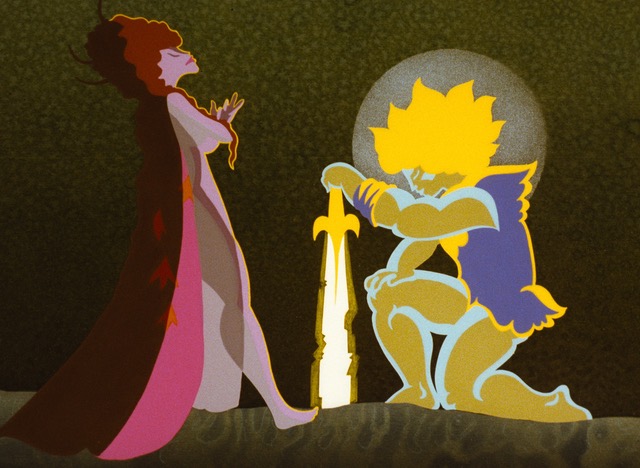
Son of the White Mare plays at the Trylon Cinema from Friday, February 6th, through Sunday, February 8th. For tickets, showtimes, and other series information, visit trylon.org.
Communism does not create a great environment for filmmaking. Communist governments tend to try to control everything, especially how people think. All art becomes state propaganda limited to a handful of party-friendly messages and forms. You have to be pretty creative to make something interesting within such strictures.
Granted, one of the most creative and influential filmmakers of all time came out of the early days of communist film. With Battleship Potemkin and Strike (both 1925), Soviet director Sergei Eisenstein put into practice the cutting-edge concepts of “montage theory.” The primary principle of montage theory was that meaning comes from the juxtaposition between shots of a film, not within individual shots. This was a radical departure in 1925, when film was still inching away from being filmed theater.
Battleship Potemkin and Strike were revolutionary in form, but their content adhered to the strict rules of Soviet propaganda. Both films depict the proletariat being victimized by wealthy capitalists and/or bourgeoisie and then valiantly overthrowing them. The films aren’t really about individual characters as much as a class of people battling another class.
Battleship Potemkin in particular was a worldwide success, bringing the USSR the kind of international PR coup that it constantly craved. Sergei Eisenstein earned a reputation as one of the era’s most important filmmakers. Despite this, for the rest of his career he struggled mightily with the Soviet government to make the movies he wanted to make. In the remaining 20 years of his career, he managed to direct only a handful of films.
After the Cultural Revolution began around 1928, Stalin’s desire for propaganda to dominate all media overwhelmed his tolerance for avant-garde filmmaking ideas. If any aspect of a film, including the editing, overshadowed its message, Stalin would accuse the filmmaker of the “formalist error.” Being too “formalist” could mean a sentence to a gulag or a firing squad.
Eisenstein managed to escape those fates after his montage-heavy 1928 film, October: Ten Days That Shook the World, was condemned by Stalin’s cronies for being too complex for the masses. (This often met Stalin didn’t understand it; he was not exactly an intellectual giant.) Eisenstein got the message. He jumped at the chance to take a long tour of Europe and then accept an offer to make a movie in the United States.
Meanwhile montage theory co-creator Dziga Vertov created a concentrated burst of formalistic creativity, Man with a Movie Camera (1929). The film turns footage of ordinary city life into a sizzle reel of flamboyant cinematic techniques, including jump cuts, split screens, multiple exposure, and much more. Now considered one of the greatest films of all time (ranking 9th on Sight and Sound’s 2022 directors’ poll), Man with a Movie Camera was universally disparaged and ridiculed in its time. It ended up representing the delirious death throes of montage-theory film in the Soviet Union.
From 1934 to 1988, official Soviet policy was to permit only one style for all media, from film to painting, called “socialist realism” (which is not to be confused with “social realism,” though it often is). Socialist realist art must be realistic, as the name implies. It also must promote Marxist-Leninist ideology, usually in the form of lionizing the proletariat. You get a lot of farmers and factory workers looking heroically into the distance.
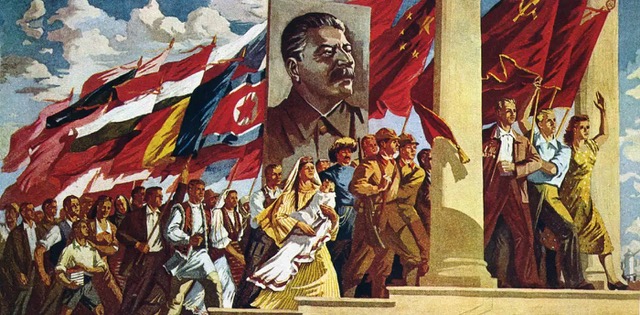
Fighting for Peace, Jules Perahim, 1950, image courtesy wikiart.org.
It can look pretty cheesy to modern eyes. Even if you love socialist realist style, it would have to get tiresome after a while. Limiting artistic expression so severely will very quickly make a country’s art repetitive and predictable.
Enforcement of socialist realism waxed and waned over the years. A handful of filmmakers, including Andrei Tarkovsky and Sergei Parajanov, were able to break through with great and formalistically revolutionary films. Doing so inevitably entailed epic battles with stodgy and uncomprehending Soviet apparatchiks.
Hungary for Innovation
Hungary was one of the many communist countries that took its cues from the Soviet Union after World War II. By 1950, the Hungarian government was in full control of film production. All film treatments came from government officials, who drew from only a few propagandistic genres. A “manufacturing film” showcased the ideal proletarian, usually a factory or farm worker. A “sabotage film” featured a dastardly intellectual or engineer sabotaging the ideal proletariats. Historical films plumbed the stories of the past that could provide direct parallels to the party line. Suffice to say, it was not a fertile ground for innovative storytelling.
Government control over Hungarian film content would loosen and tighten again a couple of times in the following decades. Throughout, formalistic elements tended to get freer rein than messaging. After Stalin died in 1953, the whole communist world slowly shrugged off the idea of the “formalistic error.” As long as your story followed communist dogma, you could play a bit with style.
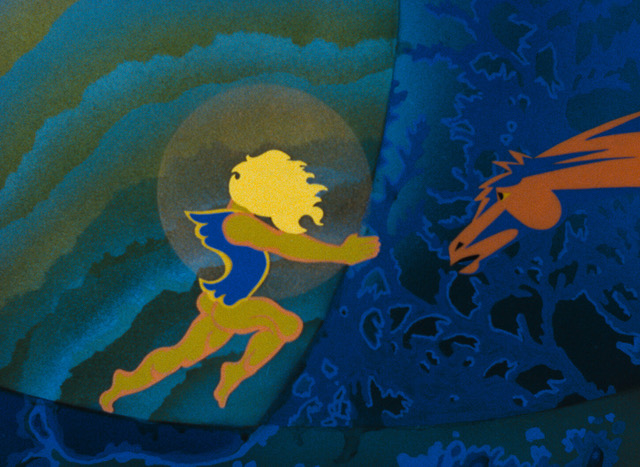
The 1981 animated film Son of the White Mare does a lot more than play with style. It creates its own stridently bizarre universe of imagery, one of strikingly bold primary colors filling thick white lines, figures morphing and merging, objects spinning for no particular reason, and much more than words could capture. “Psychedelic” is perhaps a reductive term for it all, but it at least that gets across some of the gist. Every frame of Son of the White Mare is like a masterpiece painted by Picasso on an acid trip.
Son of the White Mare director Marcell Jankovicz always insisted he never took psychedelics. In an interview published on the website CartoonBrew.com, he explained where his style came from:
“As far as I can remember, I’ve always thought in pictures and had a vivid imagination. In my animated films the design of every frame is of great importance, as if it would be a painting. Most of the time, and particularly in a mythical, fabulous context, my human characters, even lead characters, are only a minor part of the whole image.
“To try to express realistic human behavior in animation has limitations. Such attempts in serious animation are often absurdly ridiculous. Why would one imitate reality? Just leave it to living actors! Earthbound reality is not for animation. Animation is a stylized, fantastic world.”
While his style is about as unrealistic as possible, Marcell Jankovicz tried to at least keep the film’s content within well-worn territory that Hungarian authorities would allow. He based Son of the White Mare on ancient Central European folk legends. A primary source is the 1862 poem Fehérlófia, by Hungarian poet László Arany, but Jankovicz pulled ideas from many other versions as well. No one could bat an eye at the concept of an animated film based on folklore.
Jankovicz did encounter resistance when he submitted an early screenplay draft with a cyclical story structure, in which causes lead to effects and then lead back to causes. The original title of Son of the White Mare was Tree Without a Top, which refers to a World Tree that symbolizes time as a circle. Hungarian authorities would not allow this: Marxist dogma demands that time can only be linear and irreversible. Jankovic was forced to simplify his story accordingly.
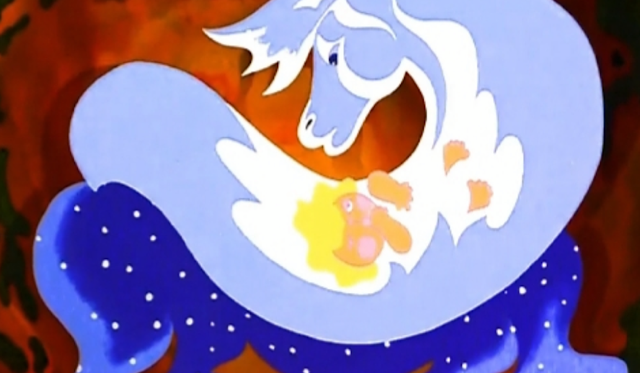
Son of the White Mare starts with the birth and childhood of the titular character, Treeshaker. His mother holes up within a tree to raise him, telling him stories of how dragons took over the land. As the years pass, Treeshaker demands more and more from her, causing her to grow weaker and weaker. You could interpret this as espousing the problematic message that there should be no limits to a mother’s self-sacrifice for her children, à la the Shel Silverstein book The Giving Tree. Personally, I detected some ambivalence in Jankovicz’s portrayal of her plight, which lent some dramatic tension to this opening section.
The rest of Son of the White Mare has very little ambivalence, or, to be honest, dramatic tension. When fully grown, Treeshaker is an idealized mythical figure: impeccably strong, brave, and noble. He is not the sort of complex protagonist that can make film plots especially engrossing. As a perfect being from the outset, Treeshaker can’t grow, change, or even face genuine obstacles.
It’s the sort of character that works best in oral folklore. An oral storyteller will set up a seemingly insurmountable trial and then act out the dashing hero defeating it effortlessly. The crowd will laugh and thrill at both the exploits and the storyteller’s charismatic showmanship. Meanwhile, the storyteller’s mere presence and personality grounds everything within genuine human experience. The storyteller takes their audience members on momentary flights of fantastical wish fulfillment, after which they quickly return to Earth. The moments of fantasy are more thrilling because they are surrounded by periods of grounding.
Movies, meanwhile, are fantastical flights lasting 60 minutes or more. Other attempts to adapt Eastern Europe folklore for the screen yielded movies like Jack Frost (1964) and Sampo, aka The Day the Earth Froze (1959). Both proved goofy enough to make for good episodes of Mystery Science Theater 3000, but they don’t hold up well without mocking commentary.
What those films don’t have, and Son of the White Mare does, is an astounding kaleidoscope of constantly changing visuals. If the film’s story fails to captivate you, you can engross yourself in the pure beauty of Marcell Jankovicz’s limitlessly creative imagery. At times, shapes will appear and interact for little reason besides entertaining themselves, and us. It is as if Jankovicz is acknowledging that some story beats might be dull, and that some razzle-dazzle is necessary to keep people tuned in. It’s hard to think of a movie more devoted to committing so-called “formalist errors.”
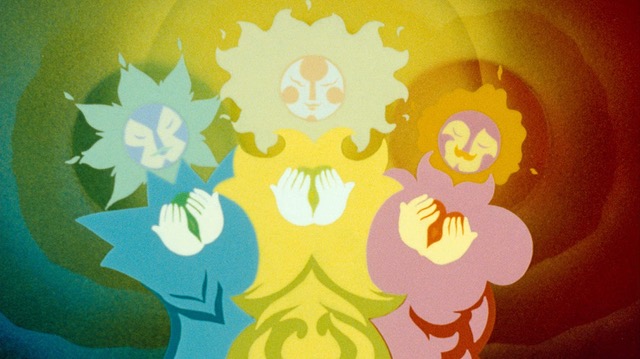
The Hungarian government could never have anticipated that a few simple folk tales would be converted into the candy-colored phantasmagoria that Marcell Jankovicz produced. Son of the White Mare got a limited release in Hungary and failed to find an audience. No one tried to get it any international distribution.
For decades, Son of the White Mare was virtually unknown outside a few animation professionals and fanatics. They passed tapes of the film around until its reputation grew into the status of a cult classic. Now Son of the White Mare transcends the hundreds of more measured and conventional films that hewed closer to the demands of communist functionaries. It does so not by having a revolutionary or even a particularly interesting story; it keeps delighting audiences by indulging in explosive, unfettered formalistic creativity. Stalin is hopefully spinning in his grave.
Edited by Olga Tchepikova-Treon