
| Penny Folger |
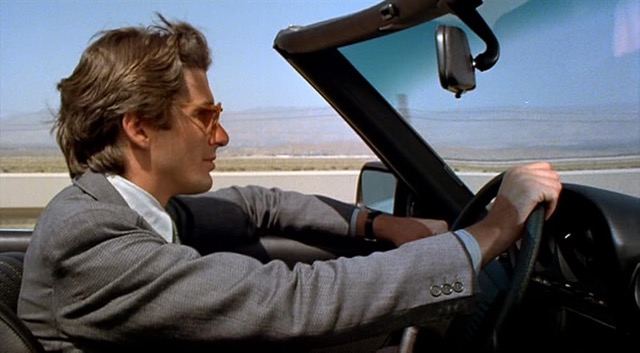
American Gigolo plays at the Trylon Cinema from Sunday, February 8th, through Tuesday, February 10th. For tickets, showtimes, and other series information, visit trylon.org.
Paul Schrader’s American Gigolo, starts out with all the luster and flash of the 1980s though it was actually shot in 1979. Yet, stylistically, it preternaturally defines the decade that was to come.
“It’s almost setting the blueprint for what the ‘80s sounded like,”1 said LA music supervisor and DJ Dan Wilcox. “They were doing this in 1979 though.” The “they” was Italian composer Giorgio Moroder, the pioneer of electronic dance music who composed the score for American Gigolo. He also wrote the music for the film’s opening song “Call Me,” which became a huge hit for the band Blondie (lead singer Debbie Harry wrote its lyrics based on the film). According to Wilcox, David Bowie once heard Moroder’s music and declared to Brian Eno, “This is the future of dance music. This is what dance music is going to sound like for the next 10, 15 years.” Quipped Wilcox, “He was only wrong in that it actually ended up being what’s almost 50 years now.”
Such stylistic choices are at the forefront when one speaks about American Gigolo, because it’s a story about a character defined by his style. Said Schrader, “The character of the gigolo was essentially a character of surfaces; therefore, the movie had to be about surfaces.”2 Schrader says the film is intentionally cold and that his gigolo, Julian Kay, is emotionally removed because Kay is a character who pleases others while never allowing himself to be pleased. Complains Kay’s unlikely love interest in the film, Michelle, a senator’s wife, “When you make love, you go to work. I can’t give you any pleasure.”
Schrader arrived at the core idea for this film while he was teaching at UCLA. While talking to a student he offhandedly listed “gigolo” amongst the hypothetical professions a character might have—”banker, lawyer, cop… gigolo”— and the idea stuck with him. It became a great metaphor as that profession involves giving love superficially, but never receiving it. Coincidentally, the inability to express love was a topic Schrader was discussing with his therapist at the time. He explains further, “It’s the story of a character whose life is predicated on not surrendering to women, but on serving them and therefore standing distant from them.”3
Kay, played by a cardboard cut-out looking Richard Gere in the performance that launched his career, glides across these surfaces like an ice skater. He is always in motion. He moves through the upper classes in designer suits like a chameleon. He speaks five languages, like a CIA agent being sent out on a spy mission. He’s always performing—even, especially, in bed. Julian’s resistance to align with any sort of real identity is illustrated even in his personal life. Asks Michelle, played by Lauren Hutton, “Where are you from?” He responds, “I’m not from anywhere. I’m from this bed.”
As a viewer who is fond of much of Schrader’s work, I think this is why I wasn’t able to connect with this film initially—I prefer emotional depths. Though, upon further inspection, this movie does have many points of interest. Its shallow glossiness is ironically also perhaps why it was Schrader’s first big directorial hit. After all, isn’t Hollywood known for its gloss and emptiness? Hollywood can be a surface oriented place, obsessed with flashiness and the new. Kay is a person who lives in surfaces and can’t emotionally connect. What better marriage?
It’s no surprise that the writer Bret Easton Ellis was heavily influenced by American Gigolo. In American Psycho,his Patrick Bateman, at least in the film adaptation by Mary Harron (I have not read the controversial book), has traces of Julian Kay all over him. It’s in his trying to achieve some sort of physical “perfection” with his body and in his wardrobe. The entire sequence in Gigolo of Kay singing to Smokey Robinson and laying out his very extensive designer wardrobe is very reminiscent of Bateman, although Bateman is much more violently malignant than Kay. “American Gigolo is Armani, and Armani is American Gigolo,” sums up Professor Jennifer Clark. “You can’t extract one from the other.”4
There are also odd parallels between Kay and Gene Hackman’s character Harry Caul in The Conversation, written and directed by Francis Ford Coppola. Both characters are extremely guarded and both have scenes where the characters tear apart their apartments, searching for a bug they fear may have been planted there.
John Travolta was originally signed on to play Kay, but Gere is a sort of a glossy blank slate in a way that Travolta, who is more charismatically blue eyed and iconic, arguably would not have been, With Travolta, admits Schrader, “It would have been a different film.”5 Chevy Chase was at one point even offered the role, one where the pretty boy character carries himself overtly sexually, possibly bisexually, all of which, done seriously, is hard to fathom with Chase. Gere was brought in to replace Travolta, who dropped out a mere two weeks before production began, partially, Schrader has speculated, due to the gay subtext.
There is indeed a certain amount of gay subtext in American Gigolo, although Julian sees doing gay tricks as “lowering” himself. However, as what is essentially a high class prostitute, he presumably has some experience in this arena. One clue is when he later struts confidently into a gay club that he apparently frequents often enough that the people working the door greet him by name.
Interestingly, Schrader himself, with his strict Grand Rapids Calvinistic background which he bestows upon the central character in his prior film Hardcore (which I have written about for Perisphere previously) felt more comfortable in the gay world, though he doesn’t necessarily identify that way. He came from a repressed Midwestern family where physical contact was minimal and in the gay scene in Los Angeles he felt suddenly free. “I could go dancing stripped to the waist, hugging and holding men, and feel completely released and liberated because I knew nothing would come of it.”6
Kay himself ends up on a journey that is a downward trajectory towards redemption and perhaps some kind of emotional honesty beneath the sheen. His redemption comes interestingly in the form of a hetero relationship, from someone who is willing to sacrifice her own station in life in an attempt to save him. Downward trajectories with eventual possible redemption seem to be an ongoing theme in Schrader’s work. Despite, or perhaps because of, his Midwestern Calvinist upbringing, Schrader seems to enjoy exploring the seedy underbelly of life, a setting for Hardcore as well.
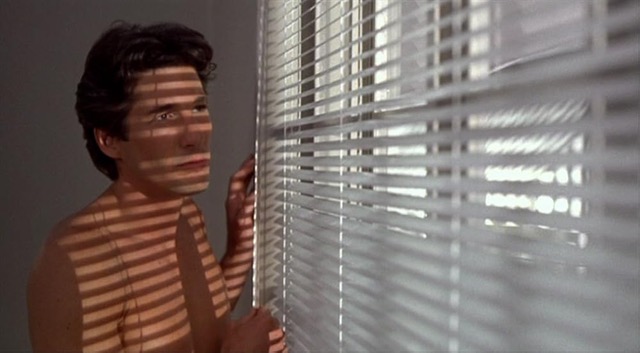
Noir or no?
American Gigolo is arguably a film noir. There were film noirs that existed in color, even in the era from which the genre originated—the Technicolor Leave Her to Heaven comes to mind—and this film’s downward trajectory and elements of crime seem to fit the bill. There is even a shot with the shadows of venetian blinds: that ridiculously cliched film noir motif. The shadow of venetian blinds going across the wall of a private eye’s office is something you might see in a film noir parody, but because this is Schrader and a film about a gigolo, of course it also features one of the first displays of full frontal male nudity in American mainstream cinema! (It’s really only a distant side view.)
At any rate, it is through this noir-style downward trajectory that Kay achieves some semblance of humanity. Or does he? He at least becomes more relatable when things start to fall apart. He’s stripped of all the artifice and flash. He starts to grow a five o’clock shadow. He rents a still not bad looking car to my mind, but it’s not a Mercedes. The horror! Julian’s car and his clothing are an extension of his identity, because we don’t get to see much of him beyond these things. They are outward symbols of his self worth, his station, his freedom to move through the world socially and at the level of class he prefers to occupy. Losing these things, speaking of full frontal, is a bit like rendering him impotent.
Yet even in his redemption there is something hauntingly stilted about Kay. Even when pushed against the wall, does he ever really reveal himself? Nicolas Roeg, a friend of Schrader’s, allegedly threw the script across the room after initially reading it. “He was furious at me because I hadn’t gotten into the depths of the characters. I just worked the surface. But that was the idea, just work the surface and not go deep inside the characters.”7 It’s a frustrating watch for those wanting emotional connection and a deeper psychological reveal, but maybe like the work of David Lynch, it leaves the viewer to project and interpret the rest.
Footnotes
1 “Dan Wilcox, “Man Machine,” American Gigolo, 2024 Arrow 4K
2 Jackson, Kevin. Schrader on Schrader. London: Faber, 1992
3 Jackson, Kevin. Schrader on Schrader. London: Faber, 1992
4 Clark, Jennifer. “American Icon,” American Gigolo, 2024 Arrow 4K
5 Jackson, Kevin. Schrader on Schrader. London: Faber, 1992
6 Jackson, Kevin. Schrader on Schrader. London: Faber, 1992
7 Schrader, Paul. “Below the Surface,” American Gigolo, 2024 Arrow 4K
Edited by Olga Tchepikova-Treon