
| MH Rowe |
Vampire Hunter D plays at the Trylon Cinema from Friday, February 13th (spooky!) through Sunday, February 15th. For tickets, showtimes, and other series information, visit trylon.org.
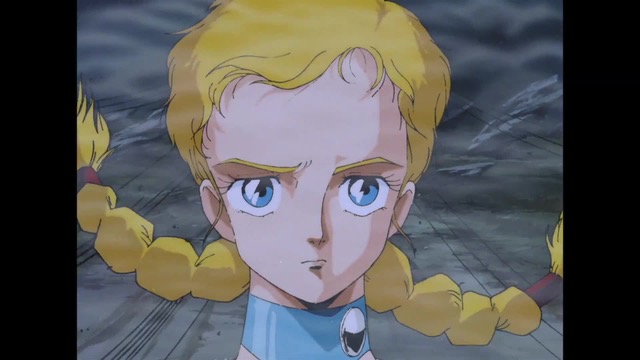
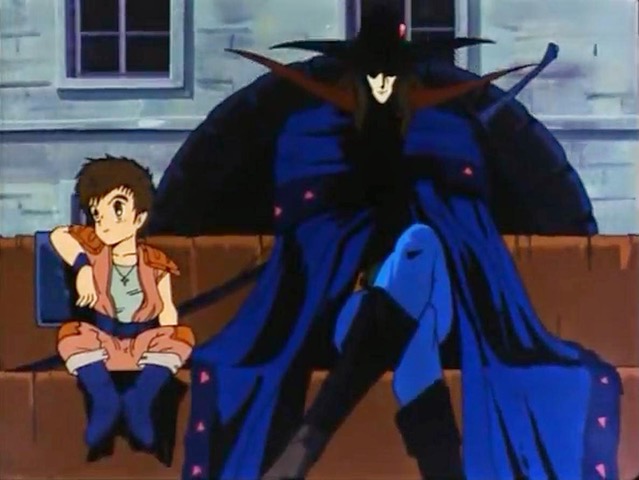
A lot of art seems gruesome and tasteless when you’re twelve or thirteen years old. It repels and attracts you for exactly that reason. When you’re older and you revisit those repulsive paintings or heinous films, some of your childish instincts will of course prove incorrect. The paintings of Francis Bacon, for example, really are incredible. You should actually be more scared of them now than you were as a kid. Other instincts will prove totally reliable and correct. For it turns out that Vampire Hunter D, the 1985 animated Japanese cartoon about a post-apocalyptic earth ruled by rapacious vampires and the tediously mysterious vampire hunter who confronts them, is indeed a grating feast of alarming and arresting images, cut with a healthy dose of leering, porno-brained fantasia. The film’s main female character may not quite be a damsel in distress, but she exists to be groped both visually by the viewer and more literally by the mutant demons who giggle as they rip her shirt off. At least the vampire hunter, named “D” obviously, wears a cool hat and cape and rides a cybernetic horse. The film named after him is perhaps brilliantly demented, but it’s annoying and ugly; it’s also prophetic.
My friend Dan was the one who showed me Vampire Hunter D, sometime around 1994. He moved away before high school. Last time I spoke with him was already 20 years ago, and even then we hadn’t communicated in almost a decade. The only reason we were talking on the phone at all was because his mother had been hit by a drunk driver and trapped in her car when it caught fire on a lonely Michigan road. She died. The news so horrified me that I found Dan’s number through an old friend and called him out of the blue.
Dan’s mom, Kathy, wrote Star Trek fan fiction. She had some of it published in a little paperback book she let me borrow when I was a kid after I told her I was interested in writing. She was kind and good-humored and exercised semi-totalitarian veto power over the movies we watched at sleepovers. This was the mid-1990s, supposedly a time of heightened vulgarity in pop culture, at least according to surveillant moms and the movie ratings system. The card game Magic the Gathering was banned at my Episcopal church. Another friend’s mom had stood with a bedsheet in front of the television during the sex scene when we rented Ace Ventura: Pet Detective. Her son whined at her, come on, mom, with an urgency I knew was embarrassing. Me sitting there awkward on the couch next to him, like I’m witness to a crime. But whose crime? His mom laughed, you’re not old enough. You’re really on your own in this fallen world when you’re not old enough to understand that even pet detectives are sexual beings.
However good or bad your memory, age loosens your childhood from you, like prying up a floorboard. It belongs not only to you but to an era, a time and a place where they did things in a way that no one does them anymore. Anime was so much scarcer in 1994 up on the hills of northeastern Pennsylvania. It felt like samizdat, circulating on crummy VHS tapes with glossy slipcase cover art, available at specialty stores or comic book shops. To watch certain animated Japanese television shows, you had to buy or rent dozens of VHS tapes. We always suspected that, although the technology existed to fit more episodes on each tape, the number had been kept artificially low to sell more units, just so some treacherous importer could buy a new golf course.
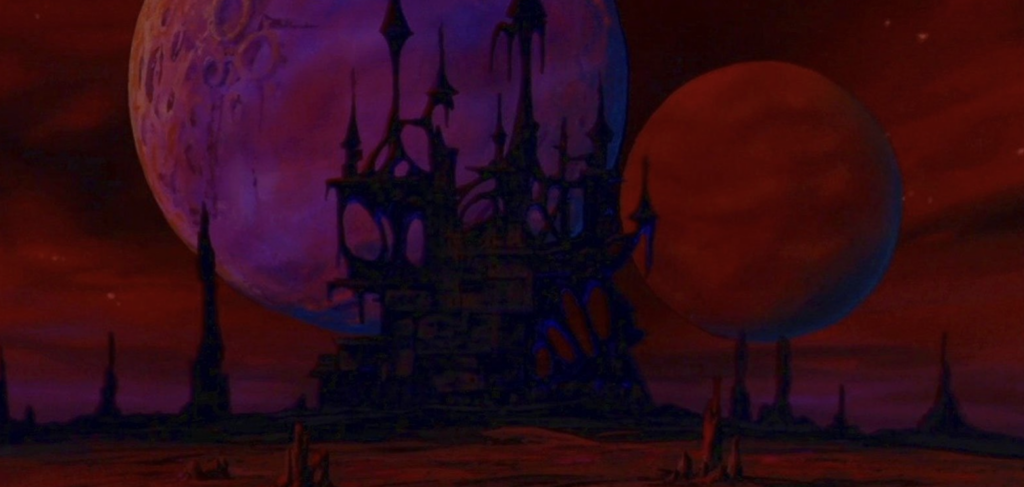
Akira may be the seminal and pathbreaking anime for American audiences, but Vampire Hunter D preceded it by three years. Bodies explode in bubbles of flesh in both films, you can’t avoid it. But where Akira cultivates an enigmatic sense of psychic power and nuclear catastrophe, suggesting the next stage of human evolution in a manner not unlike 2001: A Space Odyssey, the world of Vampire Hunter D is magpie pulp horror. A scrap heap of genres, D features slimy mutants, ghosts, and lone strangers on mechanical horses. Parts of the vampire’s castle indeed look like a castle. Other parts resemble the tubular vastness of the Death Star from Star Wars. The film is as much western as sci-fi, as much adventure as grand guignol. There are also several lingering upskirt shots, which seem especially gratuitous given that the character Doris’s outfit is so short her underwear is visible the entire movie anyway. The off-putting horniness at work in the film is really matched only by its skull-popping violence; both are nevertheless sometimes funny. Visually speaking, the ending seems to reimagine Edgar Allan Poe’s “The Fall of the House of Usher” as a nuclear detonation.
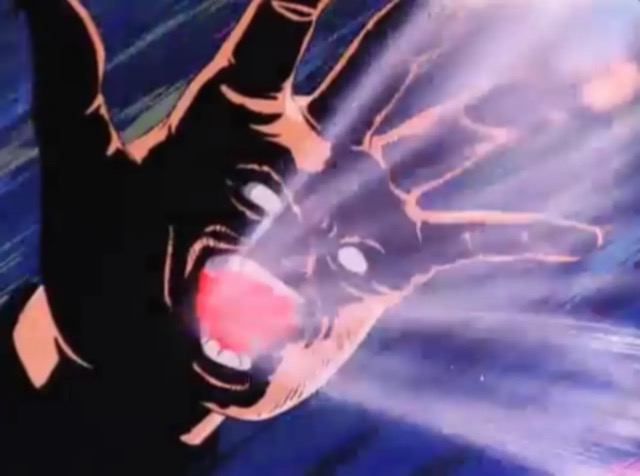
Sometimes a classic is tasteless. If Vampire Hunter D is a classic, it’s because pop culture simply resembles it now. The peculiar gruesomeness of its violence can’t help but call to mind an average episode of Rick and Morty. What made Vampire Hunter D last is probably its redeeming note of kitsch. The hectic feel of its ceaseless mixing of one generic image after another (werewolf, spaceship, ghost, laser) implies an almost cute desperation: anything to entertain. Impatient to be exciting, Vampire Hunter D doesn’t mash up genres so much as smear them together. The result is bloody and stupid, but we’ve been saying that all our lives.
Edited by Olga Tchepikova-Treon