
| Andrew Neill |
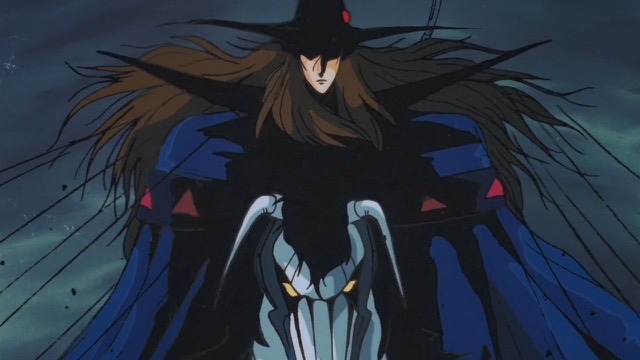
Vampire Hunter D plays at the Trylon Cinema from Friday, February 13th (spooky!) through Sunday, February 15th. For tickets, showtimes, and other series information, visit trylon.org.
The lights are out except for the TV. Outside of its pulsing glow, the bedroom is painted with deep blue shadows, which extend through the window, out onto the snowy front yard, across the icy street, a few blocks of civilization, and then miles and miles of frozen fields and grazing land. The moon is a sliver tonight, and I might as well be there, sitting alone on my bed in a narrow pool of light. South Dakota can be a lonely place for a daydreaming teen who doesn’t see his future out in those fields, but that kid sees hope late at night on a thirteen inch screen as bounty hunters, gunslingers, and lil’ sluggers transport him into new, much more exciting worlds.
I’m not going to claim to be an anime guy. There are many fans out there with infinitely more cred than me. Still, I can track my growing-up and growing appreciation for film through the medium of Japanese animation. When I saw the slate of the Trylon’s series The Art of Insurgence: 80s Animated Sci-Fantasy, specifically Nausicaä and Vampire Hunter D, my life flashed before my eyes. I was surprised to realize how foundational anime was to me discovering so much across the wide world of animation and film, particularly international cinema. The portal for this discovery, which jettisoned me out of American Siberia and into the stars, was Cartoon Network, specifically the anime block Toonami. This syndicated programming stretch on basic cable introduced me to classic anime series, inspired me to look back to core films like Vampire Hunter D, and led me to the cinema that defines my past and present.
Warning: this article is deeply millennial coded. Sorry.
Before we arrive at Toonami and dance with D, I must acknowledge where my journey with anime began, though it will surprise literally no one. When Pokémon entered my life, it became my life. When twelve-year-old me grew up, I wanted to be Ash Ketchum, the hero of the original TV series, even though I was already canonically older than him.
I was predisposed to loving Pokémon. As a kid, I was a collector of oddities and lover of creatures big and small. I watched the Westminster Kennel Club dog show every year and collected figurines of the different dog breeds. I obsessed over books of dinosaurs and prehistoric beasts before I even knew how to read (though archaeopteryx was in my vocabulary before preschool). I spent hours and hours alone in my bedroom making up and drawing a catalog of alien beings, each accompanied by details like what planet they were from and what special abilities they possessed. When Pokémon arrived, it presented the type of world I’d dreamed about, with kids like me going on adventures, finding monsters, and befriending them.
The trouble was that Kids WB, the weekend morning cartoon block on the WB network, aired the original Pokémon anime series on Sundays when my family went to church. As practicing Catholics serious about keeping the Sabbath day holy, the only way out of that obligation was to be actually sick or really convincingly fake it. I had to fill that Kanto-sized hole in my Pokémaniac soul with copycat shows like Digimon: Digital Monsters and Medabots, which aired on Fox Kids on Saturday mornings and offered similar kid-centric adventures with evolving (or, excuse me, digi-volving) monster friends and battling robots.
T.O.M. didn’t clomp his metal boots into my life until a few years later. Basic cable itself didn’t enter my house until I was a teen. But when the cable box activated, I bet the first channel I turned to was Cartoon Network. Very quickly anime moved from the limited window of weekend mornings to the expanse of weekday afternoons. After school, between 4:00 and 5:00 p.m., Toonami blasted out of space. T.O.M., the robot host of the action-based animation block, guided me through a growing catalog of hitherto unknown anime series as I noshed on Gushers and Cheez-its.
Dragonball Z indoctrinated many boys my age, including some close friends of mine. However, the prolonged gratification of that show, which centered on interchangeable spiky-haired, ‘roided-out bros as they charged up to fight increasingly more powerful alien enemies, didn’t hold my attention. As a sensitive boy who was conflict-adverse, I was much more captured by Rurouni Kenshin. That show has a more romantic, melancholic tone and a fascinating central dilemma. Kenshin is the greatest assassin who ever lived, but he’s taken a vow not to take another life. He carries a reverse-blade sword and has to find non-lethal ways to resolve conflict. Rather than provide an escapist power trip, Kenshin showed me how anime can delve more deeply into its characters’ inner lives and morality. It harkened back to the picaresque adventures of Pokémon but represented (dare I say it) an evolution to more complex, adolescent territory.
It wasn’t long before Cartoon Network’s anime programming graduated from late afternoon to late night. Concurrently, I was entering full-fledged teendom and a regular bedtime was no longer enforced. As the third of three kids, my parents gave me a lot of space and definitely didn’t police my movie and television consumption. I “went to bed” but stayed up for an increasingly mind-expanding run of anime shows that hit at just the right time in my rapid, unwieldy brain development.
I don’t exactly remember the first time I saw the opening credits to Cowboy Bebop and heard Tank!, its impossibly explosive jazz theme, but I know it hit with the power to split atoms inside my head. The show itself somehow followed through on that high. It was like Star Wars except everyone was Han Solo. There were complicated schemes, double crosses, space battles, and a super-intelligent corgi. Its combination of flashy cool and goofy absurdity opened a door that more shows with different ratios of cool and crazy walked through. Trigun, Inuyasha, Lupin the Third, and Witch Hunter Robin expanded on similar themes of adventuring heroes and supernatural worlds. FLCL and Paranoia Agent brought things back down to Earth but doubled or quadrupled down on the weirdness. FLCL in particular resonated. As an introverted teenage boy with a growing interest in pop culture and attraction to girls, its blend of teen ennui, rock and roll, sci-fi conspiracy, and manic pixie dream girls felt designed in a lab for me. A burned CD of that show’s soundtrack by Japanese rock band The Pillows was in permanent rotation in my car’s 10-disc changer.
All this syndicated anime lowered the drawbridge to anime cinema of the 1980s. Films like Vampire Hunter D represented a significant step forward into an undiscovered country of animation aimed at adults. There were things in D that Cartoon Network couldn’t show and that I had never seen before. Watching it felt subversive for a small town Catholic boy going through confirmation.
There were familiar elements in D that acted as stepping stones into its hellscape. D himself is a common archetype. Like Kenshin, he’s a wandering warrior with a waterfall of hair, an impossibly long sword, and a still-waters-run-deep vibe. He rides into town atop his cyborg horse and gets wrapped up in local drama. A young woman named Doris has been marked to be the new bride of Count Lee, a 10,000 year old vampire lord, and D has to save her.
There’s a version of this story that could be played on Cartoon Network, but Vampire Hunter D ain’t it. The violence and horniness introduced to me on television were training wheels for the real deal presented in D. The film’s enthusiastic embrace of explicit content appeal directly to the id. D slices a demon down the middle, and moments later it parts like the Red Sea, presenting an anatomical cross-section of the creature before its guts spill on the ground. Count Lee batters his minion Rei against a series of pillars with his telekenetic powers before pinning him against the wall, popping his head open, and dropping his brains. As a quick-to-frighten kid without much experience with horror, these images unnerved me. I definitely didn’t know how to process them.
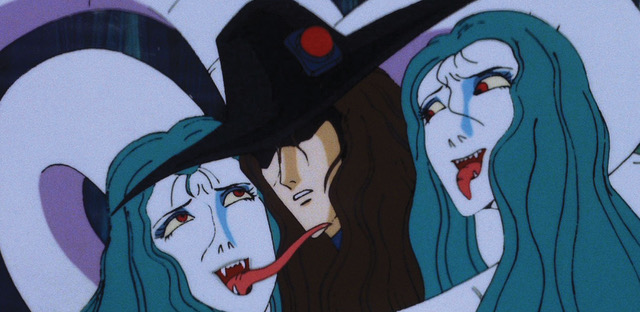
Even more powerful than the violence was the sex. If I couldn’t process the geysers of blood and bodily mutilation, I was further lost by an animated film that showed boobs. I’m sure I was sent into a shame spiral watching the Midwich Medusas, a trio of naked sirens barely covered by their cascading hair. The scene where Doris walks out of the shower and offers her neck to D—who’s a dhampir, a half-human, half-vampire hybrid—is very powerful stuff. Watching it now, it’s easy to see it as a hetero male fantasy made by a group of horny dudes and intended to excite and titillate, but it was received by teenage me with fear and confusion.
In retrospect, it feels representative of a necessary step in my cinematic education. Boundaries had to be pushed, and D was only one of many forays into uncharted lands of adulthood. I continued to explore anime films with a diversity of ideas and more complex themes like Akira, Princess Mononoke, and Paprika. They continued to surprise, delight, frighten, and confound, but I was hungry for all of those experiences. They all offered an escape from the monotony of small town life, where people only talked about the high school football team, why Chevy trucks were better than Ford, and the weather. I’ve grown to appreciate my childhood with time, but while living it all I wanted was a way out. Anime and film in general brought the wider world to my little one, most of it delivered through that thirteen inch screen in my bedroom.Anime is a medium, not a genre, and contains the potential for limitless kinds of stories. These days I don’t watch as much as I once did, and when I do I try to look outside the familiar archetypes I saw back in the Toonami days. Occasionally I find something that resonates like those early discoveries. The work of director Makoto Shinkai is swooningly gorgeous. His film Your Name. blends the everyday follies of being a teen with cosmic, body-swapping fantasy. One of my favorite recent films of any medium is an hour-long semi-feature called Look Back, which follows the creative partnership of two teen girls who share a love of drawing manga. It too elevates humble human experience into something more engrossing and metaphysical. It’s a film I wish younger me, who spent all that time in his room watching anime and dreaming up creatures, could have seen. It would have shown him the connections made through appreciating and making art, and made him feel less alone.
Edited by Olga Tchepikova-Treon