
|Nate Logsdon|
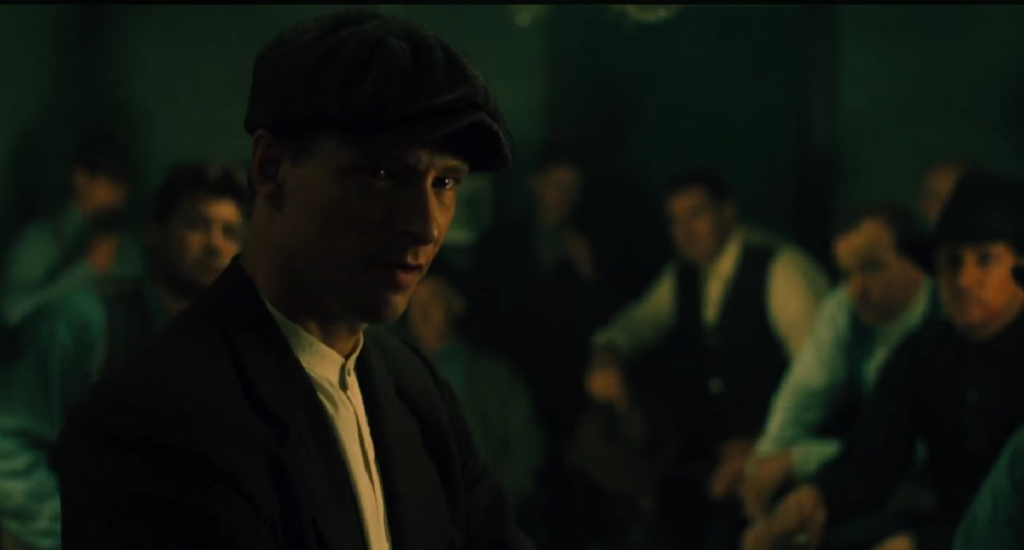
Matewan plays in at the Trylon Cinema from Sunday, March 22nd, through Tuesday, March 24th. For tickets, showtimes, and other series information, visit trylon.org.
On January 5, 1970, Jock Yablonski was found dead in his home alongside the bodies of his wife and adult daughter. They had been shot six days earlier, on New Year’s Eve.
Yablonski was a Pennsylvania coal miner who became a leader in his local branch of the United Mine Workers. In 1969, he mounted a reform campaign to unseat the UMWA president Tony Boyle, whose administration was widely seen as corrupt, disconnected from local unions, and suspiciously friendly to the interests of mine company owners. In the weeks before the murder, Yablonski lost his bid to unseat Boyle for the presidency and immediately contested the results in court and in an appeal to the Department of Labor. His son Chip Yablonski, who first discovered the bodies of his family members, immediately suspected the UMWA leadership. “I’m convinced of it without even knowing,” he told the New York Times in the immediate aftermath of the slaying.1
He was right. An investigation uncovered an outrageous murder-for-hire plot orchestrated by Boyle himself and financed with union funds. He was convicted of the murders and sentenced to three lifetimes in prison. The folk singer Hazel Dickens wrote about the assassination in a song later included in Barbara Koppel’s Oscar-winning 1976 documentary Harlan County, U. S. A.:
Well, it’s cold-blooded murder, friends, I’m talking about
Now who’s gonna stand up and who’s gonna fight?
You better clean up that union, put it on solid ground
Get rid of that dirty trash that keeps a working man down.
Hazel Dickens’s music is featured in another masterpiece of labor cinema, John Sayles’s 1987 historical drama Matewan, based on the true story of a 1920 coal mine strike that ended in a massacre. The soundtrack includes a song Dickens wrote in the 1950s about the union struggle in Mingo County, where the town of Matewan is located.
Daddy died a miner and grandpa he did too,
I’ll bet this coal will kill me before my working days is through.
In a hole this dark and dirty an early grave I find
And I plan to make a union for the ones I leave behind.
Sayles was a college student hitchhiking through West Virginia in 1970, around the time of the Yablonski murders, and he often rode with coal miners. “Almost everybody would say, ‘If you think this is wild and woolly, you should talk to my old man about the coal wars’”.2 This early encounter with West Virginia labor history became the foundation for his 1977 novel Union Dues, which in turn contained the seed of Matewan. Both works linger on the radical potential of the labor movement to transform society while yet confronting the threats of corruption and violence to solidarity.
Union Dues, Sayles’s second novel, is set in 1969 and tells the story of a West Virginia coal miner named Hunter who travels to Boston to try to find his runaway sixteen-year-old son Hobie, who has joined a commune of left-wing radicals. Hunter takes a job in a meat processing factory to support himself in his search for his son while Hobie participates in increasingly risky demonstrations and radical actions. The book’s prismatic view of the labor movement alights on discussions of Jock Yablonski’s efforts to reform the UMW; secret meetings of union miners mounting a challenge to their local leadership; intimations of pay-to-play chicanery in the Boston meatpacker’s union; and finally a ham-fisted attempt at fomenting revolution by seizing a garment factory’s equipment and holding its workers hostage—on the very day that Yablonsky’s murder is first reported.
Hobie arrived in Boston with little previous political consciousness but feels connected to the aims of the leftist commune by his familiarity with coal miner unions. Midway through the novel he recalls for his new friends a story he remembers hearing from an elderly miner back in West Virginia. It’s the story of how a child preacher in 1920s Matewan uncovered a plot by strikebreakers from the Baldwin-Felts Detective Agency to turn miners against the labor organizer Joe Kenehan and saved Joe from being murdered by delivering a coded sermon that alerted the miners to the presence of a spy in their midst.
Hobie’s tale would become the dramatic turning point of the film Matewan. Though based on true events and populated by numerous historical figures, the movie centers on the same fictional characters described in the Union Dues story-within-a-story. Joe Kenehan (played by Chris Cooper in his film debut) is an outsider affiliated with the United Mine Workers. He’s a proud former member of the Industrial Workers of the World who still believes in the One Big Union. His arrival in Matewan corresponds with a work stoppage among the white miners, who have just been replaced by Italian immigrants and African American workers brought in by the Stone Mountain Coal Company. Kenehan convinces the initially antagonistic local miners to overcome racial animus and cultural differences to form a union and go on strike.
Matewan is a rarity among American films in taking the central ideas of socialism seriously and presenting a plausible, sympathetic protagonist who makes no secret about his political views. “It true you a Red?” the striking miner Few Clothes (James Earl Jones, portraying a factual historical personage) asks him in a pivotal scene. “Yeah, I ‘spose it is,” Joe replies. Sayles makes a point of affiliating Joe’s “Red” politics with bedrock American principles. “It’s a democracy,” he says of the national union. “You know, like the United State is a democracy?”
Kenehan’s pacifism is even more of a challenge to Hollywood film conventions than his collectivism. “American labor history is a violent one, the violence being condoned or condemned depending which side of the picket line you stand on,” Sayles wrote in his book about the film, Thinking in Pictures. “The first major decision I made in writing Matewan was to not just pick a side and then root for that side to be left standing when the smoke cleared, but to question the violence itself, to question it politically, strategically, morally.”3 As Joe struggles to convince the strikers that defensive or retaliatory violence will only trigger overwhelming force, the child preacher Danny (Will Oldham, who grew up to be the songwriter Bonnie “Prince” Billy) is slowly seduced by the tragic logic of revenge. “We got to take care of ourselves,” he tells Joe as he loads a rifle. “We got to take care of each other,” Joe replies. The path to the climactic shootout feels as inevitable dramatically as it is accurate historically. And there’s no question that the capitalists and their hired thugs are the instigators of the massacre. But Kenehan’s consistent and finally fatal resistance to the use of violence wrenches a critical wedge into the flow of events: this is exactly the outcome he’d warned against.
Matewan may be rare in American cinema in its political commitment, but it’s not unprecedented. The East Side Saint Paul film nonprofit Trilingua recently screened the 1954 cult classic Salt of the Earth as part of its series “Reel Stories: Labor in Film.”4 The movie’s bracing images of Mexican children behind bars could hardly be more of-the-moment. And neither could its depiction of women leading a resistance movement, confronting a fascist police force, and winning.
Sayles was certainly familiar with the picture: it’s referenced in the dialogue of the self-conscious former activists in his landmark debut feature Return of the Secaucus 7. Like Matewan, Salt of the Earth was an independent production about a real mine strike, filmed on location, and featuring nonprofessional local actors in its large cast. Where Matewan shows miners confronting racism and linguistic barriers in pursuit of solidarity, Salt of the Earth hinges on male picketers overcoming sexism and transferring the leadership of the strike to the women of the community. Salt of the Earth depicts the triumph of nonviolence over police brutality and capitalist trickery, an alternative to the bloody lineage that Sayles traced backward from the Yablonski murders to the coal wars yet challenged through the character of Joe Kenehan.
The labor struggle continues today, as does its cinema. The 2024 documentary Union follows a group of organizers attempting to create the first union of Amazon fulfillment center workers. We see one of the world’s richest men flying into outer space while his employees sleep in their cars. We see (through hidden camera footage) anti-union propaganda being exhibited to new employees as part of their onboarding process. We see union-supporting workers being laid-off in the run-up to a vote on unionization. We see organizers being detained by police and taken off to jail. “They out here hittin’ us with almost one hundred-year-old techniques,” marvels one of the labor leaders. “Oh yeah,” his comrade replies. “You ain’t seen nothin’ yet.”
Endnotes:
- “Yablonski of U.M.W. Slain With Wife and Daughter,” New York Times, January 6, 1970. ↩︎
- Diane Carson (ed.), John Sayles: Interviews (Jackson, University Press of Mississippi, 1999), 94. ↩︎
- John Sayles, Thinking in Pictures (Boston, Houghton Mifflin, 1987), 16. ↩︎
- Trilingua has also recently programmed Matewan as well as Sayles’s long out-of-print sci-fi immigration fable The Brother from Another Planet, a real gem. ↩︎
Edited by Finn Odum