
|Lucas Vonasek|
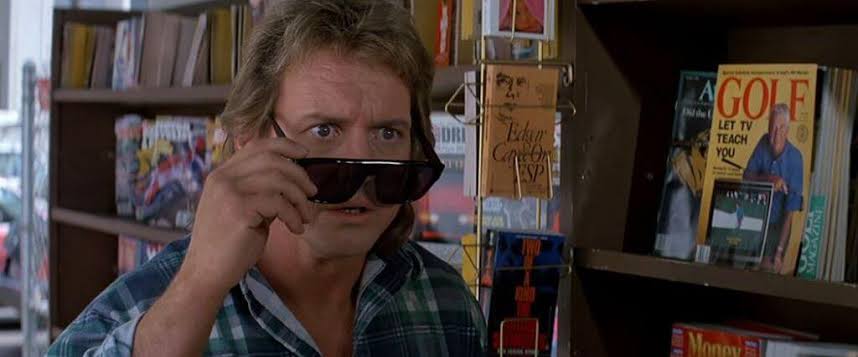
They Live plays Saturday, March 21st at Emagine Willow Creek. For tickets, showtimes, and other series information, visit emagine-entertainment.com.
John Carpenter’s They Live (1988) begins bleakly. Train horns moan as they clatter along the rails, surveillance helicopters chop through the air above in staccato, and smog drapes a city dominated by monolithic buildings clad with corporate logos. These structures loom and leer like capitalist incisors, gnawing at the communities below them. From its opening moments, the film establishes a society shaped by forces that operate at a distance—remote, unaccountable, and insulated from the harm they produce.
Nada (Roddy Piper) cuts through the din of the city on foot, en route to unemployment centers and dead-end opportunities. Like everyone around him, he is searching for work—and like everyone else, he is denied. He traverses crooked avenues of a city manipulated by unseen alien powers, controlled through technology far beyond public comprehension. The population is kept sedated by television and broadcast media, unwittingly subjected to a secret transmission signal to keep them lulled into compliance until Nada—and eventually others—begin to realize that their reality has been engineered.
At first watch, They Live can register as a straightforward 1980s science-fiction action film. It certainly can be just that, but it also can be a sharp critique of American capitalism, state surveillance tactics, and parallels to immigration police presence in the Twin Cities. The film functions as a resonating harbinger about corporations amassing record profits while ordinary people toil in housing instability, rising unemployment, privacy violations, the insistent installation of artificial intelligence in the workforce, widening inequality, and more. It presents a world where authority insists everything is normal, even while portraying a benevolent facade, while entire populations are quietly dispossessed.
Set in a fictionalized Southern California, the story follows Nada as he drifts in search of work. He meets Frank (Keith David), a construction worker who helps him find a job and introduces him to “Justiceville,” a communal encampment where food, shelter, and labor are shared. Justiceville represents a form of mutual aid—an alternative way of surviving in a system designed to isolate people from one another.
Frank understands how the capitalist world works. He describes capitalism as a rigged game everyone is forced to play from birth— “Make it Through Life.” Frank explains, “They put you at the starting line, but only everyone is out for themselves and lookin’ to do you in at the same time… you do what you can,” he says, “but remember—I’m gonna do my best to blow your ass away.” His perspective is not cynical for its own sake; it is shaped by exhaustion, responsibility, and lived experience in a cutthroat capitalist country. However, whether directly or indirectly, he shares his own desire for change even if he has much to lose.
Nada, by contrast, embodies a deeply ingrained faith in the American Dream. “I deliver a hard day’s work for the money,” he says. “I believe in America. I follow the rules. Everybody’s got their own hard times these days.” His worldview reflects the capitalistic conditioning that keeps people invested in systems that continually fail them. In this scene, not only does Carpenter give the characters dialogue to support their ideologies, he also visually reinforces this divide by framing Nada and Frank together against a looming skyline. Two cogs in the same machine, one beginning to sense its gears. Yet, change is inevitable, and later in the movie, we see these two characters clash in a titanic 5-minute fight scene that exemplifies clarity and change, and the difficulty that comes in those moments.
CONSUME. WATCH TV: The Threat of Pacification and The Moment of Clarity
As the film unfolds, Nada becomes increasingly aware of his surroundings: a heavily surveilled police state, omnipresent media, and routine displays of force. In the film, much like today, television and radio function as ghostly conduits of control, whispering instructions to obey, consume, and remain passive. No matter how dire conditions become, broadcast media continues to sell the illusion of the American Dream—the carrot on a stick for so many American residents.
The aliens in They Live are not portrayed as invaders in the traditional, Hollywood sense. They do not arrive in ships or declare war. They do not demand to be taken to the leaders of the world. Rather, they embed themselves within the fabric of the country, and we aren’t sure how long they have been embedded. There is a nauseating smoothness to how they have acclimated. They pose as executives, politicians, media figures—cosplaying as humans in costumes of perceived legitimacy. Their primary method of survival is remaining unseen. As the film makes clear: “They are safe if they are not discovered. Keep us asleep. Keep us selfish. Keep us sedated.”
This form of occupation feels uncomfortably familiar. In the Twin Cities, the presence of ICE operates in a similar way, with constant occupation woven into everyday life. Unmarked vehicles, sudden raids, and the quiet terror imposed on immigrant communities function less as public safety and more as social control. Like the aliens in They Live, ICE relies on masked federal agents to enforce their idea of normalization. Its power depends on being treated as routine, bureaucratic, and inevitable rather than violent, disruptive, and wholly immoral.
Just as Nada initially moves through the city without fully recognizing the machinery around him, many residents learn to live alongside ICE’s presence by looking past it, namely, much of the white and the affluent populace. Fear becomes background noise. Surveillance becomes infrastructure. The occupation persists not because everyone agrees with it, but because resistance is framed as dangerous, irrational, or criminal.
Nada’s discovery of the sunglasses marks the film’s turning point. Through them, the illusion collapses. Through a captivating tracking shot, advertisements are stripped of their imagery, alluring colors, reduced to commands: OBEY. CONSUME. WATCH TV. BUY. SUBMIT. Money bears religious iconography declaring “THIS IS YOUR GOD.” Authority is revealed not as guidance, but as instruction.
The glasses do not change reality—they simply reveal it. It is then up to the wearer of the glasses to choose what they do within their moment of clarity. This is Carpenter’s most damning insight. Oppression does not require secrecy; it requires distraction. Once Nada can see clearly, he cannot unsee the violence underpinning everyday life and the muted deceit that he and everyone else have been exposed to. He experiences a moment of clarity and immediately wants to share it with anyone willing to put the glasses on.
Nada tries to help others experience their own clarity. First, he tries to have Holly (Meg Foster) try the glasses on. She refuses and kicks him through the window of her high-rise apartment. She represents a sympathetic facet of the community that is not only aware of the aliens and their suppressive tactics, but later in the movie, it is revealed that she also directly benefits from them both professionally and financially. She and other supporting characters in the film are turncoats in the eyes of the resistance. Sometime off-camera, they were presented with the same revelation, and they chose to benefit from the occupiers. Holly and other characters who side with the aliens represent the threat of pacification. People who would much rather maintain the syrupy, warm status quo of their reality by choosing ignorance over resisting the occupation and risking everything for a brighter, more salubrious future.
The aforementioned five-minute fight scene between Nada and Frank is a cinematic marvel. Brutal and laborious, and with choreography reminiscent of professional wrestling, the scene is two characters fighting for their own reality to be perceived by the other. Nada desperately tries to have Frank put the glasses on and see, so he and Nada can mount a resistance against the aliens. Frank is hesitant, but after his moment of clarity, he is entirely on board.
From Naivety to Resistance: “White line is in the middle of the road. That’s the worst place to drive.”
The federal occupation of ICE officers in the Twin Cities offers its own version of a moment of clarity for many community members, namely the white, rich, and conservative communities. After the murders of Renee Good, Alex Pretti, and the countless accounts of families being torn apart, recognition and action are demanded of the community, country, and the world. While the realization of the impact of ICE’s occupation of the Twin Cities and beyond is widely shared and acknowledged, entrenched political beliefs and conservative media outlets have influenced wide swaths of people in their own potential moments of lucidity. They have refused to wear the glasses. They are satiated within their own ignorant confines as they regurgitate the same banal, regressive talking points their media outlet of choice maintains. They live in a world of refusal—a paralyzing fear of admitting that they are wrong as they become increasingly unmoored from reality.
They Live suggests that awakening is slow, painful, and risky. Nada does not immediately become radical. He witnesses police brutality, extreme inequality, and the violent erasure of community, yet remains hesitant. Frank resists waking up not because he is ignorant, but because he understands the cost. The risk of the individual is quickly outweighed by the destructive impact of the community.
The message of They Live remains relevant because it is recognizable and depressingly timeless. Nada’s awakening mirrors the slow realization that systems presented as neutral or necessary are, in fact, deeply violent. Nada’s awareness evokes parallels to a long-delayed recognition within many residents insulated by wealth and racial privilege to the reality of a system that people of color and working-class communities have had to continually endure for generations. A system that is sickeningly rife with racism, police brutality, and inequality of all manner. While the galvanization of the Twin Cities community in response to the ICE occupation is a notable sign of progress, the newfound visibility doesn’t unroot the history of inaction and complacency that has defined much of the white, wealthy, and conservative communities within the city and beyond.
Carpenter’s film argues that the first step toward change is seeing clearly—understanding who benefits, who is harmed, and how thoroughly we are conditioned to accept the arrangement. Only when people recognize occupation for what it is—whether corporate, governmental, or bureaucratic—can collective resistance begin. Sometimes clarity happens slowly. Sometimes all at once. Sometimes it can be as simple as reaching into your pocket and realizing that you’re all out of bubblegum.
Edited by Finn Odum