
| Azra Thakur |
Leila and the Wolves plays at the Trylon Cinema from Friday, December 12th, through Sunday, December 14th. For tickets, showtimes, and other series information, visit trylon.org.
Sometimes, I seem to feel a gravity rise from the depths of the ages throughout the world. In myself and in others, I notice a tendency to flee from new problems, to take refuge in churches or counter-churches, to rely on what has been achieved, to be complacent, to kneel before myths, to deliberately close eyes to injustice and stupidity. –Heiny Srour writing in “Woman, Arab and …Filmmaker” (1976)
Earlier this year I made my way over to the cinema to watch One Battle After Another (2025). I’d signed up for a writing class that required a trip to the theater to watch a newly released film every week. I was out of practice of regularly attending screenings, and begrudgingly drove over, wondering if my time might have been better spent elsewhere. I hadn’t read any reviews beforehand, and was startled to see Leonardo DiCaprio and Teyana Taylor part of a revolutionary group fighting ICE agents during the film’s opening. Am I actually seeing this take place on screen right now? I looked forward to every screening for the class after that—maybe there would be another unexpected, revolutionary surprise.
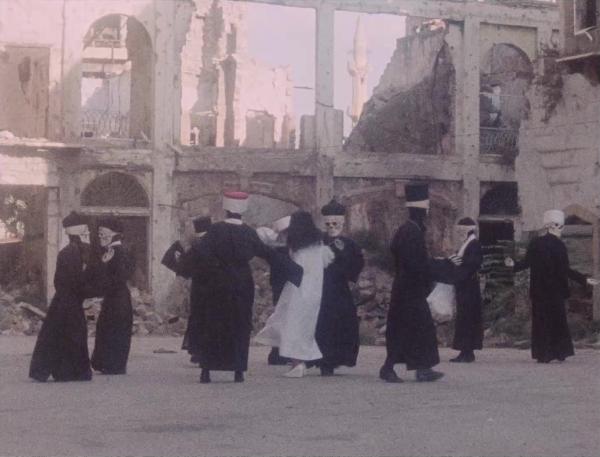
Leila and the Wolves (1984) follows an artist in London, Leila, who is preparing a photography exhibit around the history of Palestine. The film explores how Lebanese and Palestinian women resisted British and Israeli aggression from the 1930s through the 1970s. The film was recently restored and is a timey reflection, given the ongoing genocide in Gaza. Srour is a socialist, a feminist, and a Jewish woman who studied anthropology in France before returning to Lebanon to make films. The film compiles archival footage, folk songs, and re-enactments of scenes from the everyday lives of women at different points in time in a dream-like collage. Leila moves back and forth across time in a white gown, bearing witness to scenes that come alive from the photographs in her exhibit.
Leila travels through Palestinian towns and villages, where women organize and resist their colonizers from their balconies, as they travel to weddings, and fight them in the streets. The film follows Leila across many different environments while she time travels: sandy earth, a green forest, a beach near the sea with a clear blue skies overhead.
Revolution in Srour’s film takes place alongside the ordinary: women together in the kitchen, catching up over tea, discussing their relationship troubles. Revolution isn’t the work of taking individual action, but of many working together in camaraderie. The blue skies outside also make an appearance indoors at the end of the film in a room painted sky blue. The women are arranged in a circle, as though they are numbers on a clock. The camera is at their center and revolves around each woman’s face as some speak and others listen to the conversation. There are sounds of airstrikes in the background, as the women discuss whether to take up arms.
The film’s inclusion of quiet, everyday conversations among acts of resistance surprised me just as much as the loud revolutionary imagery of One Battle After Another, yet both show the importance of our relationships with friends and family in sustaining revolutionary work. I remembered time spent with my grandmother at the kitchen table during the film—helping her trim vegetables, her showing me how to shape my hands to fold samosas, reminding me not to lose courage. There will be no revolution without our love and care for each other.
The women’s acts of resistance against their colonizers surprised me just as much as the acts of care did. The film includes archival news clips of fighting alongside re-enactments of women engaging in acts of resistance. In the re-enactments, friends and family mourn women and men who die during their battles. The martyrs in Srour’s film don’t include children—the obscenity of murdered and maimed children, livestreamed in real-time has defined the genocide in Gaza. Mary Turfah writes about how the photographic documentation of the genocide in Gaza did not move more people to take action towards ending it in “The Rest is History” (2025):
Quickly, we reach the limits of the photograph. An image changes you, or it doesn’t. That it changes you only matters insofar as you do something about it. Before they left for Gaza, the activists saw the same images as the rest of us. There are many ways of seeing. Their response clarified something Israel and the media that supports it have worked hard to obscure: Gaza is close by. Given the will, there is a way.
We are witnessing an unbearable moment in time. The destruction in Gaza, the ICE raids here in Minnesota, the racist attacks against our Somali family. Instead of looking to the cinema as an escape, films like Leila and the Wolves show how the cinema can sustain us as we take action for justice. In an ideal world, we’d go to the cinema and come away with a new understanding of our shared human experience, engage collectively alongside others with a work of art. It is a physical act, to leave the house and bear the discomfort of going to the cinema on a frigid day, to remain with the grief on screen instead of turning away. Memories from our own lives resurface, as we remember our own past acts of courage, time spent with people we loved. Many years ago, after attending a film screening, I ran into a beloved English teacher in the lobby who asked “What will your role be in the revolution?” It seemed like a ridiculous question to me then. What revolution? I certainly didn’t have anything to offer. That question feels more relevant today, as we are surrounded by a consuming ugliness, a lack of regard for our shared humanity. What future do we demand? And what are the steps we need to take to get there? Leila reminds us that revolutionary work is best done alongside others, over many warm cups of tea.
Edited by Olga Tchepikova-Treon