
| Courtney Kowalke |
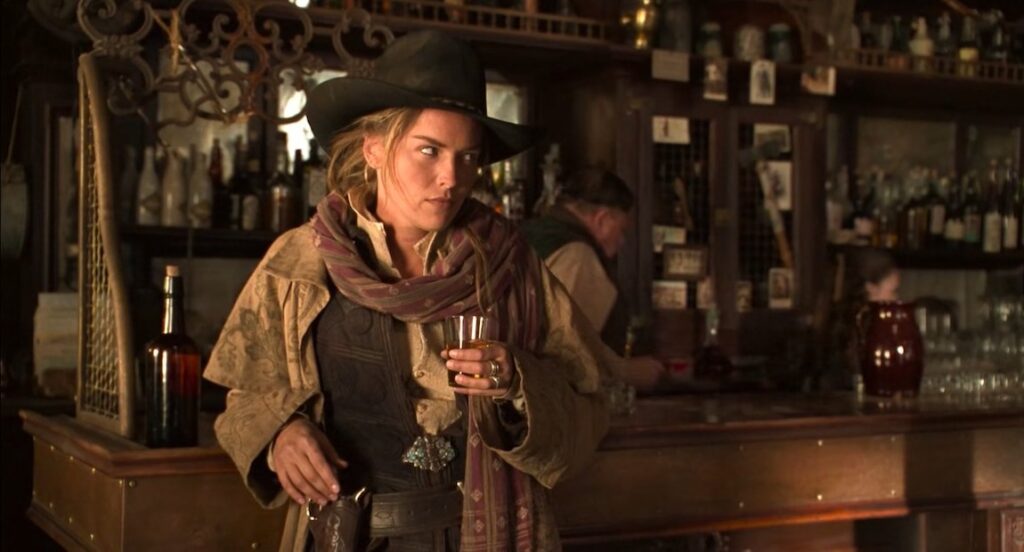
The Quick and the Dead plays at the Trylon Cinema from Sunday, December 14th, through Tuesday, December 16th. For tickets, showtimes, and other series information, visit trylon.org.
Writing this piece made me confront the fact that I have a thing for cowboys. Not the lifestyle, not in practice—I hate feeling dusty, straw and most crop pollens make me sneezy, and I’ve been scared of horses since I was ten and one bit my hand while I was feeding it. What I have a thing for is the cowboy archetype. As described by author Kirk Strawbridge for Medium, the archetypal cowboy “is not fancy and often clashes with city-folks. The cowboy is driven, has simple tastes, makes his own way in the world, is tough, has no patience for injustice, lives by self-defined rules, and is restless. Oh, and violence is always an option.” What I like is the confidence in their moral code. I like characters that do right even when it isn’t easy, even when the world has broken their spirits or when the right thing goes against the “done” thing. To quote Tina Belcher when asked why she likes zombies so much, “I just admire their swagger.”
Strawbridge’s description of the cowboy archetype immediately made me think of Sharon Stone. Following the commercial success of Basic Instinct (1992), Stone was a hot commodity in Hollywood. According to SlashFilm, “Every studio in Hollywood wanted to cast the newly minted star in their biggest property, and Sony Pictures took their shot by bringing her the script that promised to blow away one classic Hollywood genre: the Western.”
Simon Moore’s script for The Quick and the Dead (1995) was unique in that it featured a female protagonist. The film’s main character is a quiet, mysterious loner seeking revenge like many a Western ‘hero’ before her. Making this gunslinger a woman, however, gives the plot a fresh perspective. The Lady is underestimated by the men around her, who don’t seem to care or realize that she has her own aim in visiting the isolated town of Redemption. The film’s villain doesn’t realize they’ve met before and that she has beef with him until nearly two-thirds of the way through the movie. By making the main cowboy a woman, this homage to oaters of yore gains more tension and intrigue than a male-dominated retread would have.
Per SlashFilm, Sony’s TriStar Pictures division sent The Quick and the Dead’s spec script to Stone with the promise of the leading role. The studio also offered Stone a co-producer credit to seal the deal.
Stone accepted this offer and ran with it. In preparation for this piece, I read Stone’s 2021 memoir, The Beauty of Living Twice. In the tenth chapter, “Dreams,” Stone writes about her experiences behind the scenes, particularly as a producer:
“Getting a producer credit as an actress is often thought of in my business as a ‘vanity deal,’ meaning they pay you for the job but shut the fuck up and stay out of the way. I won’t accept a vanity deal and let them know that up front. This is illegal, I say, and I like to work within the law. That gets a lot of silence and not a lot of joy on the other end… That isn’t always a popular choice, but it’s mine. I don’t burn other people’s money to be popular. For me it’s called show business, not show take advantage of everyone. I don’t get taken advantage of either. Yes, I have been asked or told to do things that are wildly inappropriate, but I use my big-girl voice and say no.”1
On The Quick and the Dead (1995), Stone was a set of spurs in TriStar Pictures’ sides. She asked the studio to offer Gene Hackman the role of John Herod, the vile outlaw-turned-mayor who Stone’s Lady rides into town to destroy. Hackman accepted. Stone asked the studio to bill Hackman above her. The studio refused. Stone asked the studio to hire Danny Elfman to do the film’s score, at which point, “they cracked and locked me out of the editing room.”1
Besides Hackman, though, Stone was responsible for several major “gets” for The Quick and the Dead. Perhaps most famously, Stone lobbied hard for Leonardo DiCaprio to play “The Kid”/Fee Herod, a young gunslinger determined to prove he is a better marksman than his father. According to The Unseen Force: The Films of Sam Raimi, Sam Rockwell auditioned to play The Kid, and TriStar wanted Matt Damon for the part.2 After watching all the auditions, though, Stone got her heart set on DiCaprio.
“This kid named Leonardo DiCaprio was the only one who nailed the audition, in my opinion: he was the only one who came in and cried, begging his father to love him as he died in the scene,” Stone writes. “The studio said if I wanted him so much, I could pay him out of my own salary. So I did.”1
DiCaprio was twenty at the time; he had three credits to his name (though one of those credits was the phenomenal What’s Eating Gilbert Grape (1993)). I was honestly a little surprised to learn DiCaprio was even that old when he filmed The Quick and the Dead because he looks like a baby. He looks improbably young, yet he holds his own against Hackman. He has the same self-assuredness he has now, thirty-six years into his career. Damon or Rockwell would have played The Kid fine, but DiCaprio just inhabits the character in a way I can’t see any other actor doing.
In a 2023 interview with E! News, DiCaprio was asked about Stone, and even now, he has nothing but praise for his former co-star. “She’s been a huge champion of cinema and giving other actors opportunities, so I’m very thankful,” DiCaprio said. “I’ve thanked her many times. I don’t know if I sent her an actual, physical thank-you gift, but I cannot thank her enough.”
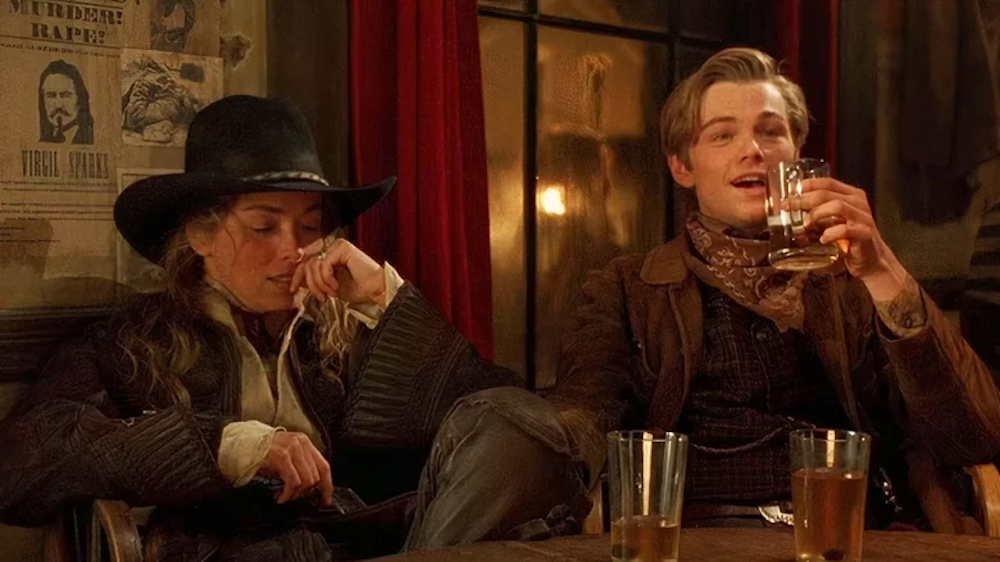
Image sourced from SlashFilm
Alongside a baby-faced DiCaprio, The Quick and the Dead stars a thirty-year-old Russell Crowe in his American film debut. The Unseen Force notes that Crowe “originally auditioned for a different role in the film before Sharon Stone asked that the actor try for the lead male role.”2 I couldn’t find what the “different role” was; I’m assuming it was for something smaller like one of Herod’s henchmen (one of whom was played by Michael Stone, Sharon’s older brother). Stone had seen Romper Stomper (1992) and was impressed by Crowe’s performance in it as Hando, a violent neo-Nazi gang leader. In a now-deleted Instagram post, Stone said she asked for filming on The Quick and the Dead to be delayed two weeks so Crowe could finish filming The Sum of Us (1994) in Australia. Fellow producer and then-TriStar chairman Mike Medavoy covered the cost this delay caused.
I have yet to sit down and watch Romper Stomper all the way through, but I watched all the clips I could find on YouTube, and I appreciate Stone’s vision because Crowe would not have been my first pick based on that movie. Don’t get me wrong—Crowe is good. I always enjoy watching him act, and Romper Stomper is no exception. He has this propulsive, manic energy throughout. Regardless of talent, though, it’s a huge leap to go from virulent young skinhead to mild-mannered reverend who Herod keeps chained to the fountain in the town square (which is something else that does things for me).
I had written a whole section decrying how wild this seemed. I then had a good laugh when I read the studio executives told Stone the same thing back in 1993. “They thought this was absurd,” she writes. “Why did I want a foreign actor who had played a bald psychopath to play a minister in a period piece in the Old West, someone we would have to push and wait two weeks [to start filming] for?”1
Stone doesn’t explain in The Beauty of Living Twice why Crowe was her top choice, but she did explain it while doing promo for The Quick and the Dead. In an interview with The New York Times published in March 1995, Stone said of Crowe, “When I saw Romper Stomper (1992), I thought Russell was not only charismatic, attractive and talented, but also fearless. And I find fearlessness very attractive. I was convinced I wouldn’t scare him.”3
I can’t say that’s something I’ve ever thought about, scaring people away with my energy. I understand struggling to find people on the same wavelength as me, though. I know how hard it can be to find an equal, and that’s just as a nobody in Minnesota. I can’t imagine how hard it is finding somebody who you feel you can go toe-to-toe with in the land of a thousand egos, especially as a woman. I’m glad Stone felt she was able to have that dynamic with Crowe. Like I said, I always enjoy watching him on screen, and I appreciate Stone for bringing him to Hollywood and the mainstream’s attention.
Crowe appreciates Stone for bringing him into the mainstream, too. In August 2020, when Crowe appeared on Late Night with Seth Meyers, the actor noted:
“It took me probably about eighteen months or more and literally hundreds and hundreds of meetings before I actually got an American gig. I only got it because Sharon Stone had seen a movie I was in. She was kind of in a sword fight with the male producers on the film and she just put her foot down and said, ‘I’m going to hire the person I want to hire as the love interest.’ If it wasn’t for her strength of commitment, I don’t know how long it might have been before I got an American movie. I’ve got a lot to thank her for.”
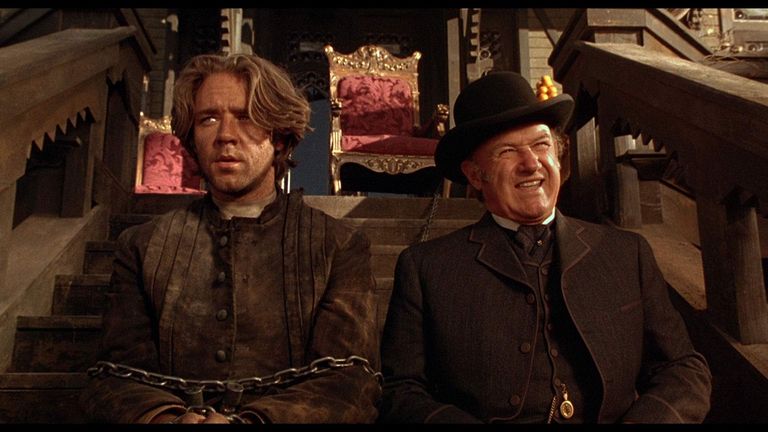
Image sourced from Mighty Chroma
Stone also fought to bring Sam Raimi on board to direct The Quick and the Dead, having found the Evil Dead series (a trilogy at the time) “brilliant.”1 According to The Unseen Force, Stone “The actress told the producers that if Raimi did not direct the film, she would not star in it.”2
While I personally enjoyed The Quick and the Dead and thought Raimi did an apt job, critics and moviegoers at the time disagreed. This reaction seems to have soured Raimi on the movie. In a 2009 interview with Empire, Raimi said, “… I reached a dead-end after that movie. I felt my style didn’t help make it into a great picture. So I kind of stopped making movies for a while and tried to rethink my situation.” In The Unseen Force, Raimi also noted, “I was very confused after I made that movie. For a number of years, I thought, I’m like a dinosaur. I couldn’t change with the material.”2
Stone also holds a grudge against the director. During a panel at last year’s Torino Film Festival, when asked how Martin Scorsese (who directed Stone in another 1995 release, Casino) differed from Raimi, Stone said:
“Well, I would say, in Sam Raimi’s case, I really liked his films. I thought he was very intelligent and very funny—different from Marty Scorsese, because he’s [Scorsese’s] Italian, he has loyalty, he has that family feeling, and because of it, Marty and I still have a relationship, and because of it, Marty and I still work together. Sam was a kid, and he doesn’t have loyalty, he doesn’t have family, he didn’t ever talk to me again, he didn’t thank me, he didn’t hire me again, he didn’t acknowledge the relationship. Marty, because I worked so hard and because I admired him so much, our relationship continues to today; there is depth.”
I have a theory about why Raimi didn’t thank Stone the way her former co-stars did. While Stone was a co-producer on The Quick and the Dead, one of the film’s executive producers was Rob Tapert. Tapert entered the world of filmmaking via his roommate in college, one Ivan Raimi, who introduced Tapert to his younger brother, Sam. Tapert and Sam Raimi made several short films together before producing The Evil Dead, and Tapert has produced pretty much every Raimi movie since.
I actually don’t think there’s bad blood between Stone and Tapert. I didn’t dig up any dirt about them butting heads behind-the-scenes during my research. However, I bet Raimi sees Tapert as more integral to his success than Stone. Stone might have propelled Raimi’s career to new heights, but Tapert helped establish him, providing Raimi support as a business partner and a life-long friend. I doubt Raimi sees any reason to thank Stone. Any other producer in Hollywood could have been the one to boost his profile; only one producer helped him establish a career to begin with.
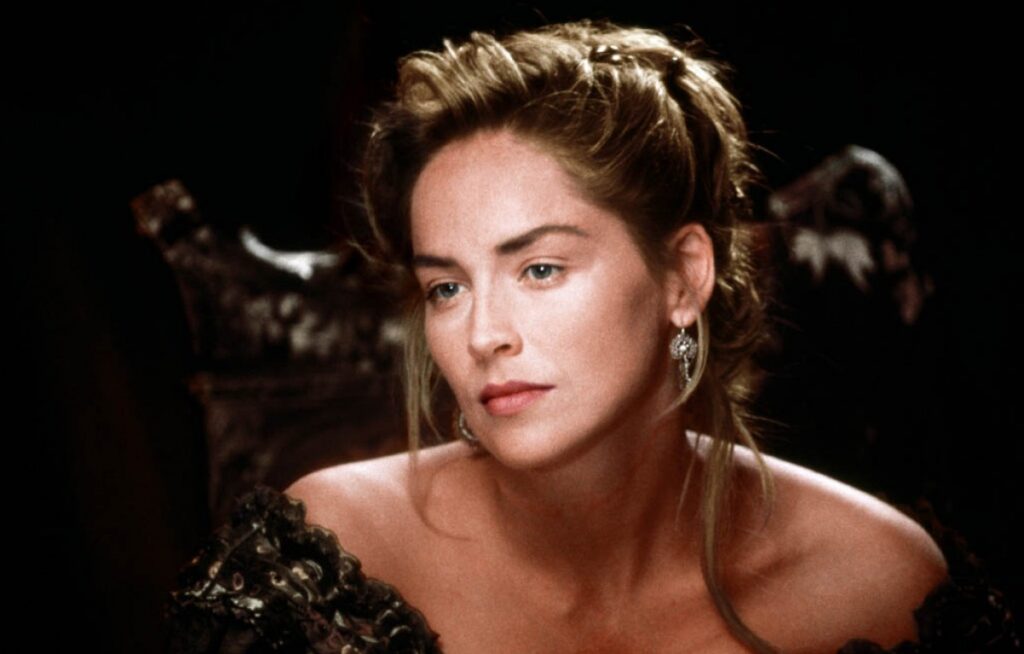
Image sourced from The Movie Waffler
During the Torino Film Festival panel, Stone also mentioned “my great Italian cinematographer Dante Spinotti” as one of her ‘gets’ for The Quick and the Dead. I have no idea how those two knew each other. My research only turned up articles about The Quick and the Dead. I compared their filmographies side-by-side, and The Quick and the Dead was Stone and Spinotti’s first time working together. However it happened, I’m glad that it did—Spinotti is a master of his craft. He was the cinematographer for many films I consider classics, such as The Last of the Mohicans (1992), Heat (1995), and L.A. Confidential (1997). Between Spinotti, Raimi, Crowe, and DiCaprio, Stone clearly had an eye for what would elevate The Quick and the Dead from the page to the screen. So many of her opinions gave the film its distinctive personality and makes it stand out from other 90s Westerns.
Despite its unique perspective and style, The Quick and the Dead was not popular at the time of its release. The movie earned about half its budget at the box office, and critics deemed it fine but nothing special. Over the past thirty years, though, casual and professional movie watchers have reassessed the film. Jay Royston of WhatCulture noted, “[The Quick and the Dead] didn’t really hit the right note at the box office despite its high power cast, but I have to put it in the top 3 Raimi movies, maybe because it is so unlike other Raimi films yet combines all three of the best qualities of a director already mentioned; working with actors, innovating camera shots and telling a good story visually.” Crowe and DiCaprio have both had long, successful careers, both winning Academy Awards for Best Actor. The choices Stone made were not popular at the time of The Quick and the Dead’s release, but they were hers. She stuck to her guns, and her choices paid off over time. She did the ‘right’ thing to make her vision a reality instead of folding under pressure, and that’s something we should admire.
Sources
1 Sharon Stone, The Beauty of Living Twice (Penguin Random House, 2021), 82-83.
2 John Kenneth Muir, The Unseen Force: The Films of Sam Raimi (Bloomsbury Publishing, 2004), 178-182.
3 Jamie Diamond, “Straight Out of Australia, to L.A.,” The New York Times, March 26, 1995.
Edited by Olga Tchepikova-Treon