
| Chelli Riddiough |

Extreme Private Eros: Love Song 1974 plays at the Trylon Cinema from Friday, January 16th, through Sunday, January 18th. For tickets, showtimes, and other series information, visit trylon.org.
When my ex-boyfriend Chris and I were splitting up, we had a breakup photo shoot. Our friend Zoey came over and took a series of photographs of us in the living room: hugging, holding the cat, sitting side by side. At the time, my close friends thought this was an insane thing to do, and when I displayed one of the photos of me and Chris on my desk after he moved out, their incredulity mounted. They thought it would be bad for me to display this relic of my relationship—harmful to my process of moving on and unappealing to any dates I brought over. This was my first big breakup, which kind of means it was my first big love. I didn’t want it to be over. The photo shoot was borne of my idealism: that our breakup didn’t have to be an ending, that we could smoothly transition into being friends, that a photograph of the two of us together was an appropriate—an edgy!—thing to display in my house.
Over time, this idealism faded. Hanging out with Chris post-breakup proved too painful, and when a therapist suggested we have a period of no contact, I agreed. I don’t remember the day that I took down the photograph of me and Chris. Now, a few years older and a few relationships wiser, I don’t think I’d have a breakup photo shoot if my partner and I went our separate ways. But when I look back, can I really be mad at my younger self? At my thought that, despite our split, we would somehow live on in a work of art? I now see that move for what it was: a desperate attempt to cling to the relationship, to preserve it in spite of the schism. It was a sweet, naïve, and misguided gesture. It was love.
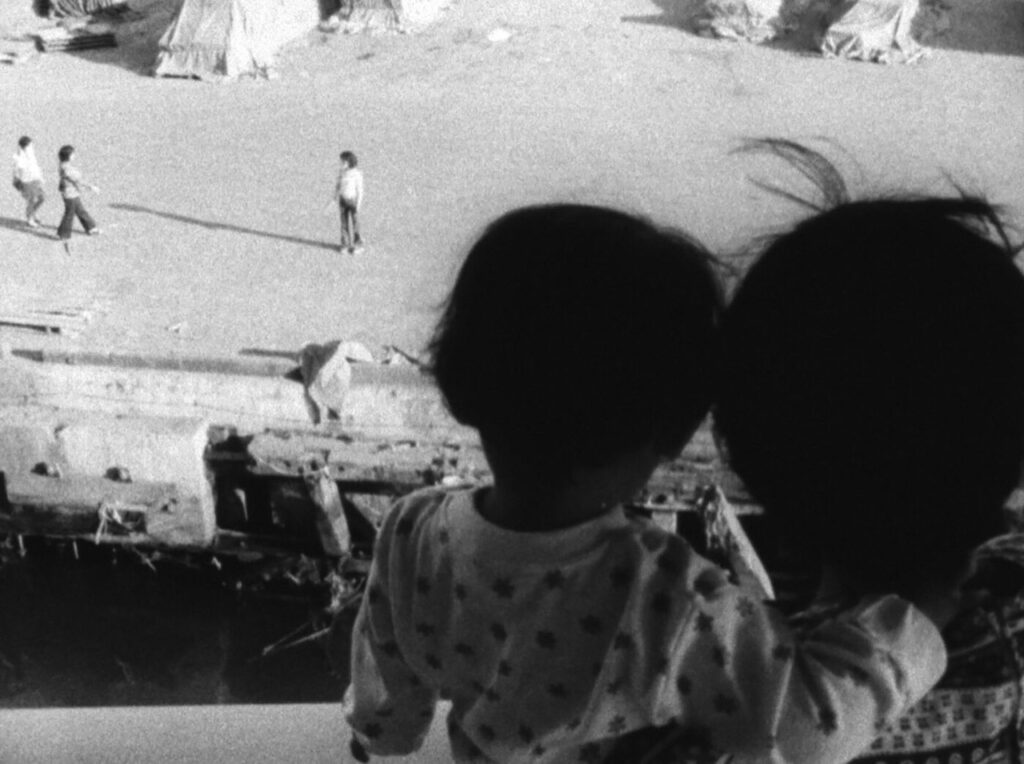
Takeda and her son leave Okinawa by ship
I wonder what my friends would make of Kazuo Hara, then, filming a documentary about his partner leaving him. This breakup art pushed to, and beyond, the next level. Shot in black and white, Extreme Private Eros: Love Song 1974 provides the audience with minimal narration and maximal realism. For two years, Hara follows Miyuki Takeda, his ex, as she moves to Okinawa with their infant son, takes lovers, and ultimately has another child. Not only does Hara trail his former partner, he brings along Sachiko Kobayashi, his lover and collaborator, to produce the film. We witness a strange camaraderie form between the two women, both of whom get pregnant—Takeda by a short-term boyfriend and Kobayashi by Hara—and give birth on camera. Much like the newborns that we see fall from the women’s bodies, this film is bloody, gasping, and alien—a scream into the void, a portrait of an unconventional woman, and an ode to a relationship’s afterlife.
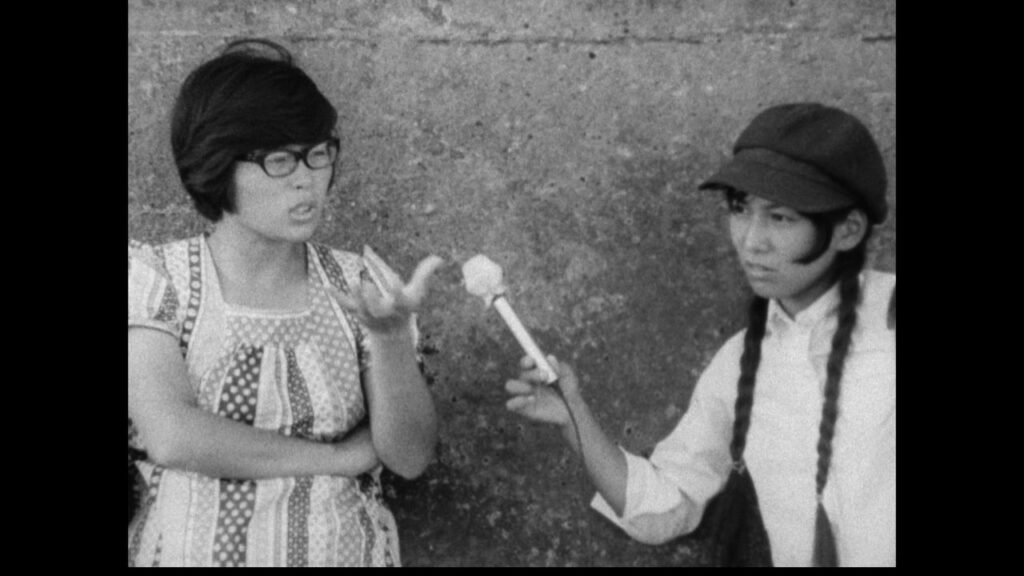
Kobayashi interviews Takeda
“Unconventional” is a mild word to describe our film’s protagonist. The first live-action shot we get of Takeda is her worrying a fingernail in her mouth before exclaiming, “Answer me!” She gestures angrily, her jaw set, then scratches her head and demands, “Look at me!” It takes a moment, as a viewer, to get your bearings. Hara has thrust us in the middle of a fight between Takeda and Sugako, her live-in lesbian lover, and the more withdrawn Sugako gets, the more explosive Takeda becomes. This is in-your-face filmmaking both in terms of content and directorial choices. During this opening fight scene, Hara films shots of the arguing women at such a close distance that I prayed he was using a zoom lens. Overall, Extreme Private Eros is a challenging movie to watch, rife with shaky shots, out-of-sync dialogue, noisy interference, and its climactic scene shot out of focus. (This was arguably a good thing.) Watching the film at times feels like eavesdropping on a private conversation, both scandalous and mundane.
Many descriptions of Extreme Private Eros mention Takeda being a radical feminist. In an age of performative politics, it’s a term that typically makes me roll my eyes. But Takeda’s actions truly are bold, especially in a repressive country at a repressive time. First, she leaves her husband. Then she moves to Okinawa, a small island so removed from the Japanese mainland that it required a passport to enter. She dates a woman, then a Black American G.I. And finally, she does have a child on her own. After she gives birth, she calls her mom to proudly report that “I just had a baby by myself.” And she really did. Not only did she give birth completely unassisted, she plans to raise the child as a single parent.
As a viewer, I was most struck not by Takeda’s commitment to independence, but by her utter lack of regard for propriety. In a 2019 interview with Desistfilm, Hara describes Takeda as “the kind of person who just has to act upon anything that she decides that she wants to do.” The way that she does so calls to mind a Tasmanian devil. She is completely unfiltered, at turns insulting her toddler son for being too sweet and confronting Kobayashi for carrying her ex’s child. She is loud, abrasive, and socially unaware—her attempts to hand out activist pamphlets to the bar girls of Okinawa raises more eyebrows than consciousnesses. Takeda is annoying. She’s mean. And yet you can understand why Hara, a gentle man by all accounts, is drawn to her and the wake she leaves in her path. Their chemistry creates a propulsive film. In the opening minutes of the film, Hara says, “I rolled a camera because I wanted to see her.” And Takeda demands, almost the moment she appears onscreen, “Look at me.” In the voyeuristic world of documentary filmmaking, they’re a perfect match.
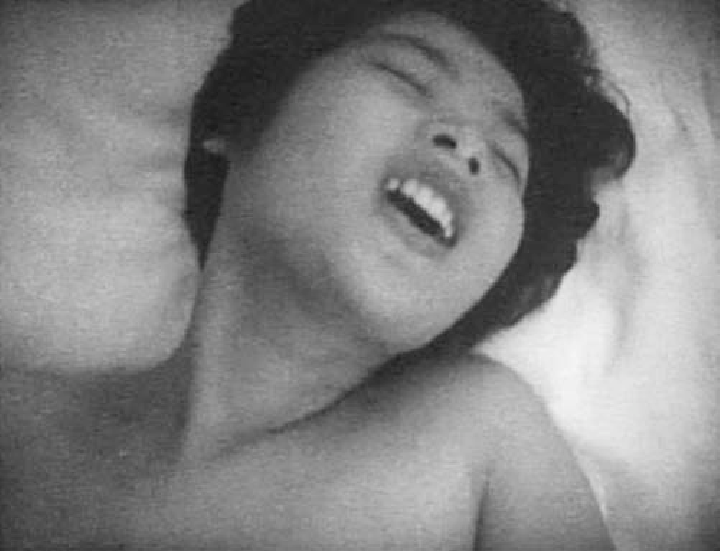
Takeda in the throes of passion
As the film goes on, one can’t help but wonder why Takeda has agreed to take part in this project. She has no interest in getting back together with Hara, nor does she seem to care about appearing in a flattering light. Is she hoping to serve as an example for other Japanese women about the possibility of liberation? Or does she just enjoy the gaze of the camera? Is she motivated by politics, enjoying some run-of-the-mill narcissism, or simply acting with the sort of impulsivity that seems to be her MO?
I think the answer can be found in the film itself. There’s a short, fragmented scene in Extreme Private Eros that shows Takeda’s face in close-up as she writhes on a bed. She tosses her head back and forth, her expression mired in a pleasure that resembles pain. Many reviewers of Eros assume that Hara is making love to her as he films. When I watched it, it seemed much more likely that she was making love to herself, masturbating while he filmed her from above. But in the end, isn’t the difference negligible? In Extreme Private Eros, intimacy doesn’t end when a relationship does. After all, what could be more intimate than letting someone film the most vulnerable moments of your life? Like their romantic relationship, this film is a co-creation, one that relies on the filmer and the filmed. Which of the two people has more power is hard to say.
Edited by Olga Tchepikova-Treon