
|Elizabeth Mathers|
Heavy Metal plays in glorious 35mm at the Trylon Cinema from Friday, February 27th, through Sunday, March 1st. For tickets, showtimes, and other series information, visit trylon.org.
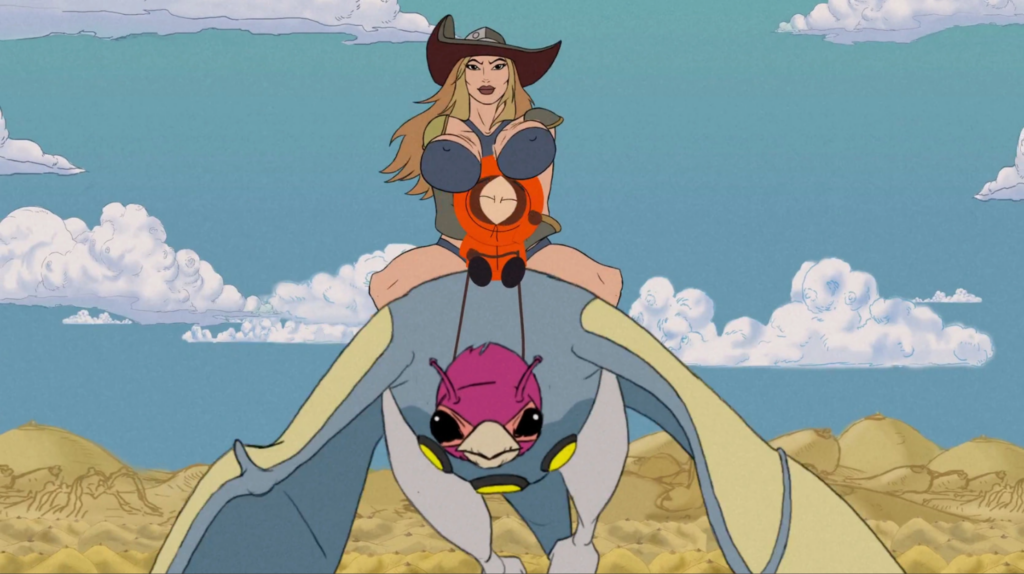
My (unknowing) introduction to Heavy Metal (1981) was South Park’s Season 12, Episode 3 “Major Boobage.” An absolutely transcendent piece of comedy. I know others also took this episode as an entry point into finding one of the greatest animated films. Heavy Metal is the gift that keeps on giving—great art, great music (duh!), great voice acting, and great replay value! A dystopic sci-fi, music jamboree all in one. (I also learned that Heavy Metal inspired another prolific sci-fi anthology series: Love, Death, & Robots (2019—current) ! )
It took a few watches for me to unravel the plot of Heavy Metal, which is told in a non-linear way through 7 different vignettes. The film’s main point, as I see it, is that something called “the sum of all evils” could hide in plain sight, yet still be defeated! In the film, some people see this evil entity and choose to ignore it, some people see it and choose to exploit it, and some people are ignorant to it completely, while still being affected. In the film, this ultimate evil is embodied by the entity named Loc-Nar.
Loc-Nar is a glowing, green orb that is generally basketball sized (it changes sizes from a marble to the size of a meteor, depending on its influence). Its powers are to corrupt and destroy. What’s truly terrifying is that Loc-Nar does not need to have direct contact with you to influence you. It kills the living, reanimates the dead, makes greed insatiable. There is no goodness emanating from Loc-Nar, so how can it be destroyed? Loc-Nar tells us exactly how it can be destroyed in Heavy Metal! What is the purpose of Loc-Nar if not to experience its own hubris at the hands of one little Girl***?
It’s humorous that the sum of all evil takes its sweet time to monologue in front of the Girl, who is destined to defeat Loc-Nar. “I have chosen you because you possess powers you do not yet understand,” Loc-Nar tells her, while quaking in its boots. After several stories, Loc-Nar admits that it seeks to end the life of the Girl while she is young and “innocent,” before she can have a chance to destroy it. “I have chosen you because you are the future that can destroy me. With your death, I break the chain for all time. See my evil, destroy your race, and prepare to die….”
The fact of the matter is, the “innocent” cannot be corrupted once it knows how to be incorruptible. The Girl is innocent, and in knowing how to NOT be corrupted, she becomes destined to defeat Loc-Nar. If the Girl is the greatest fear of Loc-Nar, it is because she is its antithesis. The purpose of Loc-Nar’s power is to prevent innocence and goodness from being protected, ultimately, so it can continue to exist and influence those around it.
Loc-Nar’s inception and existence is bound to the greed of those who seek it. To seek it without greedy intentions or with violent conquest in your heart? That wouldn’t make you immune—simply oblivious! Had the Girl never realized Loc-Nar existed, Loc-Nar may not have been defeated. One must seek Loc-Nar without greedy intentions, know its destructive powers, and choose to not use it, in spite of it—because that is peace.
What is fragile and toxic masculinity/patriarchy if not the tenuous power of Loc-Nar being subjected to an innocent, little girl? A force that is corrupting, violent, unrelenting in its destruction, just for the sake of it? Loc-Nar attempts pre-emptively to stop its destruction, even if it means truly killing an “innocent” little girl.
Throughout the film, we journey through Loc-Nar’s “life”—its inception, its unbridled power to corrupt and destroy, and its end. Loc-Nar gives the solution to its defeat to the Girl. Even after all of its existence, it was afraid of its defeat at the hands of somebody who, now, knows everything about it. It is the Loc-Nar’s hubris and arrogance that prevents it from finding any way out of being defeated.
Heavy Metal ultimately helps me not feel despair. Heavy Metal is a film of perseverance, adaptability, human “gumption,” and protest. The bands and their songs? Heavily political. Heavily against “the man” (Loc-Nar is “the man”), heavily against corruption. While ideating and writing this blog, I was reminded of this quote, attributed to James Baldwin: “The role of the artist is exactly the same as the role of the lover. If I love you, I have to make you conscious of the things you don’t see.” Heavy Metal is a laborious gift of love—a collaboration of writers, storyboard and design artists, musicians (Black Sabbath, Blue Oyster Cult, Cheap Trick, and Journey), and voice actors (notable to me: John Candy, Eugene Levy, & Harold Ramis) coming together to inspire hope in the face of hopelessness.
Not unlike the current political climate here in Minneapolis, the film shows that goodness and adaptability are stronger than a constant barrage of death threats. While there are times of peace and calm, we must be aware that all Loc-Nar can do is be consistent: consistently green, consistently orb-like, and consistently violent. Not very artful, not very intelligent. If insanity is trying the same thing again and again and expecting a different outcome, Loc-Nar’s existence as the sum of all evil is insane. Loc-Nar is too smug for an entity that has been consistently predictable, to the point it is always defeated. Maybe not today, maybe not tomorrow, but as long as the innocent know how to not be corrupted, it will happen.
What’s more metal than that?
*** The Girl, according to the Heavy Metal Fandom Wiki, is the astronaut’s daughter. She goes unnamed during the film.
Edited by Olga Tchepikova-Treon