
|Dan Howard|
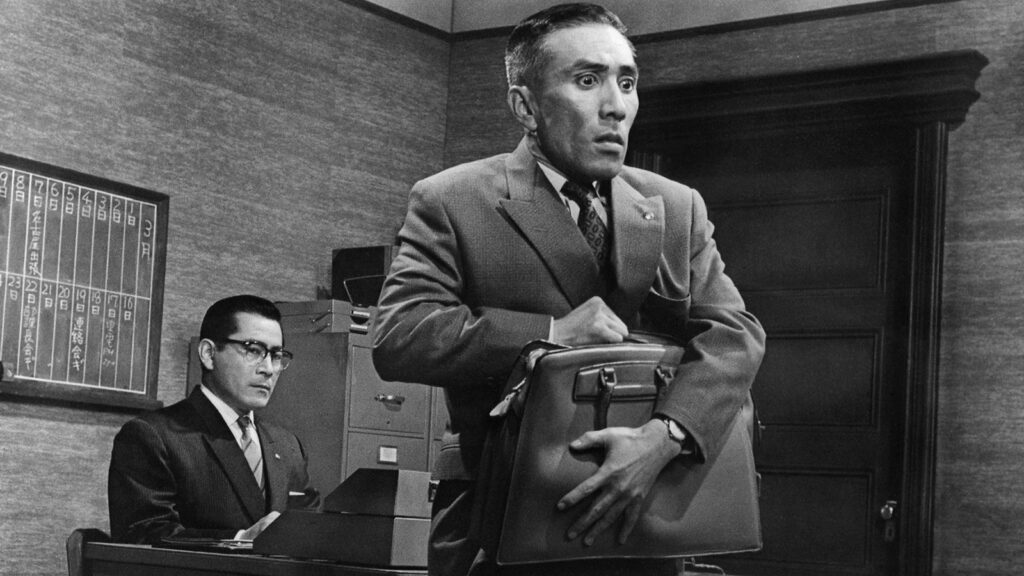
The Bad Sleep Well plays in glorious 35mm at the Trylon Cinema from Sunday, March 15th, through Tuesday, March 17th. For tickets, showtimes, and other series information, visit trylon.org.
“With hair up-staring—then like reeds, not hair—/
Was the first man that leaped; cried ‘Hell is empty /
And all the devils are here.'”
Before anything was “Lynchian,” “Altmanesque,” or “Kafkaesque,” it was “Shakespearean.” For the last four centuries, William Shakespeare’s deep-seated insight into the emotion and moral complexity of the human experience continues to enthrall audiences to this very day. Every actor wants to be worthy of embodying a Shakespeare character. So, when I had the privilege to ask Patrick Page (Hadestown) during his one-man show dedicated to Shakespeare’s greatest villains, All the Devils Are Here, how he implements Shakespeare’s characters into his own performances, his response has stuck with me ever since: “Shakespeare is always the North Star.”
Shakespeare’s plays remain a golden standard akin to actors and writers alike, and many modern writers find their own unique twists in ways we would not have expected. Against the backdrop of a high school (10 Things I Hate About You and “O”), an alternate reality 1930s fascist Britain (Ian McKellen’s Richard III), a space fantasy (Forbidden Planet), or, in Akira Kurosawa’s case, the Samurai Edo-era Japan.
Kurosawa was, without question, a great admirer of the Bard, and we see traces of Shakespeare’s plays peeking through to the screen in Kurosawa’s early works. The Men Who Tread On the Tiger’s Tail, based on a Japanese folktale, shares similarities with Henry V with its plot of a disguised leader and his followers passing through enemy territory, its themes of intense loyalty, and taking risks on high stakes. Aspects that are at the core of Shakespeare’s history plays. Also mirroring the Bard’s themes, Rashomon displays the unreliability of truth within the varying, skewed narratives of the accounts of a crime and the destructiveness of greed, desire, and fear. Even Seven Samurai even plays out like a theatrical epic. Once again channeling Henry V, Kurosawa incorporates the similar thematic structure of a band of brothers facing overwhelming odds, societal change, and throwing in a dash of Twelfth Night with Kikuchiyo (Mufine) playing the part of the fool, connecting the world of the Samurai with that of the peasants. In 1957, Kurosawa would expand his Samurai world by tackling his first direct adaptation of Shakespeare, drawing from Macbeth with Throne of Blood and, for a third time, in 1985 with his Samurai adaptation of King Lear, Ran. However, Kurosawa had a different vision for his adaptation of Hamlet with The Bad Sleep Well.
”To be or not to be. That is the question.
Whether ‘tis noble in the mind to suffer
the slings and arrows of outrageous fortune,
or to take arms against a sea of troubles
and by opposing end them.
To die—to sleep, No more.” – Hamlet
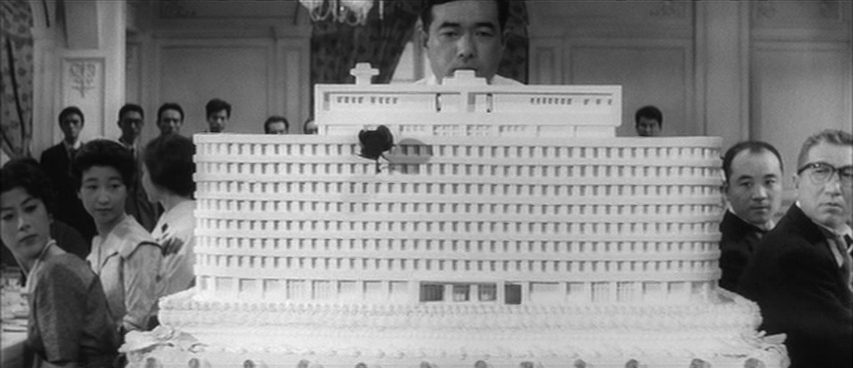
On the day of the wedding between Kōichi Nishi (Toshiro Mifune) and the Public Corporation Vice President Iwabuchi’s (Masayuki Mori) daughter, Yoshiko (Kyōko Kagawa), a mysterious additional wedding cake, designed like the Public Corporation building and with a rose sticking out of a particular seventh floor window, is brought in. Upon it’s arrival, the higher corporate officials, primarily Iwabushi, Administrative Officer Moriyana (Takashi Shimura), and Contract Officer Shirai (Kō Nishimura) are noticeably affected by the presence of such a cake, leading to disturbing revelations about Public Corporation, a government-lead company who handles construction contracts, after the wedding reception abruptly dissipates. As the press continues to breathe down the company’s neck to uncover potential scandals of embezzlement and bribery, Nishi recruits his best friend, Itakura (Takeshi Katō), and a former P.C. employee, Assistant Wada (Kamatari Fujiwara), to help enact his secret personal revenge against the three crumbling executives for the death of his father, who he believes was killed at the hands of the company.
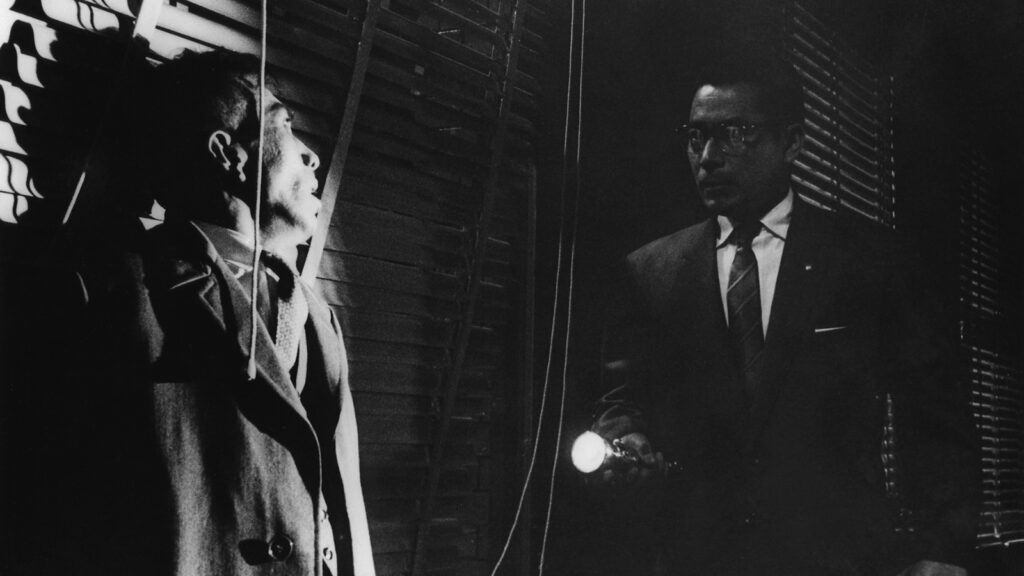
Echoes of Hamlet’s core ring throughout The Bad Sleep Well, but with a few key differences. The biggest being the distinctions between Nishi and Hamlet. Upon comparison, it feels like Kurosawa had desired to see a version of Hamlet with more focus and drive and a little less madness. Whereas Hamlet inhibits inaction and philosophical indecision, Nishi is a man of action, sound of mind in his philosophy. Hamlet desperately attempts to keep his grip on reality whereas Nishi remains grounded. Indeed, both men are driven to take revenge for their fathers’ deaths, but Nishi’s haunting by his father is more metaphorical. He doesn’t see a literal ghost like Hamlet does. Instead, he uses ghosts in a more theatrical sense. Hamlet is a haunted soul, and Nishi creates his own ghosts to haunt the executives of Public Corporation and drive them to madness, all the while hiding in plain sight and gaining their trust. He seeks to expose corporate corruption using any means necessary and, indeed, take up arms against a sea of troubles and, by opposing, attempts to end them. While there is no singular “evil Uncle” to defeat, for Nishi, Kurosawa expanded the Claudius role to be the entirety of the power of Public Corporation.
“To be honest, as this world goes,
is to be one man picked out of ten thousand.” – Hamlet
In comparing Nishi’s and Hamlet’s stories, we witness the toll their revenge takes on those around them. Even with having the corrupt corporation to tumble, there is no throne at stake, no secondary characters to assume leadership after the protagonist dies. One thing that Nishi and Hamlet do have in common is the evil lying at the core of the drama within their families, and the “Ophelia” character of the film, Yoshiko, Nishi’s wife, is the one who pays perhaps the biggest price. Maybe the only saving grace for Nishi in his revenge is Yoshiko’s love for him, her own innocent nature. She becomes Nishi’s moral compass whereas Ophelia only wishes to be so for Hamlet. However, the contrast in personalities between Nishi and Hamlet determines the effectiveness of their purposes. Contrary to their amorous relationship in the beginning, Hamlet rejects Ophelia due to his quest for revenge and his misogynistic, manipulative mindset, denying he ever loved her. Ophelia could not save Hamlet from his own self-destruction, but Yoshiko could save Nishi. Yet, the sad fates of Yoshiko and Ophelia tragically complement each other, with the latter’s ending in death.
“It’s not easy hating evil. You have to stoke your own fury
until you become evil yourself.” – Nishi
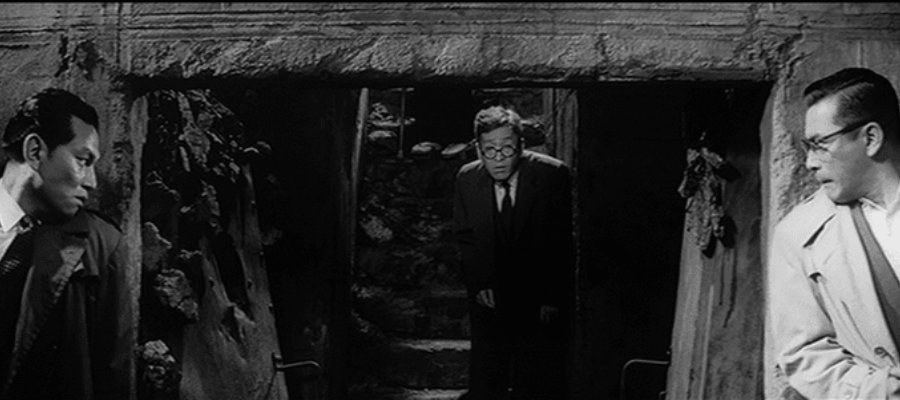
Amidst all the cunning and manipulation, Nishi is consistently reminded of his humanity not just once he falls in love with Yoshiko, but when he’s with his closest friend, Itakura. Even the film’s music is more upbeat when Nishi and Itakura interact. Itakura provides the most direct connection to Nishi’s past, essentially acting as Nishi’s Horatio. Itakura, like Horatio, acts as a calm observer who tells Nishi’s story. As old World War II buddies, having their base of operations in the old munitions factory they worked in during the war was undoubtedly an idea Itakura at the very least encouraged, if not inspired. Itakura may be the only one who truly understands the depth of Nishi’s suffering and helps him to not lose himself, like so many others have, in his desire for revenge. Horatio and Ophelia both attempted to reel Hamlet in from his madness and failed. However, the combined efforts of Yoshiko and Itakura help Nishi stay afloat, to not let revenge consume him completely. Yet, knowing Kurosawa, and knowing Shakespeare, the ending of Nishi’s story will be all but happy.
“What a piece of work is a man, how noble in reason,
how infinite in faculties, in form and moving how
express and admirable; in action how like an angel,
in apprehension how like a god: the beauty of the
world, the paragon of animals—and yet, to me,
what is this quintessence of dust? Man delights
not me, no, nor women neither, though by your
smiling you seem to say so.” – Hamlet
With all the real-life stories I’m sure Kurosawa had heard in his time, it’s clear he wanted to see them get their comeuppance. Channeling Hamlet, Kurosawa had the perfect opportunity to convey a simple, compelling message: Corporations aren’t your friends. Kurosawa always leaned towards heavier stories, but also always tended to find some light at the end of the tunnel, whether the ending is happy or not. The deeper you dive into Kurosawa’s films like Drunken Angel, The Quiet Duel, and Ikiru, the more we see why Shakespeare’s works were so impactful for him. To attempt to put into words how Shakespeare’s works continue to move the world, even centuries later, would be as astronomical as his work itself and his influence is on full display amongst 1960s Corporate Japan where it seems that indeed, all the devils are there.
Edited by Finn Odum