| Clare Brownlee |

Psycho plays at the Heights Theater in collaboration with the Trylon for our annual Hitchcock festival. For tickets, showtimes, and other series information, visit trylon.org.
Hitchcock is considered one of the enduring masters of the horror genre, and his 1960 film Psycho is no exception to that renowned filmography. It not only started a new kind of horror movie entirely, but maintains a legacy as one of the greatest in the genre.
I’m not typically a horror person. I gravitate towards comedies, towards comings of age; sun soaked indies rife with witty punchlines and punctuated by heartwarming endings. But there’s something undeniably riveting about a movie that has the ability to make your heart race and your palms sweat. And Hitchcock was a master at terrifying audiences.
From Peter Bogdanovich, in a 1999 article in the New York Times Film Review:
“Knowing that Alfred Hitchcock never previewed his movies, nor even saw them with audiences after they were released, I asked him in 1963 (when he was 64), if he didn’t ever miss hearing them scream. “No,” he told me with a tiny smile, “I can hear them when I’m making the picture.”
The movie is based on the 1959 novel of the same name by Robert Bloch and stars Janet Leigh as Marion Crane, a secretary who runs away with forty thousand dollars in order to clear her boyfriend’s debts so the two can marry. However, after stumbling upon the Bates Motel and meeting the disarming owner Norman Bates, she changes her mind and plans to depart the next day to return home and atone. Before she can, she is murdered while in the shower by who the audience assumes is Norman’s mother. However we later learn that Norman’s mother is dead, and he has taken her identity to commit serial murders—the big twist ending to the film.
Psycho was made in the days of the suffocating Hays Code, also known as the Motion Picture Production Code, a list of rules that lasted from 1934 to 1968 and greatly restricted what could be shown on Hollywood screens. While the sexuality and violence shown in Psycho may seem tame to us today, it was revolutionary six decades ago. Hitchcock spent his career dodging restrictions and finding loopholes in order to say (or imply) what was needed, and Psycho is a creative showcase of pushing those boundaries.
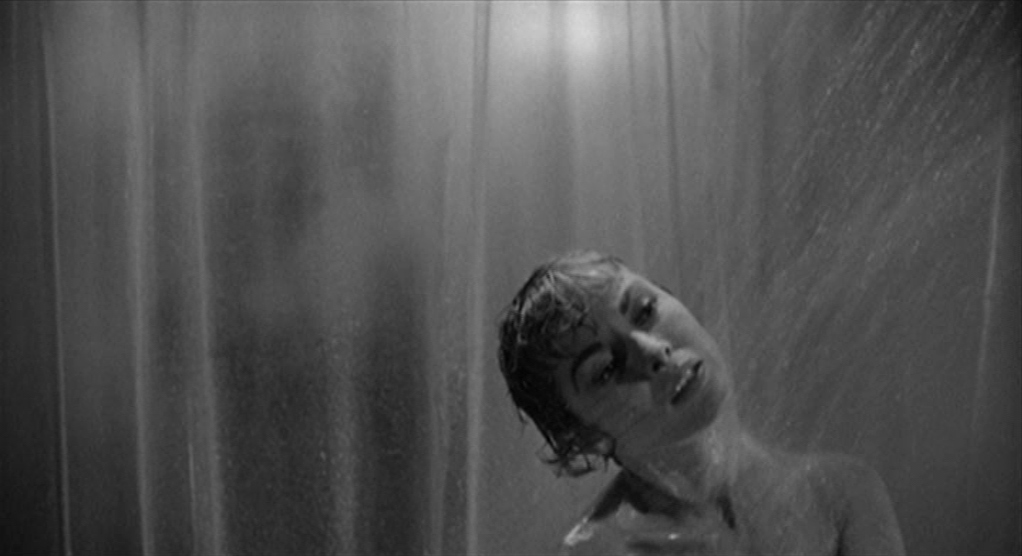
The film begins with Marion Crane and her lover, Sam Loomis, together in a hotel room. In those days, explicit sexuality was a violation of the Hays Code. And despite the restrictions on showing violence in movies, Hitchcock evaded being flagged by using clever, quick cuts and pouring chocolate syrup to represent blood in the scene where Marion Crane is murdered.
Psycho marked a significant transition not only within the horror genre, but the United States political atmosphere as a whole. Post World War Two American horror films reflected the tension of the Cold War and the fears of nuclear radiation, as well as a fear of the monstrous ‘other’—an antagonist that emerges from outside of American society. See Creature From the Black Lagoon (1954), or Invasion of the Body Snatchers (1956), both of which focus on a super-natural, alien enemy that threatens conventional human society.
But in 1960, Norman Bates stabbing the doe-eyed Marion Crane to death in her shower started a new trend in cinema. Here, the antagonist represented the worst of humanity and the damage we can do to each other within our society. It foreshadowed an age of reckoning with what humans are capable of doing to each other. The 60s saw the assassinations of JFK and MLK Jr, the Civil Rights movement and the Vietnam war. In Hollywood cinema, the focus shifted from a foreign enemy to the conflicts brewing within the borders of the United States.
Psycho created the slasher genre, where instead of a supernatural monster, it’s a real person wreaking havoc on other people. Psycho shifted focus from the potential antagonist coming from overseas to any guy on the street. Anthony Perkins’s portrayal of Norman Bates is so good in that he doesn’t strike you as immediately threatening. He’s casual, friendly, if a little lonely. He elicits sympathy, perhaps even pity—but not fear.
Hitchcock himself said that the character of Norman Bates needed to be ‘attractive’ and ‘charming’ to lure viewers into a false sense of security. This is a change from the original novel’s Norman Bates, who is described as older and unattractive. The handsome serial killer is now a borderline trope, explored both in fictional stories such as Netflix’s You, as well as dramatized retellings of real tragedies, in which conventionally attractive and beloved actors play historical villains. Examples here include Zac Efron as Ted Bundy in Extremely Wicked, Shockingly Evil and Vile (2019) and Evan Peters as Jeffery Dahmer in Monster: The Jeffery Dahmer Story (2022).
Fictional or not, it’s often young women that bear the brunt of their attacks, as Psycho’s shower scene set the precedent for many scantily-clad female characters being brutally murdered, see Halloween (1978) or Scream (1996). Marion Crane being killed off not even halfway into the movie also foreshadows an interesting trope: The Final Girl.
Often in slasher movies that feature a group of characters trying to stay alive, the first girl to go is a promiscuous character, whereas the girl to make it to the end, or at least most of the way to the end, is smarter and more modest. Arguably you could make that comparison even in the earliest version of a slasher movie. Marion is having an affair, and as a stepping stone result of that is killed. Her sister Lila is smart, behaves well, is astutely concerned about her sister, and survives.
While we’re on the subject of women in horror, something I’m incredibly interested in and excited to see is the recent rise in feminist body horror, in many ways a way to take back the autonomy and independence which has so frequently been denied to female characters in horror. Horror, while often formulaic, is an incredibly varied genre, and it’s one that reflects our society. Recent films like The Substance (2024) or The Ugly Stepsister (2025) explore beauty standards and aging, while other films such as Black Swan (2010) focus on ambition and autonomy.
The things that scare us, year to year and decade to decade, frequently change. The rise in horror now in exploring women’s bodily autonomy is undoubtedly in response to decades of violence against women in films like Psycho, as well as recent political events such as the overturning of Roe V. Wade in the United States. We’ve gone from radiation and communists to attractive men disguising murderous tendencies, to movies about robots, AI, and technological advancements that threaten humanity. Horror holds up a mirror to what scares us during the current moment, and pretty much every boundary of expression and censorship has been pushed in the past 66 years. We have a lot to owe to Hitchcock and Psycho for what we’re allowed to express, and the trajectory that this one unique film sent us on.
Edited by Olga Tchepikova-Treon