
| Courtney Kowalke |
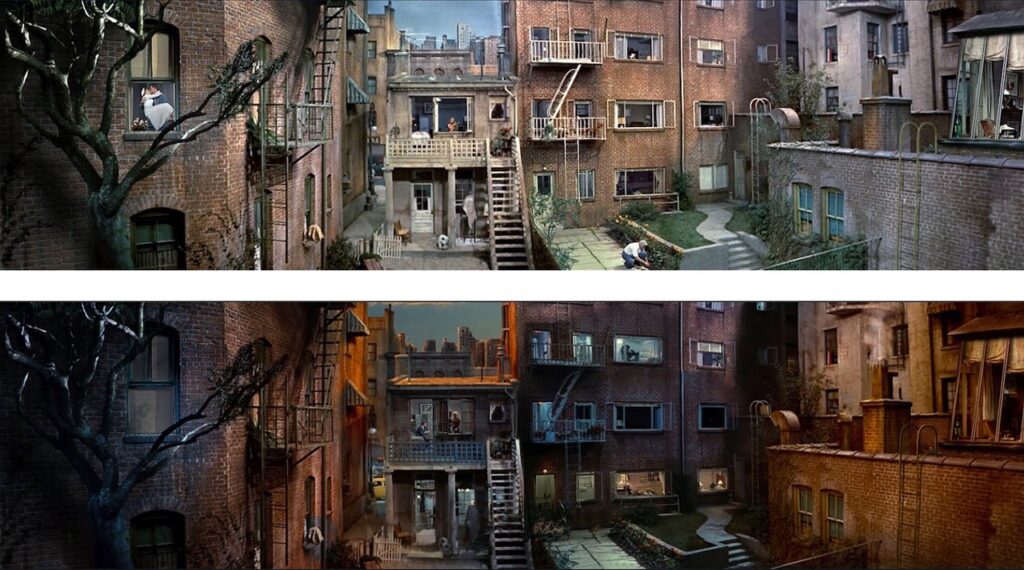
Image sourced from George Hahn
Rear Window plays at the Heights Theater in collaboration with the Trylon for our annual Hitchcock festival. For tickets, showtimes, and other series information, visit trylon.org.
If I were a character in Rear Window (1954), I would be the woman who lives above Lars and Anna Thorwald with her husband and their dog. I have thought about this a lot—Rear Window is one of my all-time favorite movies. I don’t know how many times I’ve watched it, and I was excited to have an excuse to watch it again. Anyway, I came to this conclusion some time ago. I love dogs, and I can put the fear of God in people with good speech the way the Thorwalds’ neighbor does in the film. It was a simple comparison, but I wasn’t expecting much depth from an unnamed character. Just a couple points of commonality were enough to amuse me. Upon rewatching Rear Window for Perisphere, however, I was surprised to find a new dimension to this story.
In the piece I wrote last year about Dial M for Murder (1954), I mentioned that I had lived in one place for nearly six years and that I had recently moved. At my former apartment, I knew the people who lived on either side of me by sight. I would make small talk with exactly one of these people when we were doing laundry or stuck outside due to a fire alarm, but I never learned his name. I don’t remember any of their names. I wouldn’t have recognized anyone who lived on a different floor in my building.
When I moved in 2024, though, I also got a puppy. A Dalmatian puppy, specifically. I don’t know what I was thinking. I got maybe three hours of sleep per day the first month I had her. Miss Coco had a lot of energy and needed to go outside all day every day. So did all of the other dogs in our building (and the two buildings next door to us)—by the end of that first month, I knew everybody in my new place who A. also had one or two dogs, B. was afraid of dogs, or C. didn’t have pets but enjoyed saying hi to my dog. I know almost everybody’s names and what units they’re in. Coco and I have hung out in several of their apartments. I’m part of a group chat to schedule meetups and walks around the neighborhood. In the world of my apartment complex, I am defined by my dog.
Rear Window is all about how your neighbors see you, literally and figuratively. The film follows photojournalist L.B. “Jeff” Jeffries (James Stewart), who is confined to his apartment after an on-the-job accident leaves him with a full-leg cast. Jeff sees more than (I hope) my neighbors see of me—stuck inside during a heatwave with nothing more productive to do, Jeff takes to watching other inhabitants of his apartment complex using his cameras, binoculars, and later an impressive telephoto lens. While initially spying for his own amusement, Jeff comes to believe one of his neighbors across the way, Lars Thorwald (a chilling turn from Raymond Burr), has murdered his bedridden wife, Anna (Irene Winston). With the help of his socialite girlfriend, Lisa Fremont (Grace Kelly), and his home health nurse, Stella (Thelma Ritter), Jeff’s mission becomes uncovering what actually happened to Anna.
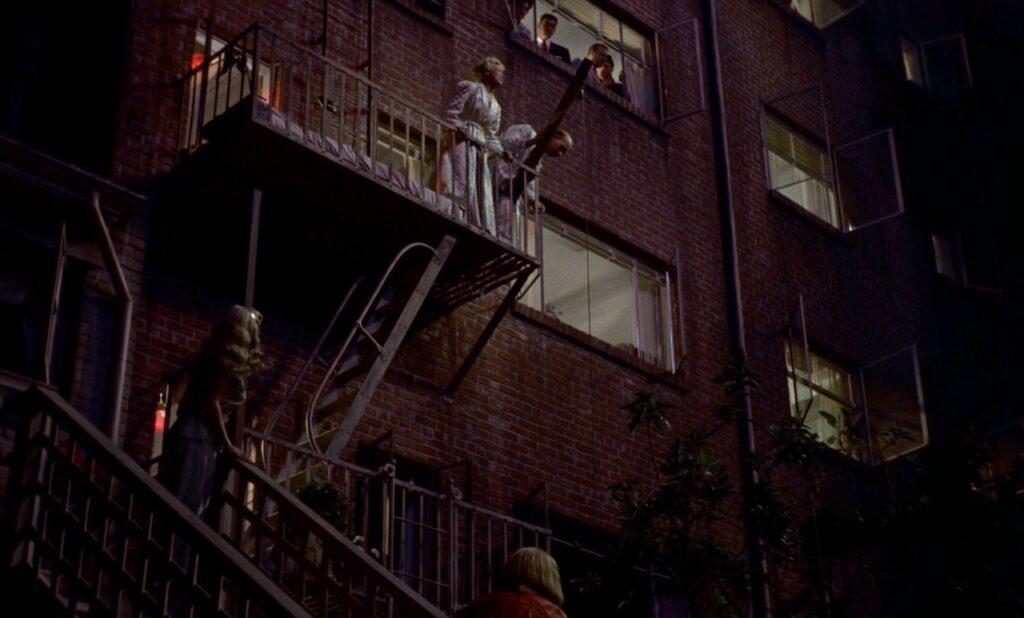
Image sourced from Alfred Hitch-blog
Nearly all of the characters in Rear Window are defined by how Jeff sees them. We have “Miss Hearing Aid” (Jesslyn Fax), an older woman Jeff knows is hard of hearing. We have the songwriter (a pre-Alvin and the Chipmunks Ross Bagdasarian), who Jeff sees agonizing over composing something. We have “Miss Lonely-Hearts” (Judith Evelyn), who Jeff sees having a string of bad (and sometimes imaginary) dates. We have Jeff’s favorite voyeurism subject, “Miss Torso” (Georgine Darcy), an enthusiastic dancer who runs around her apartment in her underwear. This is what Jeff knows about them, and what Jeff knows is all we the audience are given. I wonder sometimes what Miss Lonely-Hearts does for a living. I wonder what Miss Hearing Aid has for family. At one point, the songwriter throws a party at his place, so we know he has friends. I can also infer what Miss Torso does for work and what she has for a family based on the last we see of her in the film. We know the tiniest fractions of these characters’ lives, though, and not the whole picture of any one of them.
The symbolism of names and nicknames in Rear Window has always fascinated me. Jeff may be the protagonist and the person giving the other characters the monikers that define them, but he’s on equal footing with them—we know his initials and his surname, but we never actually learn what Jeff’s real name is. He is as synonymous with his nickname as his neighbors are with theirs.
While Jeff gets a last name but no first name, his nurse, Stella, gets a first name but no last name. This character choice highlights her familiarity and camaraderie with Jeff—she might be working for Jeff, but their relationship is warmer than a purely employer-employee relationship.
The only characters in Rear Window who get first and last names are the Thorwalds, and Lt. Thomas “Tom” Doyle (Wendell Corey), Jeff’s friend who works as a homicide detective for the New York Police Department. The Thorwalds having first and last names is a red flag for me. Immediately, I think something is up with them. Having formal names sets them apart from everyone else in the apartment complex. Doyle having a first and last name also marks him as an outsider to the community, but the nickname Jeff uses for him also brings Doyle down to their level. Doyle isn’t as involved in the investigation as Jeff would like him to be, but he’s in the loop.
And then there’s the one character in the film who gets a full name. Reading from top to bottom, we have Lisa Carol Fremont. Lisa is a socialite who works in the fashion industry. Jeff snarks that she “belongs to the rarefied atmosphere of Park Avenue,” and at one point Lisa says she lives on 63rd Street. I didn’t know enough about New York City’s boroughs to understand that reference, but some quick research opened my eyes to the history of the district. American shipping magnate Cornelius Vanderbilt revamped the avenue in the 1870s, making it a hub for businesses and transportation. It quickly became an area that signifies financial success; tons of international businesses have their headquarters on this street, and there’s a luxury apartment at 740 Park Avenue where some of the most affluent Americans ever lived (think the board members of Koch, Inc., the CEO of the Blackstone Group, and the heir to the Johnson & Johnson company fortune). I found an apartment complex at the intersection of Park Avenue and 63rd Street that is currently selling out a five-bedroom, four-bathroom unit for $5,500,00. I doubt that’s where Lisa was living, but if she’s in that neighborhood, she’s got some expensive taste.
By contrast, Jeff’s apartment is in Greenwich Village. At the time Rear Window is set, the neighborhood was starting to become the bohemian haven it is known as today. The first off-off Broadway theater (Caffe Cino) opened in 1958 in response to several playwrights and actors believing Broadway had become too corporate and commercialized. The U.S.’s first racially integrated nightclub, Café Society, ran in the Village from 1938 to 1948. Abstract painter Hans Hoffman’s art school had recently set up shop in the Village, along with the contemporary Whitney Museum of American Art. None of these institutions strike me as Jeff’s scene, but they certainly don’t seem like places Lisa would be interested in either. She and her Edith Head-designed couture already stand out in Jeff’s crowd; I can’t quite imagine her wading in the Washington Square Park fountain or enjoying watching the basketball players banging inside The Cage like the locals would.
Unfortunately for Lisa, having a full name is another signifier that she doesn’t belong in Jeff’s world. She doesn’t have a nickname. She isn’t missing a first or last name. Lisa isn’t like everybody else in Rear Window’s apartment community.
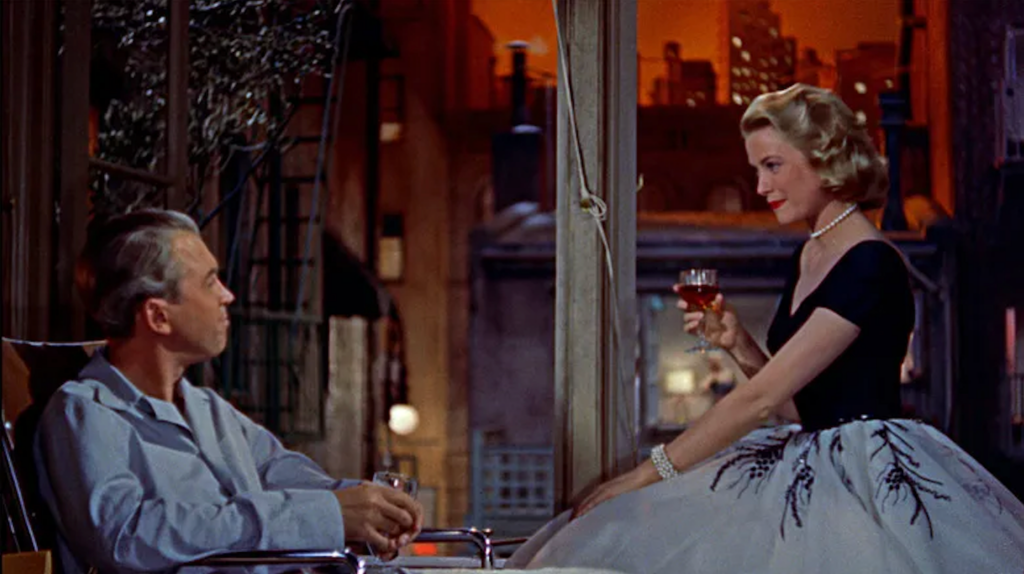
Image sourced from Flicks & Forks
Despite the murder mystery, much of Rear Window’s conflict comes from Jeff and Lisa’s relationship. From their first scene, they argue about whether they can stay together or not. Jeff isn’t sure Lisa will fit in with his rough-and-tumble lifestyle (once his broken leg has healed, anyway), but he doesn’t really want to break up with her. Lisa seemingly does break things off with Jeff before telling him she’ll be back the following night. Even the final shot of the movie casts doubt on their future as a couple, with Lisa switching from reading William O. Douglas’s travelogue Beyond the High Himalayas to reading an issue of Harper’s Bazaar fashion magazine once she notices Jeff is asleep.
At the heart of it, Rear Window really is about romantic drama. Nearly all of the couples in the movie have issues. Apart from Jeff and Lisa, there is obviously Mr. and Mrs. Thorwald. Before her disappearance, Anna is always seen belittling Lars, laughing meanly when she catches him on the phone with someone and tossing aside a bouquet of flowers Lars brings her. There is enough palpable resentment between them that it isn’t a stretch to have Jeff wondering if Lars killed Anna and hid her body somewhere on the property. Elsewhere in their little community, a young couple (Rand Harper and Havis Davenport) moves in across from Jeff at the start of the movie; in the final scene, we see them fighting. The couple with the dog (Sara Berner and Frank Cady) seem to have the only equal relationship in the neighborhood, an interesting juxtaposition with the Thorwalds since the Thorwalds live right below them. Even the outsiders we see aren’t immune to troubled relationships—while Stella claims she and her husband have been happily married for twenty years, Doyle doesn’t think too highly of his wife and takes a good, long look at Miss Torso during his second visit to Jeff’s apartment.
The singletons tell us a lot about the characters in relationships as well. When Jeff first points out Miss Lonely-Hearts to Lisa and tells her, “Well at least that’s something you won’t ever have to worry about,” Lisa comments that he might be surprised by what he would find were he to spy on her when she’s alone. Similarly, Lisa sympathizes with Miss Torso “juggling wolves” when Jeff and Lisa watch her entertaining three men. Lisa worries about winding up alone like Miss Lonely-Hearts and about finding someone who likes her for more than her looks like Miss Torso. Lisa also tells Jeff she can tell Miss Torso doesn’t care for any of the men because Lisa recognizes her disinterest; despite Doyle knocking her “women’s intuition,” Lisa knows Miss Torso already has lover somewhere else because Lisa’s own eyes never wander from Jeff.
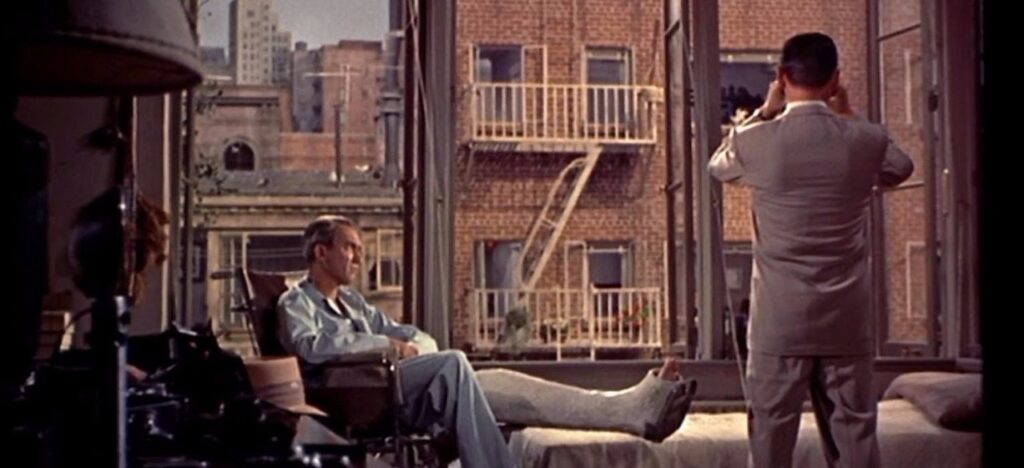
Image sourced from Daniel Robinson: From Reel to Real
Rear Window raises the question of how you relate to your neighbors. What do you have in common with the people who live in your building or on your block? How much do you have to have in common with your neighbors to care for them and want to look out for their wellbeing? Jeff wasn’t friends with either of the Thorwalds, but he was still compelled to investigate Anna’s disappearance and keep pushing even when the police gave up on it. Granted, Jeff’s drive comes more from his own curiosity than a sense of justice. The sense of justice is there, though.
The sense of justice is here, too. Beyond connecting with my neighbors to walk our dogs, we talk about what’s going on in our city. We keep an eye on what law enforcement is doing. We donate food and clothing to community members who need them. We are far fromthe only people doing this in the Twin Cities. Here in Minneapolis and St. Paul, we don’t have to be best friends to look out for each other.
Edited by Olga Tchepikova-Treon