
| Andrew Neill |
Rear Window plays at the Heights Theater in collaboration with the Trylon for our annual Hitchcock festival. For tickets, showtimes, and other series information, visit trylon.org.
Let’s start with a trigger warning for the film Rear Window: the dog dies. The sensitivity around this subject is prevalent, powerful, and worthy of respect. There’s a whole site where a community of people compile trigger warnings for sensitive content in media. Of all the content covered there, the question that gives the site its name is Does the Dog Die? The particular incident in Rear Window is especially upsetting because it’s not only death, it’s murder.
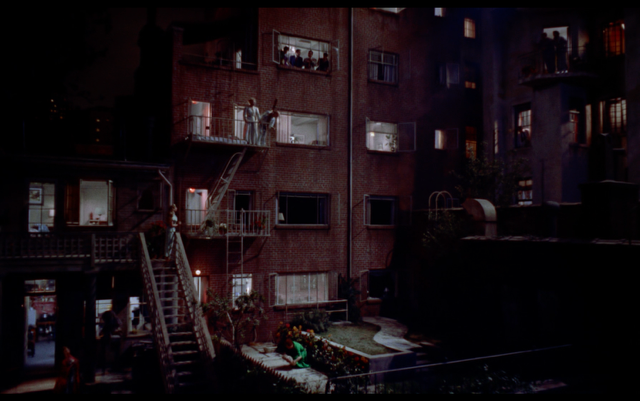
The body of a little dog is discovered in the courtyard below the titular window, a panoramic vantage point in the apartment of Jimmy Stewart’s laid-up photographer L.B. “Jeff” Jefferies. Jeff’s attention and that of many of his Greenwich Village neighbors is drawn to the scene by the scream of the dog’s owner. She chastises them for their lack of neighborliness and complicity in her dog’s fate. As she retreats into her apartment, her neighbors follow suit. They shrug off the matter and go back to their lives. Their quiet indifference proves the dog owner’s point quite loudly.
72 years later the world of Rear Window feels painfully modern. The window in Jeff’s cramped New York City apartment looks out on stacks and stack of others, each one a portal into another life. However, while people live right next to and on top of each other, there’s no shared community between them. This isolation despite proximity not only produces indifference, it stirs up conspiracy and enables murder.
“Why don’t you shut up?” This is one of the first lines exchanged between neighbors in the film, and one of few occurrences where neighbors interact at all. A woman gets up from sunbathing to peek over a fence where future two-time murderer Lars Thorwald is tending to his flower garden. She begins to offer him advice, and he fires back this dismissal. Thorwald’s rudeness seems casual, but it abets his serious crimes. He’s building up interpersonal barriers between himself and his neighbors. We later learn that no one else in Thorwald’s building knows him or his wife Anna. He exploits this anonymity to cover up Anna’s murder.
Physical barriers play their part, too. In a scene set in the wee hours of the morning, Miss Torso, a ballet dancer, comes home to her apartment and goes into the bathroom to get ready for bed. At the same time, in the next building but only a wall away, Thorwald trudges down a hallway carrying a briefcase that previously held some piece(s) of his wife. We’re glimpsing Torso and Thorwald’s activity through separate, adjacent windows. They are only a few feet from each other, but they might as well be in different zip codes. Torso is totally unaware of Thorwald’s nefarious business.
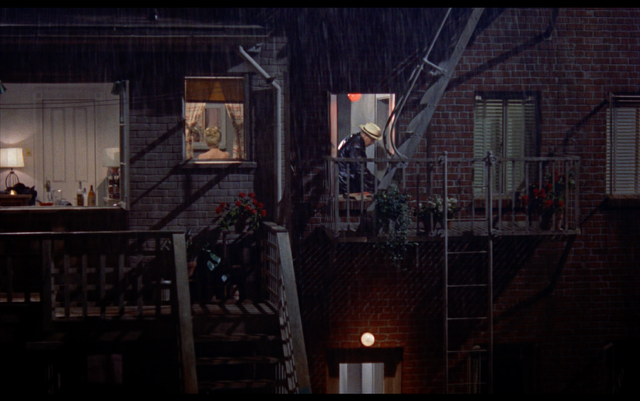
The perspective on this and all the action in the movie is Jeff’s, through his window. This late night surveillance of his neighbors is his 1950s version of doomscrolling. Rather than go to sleep, he leers at Miss Torso as she gets undressed. He chuckles when the songwriter in the corner studio stumbles in drunk and sends his sheet music flying in anger. He monitors Thorwald’s suspicious comings and goings. Jeff is not some appointed neighborhood watch, he’s a stir-crazy photojournalist laid up with a broken leg. He’s bored, and he’s craving titillation, amusement, and excitement. His neighbors are unknowingly providing him these releases through their open windows rather than their Instagram accounts.
Jeff’s relationship with his neighbors is entirely one-sided—his side. Apart from the Thorwalds, he doesn’t learn anyone else’s actual name, and he specifically bestows nicknames upon the women living alone across the courtyard. In addition to “Miss Torso” the ballet dancer, there’s “Miss Hearing Aid” the sculptor and “Miss Lonelyhearts” who lives below the Thorwalds and with whom Jeff has developed a kind of parasocial relationship. He’s taking an interest in and taking pity on her unsuccessful attempts at romance.
When we’re introduced to Miss Lonelyhearts, she seems to be preparing dinner for two, but when she answers her door, no one is there. She’s acting out a date with an imaginary guest. As she raises a wine glass to her invisible suitor, the film cuts to Jeff, who raises his glass in response and they each take a sip. Through editing, Jeff and Lonelyhearts share a moment together, but only one of them knows it. Later Jeff and his girlfriend Lisa, played by Grace Kelly, watch as Lonelyhearts fights off an actual man who forces himself on her. The violent encounter provides a reality check to Jeff and Lisa, reminding them that they’re peeping on real people with real problems. Still, they don’t act in any way to reach out to or help Lonelyhearts after this incident.
Jeff’s plan of action for Thorwald doesn’t involve his neighbors either. He contacts an old army buddy, Tom Doyle, who’s now an NYPD detective. Jeff’s reliance on police intervention rather than organization within his immediate community is a pervasive and damaging instinct. I’ll give his buddy Doyle some credit: when Jeff proposes that the detective break into Thorwald’s apartment and search for evidence, Doyle reminds Jeff of the Constitution and the need for a judicial warrant. It’s a remarkable moment, particularly in light of this winter’s federal occupation here in Minneapolis as ICE agents battered their way into homes with impunity. Jeff’s suspicions of Thorwald may ultimately prove correct, but his lack of regard for the Fourth Amendment certainly crosses into fascist territory there for a minute.
The film climaxes with a deus ex cop. As Thorwald pushes Jeff out his window, police swarm the courtyard and Jeff’s apartment, arresting Thorwald. A colleague of Doyle says Thorwald has confessed but it happens offscreen. The film assumes we will believe what the police say. This kind of inherent trust in law enforcement is a common and recognizable movie trope, even if it rings false. This winter in Minneapolis it wasn’t police that came to the rescue, it was neighbors. As rights were ignored and people were taken from their homes by law enforcement agencies, it was neighbors who organized, protested, recorded, and protected. The community stepped up when faced by a great threat and collectively mourned when lives were lost. We didn’t look at the tragedy unfolding before us and retreat back into our homes indifferently.
Rear Window is one of my favorite movies. The craft in it is some of the best there is. But even with the incredible production design and vivid color cinematography, the world it depicts isn’t one I care to live in. The murderer is apprehended and the status quo is restored, but both the method of apprehension and the status quo are troubling. The movie leaves us on an image of the stunning Grace Kelly, but it left me uneasy. Since everything worked out for Jeff and Lisa, aside from Jeff breaking his other leg in his fall, they are going to keep on living their isolationist way. Nothing has compelled them to change.
There is a little hope outside Jeff’s apartment. At the beginning of the final, virtuoso tracking shot, we see Miss Lonelyhearts visiting the songwriter, who puts on a record of his new song that she has admired from afar. It’s the only positive encounter between the featured neighbors in the film, but it’s a start. A safer and more connected community is possible if we open our doors and look out for each other, rather than peer at each other suspiciously from a distance.
Edited by Olga Tchepikova-Treon