
|Finn Odum|
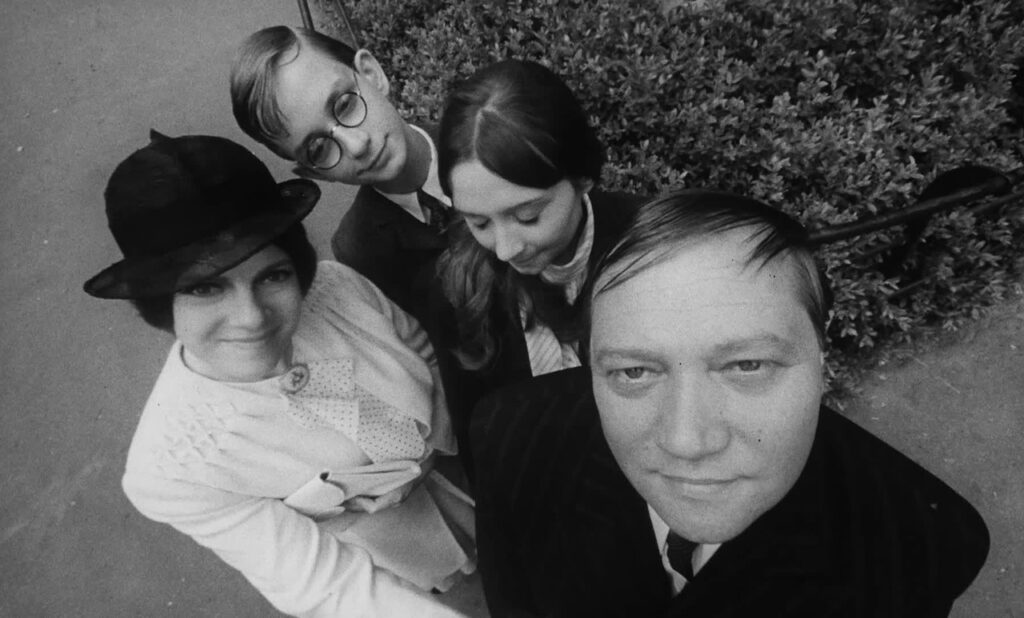
The Cremator plays at the Trylon Cinema on Friday, June 5. For tickets, showtimes, and other series information, visit trylon.org.
This essay contains spoilers for The Cremator (1969) and contains discussions of suicide and depression.
It’s 10:30 p.m. on a Tuesday.
The lights in your apartment are dimmed. There’s a migraine kicking in, and your insomnia is fighting the sedative in your medication just long enough to keep you conscious. You’re aching for the sweet release of death sleep—but you know that if you try to lay down, you’ll be staring at the back of your eyelids for another three hours.
So you turn on the TV. The faint glow of the Dark Mode YouTube homepage shines (glowers? Dark Modes?) in your face. There’s a wealth of high-quality content at your disposal and yet you select a video named MOST DISTURBING UNSOLVED CASES BRAZIL VOLUME FIVE. You have not watched volumes one through four. You queue it anyway.
An advertisement for Waymo interrupts the dark screen. “I was cycling on this road when a car hit me and dragged me fifty feet,” the “cyclist” they hired says. You push down the thoughts about the people who can’t speak about car accidents and skip the ad. Another black slide appears: a content warning about dangerous and disturbing content. Viewer discretion is advised. Then comes an unremarkable voice:
“Welcome to volume five of the most disturbing unsolved cases in Brazil. I’m escoobydoo87, and tonight we’re starting off with another brutal serial killer—”
You turn the TV off. Staring back at you, reflected in the darkness of the shitty monitor your AV friends want you to replace, is your round, hopeless face.
You look tired.
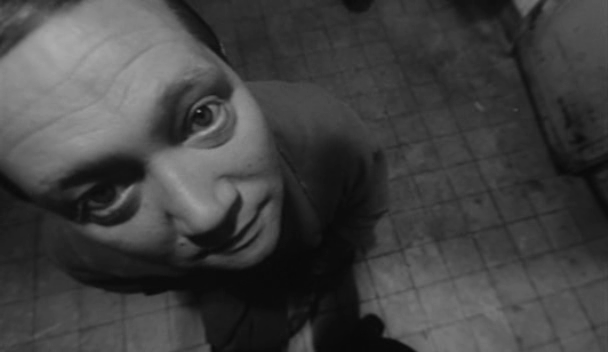
POV: YOU BUT YOU’RE ME BUT WE’RE KAREL
Your essay begins.
The American Czechian Family is Dying, Anyway
I was transfixed when I first watched The Cremator.
Specifically, I was reuniting with an old friend from college when I had to return to my Trylon shift that day, and I figured my pal wouldn’t mind taking a trip to 1930s Czechoslovakia with me. We, two semi-bisexual freaks who are too into the first Saw film, loved it. I logged it, wrote some bullshit poetic Letterboxd post about it. I finished my shift. I moved on.
Except I didn’t, because I was swiftly adding it to all of my “best of” lists. Something about The Cremator, all of its sick comedy, its “gentle malice and soft violence” as I put it years ago, really hooked me. Perhaps it is because protagonist and titular Cremator, Karel Kopfrkingl, is a freak with a face meant for a fish-eye camera. Perhaps it’s the unhealthy fascination I have with a man’s descent into family destruction.
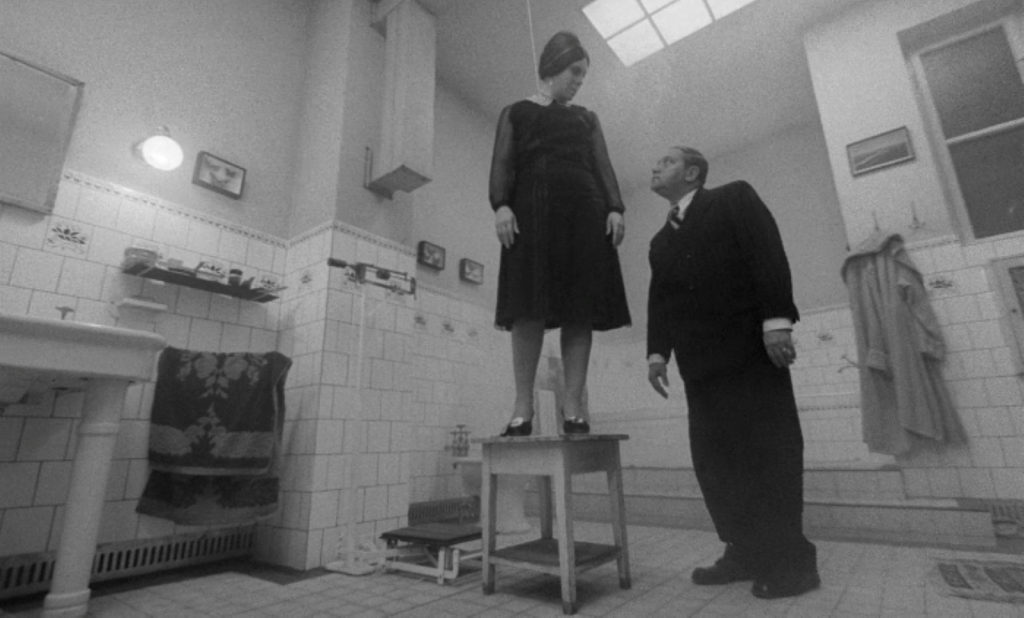
Could be both but it’s certainly neither. It’s the one scene I remember the most—the one where Karel hangs his wife. If you’re lucky, you won’t have many memories of loved ones who’ve hung themselves. You’ll only have seen it in the media, fictional or otherwise. A hanging is a vile death, steeped in calcified hierarchies and racial violence. In the US, it conjures visages of lynchings and anti-Black hate crimes. It was a political tool used during the Nazi occupation of the Czech Republic, where The Cremator was set—thousands of civilians and prisoners alike were hanged, some for “crimes” and others for their mere existence. It was a weapon used in concentration camps.
A hanging is a public death, even when done in private. In The Cremator, it is a curse cast upon Maria (who is called Lakmé by her husband, because he is obsessed with stories that are not his). Karel calls it liberating her soul. He wants to free them both—her from the so-called confines of a half-Jewish heritage, and him from the allegation that he’s married to a Jewish woman. Karel sinks into fascism like a feral cat’s teeth in the leg of an unsuspecting passerby. He must kill her, because she is not pure, and if she isn’t, neither is he. He must kill her, period, end sentence. So he lets her hang.
And I sit there. Sit there not shocked by femicide, not taken aback by the toxic spiral into Nazism, not startled by the haunted, hollow way Karel walks away. I sit there and think of the other things a hanging can represent. I sit there thinking about Maria, looking down at her husband before her last lifeline is pulled out from beneath her feet. I sit there.
You sit there.
You’re upright in your twin XL dorm bed, wondering why there’s someone knocking on your door past 11 p.m. Your friends know you want to sleep. Your friends know you need to wake up early.
They know what you don’t.
There are maybe four or six of them standing outside. They shuffle in at once, sullen and weary, and someone is holding your hand as another person says that an email just went out about a classmate passing away. Somehow, in a split second, you know who it is before they say anything. They are looking at you with pity.
You hate them.
You hate your friends for coddling you as if you haven’t seen death before. You hate the classmate who saw him, who has gone around talking about it as if the image of him hanging wouldn’t burn into the minds of his loved ones. You hate the school’s thoughtless plea to “tell someone if you’re depressed,” because you know more than anyone else that won’t help. You hate it you hate it you hate it you.
Hate yourself.
Self-loathing is part of the grieving process.
In Karel’s ideal world, he is married to a good German woman with a strong German son and a beautiful German daughter. But he is not German. He will never achieve perfection, the Aryan desire for whiteness and blonde hair and blue eyes. The film is shot in black and white but we can still see how dark his hair is. Throughout the narrative we learn about the things that drive him—Nazism, the liberation of death, and the stories of others that he wishes were his own. Karel spends much of the film ruminating on Tibetan mysticism, dreaming that he’s the next Dalai Lama.
Karel, I believe, hates himself.
I know this because in the same way that he calls his wife the wrong name, he himself prefers to be called Roman. I know a thing or two about going by a different name. I know about self-loathing, the perils of wishing to be a different person. And while you’d never catch me trying to murder my entire family in the name of fascism—Karel and I are certainly not #twinsies—a fraction of me wants to understand a fraction of him.
To understand the one-eighth that drives him to hang his wife, the one-fourth that invites his son, his sweet, innocent son, into the clutches of death. The one-half that chases his daughter down and puts her fate in the hands of the Third Reich. I want to know why someone who works so closely with the dead would lead his family to a slaughter. Karel refers to his crematorium as a Temple of Death—a holy place where the unholy act of familicide is carried out. He praises Death, envisions her as a woman, acts as if she’s the purest form of liberation. He worships her more than he loves his family.
I’ve seen this film before, and I’ll see it again, because even after watching him club his son to death, I still want to know why he did it.
It is not empathy that drives me. Not fear. It’s
something wrong with you.
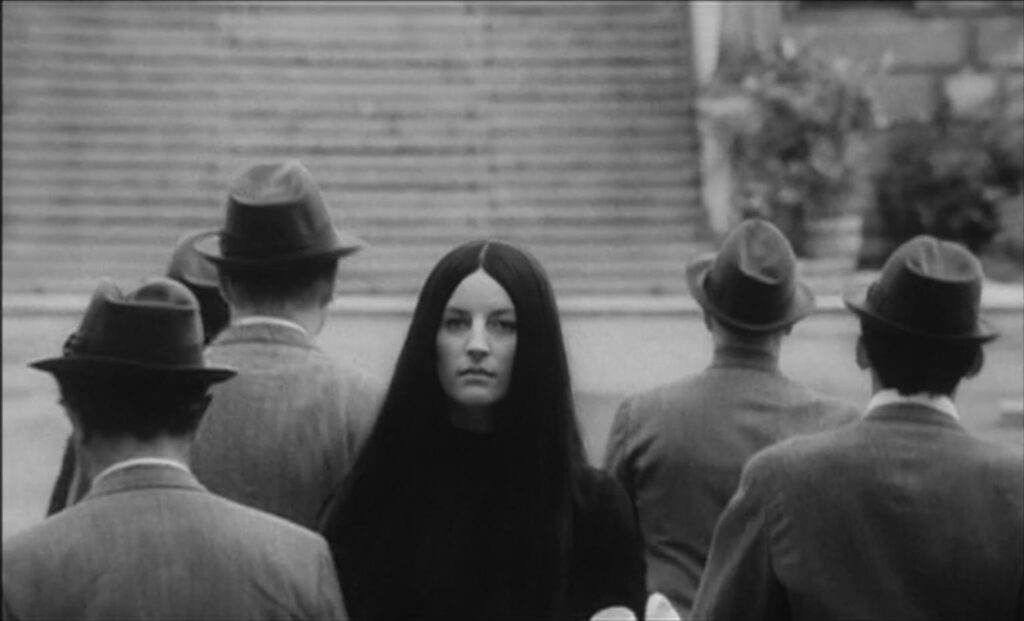
Because you are obsessed with stories that are not yours. You are transfixed by death and violence, by the people who do terrible things, by your desire to learn why. You watch videos about psychopaths because you’re desperate to understand how people kill. What draws someone to end another person’s life. What makes people like Karel, who is both fictional and a representation of so many real people, hang his wife from the rafters.
Death is natural, the end of a cycle. It is necessary. And you still see it as a form of abandonment, whether or not that’s fair to the person who died. So you cling to stories like Karel’s for comfort. The more you learn about it the safer it becomes. Knowledge is your safety net. Your fortress. Your Czech Death Temple. And somewhere within you, you believe that when Death finally reaches you, you’ll be prepared for her. Because you’ve watched and read and lived her over and over.
Edited by Olga Tchepikova-Treon