
| Dan McCabe |
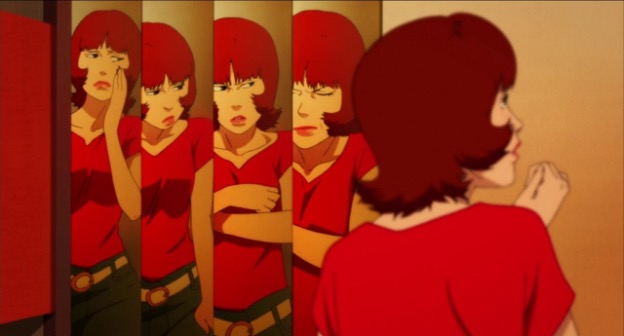
The many faces of Paprika, one-half of the main character in Satoshi Kon’s 2006 film Paprika.
Paprika plays in glorious 35mm at the Trylon Cinema on Friday, November 20th and Saturday, November 21st. For tickets, showtimes, and other series information, visit trylon.org.
Dreams have long fascinated humanity, and we’ve always had this inclination that they contain deeper meanings than a series of random, often nonsensical images and scenarios first appear to contain. The concept of prophetic dreams, a staple of modern fantasy, traces its origins to meditative, religious poems, like the Old English “The Dream of the Rood.” Dreams also serve as the foundation of the philosophy of psychoanalysis, especially the writings of Carl Jung.
It’s only a short leap of logic to move from the statement “dreams are mysterious and interesting” to the question “what if we could experience each other’s dreams firsthand?” If we could just view each other’s dreams in person, perhaps we could better understand ourselves and our reality. Or, maybe we could break into each other’s minds and steal valuable secrets. Enter the films Paprika (2006) and Inception (2010).
When I first heard about Satoshi Kon’s Paprika a couple of years ago, it was in passing, maybe on one of those listicles describing Hollywood blockbusters based on Asian films. Think movies like The Magnificent Seven (1960) (based on Seven Samurai (1954)) and The Departed (2006) (based on Infernal Affairs (2002)). Christopher Nolan, to date, has not claimed that Paprika influenced Inception or served as source material. But the films share a similar premise: a technology allowing people to experience common dreamscapes.
While Kon’s work in Paprika may or may not have influenced Nolan when he developed Inception, comparing how these two films approach their common premise can allow us to better understand both films. And, frankly, it’s a fun mental exercise.
Before you continue, this article will describe plot details from Paprika and Inception. This is your customary spoiler warning.
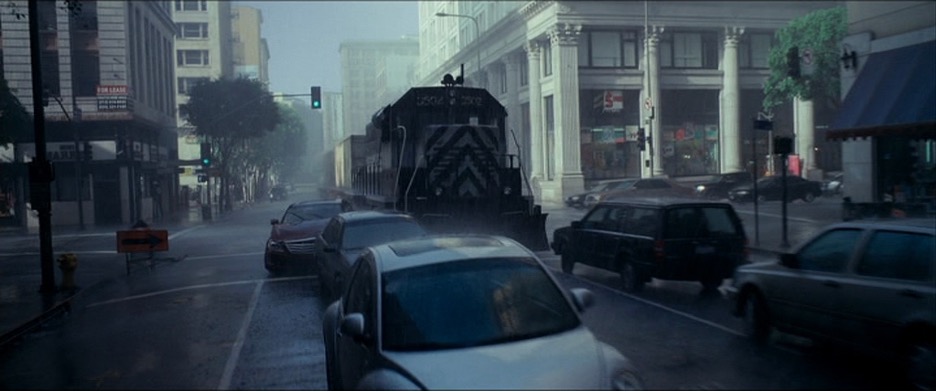
The dream sequences in Inception immerse the audience in a Hollywood action film milieu. Even the “dreamlike” elements like this speeding train serve are genre-appropriate.
Dreams Appropriate to Genre
In one sequence in Inception, Ariadne (Elliot Page) enters Cobb’s (Leonardo DiCaprio) dream space and finds his subconscious connected vertically with an elevator running between the floors of his mind. Elevators also appear in Paprika, within Detective Konakawa’s (Akia Otsuka) dream, connecting different sequences inspired by Golden Age Hollywood movies. Other than elevators, the dreams in these two movies have little in common.
Inception gives us dreams built by architects like Ariadne, Cobb, and Mal (Marion Cotillard) who imagine realistic buildings, topographic features, and physics. Now, our minds might give us the perception that dreams contain detailed, complex worlds, but no one dreams in glorious Hollywood action movie production values. Even for those of us who dream in color, we never remember the vibrancy.
Contrast Inception’s blockbuster dreams to the sequences in Paprika. Here, chaos and symbolism rule the day. Oh, and creepy dolls. An unreasonable amount of creepy dolls. Animation gives Paprika an advantage here because it allows the film to portray dreams as a series of often disconnected images or vignettes, which is certainly how I experience dreams. While the dreams in Inception might have more “realism,” the dreams in Paprika are a more accurate representation of real dream sequences.
Comparing the structure of the dreams in these two films matters because they create worlds appropriate to the plot of each film. Inception is a heist movie, so it needs a structured setting that the characters can scheme to break in and out of. A bizarre, ever-changing dreamscape would not work. Just imagine if the Arctic military base in the film’s third act got suddenly turned into an underwater coral reef. It would pull the viewer out of the suspension of disbelief, even if it created a more accurate representation of a dreamscape.
Paprika is a mystery: why is the DC Mini dream-sharing device malfunctioning in a manner that makes people want to throw themselves out of windows? The symbolism and chaos of its dreamscapes deepen that mystery. We’re trying to figure out how the pieces connect, just like Atsuko Chiba (Megumi Hayashibara) and her colleagues. While the mystery plot does not depend on an abstract setting, it certainly benefits from it. While Atsuko tries to solve the central problem of the story, the audience is left thinking about all the little mysteries around her, and how they connect to the DC Mini’s hallucinating effect.
Describing the Technologies and Suspension of Disbelief
Nolan spends a good deal of the second act of Inception describing how the dream-sharing technology works. “That’s why the military invented dream sharing,” Arthur (Joseph Gordon-Levitt) says in one of the clunkier bits of dialogue in a Nolan film. I often point to that line as an example of “as you know, Bob” exposition: something a character says for the audience’s edification that no one would say in real life. However, I think it’s important to know that the dream-sharing technology has a military origin, and not only because it helps explain the amount of gunfire in these dreams.
A common heist movie trope involves assembling the team and going over how the team plans the break-in, theft, and escape. The military origin of the technology helps explain why the artificial dreams have more detailed structures than natural dreams. It provides a simple answer to a question (why are these dreams so real?) that might otherwise pull the audience out of their suspension of disbelief. This sets the audience’s understanding so that when Cobb’s plan goes awry in the third act, the viewers stay immersed in the action rather than questioning the setting.
Heist movies like Inception often spend a good deal of the first two acts assembling the team and explaining the plan. Contrast that to mysteries like Paprika. How the DC Mini works, other than “you put it on your head and share dreams” does not factor into the film. The characters already developed the technology, and the background function of the tech is not important to solving the film’s central mystery: why the DC Mini causes its users to hallucinate and what to do about it.
Some of the obscurity about how the DC Mini actually functions helps create an aura of mystery, but it also helps the ending land. We don’t get to see exactly how the technology works, so when the dream world and the real world seemingly collide at the end of the movie, we’re immersed in the fantasy of it all. We get to fill in the blanks with our imagination, and we’re not questioning whether the DC Mini could cause mass hallucinations in seemingly half a city.
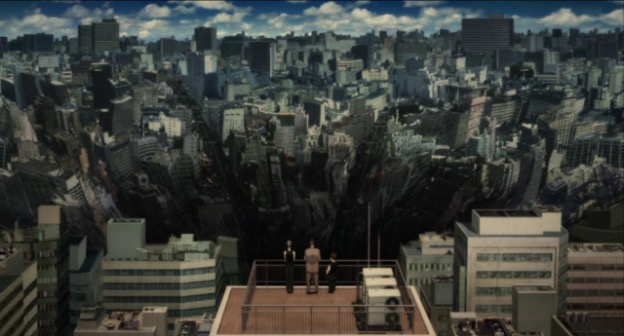
Paprika’s mass hallucinations create a powerful source of tension. Here, the entire city seems swallowed up in them.
Dangerous Technologies and Heightened Tension
The dream-sharing technology in Inception and the DC Mini in Paprika affect the characters differently. On the surface, both technologies can psychologically damage the users, but in contrasting ways. The DC Mini does not create a compelling, competing reality like the Inception tech, it immerses the user into a more abstract dreamscape. The shared dreams mix and blend each user’s imagination, subconscious imagery, and memories.
Ultimately, the company that controls the DC Mini, the Institute for Psychiatric Research, wields undue influence over the technology. The actions of the company’s chairman, Dr. Seijirō Inui (Tōru Emori), cause the mass hallucination during the film’s climax. The technology itself may have driven Inui to madness, and the connected nature of the DC Mini spreads that madness like a virus. The overshadowing corporation plays directly into modern fears of big-business puppet masters misusing technology.
The mass-effect, terrifying abstraction, and corporate overlord overtones of Paprika certainly keep the tension and conflict bubbling at a compelling pace. These elements make me question whether the DC Mini is more or less dangerous than the dream-sharing technology in Inception. After thinking it through, I would say that it’s equally dangerous, but dangerous in a different way.
The Inception tech does not seem to exist in a network the way the DC Mini does. It requires the dreamers to sleep under heavy sedation, in close proximity to each other and the portable dream-sharing tech. However, unlike the DC Mini, it immerses the characters into a convincing reality. The dreams in Inception are so realistic that the characters must create physical totems that can remind them of the real world. The danger doesn’t come from external forces or the threat of mass hallucination, but within the dream worlds themselves and deep in the characters’ subconscious. The tension and danger are more internal to the characters than in Paprika. This creates a great deal of momentum for the story too, but Nolan’s film accomplishes that in a different manner.
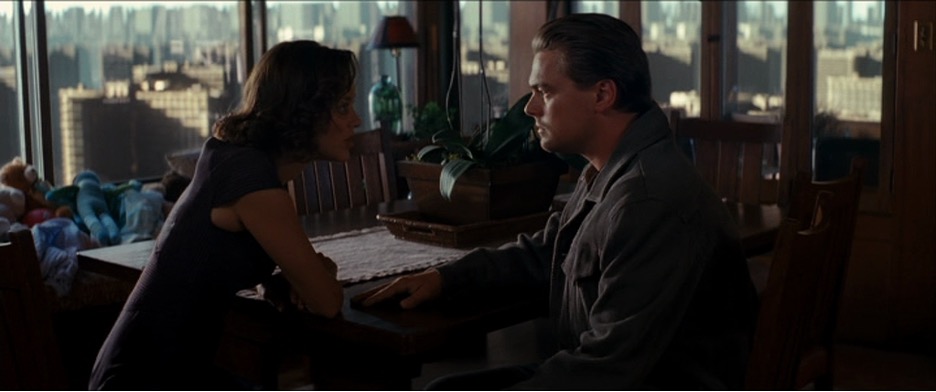
The Mal specter (Marion Cotillard) and Cobb (Leonardo DiCaprio) during the pivotal scene where Cobb confronts his grief and guilt, allowing him to succeed in rescuing Saito (Ken Watanabe).
Contrasting use of Dream Specters
Finally, each film contains what we can call a dream specter: a persona or illusion present in the dreamscape that does not exist in the real world. In Inception, Mal exists in Cobb’s subconscious as the personification of his grief and guilt over the death of his wife, the real Mal. When she appears in the shared dreams, she creates chaos and threatens the safety of Cobb and his team, but she has no thoughts or motivations of her own. She’s merely an uncontrollable aspect of Cobb’s psyche.
The specter serves two purposes. First, she deepens the audience’s understanding of Cobb’s internal struggle with grief and guilt. The second purpose heightens the tension because the audience never knows when the Mal specter will appear and upend the plot. In the end, Cobb must make his peace with his wife’s death in order to neutralize the specter’s threat.
Whereas Mal is a specter of danger and chaos, Paprika is the opposite. Paprika is Atsuko’s dream-based alter ego: a playful and adventurous detective. Atsuko maintains a far more stoic and distant presence in the real world, and the Paprika specter allows Atsuko to move freely in the dream world. It also creates a useful disguise when Atsuko is conducting unsanctioned therapy sessions with the DC Mini.
During the third act, Paprika separates from Atsuko during the mass hallucination scene. Even if she is Atsuko’s projection, she helps resolve the film’s final conflict as a being apart from Atsuko. Without her, Atsuko would not have succeeded in unraveling the damage caused by the DC Mini’s mass hallucinations.
However, Paprika makes it clear that deep down, there is not much difference between Atusko and Paprika: they are simply two different sides of the character’s personality, which are useful in different circumstances. Paprika is part of Atusko’s psyche, but Atsuko retains the ability to interact with and become Paprika. Contrast this to the relationship between the Mal specter and Cobb because Cobb cannot control or connect with the Mal specter until Inception’s climax.
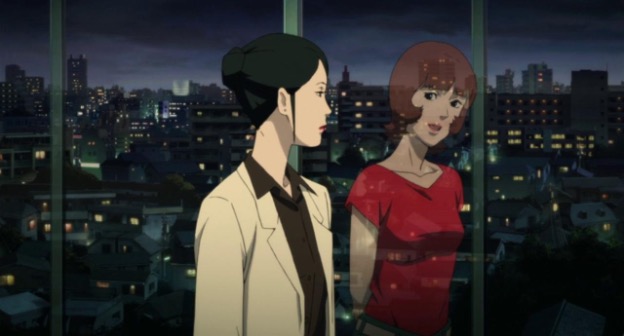
Two halves of a whole main character: Atsuko and Paprika.
Inception and Paprika appear similar at first glance, so much in fact that one could assume that Paprika influenced or inspired Christopher Nolan to make Inception. Delving deeper into them, they use their shared premise in different, but equally effective ways. Paprika plays at the Trylon November 20-21st, and if you go see it, I recommend viewing Inception shortly after and see what similarities and differences you can spot.
Edited by Olga Tchepikova-Treon