
| Jay Ditzer |

Brian Cox as Dr.Hannibal Lecktor.
Manhunter plays at the Trylon Cinema from Sunday, April 5th, through Tuesday, April 7th. For tickets, showtimes, and other series information, visit trylon.org.
WARNING: Spoilers for Manhunter and The Silence of the Lambs ahead.
Will Graham: I thought you might be curious to see if you’re smarter than the person I’m looking for.
Dr. Hannibal Lecktor: Then by implication, you think you’re smarter than me since you caught me.
Will Graham: I know that I’m not smarter than you.
Dr. Hannibal Lecktor: Then how did you catch me, Will?
Will Graham: You had disadvantages.
Dr. Hannibal Lecktor: What disadvantages?
Will Graham: You’re insane.
This is an arresting exchange, no pun intended, not least because of what it tells the viewer. In Michael Mann’s Manhunter, Scottish actor Brian Cox plays the brilliant psychiatrist-slash-cannibalistic serial killer Dr. Hannibal Lecktor (spelled differently than in Thomas Harris’s source novels, the movies and the TV show—a typographical anomaly that will be fortuitous when comparing incarnations). Lecktor is not an erudite antihero who only cannibalizes those who offend him with their lack of manners—at least not yet, he isn’t. Yes, Cox’s Lecktor is supremely intelligent, but he is also mentally ill, fallible, and not least of all incarcerated. Manhunter treats his insanity not as a quirky accessory but as a liability—a critical distinction.
By the time Anthony Hopkins donned the mask (both figuratively and literally) in The Silence of the Lambs, Lecter (the canonical spelling) had begun his transformation from supporting character to cultural icon. Hopkins’s performance is memorable and much celebrated, but it also accelerated the character’s pivot toward the grandiose and fantastic. Cox, who arrived first and with much less fanfare, gives us something more realistic and therefore more frightening.
Hopkins gave the definitive performance, earning an Academy Award and becoming a cultural touchpoint. But for my money, Cox gave the best performance, because while Hopkins played Lecter as an amalgam of Frasier Crane, Kaa from Disney’s The Jungle Book, and Truman Capote, Cox played Lecktor as… Hannibal Lecktor. Putting it in personal terms, I saw Rushmore on its first day of wide release not because Wes Anderson was the hot new indie filmmaker or because Bill Murray’s performance was being singled out for advance critical praise, but because Brian Cox was in it. I was thrilled when Cox gained widespread acclaim in HBO’s Succession because it felt like the rest of the world had finally caught on.
Cox’s Lecktor occupies the margins of Manhunter. He appears briefly, speaks like a normal (if arrogant) human being, and never seems aware that he is in a movie. There is no “Look how creepy I am!” showboating. He seems like the sort of person whose arrest would prompt TV news reports in which a neighbor inevitably says, “He was quiet and kept to himself. He never bothered anybody.” That veneer of normalcy is what makes Lecktor disturbing. The performance doesn’t insist upon itself.
With fewer than 10 minutes total screen time, Lecktor isn’t the primary antagonist in Manhunter. That job belongs to Francis Dolarhyde (portrayed by the late Tom Noonan), aka the Red Dragon, aka the Tooth Fairy. Being incarcerated and everything, Lecktor is theoretically neutered, yet he is no less dangerous than Dolarhyde—arguably more so, because being locked up doesn’t hinder his reach.
As with Manhunter, Lecter is not the big bad in Silence of the Lambs—that would be Buffalo Bill (Ted Levine)—but because Lecter was written with a more theatrically ominous vibe (exacerbated by Hopkins’s performance, which occasionally veers dangerously close to camp), his presence dominates the film. Though Hopkins only has roughly 16 minutes of screen time, that screen time is judiciously spread out through the movie. Lecter even has the final line before the credits roll. That cringey last line—“I’m having an old friend for dinner” (BECAUSE HE’S A CANNIBAL, GET IT?)—is the precise moment when Lecter goes from brilliant yet disturbed secondary character to a smirking parody that retains the intelligence and charisma but jettisons the subtlety of Cox’s version.
That change, the sense of “there’s a new sheriff in town,” is visible from the first time we see Hopkins in Silence of the Lambs: unblinking, staring FBI trainee Clarice Starling (Jodie Foster) down, a bemused look on his face, standing unnaturally still in his cell. His calibrated accent, the deliberate movements or lack thereof, the otherworldliness are unsettling but obvious. It is a remarkable piece of acting, yet it is also unmistakably a performance. As portrayed by Hopkins, Lecter ceases to be merely a supporting character and becomes something closer to a supervillain right up there with Darth Vader or Fu Manchu.
This evolution isn’t just about different acting styles; it also changes how Lecter is perceived. In Manhunter, Lecktor’s intelligence feels grounded in sharp but recognizably human observation, a kind of social acuity that comes from paying close attention rather than being omniscient. But in The Silence of the Lambs, that same perceptiveness is reframed as something almost comedically heightened.
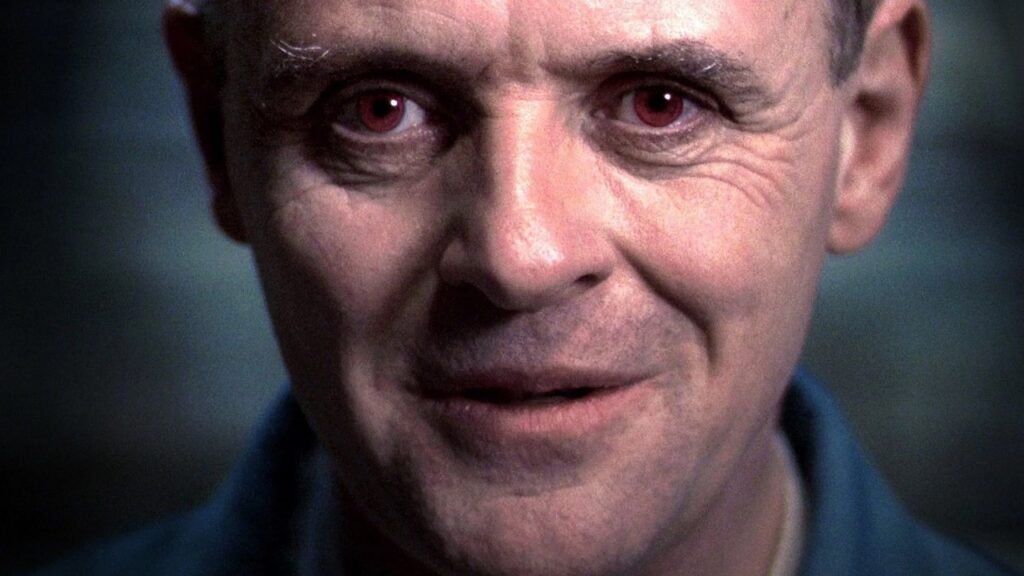
Anthony Hopkins as Dr. Hannibal Lecter.
In Manhunter, Lecktor needles FBI Agent Will Graham (William Petersen) about his “atrocious” aftershave—a small observation that plays as scathing wit or a catty insult rather than the reaction of a person with an unnaturally advanced sense of smell. Lecktor’s acuity feels normal. By contrast, in Silence of the Lambs, Lecter’s sensory awareness is near superhuman. When he coolly says “I myself cannot” after another inmate says he can smell Starling’s “c*nt,” the line nudges him into the realm of old Silver Age Superman comics in which the Man of Steel was indiscriminately given powers when the plot required them. Lecter is no longer merely perceptive; he now has the olfactory senses of a trained bloodhound. Although it’s framed as Lecter being chivalrous to Starling, this little bit of scratch-and-sniff chicanery lets us know that Lecter is superior to regular mortals. It also strains credulity.
But this drift toward the superhuman isn’t just because of Hopkins’s approach or the film’s style. Once Lecter proved to be a pop culture sensation, all notions of restraint went out the window. Thomas Harris, for reasons both commercial and creative, couldn’t resist gilding his cash-cow lily. After his debut in the novel Red Dragon, Lecter was upgraded to having maroon-colored eyes and six fingers on his left hand—apparently horns and a tail would have been too unsubtle, even for the author who thought it was deliciously clever to name a fictional cannibal “Hannibal.”1 We’re also told that Lecter’s pulse remained calmly in the 60s even while eating the tongue out of a still-living nurse’s mouth.2 At that point, why stop there? Give him x-ray vision. Let him teleport. Have him breathe underwater. If you’re going to turn a serial killer into a nigh-invincible demon prince, commit.
Which is why Cox’s portrayal in Manhunter reads so differently in retrospect. Without the superhuman abilities of later films and novels, Lecktor relies on practical intelligence and observational precision. There’s a scene midway through Manhunter in which Lecktor requests a call to his lawyers. Once the buttonless phone is placed in his cell, he pries open its face with the cap from a highlighter and pulls a stick of Wrigley’s gum (spearmint) from a pack. The prison operator connects him to his lawyer’s office, but when they answer, Lecktor apologizes for misdialing and hangs up.
He then uses the foil from the gum wrapper to spark the wires inside the phone, activating the dial tone and an operator response. He tells the operator that he doesn’t have the use of his arms (!!) and has the operator call the University of Chicago’s Department of Psychiatry. Claiming that he needs to overnight a book to Graham, Lecktor wheedles Graham’s home address from the receptionist. He will later provide the address to Dolarhyde so that he can kill Graham and his family.
Contrast this with Lecter’s jailbreak in Silence of the Lambs. Sure, he escapes prison, a much better result for him than unlimited calls, but he does it in a fairly obvious way. There’s a lot of blood, a lot of theatrics, and a final flourish that defies the laws of time and physics. It’s effective filmmaking, but it’s a long way from a man in a prison cell casually hot-wiring a telephone with a stick of gum.
Manhunter keeps Lecktor grounded in the reality of what an intelligent, determined human being might actually be capable of. Cox’s Lecktor solves problems; Hopkins’s Lecter obliterates them. It makes for entertaining cinema, but it trades the quiet, unnerving realism of Manhunter for something showier and less credible. That trade-off is not without its rewards—I love both Manhunter and Silence of the Lambs, both Lecktor and Lecter—but it fundamentally alters the character. One dazzles; the other unsettles. One was celebrated ad nauseum; the other barely registered. One asks you to believe in a mythic antihero; the other asks you to believe in a man.
Don’t get me started on Tom Noonan versus Ralph Fiennes.3
Footnotes
1 It is possible for a person to have maroon- or red-colored eyes, but according to the Journal of Human Genetics, it’s either a sign of an underlying medical condition or a secondary trait of albinism, which Lecter is not afflicted with because of course he isn’t—that would be seen as a flaw. See Désirée White and Montserrat Rabago-Smith, “Genotype–phenotype associations and human eye color,” Journal of Human Genetics 56 (1) (October 14, 2010): 5–7. doi:10.1038/jhg.2010.126. PMID 20944644.
2 The Lecter that appears in Harris’s novels is described as a small yet very fit man possessed of a “wiry strength.” No disrespect to Hopkins, but in Silence of the Lambs, he looked like someone who might get winded climbing more than a single flight of stairs, not a man with the strength and stamina of a professional athlete.
3 Just kidding.
Edited by Olga Tchepikova-Treon