
| Wil McMillen |
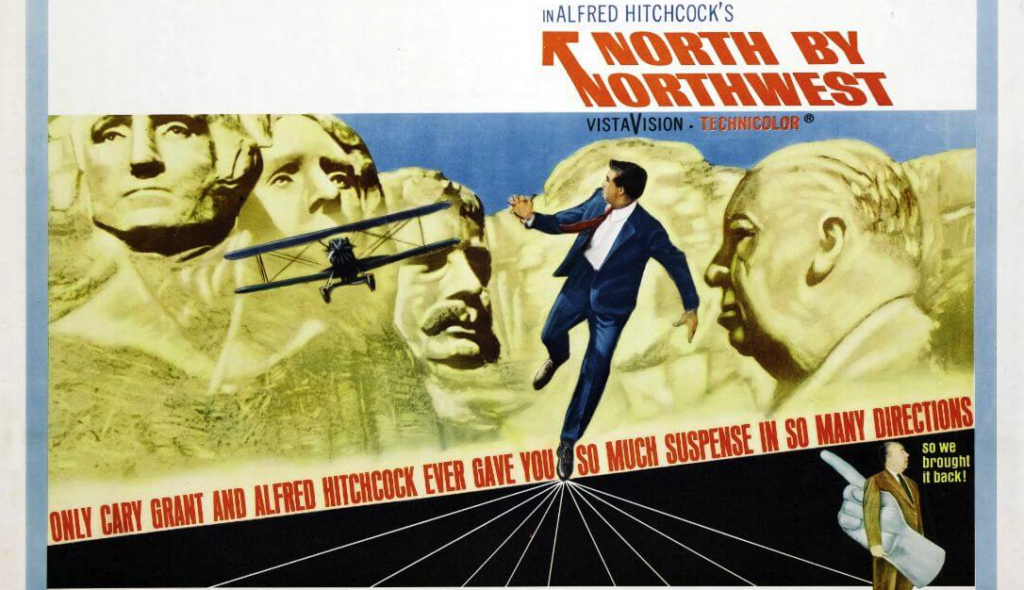
North by Northwest plays at the Heights Theater in collaboration with the Trylon for our annual Hitchcock festival. For tickets, showtimes, and other series information, visit trylon.org.
Sometimes you see a thing, and then you can’t unsee it.
I’m sorry for what I’m about to do, but I’m about to ruin the ending of North by Northwest for you.
I blame my wife for this.
Proceed with caution if you don’t want to know how the magic works.
When we were dating, we got the opportunity to see Alfred Hitchcock’s 1959 classic on the biggest screen at the AFI Silver Theater in DC, in 70mm no less. I was in heaven, not just because my girlfriend was enjoying the film but because it was the most pristine print of the film I’ve ever seen. If you ever do get the chance to see it in 70mm, you definitely should.
When it was over, we left the theater and she immediately burst out laughing. “I just can’t believe that ending!”
“Pretty great, right? Mt. Rushmore is why he wanted to do the movie…”
“No I mean it was so fake! They weren’t hanging from a cliff, they were laying down!”
“Say what?”
“He’s holding on with one hand and she’s still hanging onto her purse! She looks like she’s halfway through doing a pull up and just quit. How could you hang from a cliff in that position, and hold onto your purse? Her arms are bent and that purse is straight out sideways!”
When I got home I pulled out my DVD and tried to see what she had seen.
Oh, crud.
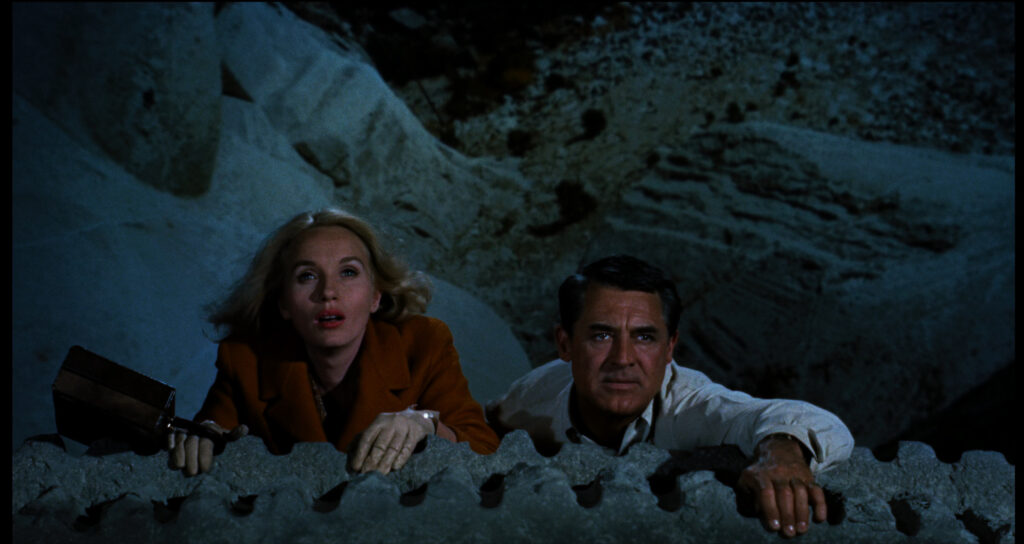
Now I can’t NOT see that purse hanging out sideways. I can’t NOT see how her arms are bent as she’s supposedly holding her full bodyweight up. They’re clearly laying down with a painting behind them.
Why would Hitchcock, with his notorious attention to detail, have them hanging at such an awkward and unrealistic angle?
Why wouldn’t he mention the purse?
Why hadn’t I noticed before?
We’ll come back to that. But let’s leave them hanging there for a moment.
Falling, as Roger Thornhill and Eve Kendall are about to do in North by Northwest, is the ultimate nightmare for Jimmy Stewart’s character, Scottie Ferguson, in Hitchcock’s previous film, Vertigo. It’s also the film where Hitchcock broke from using the process shot realistically. In Vertigo, he utilizes rear projection as a means to put you into the fracturing mentality of Scottie as he falls for Madeleine Elster (Kim Novak), and then watches her fall to her death. Multiple times throughout the film, Stewart is shot against a background that is clearly false, but allows you to visually see his disintegrating mind as he searches for his lost love who never actually existed. The most famous of these is the circular shot of Scotty finally remaking Judy (also Kim Novak) back into the dead and elegant Madeleine. As the camera rotates around them, the room dissolves into the last location they were together, the barn at Mission San Juan Bautista. Not only does the camera rotate and the background change, but it ever so slightly glides in and out towards the couple, giving us the sensation of not only being transported, but falling into the past.
Other Hitchcock films followed, using rear projection as a tool to express the unreality of what a character was experiencing on screen. In Psycho (1960), rear projection is used during the murder of Arbogast. Actor Martin Balsam sat in a chair that was angled backwards. Behind him a screen was placed, with a dolly shot going down the stairs. The cameras roll and Balsam flails as if he’s falling. The illusion is of a man who has not only been knocked off his feet by the knife slash, but also by what he’s just seen. He doesn’t know what’s happened to him. He doesn’t understand. It doesn’t feel real, and neither does the shot. But it works perfectly to put the audience in a confused headspace. They don’t know what’s hit them, just as Arbogast doesn’t.
Hitch’s use of rear projection and matte shots in The Birds (1963) become more and more unhinged as the film goes on. At first, the usage of matte paintings is subtle, as in the scene when socialite Melanie Daniels (Tippi Hedrin) takes a motorboat across the lake to Mitch Brenner’s (Rod Taylor) house. The clouds are ominous but the lake is clearly from a sunny day. It’s off, but it’s difficult to put your finger on why until you realize that the entire sky is a matte painting overlying the actual sky, while the shot of the lake is quite real.
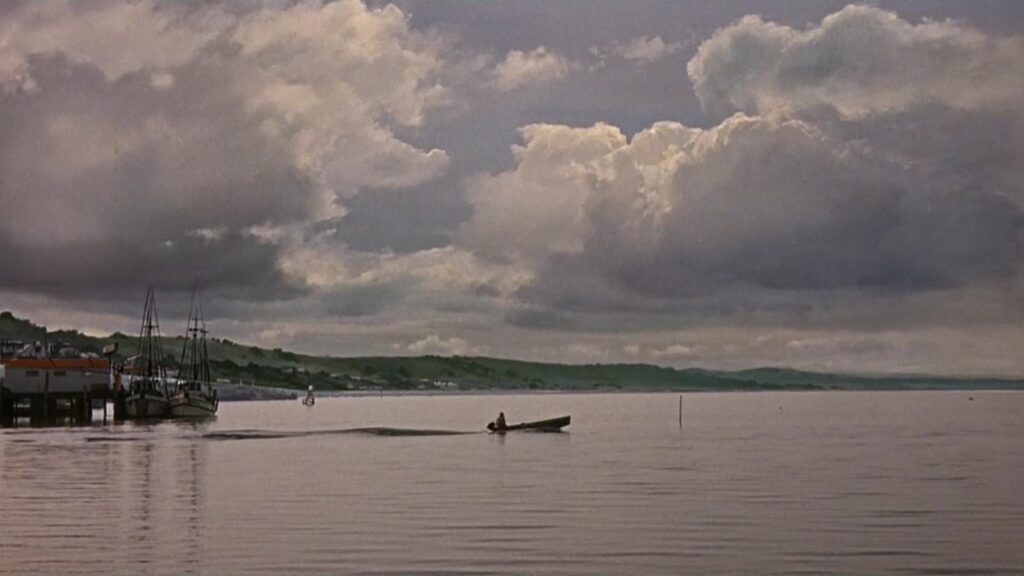
Progressing through the film, as the bird attacks grow, the backgrounds become more and more obvious, particularly in a scene where Melanie is stuck inside a phone booth as the birds attack the town. Again, Hitchcock is using the unreality of the rear projection shot as a descent into the madness that surrounds Melanie.
The most controversial usage of rear projection in Hitchcock’s filmography is in Marnie, a film I will defend as Hitchcock’s last true masterpiece. Within this film, obviously false backgrounds appear at a dizzying pace. Many critics have said this shows Hitch losing interest in his picture. I would argue it’s quite the opposite. Watching Marnie on the big screen is a descent into madness. As a viewer, you’re never sure of what exactly is real and what is a fabrication in Marnie’s mind. The background plates used give you a taste of what it must be like to live in Marnie’s head, her dual nature, and her fight to bury her past. It’s Hitchcock’s most expressionistic use of the process shot since Vertigo. The two films would make quite the double bill.
So what then are we to make of North by Northwest? Made in the middle of this astonishing five masterpiece run that Hitchcock had between 1958 and 1964, it’s a film that is light and fun and blends its process shots with a skill that is nearly invisible. It’s a film completely at odds with the two serious pictures it is sandwiched between, Vertigo and Psycho.
But there are moments where that reality is broken.
North by Northwest is a film that is utterly absurd, up to and including the title. There is no north by northwest coordinate. It is not a direction on a compass. It doesn’t exist. The only reason things happen in the movie is because they have to get to the next set piece. North by Northwest moves as fast as it does because it is a movie built out of set pieces.
The origination of the tale came from writer’s block. Ernest Lehman was approached by Hitchcock to adapt “The Wreck of The Mary Deare” by Hammond Innes. Leahman couldn’t find a way into the story. In an effort to keep Lehman from quitting the project, Hitchcock suggested they begin writing something else, and threw out an idea he’d had for a long time. “I’ve always wanted to do a chase across Mt. Rushmore.”
And there was the seed. The two men began throwing set piece ideas at each other. Scenes they had wanted to do but had never had a place for were put into the mix. Now all they had to do was connect them.
North by Northwest is a film about a man mistaken for a spy who doesn’t exist. The idea came from real life. Hitchcock got the idea from journalist Oscar Guernsey, who told him about how the CIA had once used a non-existent decoy. This outlandish tale was all the impetus Hitch and Lehman needed to throw in every manner of unreality. So, Hitchcock and Lehman have Roger Thornhill raise his hand in a restaurant as a waiter is asking for a “George Kaplan” and now he’s mistaken for the fake agent. It’s a simple setup and completely unrealistic. The beauty is in the simplicity. By making the setup so simple, the audience never questions it.
There are early, subtle hints that Roger Thornhill’s sense of reality is about to completely disappear. The first instance of this comes early in the film when Thornhill is kidnapped, threatened, and after having a bottle of bourbon poured down his throat, sent driving down a weaving and winding mountainside. The location of this kidnapping? The North Shore of Long Island, a notoriously flat place.
Again, a lie. A false reality. A painted backdrop behind a misidentified secret agent. Much like the unrealistic rear projection as the inebriated Roger careens down the hill in his car. It’s clearly a backdrop on a soundstage, but the sense you get is of a drunken driver trying to maintain not just control of his car, but also of his poise. Once again Hitchcock uses the false background to plunge the audience into the hero’s nightmare. Is this real? Is it a dream? Why would you try to kill someone by sending them drunk driving down a curved highway?
Plunging himself deeper into the nightmare, Thornhill goes to the UN to meet a diplomat who gets stabbed in the back by a thrown knife. If you’re in a nightmare, of COURSE it it’s a thrown knife and of COURSE it makes sense for Thornhill to grab the knife as the diplomat falls. It’s awkward, clumsy, and only serves a purpose of having a photographer take a picture of Thornhill holding the knife. It makes sense in the moment but once you wake up, you think “Why would I do that?”
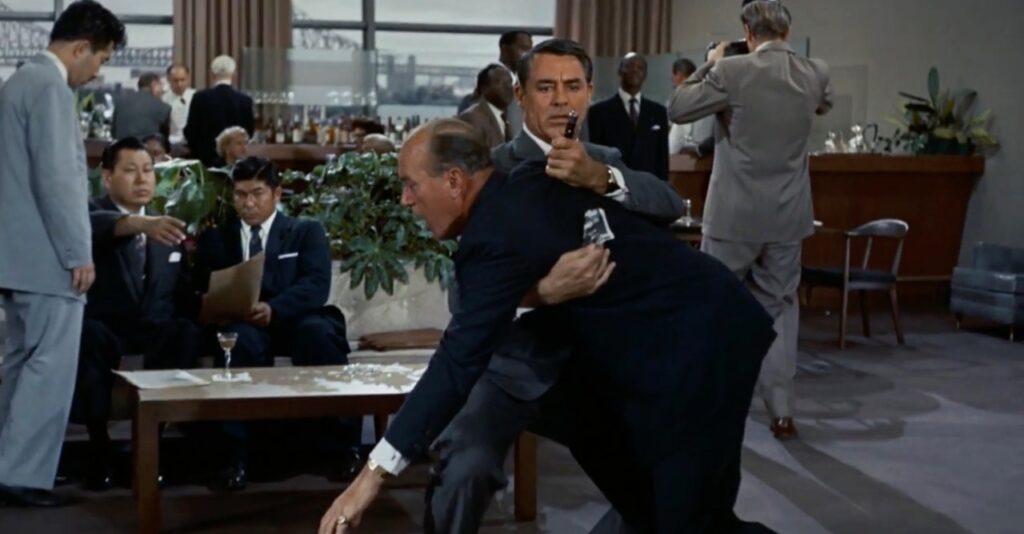
And now, much like he did in Vertigo, Hitchcock gives us, the audience, a scene with information that Thornhill doesn’t know. The USIA, (The United State Intelligence Agency, but we all know they mean CIA), has never had an agent named Kaplan, but they’re very happy now to let the charade continue for their benefit. It’s as if Hitchcock is winking at us and saying “It’s only a movie. None of this is real. Just go with it.”
So we have Thornhill jump on a train to escape, which also just happens to hold Eve Kendall, an operative for the USIA, who he just happens to sit with. In a famous line of dialogue between the two of them, Hitchcock tells us everything we need to know about the logic of the film. Eve pulls out a cigarette and Roger offers her a light with his matchbook. On the matchbook are his initials: R.O.T
Eve: “Roger O. Thornhill. What does the O stand for?”
Roger: (smiling) “Nothing.”
Nothing is as it seems. Nobody is who they say they are.
Which is good because it leads to one of Hitchcock’s greatest scenes. It turns out Eve has set Roger up to be shot by a crop duster in Iowa, which, much like the drunken car ride, is a terribly inefficient way to kill your target. But it would make sense if you were in a dream.
In the film’s famous climax, Thornhill is held hostage by a house maid who doesn’t know her gun is a fake. The bad guys take Eve to a plane to escape. They are loading up on a landing strip located at the top of Mt Rushmore. Yes, you read that correctly. Look at this Google Earth image and show me a good place for a runway.
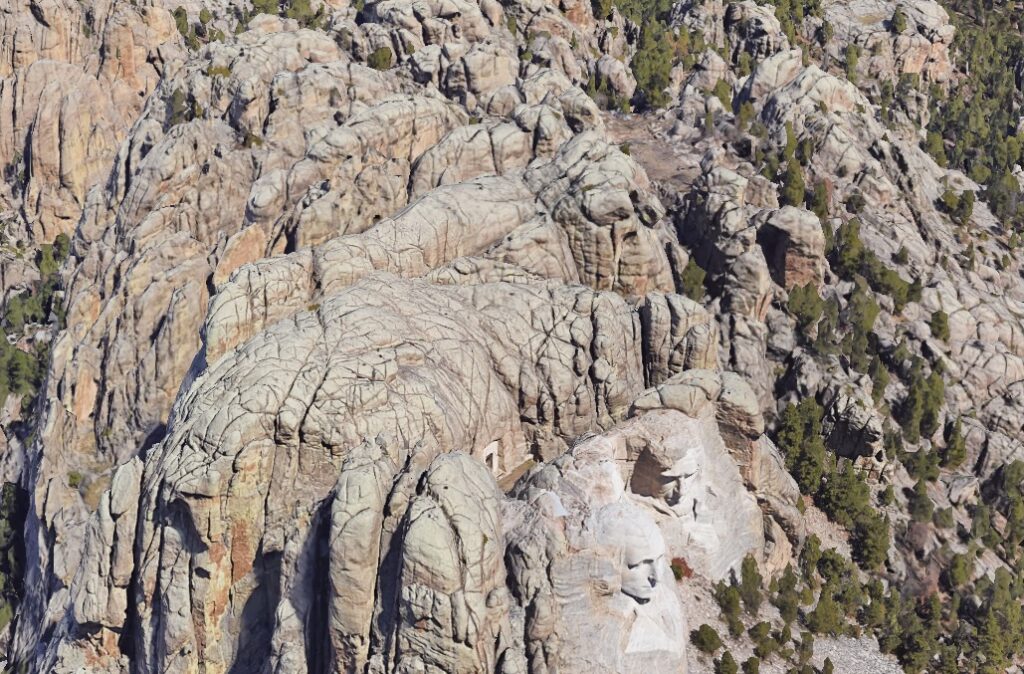
But we’re so deep into the nightmare, we’re only worried about whether Eve is going to get thrown out of a plane. It makes zero difference in our mind that there’s no possibility of a runway on top of George Washington’s head.
Which brings me back to the purse.
Why would Hitch leave that purse sticking out sideways, defying gravity? If I’m judging it based on how he uses it in the other films of this period, then it’s because once again, Eve and Roger are living in a dream that has turned nightmare.
And so, the purse sticks out sideways.
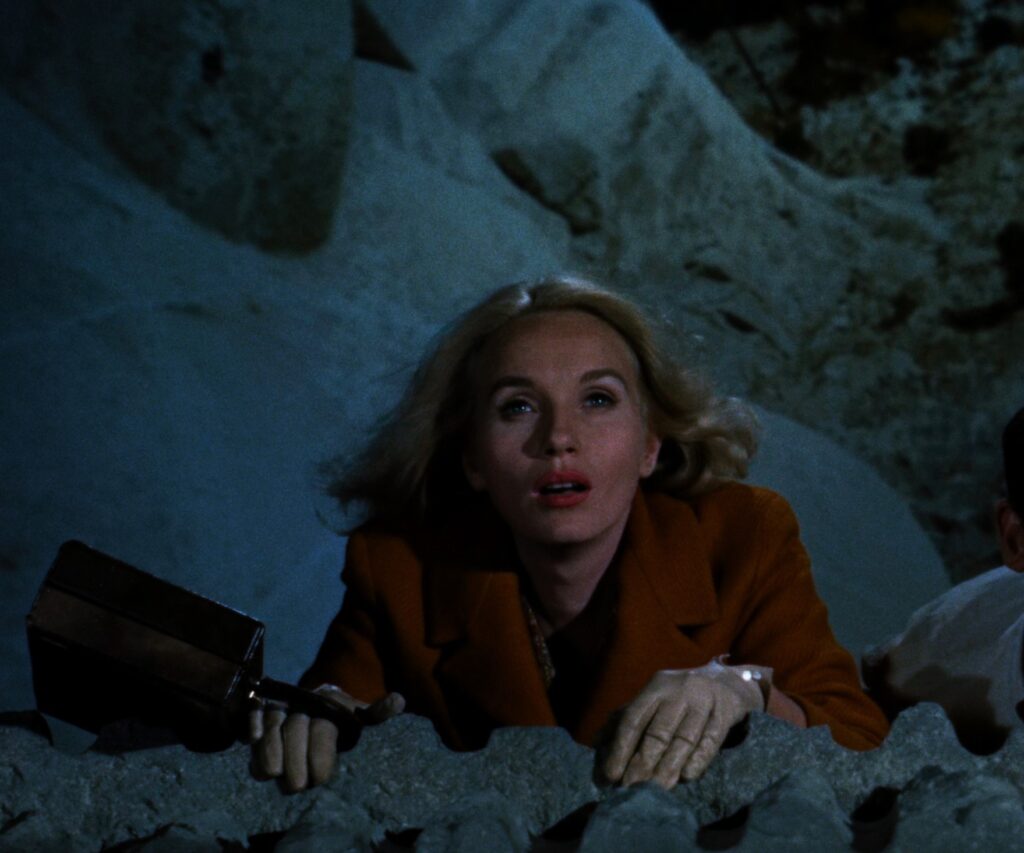
Eve is holding up her whole weight on a cliff with her arms bent. Roger hangs on with one hand and is still able to make one-liners about how his ex-wives divorced him because he “led too dull a life.” The geography of Mt Rushmore doesn’t make any geographic sense as they cross it. And the painted backdrop is patently obvious if you stare at it. It’s the logic and reality of a nightmare with a coating of comedy that keeps us emotionally off balance.
Or, maybe it’s simpler than that.
Maybe Hitch was just having fun and knew most of us wouldn’t notice.
Maybe I’m tangling myself in knots trying to justify a fake background I never noticed until my wife pointed it out.
Maybe the answer to the meaning of the purse is the same answer as the meaning of the O in Roger O Thornhill:
Nothing.
Edited by Olga Tchepikova-Treon