
|Matthew Tchepikova-Treon|
Tickets for The ’80s Action Extravaganza III are sold out, but you can still learn more about it and other exciting Trylon events by visiting trylon.org. This programming is made possible through partnership with the Cult Film Collective.
For the inaugural 1980s Action Extravaganza, three years ago now, I wrote an ode to a few particular moments from action movie soundtracks that, by sheer musical force, can compel moviegoers to exclaim aloud, “Fuckin A!” This year, inspired by the programming for Action Extravaganza III, I’d again like to pay tribute. But I’ve been thinking a bit more broadly this year, a bit more about what even constitutes a “Fuckin A” moment in action cinema. So, this time round, I want to take an auscultatory look, so to speak, at the bio-mechanics of the 1980s Action-Movie Soundtrack (hereinafter the AMS-80) to examine how it so effectively secretes simulated dopamine into our endocrine systems.
With this year’s Extravaganza in mind, I’ve isolated four highly codified frequency-events: The Electrocardiodrum; The Arpegginator; The Saxophonic Interlude; The Terminal Vocal Event. As always… No spoilers! Maybe some hints? Definitely a few red herrings.
1. Electrocardiodrum (Machine Heart)
The AMS-80 existed as a kind of musical manifesto for the late-twentieth-century’s obsession with the “(Digitally) Perfected Self.” It was a decade during which composers began trading in the old wood-and-horsehair symphonic orchestra, and its dependence on Wagnerian hand-me-down leitmotifs, for microchips and MIDI cables, electric guitars and keyboards, interfaces and IBMs. All of which were powered by the AMS-80’s heartbeat: the electrocardiodrum.
Drum machines and electronically FXed drums were a hallmark of action movie music. Especially gated reverb, an effect achieved by applying a massive amount of artificial reverberation to any drum hit then abruptly cutting it off with a noise gate before the sound wave’s natural decay can occur. The result is a sound that possesses the atmospheric volume of a cathedral but the temporal duration of a gunshot. It’s an acoustic illusion that suggests a world where space is infinite but time is strictly rationed by an unrelenting clock. As a result, the electrocardiodrum also stylishly represents the typical action hero’s journey. Take for example the “Top Gun Anthem” by Harold Faltermeyer. Perhaps best known for his Beverly Hills Cop theme, “Axel F,” Faltermeyer’s far more fatalistic score for Top Gun opens and closes the film in true Joseph Campbellian fashion. The ghostly reverb that envelops a sparse Roland TR-808 drum machine in the opening credits—Maverick’s paterfamilias inside the music machine, no doubt—transforms into Mach-2-level drum hits following the final dogfight:
2. The Arpegginator (Nervous System)
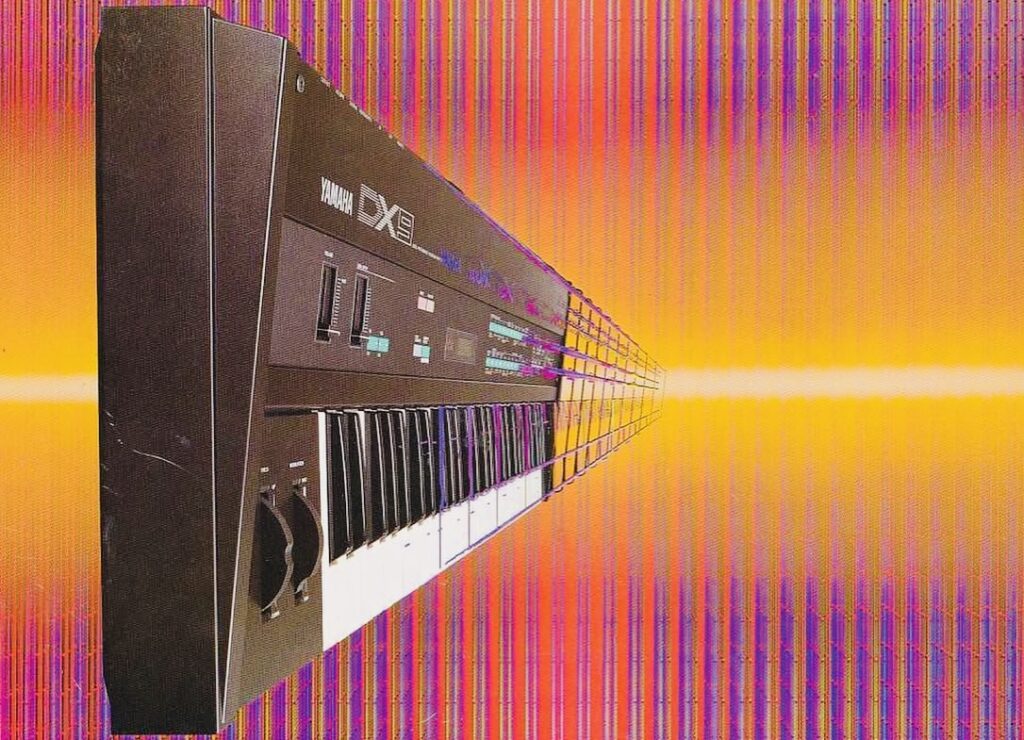
This development of the AMS-80 also marked a fundamental shift in the auditory physics of cinematic heroism. Where a John Williams score from the late 1970s might utilize a traditional brass arrangement to imply the nobility of organic human struggle, the AMS-80 privileged Frequency Modulation machines. This allowed for a ubiquitous sonic texture that was simultaneously hyper-real and utterly synthetic, mirroring the era’s obsession with the chrome-plated perfection of the human physique, especially as an instrument of state-sanctioned violence. To paraphrase Eddie Murphy from The Nutty Professor: “Synthesis, alllll synthesis!”
A prominent element admittedly under-examined here are Synth Pads, essentially the sonic spandex of action music: thin, shimmering chords stretched tight over the soundtrack’s more motoric features. But sequenced arpeggios were the AMS-80’s true autonomic nervous system, with relentless (often sixteenth-note) electric pulses firing like synaptic neurotransmitters directly into our adrenal glands.
This guy definitely knows what I’m talking about:
The arpegginator also functions as an aural surrogate for the protagonist’s cognitive processing: “I am currently calculating the trajectory of this grenade.” Unlike the melodic leitmotifs of yore, which sought to convey character depth or tragic interiority or even moral deliberation, the AMS-80’s arpegginator conveys shear momentum plus the efficient execution of high-speed tactical decisions, i.e., an infinite state of kinesis. This is Cold War ideology plain and simple, a sound that strips away the messy, polyphonic nuances of human emotion and replaces them with a streamlined, monophonic, ballistic certainty.
3. The Saxophonic Interlude (Speaking of Ballistics)
Within the AMS-80’s synthetic wall of industrial noise there exists an often overlooked element of significant structural importance where the gunfire ceases and we are suddenly confronted by a breathy, alto-saxophone lead. A vestige of Film Noir, this is the moment where the soundtrack’s masculinist drive momentarily melts into a pool of hardbody vulnerability. But this ain’t the saxophone of Charlie Parker or John Coltrane. It’s more of a simulated human moan processed with so much glossy reverb that the instrument sounds like it’s being played through silk bedsheets.
The catch, though, is that it doesn’t even have to accompany an actual sex scene. While naked breasts are almost always de facto, the saxophonic interlude often signifies hyperbolic sensuality in the most broad, semiotic terms possible just to remind us that the idea of sweaty sex is on everyone’s mind all the time. Taken out of context, the most cloying example might be the “Coke Deal” cue from Lethal Weapon by Michael Kamen:
But that’s the thing about the AMS-80. In the movie, in the moment, this sound works like a certain tropane-alkaloid straight to the brain.
4. The Terminal Vocal Event (Post-Climax)
Finally, we reach the Terminal Vocal Event. This is the structural anomaly that occurs during the film’s resolution, perhaps as the camera pans up from a smoking ruin toward the sunset. Manifested as a tenor vocal soaring over distorted electric guitars, it is here that many action movies attempt to retroactively imbue their 90 minutes of kineticism with meaning. The lyrics are almost universally tautological, letting us know that there is “no easy way out,” affirming that one is indeed pushing it “to the limit,” or declaring that “all we want is life beyond Thunderdome.” It is the sonic equivalent of a post-coital cigarette smoked in the wreckage of a burned-out warehouse, providing a sense of closure whether the movie’s actual story earned it or not.
Of course, the terminal vocal event isn’t without precedent. Blaxploitation scores in the 1970s regularly name-checked their Pusher Men and Foxy Women, offering us both narrative re-utterance and psychological interiority. Likewise, Bill Conti’s 1976 accompaniment to Rocky’s arduous training, a musical masterwork, literally includes the lyrics “trying hard now / getting strong now.”
Nota bene. The vocal event doesn’t exclusively happen in the finale. Perhaps its true raison d’être is the training montage, the AMS-80’s most significant contribution to musical form. All the same, the point is that the lyrics exist as a moral imperative that triggers a Pavlovian response in the audience, signaling that the hero is currently transcending their own mortality for our cinematic salvation. Perhaps the thunder was in our own hearts all along:
Coda (Bonus Track):
If you don’t know, you will soon. See y’all on Saturday. Fuckin A!
Edited by Olga Tchepikova-Treon