
| Wil McMillen |
Psycho III plays at the Trylon Cinema on Thursday, September 3. For tickets, showtimes, and other series information, visit trylon.org.
It’s astonishing to realize now, but Anthony Perkins wasn’t even nominated for Best Actor for his role as Norman Bates in Alfred Hitchcock’s cultural earthquake Psycho. Horror films rarely get the attention they deserve, but one would expect that when the supporting actress (Janet Leigh) and the director both received nominations, the actor at the center of one of the most seismic twists in film history would at least have been nominated. It was an era-defining performance. It was the role of a lifetime.
It was also a curse.
In the years following Psycho, Perkins continued to turn in high-quality work, but the shadow of Norman Bates hung over many of his performances. For years, he tried to escape his typecasting.
But it wasn’t the only thing he was trying to escape.
If art is autobiography, then we need to look at Perkins’s first directorial outing, Psycho III. While it didn’t garner the best reviews, and Perkins himself later mocked his directing as the work of an amateur, there is so much going on within the film, it deserves another, deeper look. Because Anthony Perkins was taking control of the character that had controlled him.
And I think Psycho III is Anthony Perkins’s autobiography. In particular, his battles with his own sexuality.
Before I go on, I want to be perfectly clear. I am not in any way equating Anthony Perkins’s feelings about his homosexuality with the murderer at the heart of the Psycho series. But I am very interested in how his participation in the now debunked practices of “conversion therapy” he put himself through mirror the push and pull of “Mother” calling to Norman and making him do things he does not want to do. I think Anthony Perkins was telling us a lot about himself in the guise of his most famous character.
From the time he was young, Perkins knew he was homosexual. He kept it a closely guarded secret, but had affairs with many men, including a long running relationship with Tab Hunter. Being found out could be catastrophic for his career and for his life at the time. By the time he was 39, Perkins had undergone conversion therapy and electroshock therapy under “Psychologist to the Stars” Mildred Newman to try to “cure” himself. It’s worth noting that Perkins’s friend Stephen Sondheim called Newman “completely unethical and a danger to humanity.”1
Conversion therapy is founded on a false assumption: that the person being treated is fundamentally wrong and that intervention can produce a different person from the one you truly are. Psycho III repeatedly dramatizes a similar idea, although in a completely different fictional context. Norman is continually being told that his identity is fundamentally wrong, that his attraction to women is bad, and he himself is bad because of it. “Mother” functions as the mechanism that keeps him in line with that belief. Whenever Norman experiences desire, independence, or the possibility of a different life, “Mother” rears her ugly head.
For Norman, the battle for “normalcy” exists entirely within his mind. It’s internalized. The internalizing of this battle has the outward effect of violence upon others.
For Anthony Perkins, who had long hated his sexuality but felt compelled toward it, he sought out “normalcy” from outside sources. He went so far as to allow the violence of electroshock therapy to be used on himself in an attempt to change who he was.
So it’s interesting that by the time the script for Psycho III landed on his desk, it struck him so deeply he demanded not only to star in it, but also make his directorial debut.
The film opens on a black screen. A cry is uttered at top volume:
It’s an anguished scream and a startling opening to what, at the time, was thought to be just another slasher sequel. It’s bracing, and upsetting. It shakes the audience with an act of blasphemy, marking the film as a something more serious: an exercise in personal turmoil.
The nun who screams these words is Maureen (Diana Scarwid). She has accidentally knocked one of her sister nuns from a bell tower during a suicide attempt, and has left the convent in shame. The sequence echoes Vertigo, with the bell tower even having the same shape as the Mission San Juan Bautista location where Madeleine falls in Hitchcock’s film.
The choice to make Maureen a nun in the midst of a crisis of faith, pushing away the church that she has known her whole life, and trying to escape to a life she wants for herself, is an explicit mirror to the battle raging within Norman. They both want to escape their lives. They both know they want something more for themselves. And yet that old life keeps bubbling back to the surface, chasing them, pulling them back to what they don’t want.
Maureen’s guilt is so overwhelming she attempts suicide.
In a reflection of the famous shower sequence, we see Norman watching Maureen through the peep-hole in the wall of the notorious Cabin One, where Janet Leigh took her famous final shower. Maureen strips and enters the shower, and we believe we are about to witness another shower murder.
Instead, “Mother” opens the curtain and confronts what “she” sees—Maureen has slit her wrists in a suicide attempt and is laying in a blood-filled bathtub.
It’s one of the most heartbreaking scenes in the series. The acting is exquisite. “Mother” instantly turns back into Norman, the knife dropping to his side. Without seeing his face, we can tell from the slight way his body slumps and slightly bends that Norman feels sadness and pity for Maureen.
Maureen, a tear falling from her eye, reaches up to what, in her dying moments she sees as a vision of the Virgin Mary, and feels forgiveness.
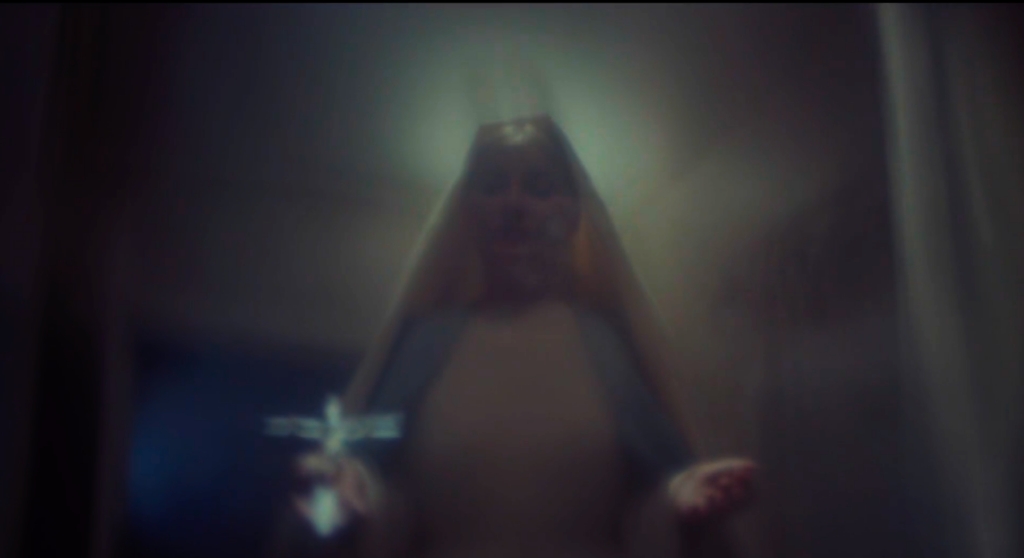
The heart has leapt forward out of the darkness.
Norman saves her life, just as we believed that “Mother” was about to take it. Two hurting people have found each other, and their lives are changed.
Norman and Maureen begin an awkward romance, very much reflecting the inexperience of both characters. It’s as if we’re watching two young teenagers on their first date. It’s awkward. It’s stiff. And when the moment comes where the romance would normally be consummated in any other slasher film, Norman is unable to perform.
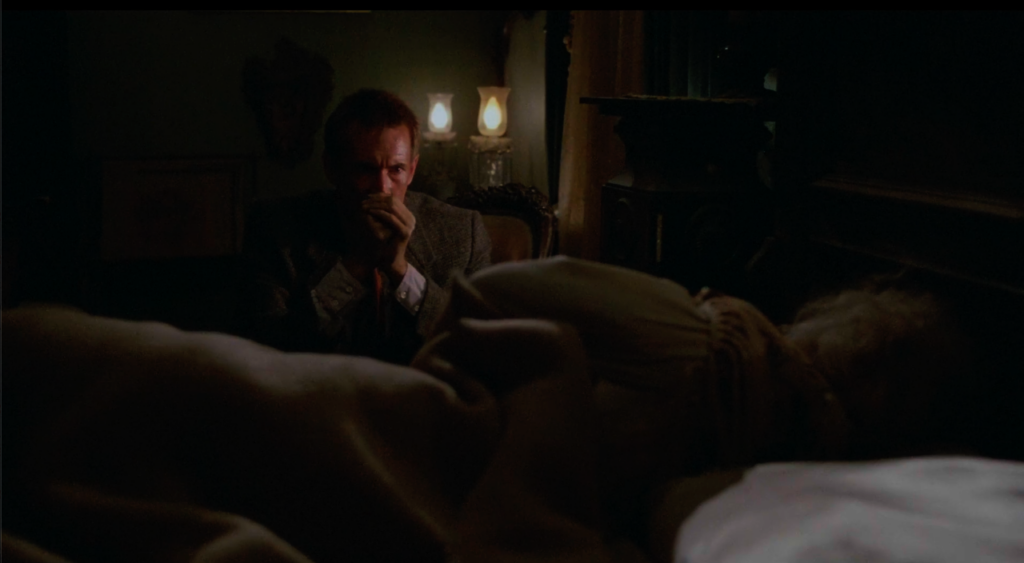
Instead, they fall asleep in each other’s arms, holding onto each other as if their lives depended on it.
Because they do.
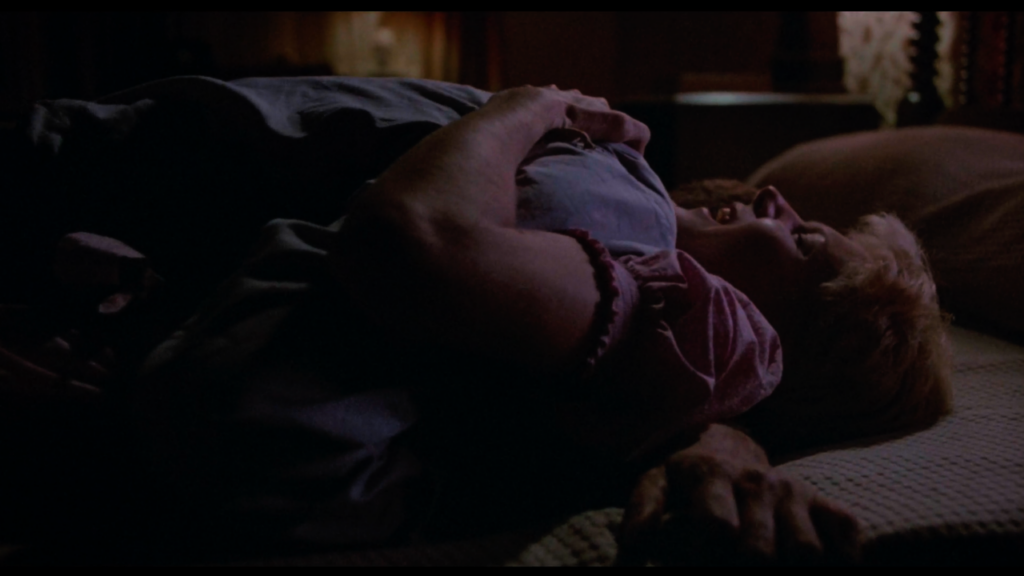
If Norman was to go any further, “Mother” would arrive and Maureen would be no more. Norman knows this, and fights his own tendencies. He’s caught in a desperate internal struggle to be “normal.”
Maureen also reflects this desire to be “normal.” During her recovery from the suicide attempt, Norman visits her, and she thanks him for saving her. When Maureen asks Norman why he’s so nice to her, Norman replies:
“People should look out for each other, don’t you think? I mean, we sometimes get lost. But if we had someone looking out for us, to help us understand, maybe we wouldn’t do some of the sad, awful things that we do.”
Maureen asks “Why are you so kind? The way you found me…you must think I’m mad.”
Norman replies, in a callback to the first film “Not at all. We all go a little mad sometimes.”
To which Maureen states “But sometimes the despair, it’s so overwhelming, I just want it to stop.”
Early on in Psycho III, there’s a monologue that gets directly at this inner turmoil. A reporter, Tracy Venable (Roberta Maxwell), is working on a story about serial killers who have been released from prison and is interviewing Norman at a diner. When she asks him about seeking revenge about those who imprisoned him, Norman replies, glancing straight into the camera and briefly looking directly at the audience:
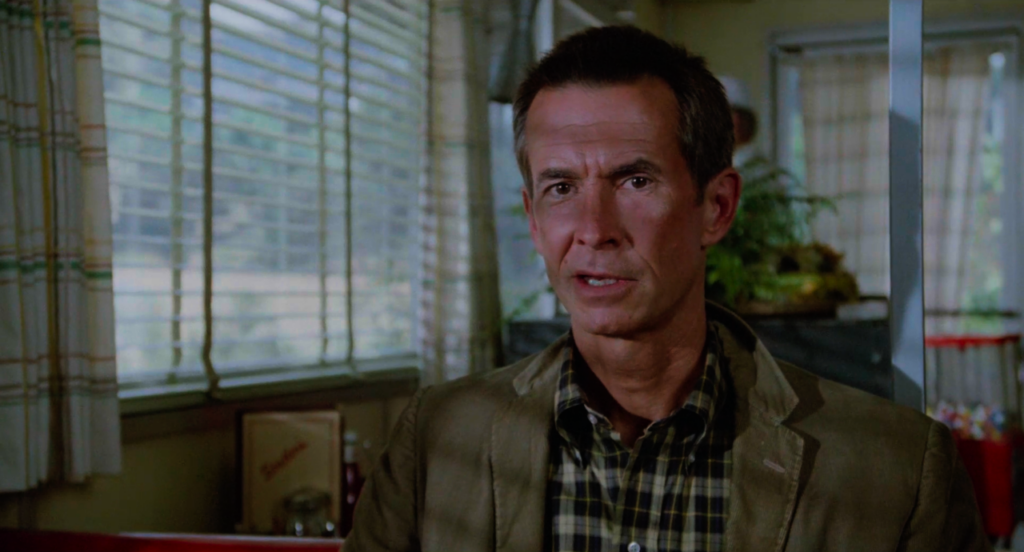
“The past is never really past. It stays with you all the time. And no matter how hard I try, I… I can’t really escape. It’s always there. Throbbing inside you. Coloring your perceptions of the world. Sometimes, controlling them.”
This glance to the camera seems to be Perkins at his most confessional.
Normally when an actor briefly glances at the camera, the director will cut away from it, particularly if the scene is set up like this one, with two people talking to each other in three-quarter closeup. But Perkins, as the director, chose to leave this moment in.
Breaking the third wall is always confrontational to the audience, and this moment feels so personal, you almost want to look away.
But then, so much of Psycho III is about keeping an open secret.
There is no mystery as to whether Norman is still channeling his mother. We witness his conversations with her corpse multiple times throughout the film, whereas in the other films in the series, these moments were generally held offscreen, in order to keep the “secret.”
Interestingly, Perkins presents “Mother” as an “other” throughout the film. We see Norman having conversations with her. When the murders occur, Mother’s face is silhouetted so we cannot see it.
We know it’s Norman in the dress this time.
There’s no secret.
And yet Perkins, as a director, covers up Mother’s face as if there is one.
Late in the film, Duane (Jeff Fahey), a drifter who is working at the Bates Motel, steals Mother’s body and threatens to go public with Norman’s secret. It doesn’t take much of a mental leap to connect “Mother” to Perkins’s own closeted homosexuality. The worst thing in the world at the time for an actor was to be outed. Exposure was the last thing a gay actor or actress wanted.
So when Norman has to kill Duane because he’s threatened with exposure, Perkins makes sure to show us Norman glancing at Duane’s pornography before finishing him off during a fight.
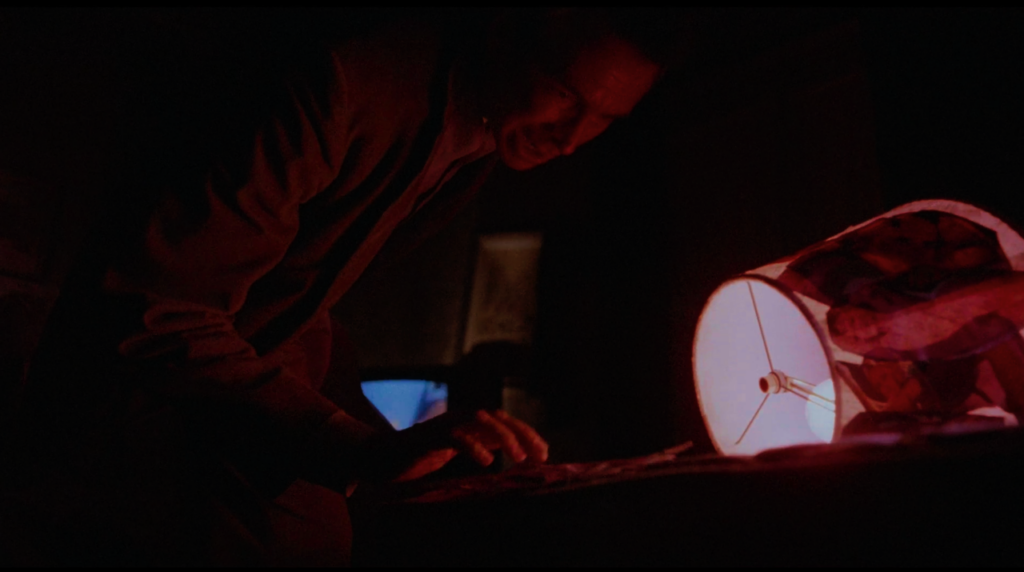
Because once Norman becomes aroused, “Mother” arrives.
It isn’t “nice guy” Norman killing Duane. It’s always Mother who does the deed.
That dark, hidden side has to be hidden at all costs, up to and including murder.
In the final scenes, Norman experiences a horrifying tragedy (which I won’t reveal here. It’s a shattering moment in the film) and it seems as though Mother has taken over for good.
But in the final seconds, Norman fights back and literally kills Mother, stabbing the taxidermied corpse and beheading it.
It’s difficult not to read this moment through the lens of Perkins’s own history, particularly his belief that he had defeated his own homosexuality through conversion therapy.
But there’s yet one more twist left. As Norman is driven away to prison again, he reaches down into his jacket and begins caressing the hand of the corpse of his mother. Norman may be through with his mother, but “Mother” isn’t through with Norman.
Looking back, it’s not difficult to see Psycho III as part of a larger story about identity, secrecy, and the consequences of trying to be someone you’re not. Anthony Perkins’s life illustrates what happens when society tells a person that some part of himself must be hidden, corrected, or transformed.
Conversion therapy promised Perkins that another person could be produced by changing the supposedly defective one.
Anthony Perkins deserved better.
In 1973, after undergoing conversion therapy, Anthony Perkins married photographer Berry Berenson, with whom he had two sons, filmmaker Osgood Perkins, and singer/songwriter Elvis Perkins. By all accounts it was a very happy marriage.
But the tragedy of Anthony Perkins is that for a period of his life, the culture around him forced him to become something he was not. The culture told him that if he became someone else, he could finally be happy.
For Anthony Perkins, living a split life was murder.
Notes:
- Mark Harris, Mike Nichols: A Life, 220. ↩︎
Edited by Olga Tchepikova-Treon