
| Courtney Kowalke |
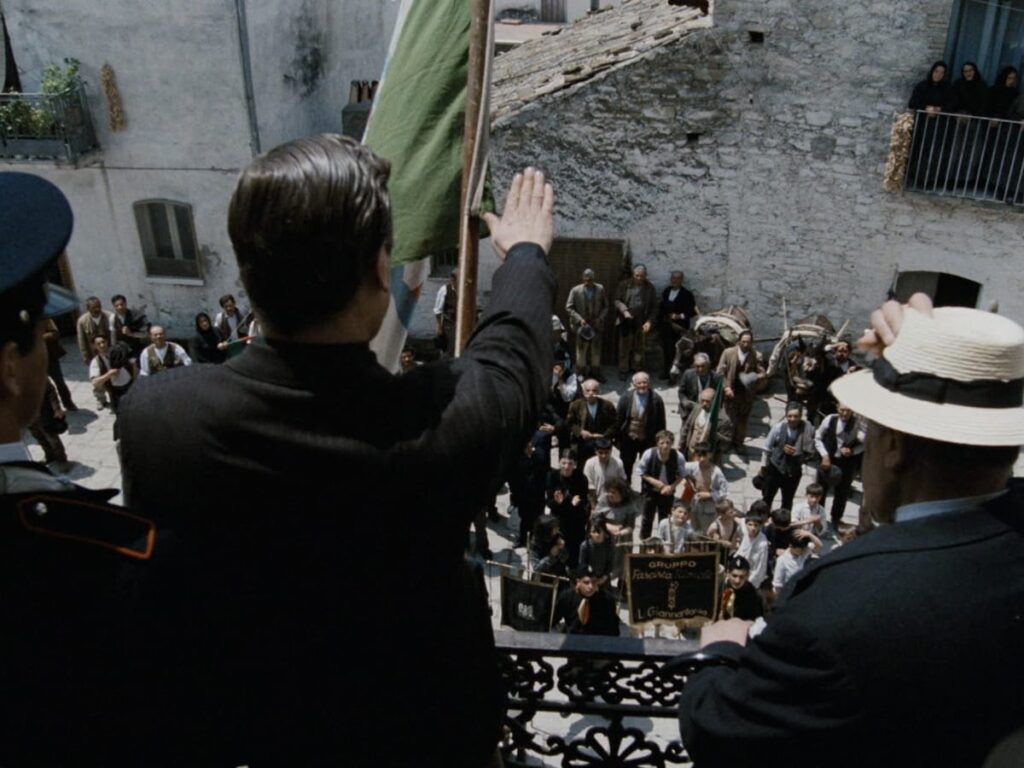
Christ Stopped at Eboli plays at the Trylon Cinema from Friday, September 11th, through Sunday, September 13th. For tickets, showtimes, and other series information, visit trylon.org.
For the past year, I’ve had Umberto Eco’s essay “Ur-Fascism” open in a tab in Firefox on my phone. Going about my daily life the way I did prior to 2025 has me feeling wrong-footed. I feel like a foreigner on earth, like the world around me changed but also like everyone in my orbit is pretending it’s the same. Reading the Italian philosopher’s proposed tenants of a fascist government helps; it makes me feel less alone in the world. The essay shows me the changes I’m noticing are not new struggles, not for our politics and not for our society. Watching the Italian biopic Christ Stopped at Eboli (1979) made me feel a similar way. It also made the state of the country I live in much clearer in my mind.
I noticed too many similarities between reality and fiction for me to expand on all of them. Carlo Levi (Gian Maria Volonté) commiserating with his sister, Luisa (Lea Massari), that the government denies any outbreaks of malaria while both Levis are treating multiple malaria patients per day reminded me of our secretary of health and human services Robert F. Kennedy Jr. claiming as recently as August 26 that his opponents are fabricating their reports of measles outbreaks and deaths for attention. The people of Gagliano being forced to slaughter all their goats because they can’t pay the newly-imposed taxes on keeping goats reminded me of the several hundred wild horses being rounded up and sold to slaughter to save the government money in August. Italy’s 1935 attacks on Addis Ababa—in a failed attempt to capture Emperor Haile Selassie—and Walwal, Ethiopia, which led to Italy using Ethiopia’s oil reserves, reminded me of the United States capturing Venezuelan President Nicolás Maduro in February so we can control their oil sales. The list continues as we live through it. As such, I narrow my focus to one man living in one village during one movie.
Christ Stopped at Eboli follows a year in the life of renaissance man Carlo Levi (Volonté). Levi considered himself a painter, but he was also a trained physician as well as a political activist and writer. Levi helped found the anti-fascist movement Giustizia e Libertà (Justice and Liberty) in 1929 and was part of the “Gruppo dei Sei” (Group of Six) in Turin, a movement whose name reminded me of the “Minneapolis 15,” a group who are currently fighting federal conspiracy charges for resisting U.S. Immigrations and Customs Enforcement (ICE) officers during Operation Metro Surge in January. Apparently organizing to protect your neighbors has always been felonious.
According to Eco’s fourth point in “Ur-Fascism,” “For Ur-Fascism, disagreement is treason.” I searched high and low for what criminal charges Levi was arrested on and found nothing. I couldn’t find anything about him inciting violence or attacking carabinieri (Italian national guardsmen). Nothing about him vandalizing property or resisting arrest. Levi’s own foundation’s website says, “Rather than facing a formal trial in a traditional courtroom, the Fascist Provincial Commission sentenced him under administrative police measures to three years of internal banishment (confino politico) in 1935.” The downplaying of the fact that he didn’t get a trial sent a chill down my spine. Levi’s disagreement was criminal enough to require punishment by the state.
Christ Stopped at Eboli starts with Levi being escorted by government officials from his home of Turin in the north to the southern province of Matera and a village there called Aliano in real life and Gagliano in both the movie and Levi’s memoir, also titled Christ Stopped at Eboli. (Although not explained in the book or film, Levi called the village “Gagliano” both to give the place a shred of anonymity and also because it’s how the peasants pronounced “Aliano” with their southern dialects.)
For global reference, I’ve provided a map showing the distance between Turin and Aliano.
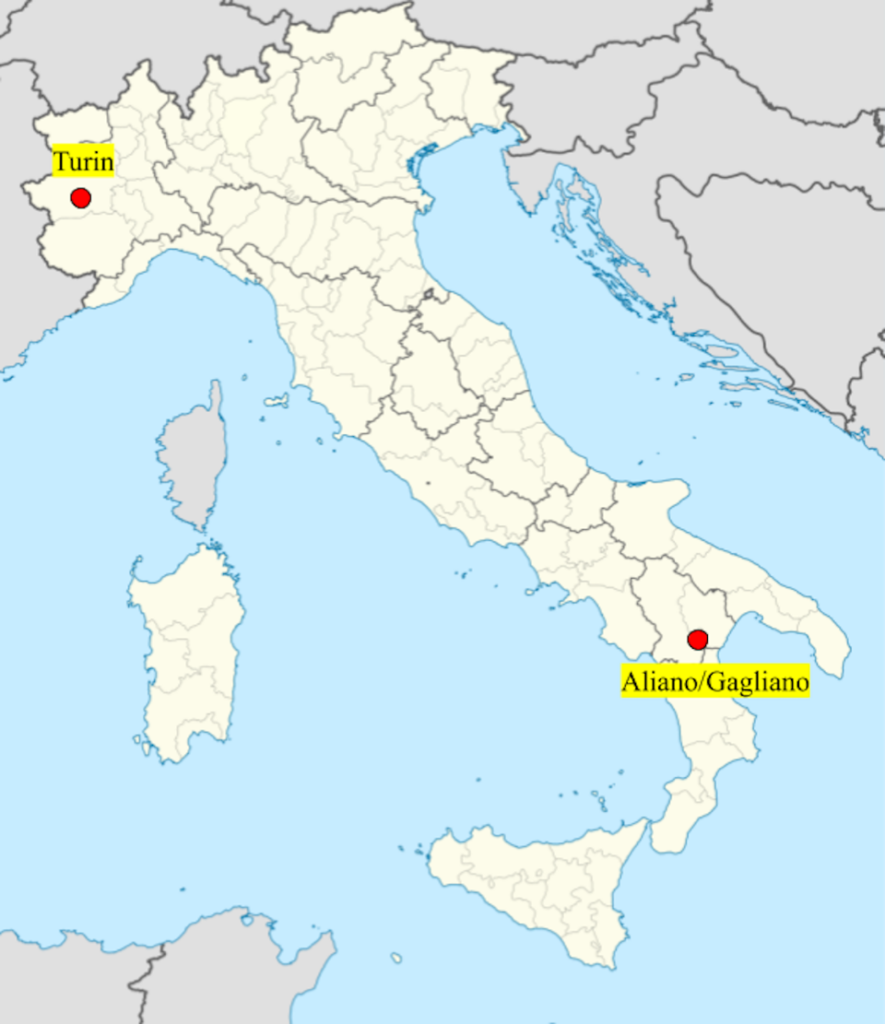
For local reference, the move would be like getting booted from Minneapolis to Jena, Louisiana. Jena is home of the LaSalle ICE Processing Center, where student Mahmoud Khalil was held without a warrant for three months last year. (My initial comparison of the trip from Minneapolis to the South Florida Detention Facility, or “Alligator Alcatraz,” was fortunately rendered moot while writing this as operations (allegedly) halted there in June.)
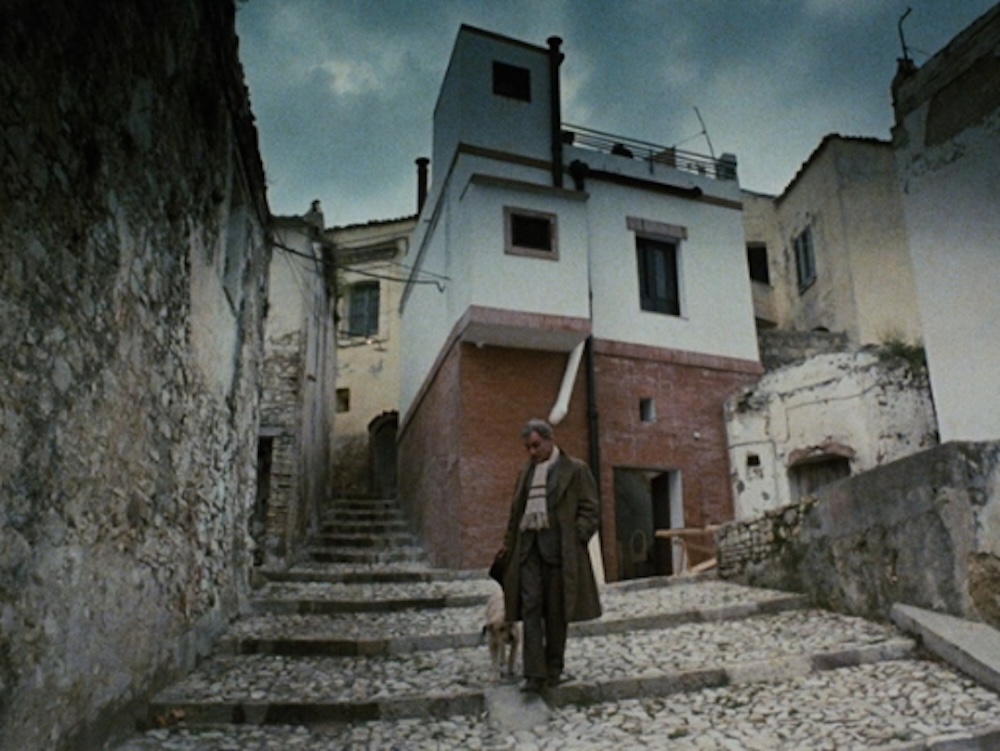
I couldn’t find a specific number in the film or in Levi’s memoir, but this year’s preliminary census data gives Aliano/Gagliano’s population as 804 people. Levi was confined to the town’s limits, sort of like the Haitian immigrants in Springfield, Ohio, who are currently required by ICE to wear ankle monitors which will alert the government if they leave the 75-mile radius they are confined to. The carabinieri probably wish they had that technology. We often see them following Levi as he walks his dog around Gagliano during Christ Stopped at Eboli. We see them herding Levi back towards the center of town a few times, but Levi doesn’t push his boundaries too often.
Levi is a stranger in a strange land. The locals are nice to him; the southern regions of Italy did not completely support Mussolini (more on this later). Still, the fascism is there, a fly in the ointment. Early on, Levi meets a friendly woodworker (Giuseppe Persia) listening to a recording of aviator Francesco de Pinedo’s post-“Flight Over Three Continents” victory speech.1 Levi bonds with the other man, but de Pinedo’s speech in the background slowly turns to praise for Mussolini.
“With great satisfaction, I tell you that Italy grows greater,” de Pinedo crows on the recording. “And you must be proud to say that you are Italian. Italy has sacrificed its sons for its greatness. And you, out of respect for our martyrs must know that you are Italians. You must be Italian in name and in fact.” Volonté provides some stunning facial acting as Levi comes to grips with the fact that everyone in Gagliano may be kind to Levi, but on some level, they still believe and promote propaganda from the government which exiled him.
Eco’s seventh point in “Ur-Fascism” notes, “To people who feel deprived of a clear social identity, Ur-Fascism says that their only privilege is the most common one, to be born in the same country. This is the origin of nationalism. Besides, the only ones who can provide an identity to the nation are its enemies… The followers must feel besieged. The easiest way to solve the plot is the appeal to xenophobia.” Eco’s ninth point also notes that fascism equates pacifism with trafficking with the enemy—life should be permanent warfare.
To wit, in the middle of Levi’s exile, Mussolini starts the Second Italo-Ethiopian War. Wikipedia cites this conflict as “a war of aggression,” meaning it was started without the justification of self-defense. Fascism means a need to have enemies, both internal (political agitators like Levi and the Minneapolis 15) and external (the Ethiopians and the Iranians). It’s us versus them, our pure and beautiful land versus the barbarous foreigners.
“In wartime, ideas don’t matter,” Gagliano’s mayor, Don Luigi Magalone (Paolo Bonacelli), tells Levi. “The Patria is what matters.”
In the book, Magalone’s sister, Donna Caterina Magalone Cuscianna, speaks a similar line, although the difference in its wording intrigued me. “Well, ideas are not so important; it’s our country that matters,” Cuscianna says. “You, too, are for Italy, aren’t you?”2 Magalone is firm; Cuscianna is wheedling. Surely Levi is for Italy; surely he wouldn’t be disagreeing with her. Why would he disagree?
Levi is for Italy, but not the Italy Cuscianna means.
Most of the locals disagree with the Magalone siblings’ reverence of Italy. The people of Gagliano feel disconnected from the capital and from the nation’s beloved Il Duce. When Mussolini’s speech announcing Italy’s attack on Ethiopia is broadcast on the radio, Levi is shown listening to it while reading Scena Illustrata—an Italian travel magazine—at his friend’s barber shop. The barber continues with his work, not paying the self-aggrandizing much mind. Early on, Magalone tries giving his own balcony speech a la their dear leader. When the carabinieri attempt to round up villagers to go to the city square, many of the Gagliano peasants tell the guards off, yelling that they have to work and they don’t have time for the show. The mayor and the villagers of Gagliano lives in two different Italies, Levi notes. There’s the Italy up above, passing laws and sending men to war, and there’s the Italy down below, the workers with no power who resent the state for making rules without considering how its poorer people live.
“They feel no part of a glorious civilization, which they consider their mortal enemy,” Levi writes in a letter to his sister. As a prisoner of the village, everything Levi sends and receives by mail is read by the mayor and approved or denied. This particular letter does not pass muster; Magalone refuses to send for Levi and reviews it with Levi for possible censorship.
“Here, none of the peasants belong to a political party,” Levi writes. “They’re not Fascists, nor do they belong to any other party. What connection do they feel with the government, power, the State? The State is ‘the people in Rome,’ who have always existed and always will, like hail, landslides, drought, malaria. For the peasants, the State is farther away than the sky and more evil because it’s always their adversary. The State is a form of fate like the wind that burns the crops, and the fever that burns the blood.”
“Who do you mean by ‘the people in Rome?’” Magalone chastises Levi while reviewing the offending letter. “And why go on about the peasants? Forget about them… You should mix with gentlemen of your own class. We’re the State. And you demean yourself with these words.”
That’s Eco’s tenth point in “Ur-Fascism.” “Elitism is a typical aspect of any reactionary ideology, insofar as it is fundamentally aristocratic, and aristocratic and militaristic elitism cruelly implies contempt for the weak,” Eco writes. “Since the group is hierarchically organized (according to a military model), every subordinate leader despises his own underlings, and each of them despises his inferiors. This reinforces the sense of mass elitism.”
This point along with Magalone’s remarks reminded me of America as well. In Bill Moyers’s 1988 Washington Post article, “What a Real President Was Like: To Lyndon Johnson, the Great Society Meant Hope and Dignity,” Moyers quoted our 36th president as saying, “I’ll tell you what’s at the bottom of it. If you can convince the lowest white man he’s better than the best colored man, he won’t notice you’re picking his pocket. Hell, give him somebody to look down on, and he’ll empty his pockets for you.” White Americans needed to oppress somebody. Johnson came to this conclusion after a lifetime of observing racial dynamics in his home state of Texas. Johnson’s views were also influenced by the prominence of the American civil rights movement during his presidency. In Johnson’s experience, White Americans still needed to feel like they had power, and they couldn’t be weak if there was another race or class or gender they could harass.
“Between any type of State and the peasants, there will always be an abyss that can be closed if we create a type of State that also belongs to the peasants,” Levi argues near the end of the movie when reunited with his Giustizia e Libertà contemporaries. The Italian government will always view the poor people in southern Italy as a problem to be solved because they do not treat these people as their equals. Levi argues that the Italian government will never fully solve “the Southern Problem” until it listens to the thoughts and opinions of the people living there.
In Christ Stopped at Eboli, the people of Gagliano resent the Italian government for starting another war. “If these people in Rome have so much money to spend on war, why don’t they spend it here?” the woodworker asks. “Make new fountains, plant trees, instead of cutting down the few we have left.” Another citizen nicknamed Faccialorda (“dirty face”) points out they could also repair the bridge that collapsed four years prior.
These are sentiments I have also seen in America over the past year. In February, we helped Israel launch yet another attack on Iran; come September, the Washington Post reports that the U.S. military “will have incurred some $37.5 billion in taxpayer-funded costs in connection to the war.” That’s $37.5 billion that could have been spent in our country. We have roads to fix here. We have schools to fund here. Just like the Gagliano villagers in Christ Stopped at Eboli, my neighbors and I are left wondering how the government has all that money and why it can’t be spent solving structural problems here in the Twin Cities.
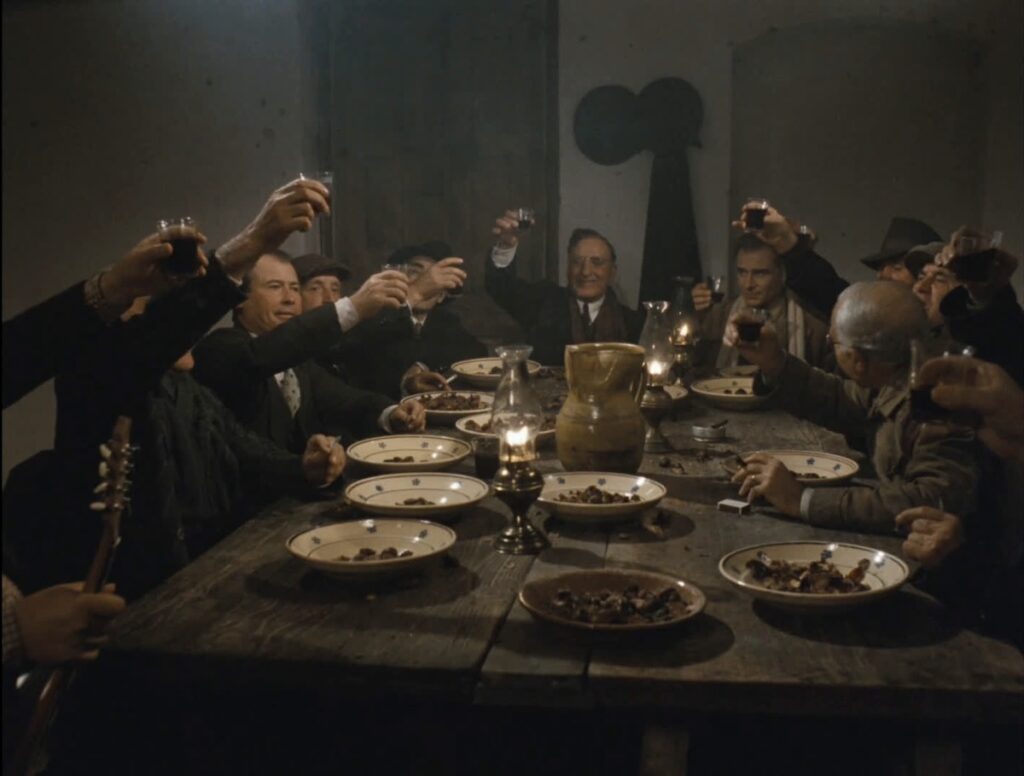
On the subject of the U.S., several of the villagers Levi befriends are former Americans. It was common occurrence there—in the film, Levi is primarily seen with a group of eleven men, but in the book, he describes even more people who were born in Italy, moved to and lived in America for several years, then returned to Gagliano due to ailing family members or inheriting land there. “Gagliano is full of these returned emigrants, who look on the day of their return [to Italy] as the unluckiest of their lives,” Levi noted in his memoir.3
The men who returned from America revere it. The joiner has a large picture of then-president Franklin D. Roosevelt hanging in his studio, a portrait Levi claims was a fixture in many Gagliano homes.4 They have no love for Rome, instead longing for New York City.
“Naples is our capital because it’s the city of misery,” one man (Accursio Di Leo) tells Levi during an evening Levi spends with the former Americans.
“Naples has no kings today,” another man argues. “We only go there for the boat to America.”
“And Rome’s for the rich, the capital of a hostile foreign state,” the woodworker says.
“New York would be our capital, if we had one,” a man credited as “L’italo-americano” (“the Italian-American,” Vincenzo Licata) finally decrees.
“Yes, New York, rather than Rome or Naples, would be the real capital of the peasants of Lucania [the then-administrative region of Southern Italy which Gagliano was in], if these men without a country could have a capital at all,” Levi validates the men in his memoir.5 “Men without a country” is an apt way to describe this group of Gagliano men. Their sense of disconnect from their homeland is emphasized by a smash cut from the formerly-American men reminiscing about running through the upstate New York countryside feeling like boys again to all of them listening to Mussolini announcing Italy’s attack on Ethiopia in silence. Their days of joy and freedom in America are gone. They’re left in a town far from the capital, feeling unseen and ignored by their federal government.
I understand feeling like your government is not listening to you, the little people of your country. As of mid-August, fifteen automated license plate readers (ALPRs) have been installed in my neighborhood in Richfield. According to Finding Flock, “At 2.2 per square mile it is more densely covered than 63% of the 2,302 US cities indexed nationally. Nearly all of [the ALPRs] — 93%—are Flock Safety units.” We did not vote on this matter; we woke up one day, and the cameras were here, watching us at the Hub and the Shops at Lyndale. We lost $36,000 that could have been put towards structural improvements in our community without knowing it.
On August 22, I emailed the Richfield City Council with my concerns about everyone in Richfield being tracked by a private, for-profit company and what the company might do with the information they gather.
“I am a Richfield community member, and I am writing to ask that you NOT install any additional Flock Safety cameras or devices in Richfield, effective immediately,” I wrote. “They’re terrifying. Every day these cameras remain active, they collect sensitive data that could be used to violate our rights. Flock Safety’s system conducts mass surveillance of Richfield residents by logging every vehicle’s movements without a warrant, without probable cause, and without meaningful public oversight. Who is that information being sold to, and what are they using that information for?”
Richfield Councilmember Walter Burk’s response was swift. “After conversing with many people about FLOCK cameras in Richfield, I continue to support their use by Richfield law enforcement,” Burk emailed me. “Although there have been documented abuses of the FLOCK system in other places, I have not been given any proof of abuse here in Richfield. Instead, I have been provided proof that convictions for serious crimes were obtained through FLOCK data. The demonstrated benefits of using this system outweigh the alleged detriments to Richfield residents.”
Richfield Councilmember Sean Hayford Oleary agrees with Burk. “Flock was accepted by the Council at the request of our police department, who continues to feel it is a valid investigative tool,” Oleary commented in response to a Change.org petition started by Richfield citizens seeking accountability for the cameras. “State law precludes many of the most troubling violations that have occurred in other states; in addition, Richfield itself has additional protections: retaining data for half the allowed period (30 days rather than 60), and sharing access to video exclusively with our 911 dispatch partner, the City of Edina.”
The Richfield City Council loves the surveillance state. The City Council loves that Big Brother is watching. The City Council doesn’t care that Flock is building a database of every trip everyone takes in our community that can be reviewed at any time without a warrant. The police need their military-grade tech to fine and arrest more and more and more of us. Arresting people is what’s most important. The Richfield City Council doesn’t care about the privacy of the people in Richfield, and the council members don’t understand why it scares me. Just because their power has been abused in other parts of the Twin Cities doesn’t mean it will happen here. Just because someone was chased, cornered, and threatened by cops seventeen miles away from us because their license plate got logged into the system wrong doesn’t mean it will happen here in Richfield. It can’t happen here. It’s great, actually, that the government is watching you whenever you’re in public. Why are you so worried about living in the panopticon? It’s fine. Everything is fine.
Richfield Mayor Mary Supple’s response two days later was—in my opinion—a bit more even-handed (although she only addressed the 10 FLOCK cameras and not the five other ALPRs in our community). “The Richfield Police Department does not share its Flock data with any federal agencies,” Supple wrote me. “We only share with the Edina Police Department as they do our dispatch. Edina does not share with federal agencies. The national share button on our system has been disabled from the start to increase security. The data is not sold to anyone and is only accessed when a crime is being investigated… The Flock license plate readers have helped in the investigation of homicides, burglaries, and car theft, so we have continued the contract. We are working diligently to make sure all safety protocols are in place to protect against the misuse of the data.”
I guess it’s nice to know they aren’t currently selling our data to anyone, although I sincerely doubt it will last. As of June, I was still receiving payments from Meta due to Facebook selling my data to Cambridge Analytica in 2023. Hackers still exist and are evolving with the times. Things intended to be private do not always stay that way. Additionally, an officer from the Richfield Public Safety department tailed me for 45 minutes on August 26 because my neighbor called them claiming I let my dog off leash while we were walking (my dog was not off leash), so forgive me for being skeptical of how much major crime they’re solving and how much tech they need to solve all of these crimes.
The police state is here to stay, which is a shame because nobody I’ve talked to on the ground likes it. I know of two ALPR protest groups in Richfield. Our official community Facebook page has multiple posts made my people wondering who okayed these cameras. Everyone outside of Richfield who I’ve told about our neighborhood being Flocked has reacted with horror. And yet, more of these cameras are being added across the state and the country every day. What concerns us does not concern Mayor Supple. There’s money to be made in monitoring us, and every level of the government wants a cut of those Peter Thiel billions. The future is a boot stomping on a human face forever, and every level of the U.S. government is happily helping lace it up.
While I understand why the Italians of Christ Stopped at Eboli revered America and dreamed of moving back there, it disheartened me, not only because of current affairs, but because the roots of fascism have always been here. As Richard Steigmann-Gall noted in his article, “Star-Spangled Fascism: American Interwar Political Extremism in Comparative Perspective,” while it’s difficult to classify early American movements as “fascist” since they predate the term by decades, “Many of [these early movements’] beliefs strongly align with the tenets of fascism.” We had Native American Party of 1845 and the Know Nothings, whose “us vs. them” mentality against Catholic (mainly Irish) immigrants had the Know Nothings demanding their ‘enemies’ be removed from all sections of society. According to Steigmann-Gall, “[T]he Know Nothing movement’s heavy-handed approach to intimidation, often through the use of violence, mirrored the methods which fascists would employ in the future.”6
More overtly, anti-Black racism in the U.S. is a forerunner of WWII-era fascism. The Klu Klux Klan emerged in 1865 and is still active today, resisting national racial equality movements. The Black Legion—a radical off-shoot from the Klu Klux Klan—emerged in 1915 and grew during the Great Depression. In 1936—the last year of Levi’s exile—The Associated Press reported that Black Legion members murdered up to 50 people in southeast Michigan. These hate groups were of course predated by Jim Crow Laws and Black Codes, which legally mandated the Black people were inferior to white Americans and forbade them from entering public places, from voting, and from holding certain jobs. And all of this discrimination stems from chattel slavery, which is baked in the crust of our country. The American institution of slavery predates the U.S. Declaration of Independence. It has always been here. The underpinnings of fascism have always been in our country.
“My book Christ Stopped at Eboli opens with the words, ‘Many years have gone by, years of war and of what men call History,’” Levi writes in the forward of Christ Stopped at Eboli. “Once again, many years have gone by, years of war and history, of changes in men and things, years so crowded and dense and renewing that one cannot describe them in terms of number, for each living moment has been—as always with real things—eternal.”7 We in America in the year 2026 have seen this happen before. We have seen changes like this, wars like this, leaders like this. We’re reliving history. We’re driving toward that single end Horace writes about. What’s going to happen next? Are we doomed to the same fate, or is there still time to learn from our past mistakes?
Notes:
- I apologize for being vague when referring to Christ Stopped at Eboli’s minor characters. Actors are not listed alongside their roles in the closing credits, and the Internet Movie Database was just as stumped by this information as I was. (I was, however, greatly amused to see IMDB credit Rocco Sisto, an actor I was keeping straight from the others due to his impressive facial hair, as “Old man with big moustache.”) ↩︎
- Carlo Levi, Christ Stopped at Eboli: The Story of a Year, trans. Frances Frenaye (The Noonday Press, 1947 original, 1963 reprint), 54. ↩︎
- Levi, Christ Stopped at Eboli, 124. ↩︎
- Levi, Christ Stopped at Eboli, 122. ↩︎
- Levi, Christ Stopped at Eboli, 123. ↩︎
- Steigmann-Gall, Richard. “Star-Spangled Fascism: American Interwar Political Extremism in Comparative Perspective.” Social History 42, no. 1 (2017): 94–119. ↩︎
- Levi, Christ Stopped at Eboli, ix. ↩︎
Edited by Olga Tchepikova-Treon