
| Courtney Kowalke |
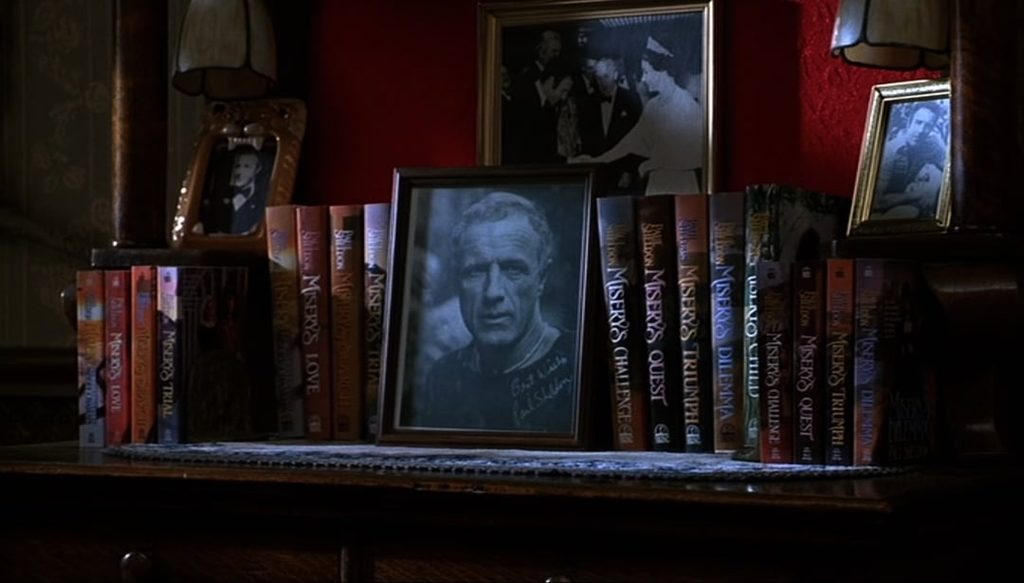
Image sourced from Reddit
Misery plays in glorious 35mm at the Trylon Cinema in partnership with the Cult Film Collective from Friday, September 25th, through Sunday, September 27th. For tickets, showtimes, and other series information, visit trylon.org.
On September 24, 2018, a post on the celebrity gossip website Oh No They Didn’t changed my life. As reported by LiveJournal user tevhenna, daytime talk show host Kelly Ripa commented on her husband actor Mark Consuelos’s Instagram (a post which has since been deleted). Not a headline-worthy event, I know. At the time, however, Consuelos had recently joined the CW show Riverdale. I was not into the series, but I knew of their fanbase. My impression was that the show had a lot of fans, most of the fans were in their teens or early twenties, and most of them had unhealthy attachments to the show’s actors.
One such fan with the Instagram handle mariaxdiaz felt the need to reply directly to Ripa hyping up her husband. “@kellyripa yes he is so handsome but you need to go Kelly you look to old for him sorry but you do [sic],” mariaxdiaz wrote. (Ripa is five months older than Consuelos. The audacity of her to rob the cradle in such a horrible, terrible way.)
In a move that shouldn’t surprise anyone who has watched Ripa sass her guests for the past 25 years, Ripa wasn’t going to let that slide. Ripa replied, “you need to learn how to spell the word too sweetie. As in you’re too stupid to be with my young, handsome husband. Ps, he likes proper grammar as well you dope” [sic].
I was fascinated by the exchange. I still am fascinated by it. What would possess someone to say that to another person, let alone another person they had never met and don’t personally know? What did mariaxdiaz think was going to happen? Did she think Ripa would reply, “You’re right—going to file for divorce now so you can have him!” What was the desired outcome of the interaction, apart from attempting to shame Ripa for her appearance?
In the eight years since reading that post, I have been further baffled by people on the Internet. As the social media landscape evolved, this type of attitude became more normalized. I crossed paths with one too many “stans” before I quit using Twitter, people with accounts dedicated to their favorite musicians’ accomplishments and to tearing down any other musicians they perceived as threatening their idol’s throne. (I’m not sure most stans know moniker is derived from Eminem’s song “Stan,” which tells the story of a stalker who grows so angry at Eminem not replying to his letters that the fan eventually commits a murder-suicide. Not something I aspire to be compared to!) I don’t have TikTok, and I unfollowed everyone I didn’t know personally on Instagram after realizing how strange it was that I could see into the lives of these people who don’t know I exist.
My discomfort—both at the thought of being allowed to “see into” celebrities’ lives and of inserting myself into their lives by force—seems to be an anomaly. In the past five years, there has been an increase in fans acting overly familiar with celebrities in the world offline. Chappell Roan made headlines in 2024 for asking fans to quit stalking her parents and her sister and to stop yelling at her when she doesn’t want to take pictures with them. In my search for an example of how there’s been a surge of audience members throwing objects onstage and attacking performers, I was surprised to turn up a whole Wikipedia article about concert abuse in the 2020s. When Billie Eilish was yanked into the crowd by a fan at her Oct. 10, 2025 concert in Miami, witness Andres Rodriquez told NBC News, “I saw that and my first reaction was like, ‘So what was his game plan, like, what was he [the fan] trying to do here?’”
While overzealous fans are reported on now more than ever, they have always existed. The most famous example in pop culture is Annie Wilkes (Kathy Bates, a role she deservedly won the Academy Award for Best Actress for). The antagonist of Misery (1990) and the 1987 Stephen King novel the film is based on, Annie is the self-proclaimed number one fan of romance author Paul Sheldon (James Caan, in a role I always thought he deserved more accolades for). For decades, Paul has visited the Silver Creek Lodge in Colorado to work on his stories. Annie owns a farm in the area, and when Paul endures a nasty car accident at the start of the film, Annie swoops in to save him. It’s an easy save to make since she’s stalking him. When Paul calls her finding him “a miracle,” Annie laughingly admits, “In a way, I was following you… Well, it wasn’t any secret to me you were staying at the Silver Creek [Lodge], seeing as how I’m your number one fan and all. Some nights, I just tool on down there, sit outside, look up at the light in your cabin, and I’d try to imagine what was going on in the room of the world’s greatest writer.”
Following Paul is the second-lightest of Annie’s offenses. (The lightest, in my opinion, is catching him in a lie based on an anecdote Paul told on The Merv Griffin Show eleven years prior to the events of Misery.) She refuses to let Paul use her phone to call his daughter, claiming the lines are down. She refuses take him into town, claiming the roads are too bad and that her training as a nurse means she’s qualified to care for him at her home. When she reads Paul’s latest release, Misery’s Child, and learns he killed off the title character, Annie goes berserk. She wakes Paul in the middle of the night to scream at him for “murdering” Misery. Annie repeatedly refers to Misery like Misery is a real person. From that night on, Annie forces Paul to undo his ‘crime’ by writing a new Misery book, and the aforementioned offenses pile up like charcoal brickettes on a grill.
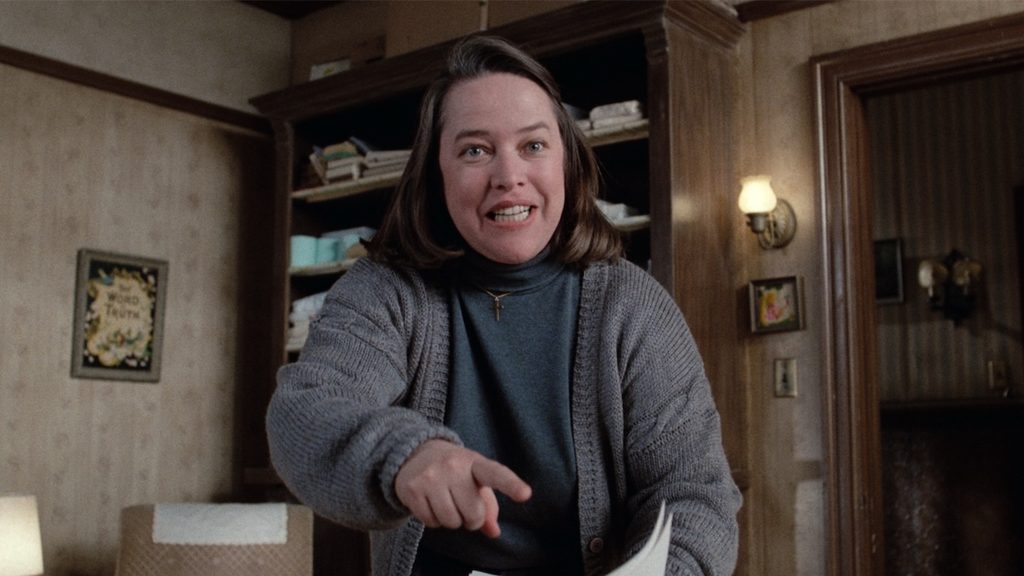
Image sourced from Cinema Blend
In many ways, Annie Wilkes is the forerunner for the current phenomenon of parasocial fans. According to Wikipedia, a parasocial relationship is “an illusory experience, [in which] media audiences interact with personas (e.g., talk show hosts, celebrities, fictional characters, social media influencers) as if they are engaged in a reciprocal relationship with them.” It’s a trend that has been growing in public consciousness since 2020, when many people were not allowed to leave their homes but had steady Internet access. However, the first recorded use of “parasocial” was in 1956. The term was coined by American sociologists Donald Horton and R. Richard Wohl in relation to early television viewers.1 Even 70 years ago, audiences were developing one-sided relationships with game show hosts and newscasters. I shouldn’t be surprised—people are wired to connect with other people, and they’re wired to fantasize about other things they could be doing when they are bored. Of course people latched on hard to these new people and possibilities suddenly presented in their living rooms.
Almost every study I found about how or why parasocial attachments developed gave a single reason—loneliness. Lonely people are more likely to latch onto personas and mistake them for deep, meaningful relationships rather than products being sold. In a 2021 TEDx Talk titled “Parasocial Relationships,” speaker Lihn Nguyen elucidated, “… it makes sense—when you’re lonely, you crave interactions with others, yet your self-esteem issues makes it harder to connect with real-life people when you fear the social rejection that might take place… which is why parasocial relationships seemingly provide the perfect solution.” [sic] You get the rewards of friendly interactions without truly putting yourself out there.
That’s exactly what Annie Wilkes does. Early in the film, she tells Paul, “When my husband left me, I wasn’t prepared. It wasn’t any easy time. For a while, I thought I might go crazy… I don’t know about you, but what I did to get through it was I dove into work. Days, nights. Night shifts can be lonely at the hospital. I did a lot of reading. That was when I first discovered Misery. She made me so happy. She made me forget all of my problems. Although I suppose you had a little something to do with that, too… .” Reading Paul’s books helped Annie feel less alone, but over time that sense of comfort warped into a sense of connection, a feeling Paul had no knowledge of or reciprocation for.
On some level, Annie knows it’s a one-sided affair. When she despairs as Paul is nearing the end of Misery’s Child, Annie sees through Paul’s flattery and his claims that he likes staying with Annie.
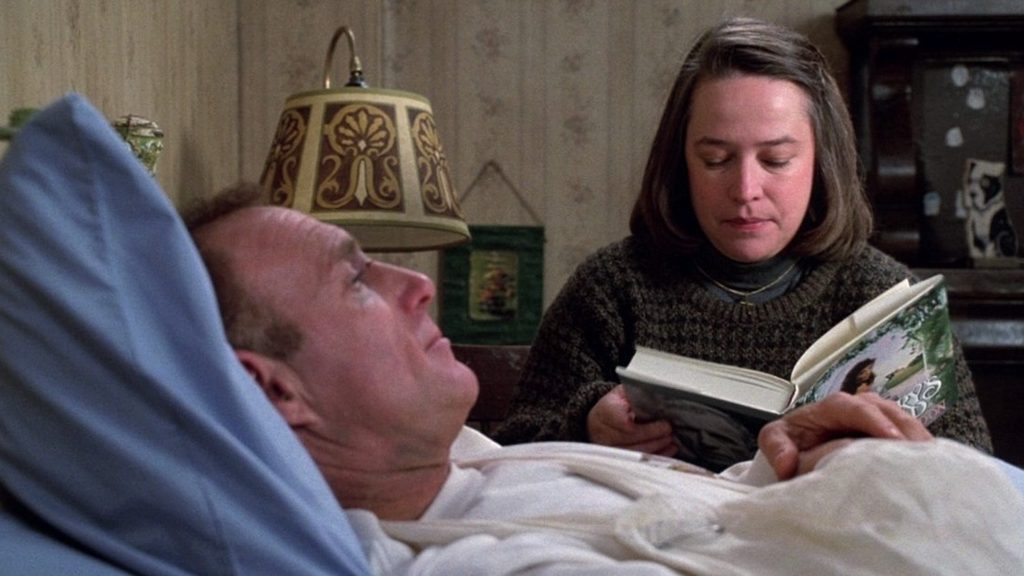
Image sourced from Talk Film Society
There’s a sense of entitlement tied to this loneliness, too. Because the lonely person’s social needs are not being met, they seem to grow and warp until they’re all this person can think about. Annie’s need for comfort, for her favorite character to be alive sans deus ex machinas or retroactive continuities, is more important than getting Paul the medical attention he needs. Annie loves Paul, but only based on what he can do for her. She doesn’t truly care about him as a person.
In a 2024 post titled, “How Capitalism Created Parasocial Relationships,” Saint Xavier University student Samantha Alcala wrote, “Parasocial relationships are transactional. Fans support celebrities and their work in exchange for content and interaction (even if it’s indirectly). Fans are spoon fed all this content to the point that they feel like they truly know the celebrities they admire. It becomes an addiction, to the point that they overlook their flaws and defend them no matter what. … Then, once their favorite celebrity acts out of character, they become aggressive. If you know anything about K-pop, you may have heard that some fans become genuinely upset whenever their favorite artist dates. … To these fans, since they support their favorite artists monetarily, the artist absolutely cannot break the persona they are paying for.”
Breaking the persona your audiences want can have deadly consequences. On December 8, 1980, Mark David Chapman assassinated the former Beatle John Lennon in New York City. Three years later, in an interview Jim Gaines, Chapman admitted, “I always wanted to be a Beatle. I’d always think, man, what would it be like to be a Beatle?” According to Gaines, “Chapman specifically idolized Lennon. Recalling a particularly intense acid trip, he told a friend he thought he had become the former Beatle. However, his affection for Lennon eventually waned.”
Much like Annie Wilkes, Chapman transferred his obsession to a character in a book—Holden Caulfield, the protagonist of J.D. Salinger’s The Catcher in the Rye. “I really identified with him,” Chapman told Gaines. “His plight, his loneliness, his alienation from society.” Chapman absorbed Holden’s disdain for phonies and people who don’t practice what they preach and weaponized it against his former idol. According to Gaines, Chapman—a devout Christian—was especially angered by Lennon’s infamous, “We’re more popular than Jesus now” remark. Lennon stopped acting in a way Chapman approved of, so Chapman decided to kill him.2
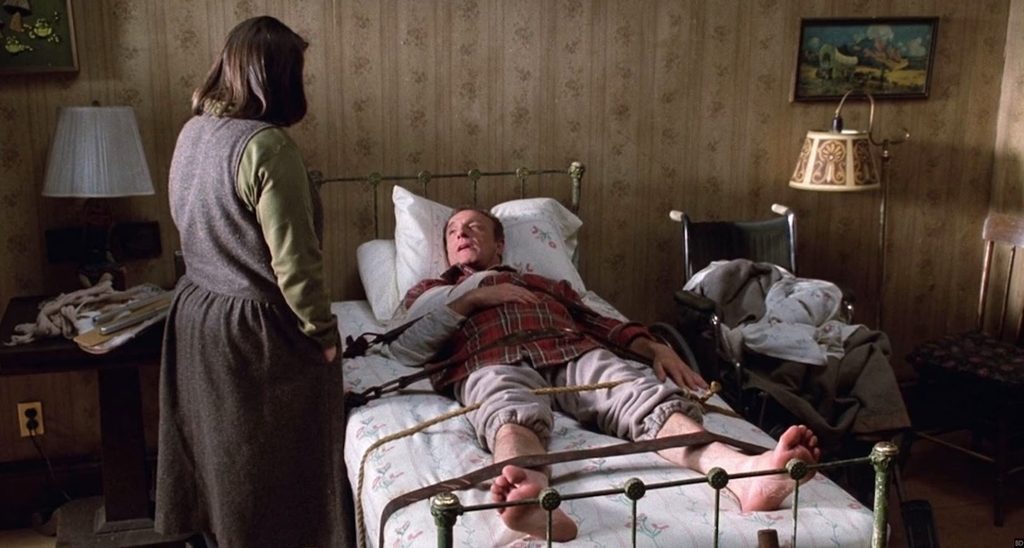
Image sourced from Bloody Disgusting
So, what was the desired outcome of Chapman’s plan? “Shooting Lennon was an answer to all of my problems, I guess,” Chapman told Gaines. “It was to cancel all my past, to give me an identity.” Chapman wanted to be infamous, to be known for something, anything. That seems to be the goal of most parasocial fans. They want attention, good or bad. They want somebody in the spotlight to acknowledge them, to see them, to have some kind of public identity even if that means getting arrested for harassment (at the very least).
Annie has a simpler goal. She wants Misery to be alive and well. Annie wants her life to return to the way it was before she met Paul Sheldon and got to know him better. Paul drinks. He smokes. He swears. He doesn’t love Misery as much as Annie does, doesn’t cherish her the way Annie does. She can’t have that. She needs the version of Paul Sheldon that existed only in her head. Unfortunately for Annie—and for mariaxdiaz on Instagram and everyone on stan Twitter—the object of her attention is a real person. People do what they are going to do. Paul has his own goals, and he knows how to play the role Annie wants just long enough to turn the tables. A fan might want attention, but a creator knows you should be careful what you wish for.
Notes
1 Donald Horton and R. Richard Wohl, “Mass Communication and Para-social Interaction: Observations on Intimacy at a Distance,” Psychiatry, vol. 19, issue 3 (1956): 215-29.
2 During my research, I ran several times into a story that Misery was inspired by Chapman asking Stephen King for an autograph while claiming to be his number one fan. This story isn’t true—King himself admits their paths would never have crossed, and Chapman has never cited King as an influence. While that connection would have been an interesting way to tie the threads of my review together, it doesn’t exist.
Edited by Olga Tchepikova-Treon