
|Victoria Breshears|
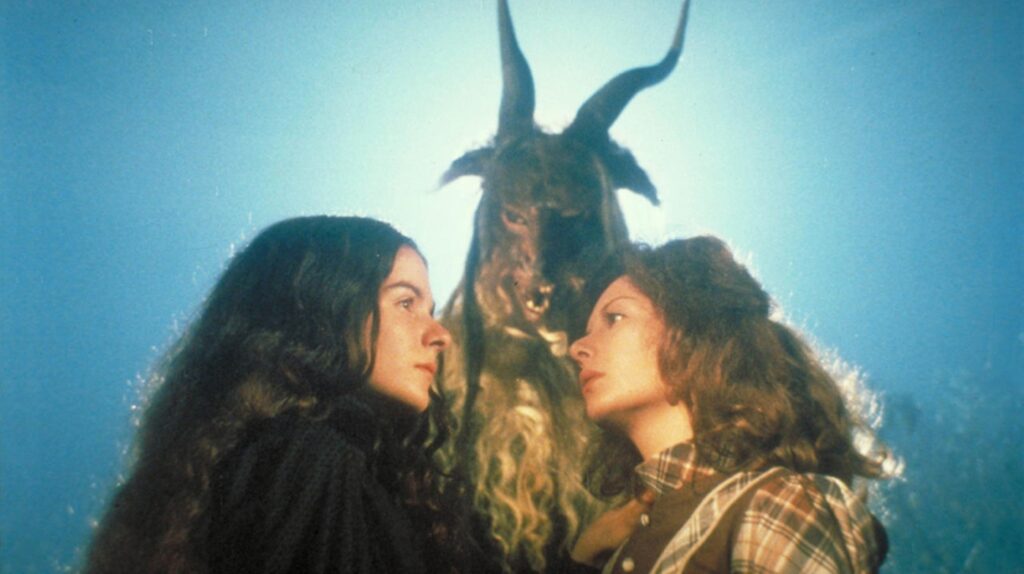
Alucarda plays at the Trylon Cinema from Friday, October 23, through Sunday, October 25. For tickets, showtimes, and other series information, visit trylon.org.
When the White House deactivated entry badges for reporters from CNN, Politico, and MS NOW this September, the administration defended the lockout through the familiar vocabulary of institutional decorum. The move cleared the room of inconvenient questions. Deactivating a press badge does what political argument never can: it enforces an artificial hush so authority can speak without interruption, no matter how hollow its claims. It is the clearest sign yet of an administration retreating from public scrutiny it no longer knows how to handle.
That instinct is hardly unique to state press rooms; every institution built on absolute discipline requires that same silence to govern. Within the stone walls of a cloister, quiet is the primary instrument of bodily control. The monastery runs on predictable murmurs: the low hum of confession, Latin liturgy, and bells instructing bodies when to kneel and when to leave. To break that hush is an existential threat to the hierarchy that keeps the roof up.
Juan López Moctezuma’s Alucarda (1977) breaks that peace immediately. Loosely adapting Sheridan Le Fanu’s vampire novella Carmilla, the film tracks Justine (Susana Kamini), an orphan sent to an austere convent where she meets Alucarda (Tina Romero). When the girls open a sealed tomb in the monastery crypt, they unleash a curse that turns into forest blood rites and demonic possession. Led by Father Lázaro (David Silva) and an order of linen-swaddled nuns, the church authorities respond with isolation, physical restraints, and ritual flagellation.

Alucarda is notorious for gore, nudity, and a shrieking audio track that tests an audience’s patience. Mainstream critics wrote off that sound as cheap drive-in sensationalism or bad ADR. In reality, Moctezuma strips the horror scream of its usual helplessness and weaponizes pure volume against the cloister’s authority.
That helplessness has a long pedigree. In 1933, Fay Wray set the template for the screen victim on the Empire State Building. From Wray through Marilyn Burns in The Texas Chain Saw Massacre and Jamie Lee Curtis in Halloween, the scream queen’s voice registers panic and begs for survival. The sound is purely reactive: a nervous system breaking under an attacker. The camera frames the victim to lock us into that terror, watching someone test locked doorknobs or collapse on the floor.
Historically, that scream worked as a distress flare. In Universal monster movies or Hammer Dracula films, the wail brought the hero, the detective, or Van Helsing running into the room to restore order. By the time the slasher cycle took off in the late seventies, as Carol J. Clover writes in Men, Women, and Chain Saws, the shriek had become a pre-mortem punctuation mark: the sound of a body trapped right before dying.

Tina Romero discards that playbook. When she screams as Alucarda, she never backpedals, covers her face, or cries. She walks directly into the frame, stares down the priests and doctors, and uses raw volume to take over the room. Romero plays the rampage with obvious relish, something classic scream queens are rarely allowed to do. She uses noise to wreck an environment built on enforced quiet. Rather than signaling distress, her voice functions as an offensive weapon against the cloister’s authority.
That performance works because of the mix itself. Horror sound design usually softens a scream with room reverb, dynamic falloff, or an orchestral score that establishes distance. Moctezuma cuts out those cushions. The vocal track sits bone-dry right at the front of the mix, pushed so hot that the mono optical track clips and distorts.
Once Justine’s possession takes hold after the crypt is opened, the movie stops caring about acoustic realism. When Alucarda matches Justine’s wails with her own, the screams cease to be separate cries of pain; they lock into an abrasive, two-part wall of mid-range frequencies that drowns out dialogue, score, and background tone. It produces sensory saturation.
That saturation directly undercuts the men trying to run the convent. Father Lázaro’s power depends entirely on being heard. He recites prayers to maintain control over the cloister. Alucarda refuses to engage him on his terms. She skips theological debate and produces pure noise. In A Voice and Nothing More, Mladen Dolar notes that the scream sits outside language, acting as a physical break in the symbolic order. Every time Father Lázaro starts an exorcism, his Latin disappears under Alucarda’s volume. Her voice is acoustic sabotage, robbing the church of the quiet it needs to exert authority.
The secular world runs into the same wall. Dr. Oszek (Claudio Brook) shows up with clinical gear, medical books, and European rationalism, expecting the girls to explain their crisis. He wants Justine to describe her symptoms so he can classify her illness and write a prescription. Justine answers with another blast of noise. The scream refuses medical translation, leaving the doctor as useless as the priest.
Romero grounds the sound with a deliberate physical refusal: she never blinks when she screams. Institutional decorum demands bodily compliance before vocal obedience—eyes cast down, neutral expressions, deferential postures. Instead of flinching, she stares straight ahead with eyes wide open, leveling her gaze directly at the priests.

Placing that physical defiance next to Lucero Isaac’s costumes—nuns wrapped head to toe in stained bandages like dry plaster casts—sets up a stark material contrast. It is living tissue against dead stone. The nuns’ bandages show what the institution wants: a body dried out, bloodless, and still. Alucarda’s wailing shows the strain it takes to keep that stillness in place.
The convent’s rush to gag and bind the girls is an early version of the mute button. Both use bureaucratic decorum to protect an authority that cannot handle friction. You see it whenever legislative committees cut microphones and scramble to enforce decorum rules in the instant that proceedings lose their polite veneer. The maneuver displaces the substantive issue by focusing entirely on tone. Failing to speak politely is treated as a graver offense than the systemic harm being challenged.
In “The Gender of Sound,” Anne Carson demonstrates how Western institutions have spent centuries treating the disorderly female voice as a civic threat that needs masculine containment. Calling a voice “shrill,” “disruptive,” or an “offense against decorum” provides an easy excuse to wipe it from the record without answering the criticism. Father Lázaro does not just want to save Alucarda; he needs her to shut up. Decorum is the cloister’s primary defense because calm opposition can be processed, filed away, and quietly survived. To speak politely within those walls is to legitimize the terms of your own confinement. Alucarda’s screaming rejects the whole setup, bypassing approved channels and proving how fragile the order is when it cannot control the volume.
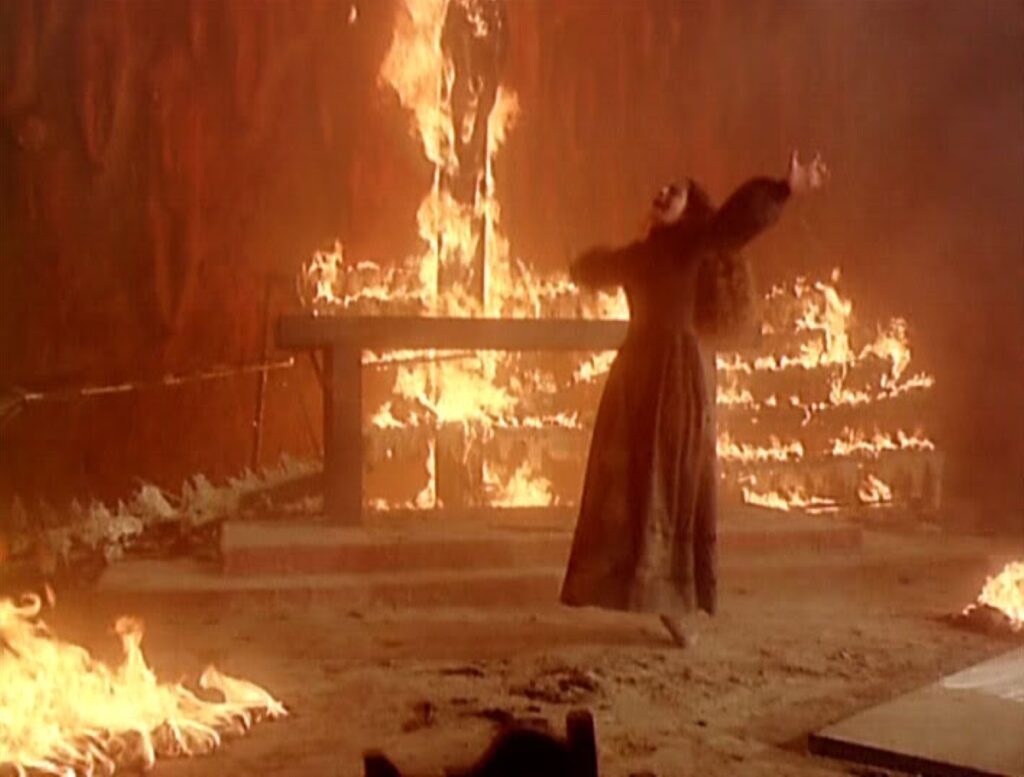
By the finale, the monastery collapses into an inferno fueled by its own panic. Moctezuma piles on synthesizers and layered wailing, turning the building into an unendurable chamber of noise. The walls split, crucifixes fall into the fire, and the cloister burns in the purge it started.
Complaining that Alucarda is too loud repeats the mistake of the men holding the cross and the medical kit. It assumes that people fighting total confinement have an obligation to speak in the polite language of the prison. Moctezuma knew better. When a system relies on quiet to protect itself, you do not politely ask the walls to move. You scream until they fall down.
Edited by Finn Odum