
| Abraham Teuber |
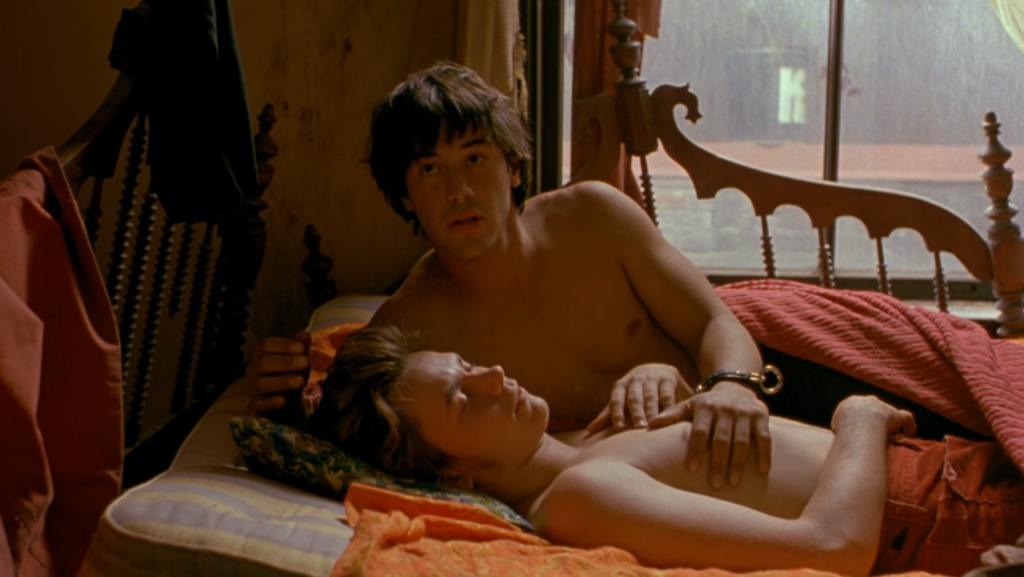
My Own Private Idaho plays in glorious 35mm at the Trylon Cinema from Sunday, August 23rd, through Tuesday, August 25th. For tickets, showtimes, and other series information, visit trylon.org.
Though it embarrasses me to admit it, I own just a single DVD. At one time, I had many more I could proudly hold in my hands. Now, sheaves of plastic collect dust in my parents’ basement, entombing masterpieces like Spy Kids, Ice Age, and Akeelah and the Bee. With shame, I keep kicking the physical media can. My movies only exist on the screen.
Nevertheless, when I turned 23, my friend Linda decided it was about time I owned one of her favorites. In the karaoke room at the Black Hart of St. Paul, after a fanfare of jolly strangers sang me “Happy Birthday,” I tore through tissue paper to reveal Keanu Reeves, dreamy and smoldering in a leather jacket: my own My Own Private Idaho.
I had never seen the film before, but Linda is one of the few people whose taste I trust implicitly. In the rare case I don’t like one of her recommendations, I assume the problem lies with me. We watched the movie together a few weeks later. Her streak of good taste sped along like a motorcycle down a desert highway.
My Own Private Idaho is an elusive mishmash. One moment it’s vague and subtle, the next it’s obscenely on the nose. Gus Van Sant blends Shakespearean verse, poetic tableau, pervy gangsters, and lonesome coming-of-age in the American Northwest. The story follows Mike (River Phoenix), a listless young sex worker tormented by johns, narcolepsy, and an irresistible urge to know the mother who abandoned him. His only balm is the scrappy community he’s salvaged on the streets.
Most notable in this group of misfits is Scott (Keanu Reeves), the mayor’s rebellious and tenderhearted son. Where the other young men sell their bodies out of desperation, Scott immerses himself in counterculture as a mutiny against his father, knowing he’ll come into an inheritance on his 21st birthday regardless. When things sour in Portland, Scott whisks Mike away on a quest to find his mom.
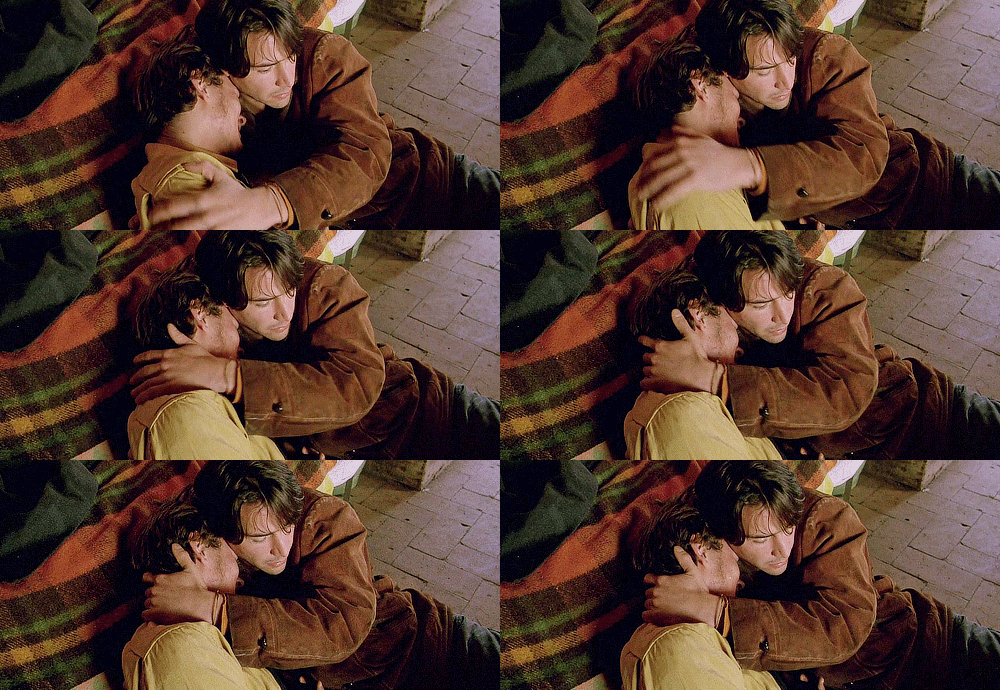
I credit any prior familiarity with My Own Private Idaho to a digital upbringing on Tumblr. In a bygone era of proliferated homoerotic gifsets, River and Keanu gazed and grazed each other in slo-mo. Scott was ahead of his time, a figure of advantageous bicuriosity without today’s dangly earring, chipped nail polish, and waifish Chalamet frame. I didn’t know much about the movie, but the caresses shared by the film’s heartthrobs were unavoidable for a certain subset of online queers in the early 2010s. I was a hesitant participant in this world, inspecting snippets of gay cinema like intriguing curios through the glass of an iPod Touch.
Linda was more of a curator. She knew even at 14 that the coolest things were classic. I remember the day she brought me to her locker and proudly flashed the only printed penis to be found in our Catholic high school’s library (in a punk rock history book, naturally.) Tumblr was her archeological site, a chance to brush barely settled dust from media relics of the decades prior. Even with Linda as guide, I couldn’t crack this coolness for myself. I mostly reblogged Broadway fan edits, holding out for the lucky day I found a Hamilton bootleg.
There was another side of Tumblr, of course, mired in flippant pseudointellectual superiority. The platform’s collective voice became marked by its compulsion to scrutinize culture for loose threads. Anything could unravel into a tangled mess we called “discourse.” In an instant, lowercase screeds could set whole fandoms on fire, the rest of us adding a delighted “yikes” that concealed our barely pubescent political development. Occasionally, we felt the sting of the dreaded revelation that our faves were—I shudder at the very thought—problematic.
Tumblr also introduced screenagers to the art of the queer reading. Could that Keanu Reeves, star of The Matrix, really act like such a homosexual? Yes. And so could everyone else! Fanfic, though pleasurable, was ultimately unnecessary once you calibrated your eye to the codes. Disney villains. Soft-spoken celebrities. The buttoned-up boy next door. The straightest people imaginable. Everywhere we looked, queerness dawned on us, surfacing in contours as our gazes adjusted to the lack of light. Any clue at all was a triumph. GIFs replayed on loop, boiling off context to make queerness even easier to find.
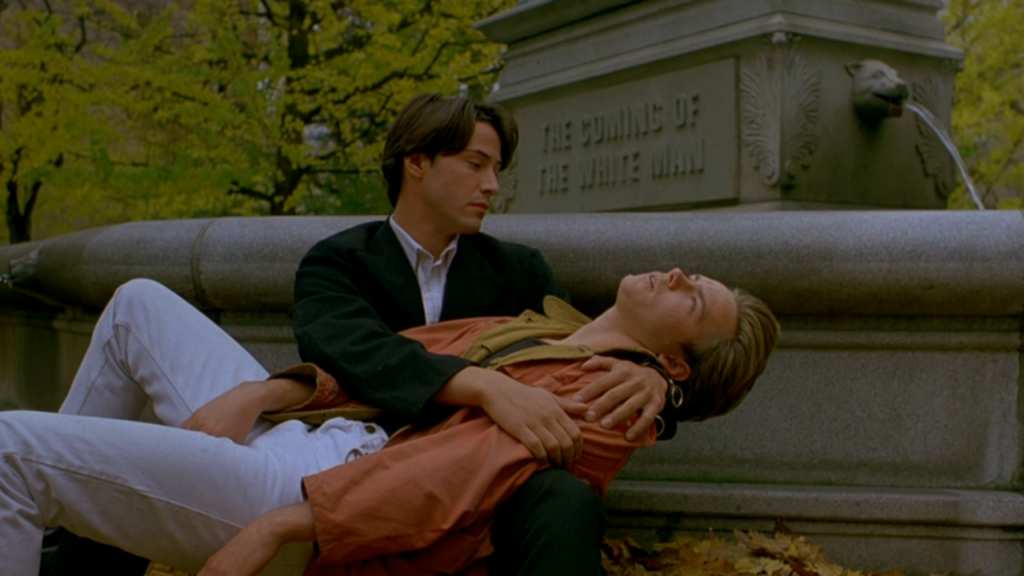
I am glad that I outgrew this ogling lens before watching My Own Private Idaho. Upon finally seeing the film, I was surprised that those screengrabs multiplied on my dashboard without scathing jabs against their devotees. Far from Tumblr’s favored call for queer representation, the movie presents a fairly depraved version of gay life.
A Tumblrina through and through, I could assure you in my sleep that “Sex work is valid!” But My Own Private Idaho shirks easy interpretations at each stylistic turn, centering gay relationships marked by exploitation, transaction, and betrayal. There is no love to be had besides commiseratory bonds of suffering and Mike’s unrequited desire for Scott.
By now, I’ve tamed the fiery impulse to reject art on the basis of this absence. Instead, I see how the movie expands conceptions of queerness beyond the PR-approved catchphrases that abound on patches, prints, stickers, and buttons all over present-day Portland. “Queer existence is resistance.” “We choose our families.” “Sexuality is fluid,” but we’re “born this way.”
A lesson often learned the hard way is that these slogans are aspirations, not rules. No identity guarantees goodness. All kinds of families can break. And being gay actually is a choice. Sure, the ability to get the hots for members of your same sex is likely a birthright affliction. But leaping from attraction to behavior to identity is not the product of a simple equation. It’s a self-guided journey into the void.
In the film’s best scene, the two young men start a fire at this crossroads. After weeks of accepting Scott’s kindnesses, Mike summons the courage to name them. “I’d like to really talk to you.” Here, the meaning really is all subtext, a realization creeping on the audience and Scott.
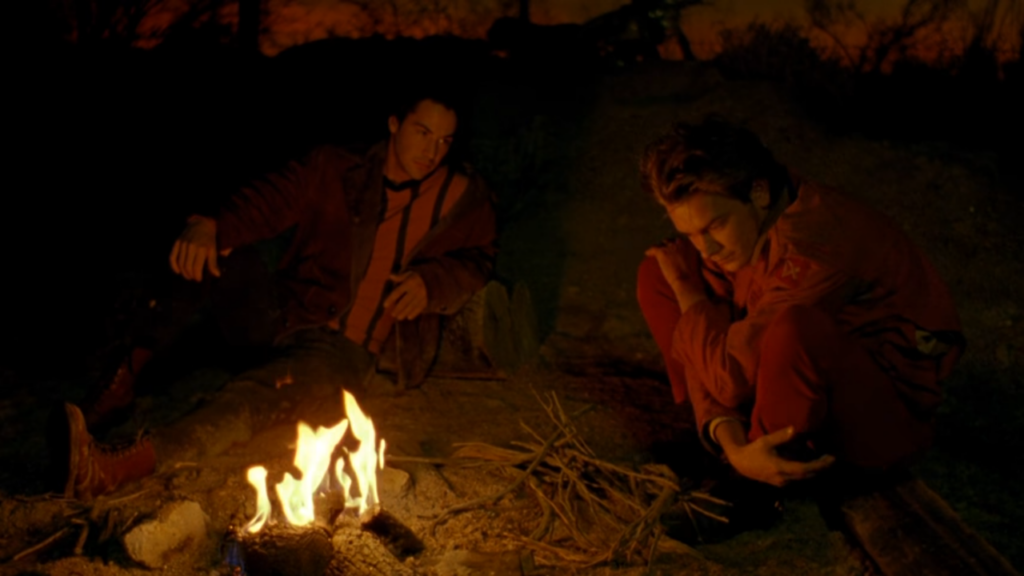
Scott, who devotes himself to Mike, who holds him when he’s overcome by sleep, who humps him for his own father to see, who blows all the same men, replies: “Two guys can’t love each other.” Mike is just another property for the capitalist’s son to buy and sell. Their relationship was a simulated partnership, offering Scott the pleasure of homoerotic intimacy without demanding the vulnerability to consummate it.
Scott’s queerness possesses friction. It is a queerness against. Mike’s queerness is solitary, drifting in search of meaningful contact. He is predictably crushed. They find his brother in Idaho, who provides no consolation and even more horrific realizations. Then Italy, where Mike’s mother has disappeared and Scott falls for a woman. Cut back to the West, where Mike stumbles down the road he traveled with Scott, disoriented and motherless.
At first glance, Mike’s arc might look like a conventional trauma plot, a romantic effort of cinematic psychoanalysis to crack the turmoil of his childhood. But the film doesn’t affirm such an easy interpretation. In the first and last shots, Mike stays in exactly the same place, alone. Idaho is both desolate and gorgeous, wide open and private. Mike is not the person he finds at the end of the road. Mike is the man on the road, the jackrabbit dashing aimlessly in the sagebrush, the hopeless secret in the night.
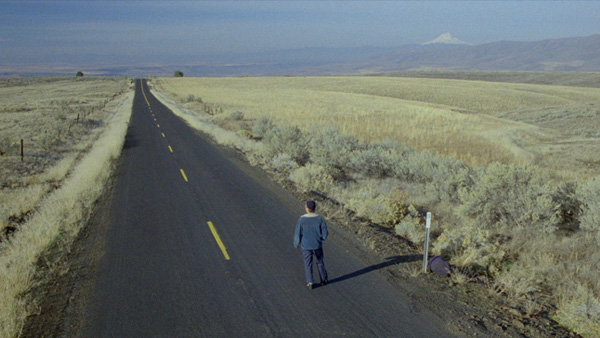
The impulse to find similarities between art and my own life annoys me. We reduce stories by upholding the value of their autobiographical resonances. More often than I’d like, I watch a beautiful movie and my heart soars highest at an insignificant detail. A familiar name or uniquely meaningful place makes my subconscious go “See?!”, as if random points of symmetry between my life and the lives on screen are evidence of the art’s success.
Still, sentimentality overcomes me. I feel a very personal chill when I think about Mike’s bonfire confession to Scott. At 14, watching flames with Linda, I told another person for the first time that I thought I might be queer. We wouldn’t touch the subject again for years, but that moment was a first step onto a road that took us through years of homosexual epiphanies, homosocial disappointments, and hard nights in Portland.
Tumblr fades in the rearview. We find new films at the Trylon. Every day, we decide to be gay.
Edited by Olga Tchepikova-Treon