
| Luis Lopez |
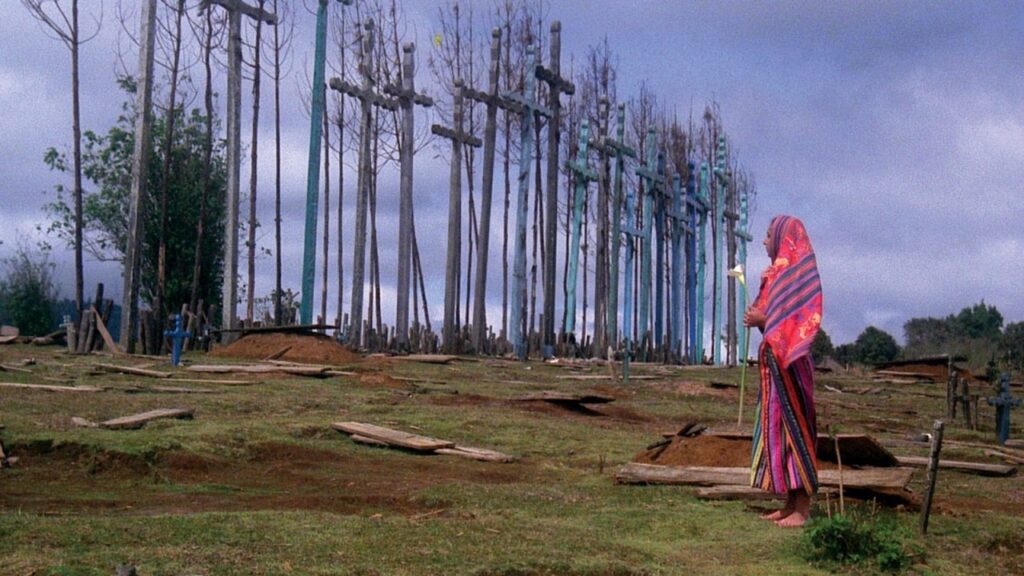
El Norte plays at the Trylon Cinema from Friday, August 21st, through Sunday, August 23rd. For tickets, showtimes, and other series information, visit trylon.org.
Gregory Nava will be at the Trylon in person and I plan to ask him if he shot a version of El Norte in which Enrique’s sister Rosa survives at the end. She dies after a solo teardrop escapes her body that’s wrapped in a white hospital gown adorned with miniature blue rhombi—a pattern as at home in that fabric as it would be on a mass produced shower tile. When we first meet Rosa, she’s wearing a complete traditional indigenous Guatemalan outfit: a colorful huipil, faja, and corte; including a tocoyal to help stabilize the cantaro she balances on her head.
She likely would have made this traje herself—a craft that’s learned from an early age and used for a lifetime. Backstrap weaving demands practiced dexterity and a deep well of stamina. One spends hours on their knees focused on completing their project carrying traditions and superstitions alike such as stepping over the rope that suspends the loom in place will result in a future baby to be born with its umbilical wrapped around its neck.
The brocading that adorns the huipil looks like chevrons or zigzags to an outsider, a series of geometric shapes—but within her community, it communicates a story she wishes to share to those that can understand.
—
My first winter in Minnesota I picked up a friend for dinner and she started laughing as soon as she saw the block of ice that had collected on my windshield. She took a photo of it to send off and ask me how I managed to drive around with that thing blocking my vision. “How do you all drive around here with this?” I asked as she kept taking more photos laughing pointing her camera at the 4-inch area just above the hood at the bottom center of the windshield that was not iced over and I would lean over to see out of while I drove. It’d be another week or two before I discovered the defroster button on the dash.
—
Enrique and Rosa are at the Mexico-US Border and a man who tried to rob them at knife point screams at them about how they lied to him about their financial situation. “Now I’ve had my balls busted for a lousy 20 bucks,” he scoffs at mostly himself. The siblings having been given the life savings of their godmother for their journey; they don’t yet understand that their remaining cash reserves are equivalent to a single day’s pay of a bus boy in 1980s Los Angeles.
Along with the clothes on their back and the life savings of their godmother, they carry a name with them around Tijuana looking for the man that they’ve been told will lead them past the border and into El Norte. The thief is one that tried to take the place of their coyote hoping to lead them out far enough that they wouldn’t be disturbed as he knocked them out and stole their money. “In the North, if you don’t look after yourself, you’re fucked,” Enrique’s future friend will advise him.
—
I learned to read English by reading along to wooden block picture books in a corner with heavy headphones bigger than my head. With one hand I held on to them and in the other I turned the wooden pages. I learned alongside only a few classmates that I can remember, Candy, whose future boyfriend would try to jump me after school five years later after word got to him that I was seen tying her shoes in the hallway; there was Walter, who was as loyal as anyone I’ve ever met.
The three of us managed to learn English that year in second grade well enough that we didn’t have to sit in our corner with the oversized headphones any longer. I don’t remember any of the simple stories that made up my early reading life, but I recall the feeling of turning the thick pages on the wooden block books. Eventually I’d be good enough at reading that I didn’t have to follow along with the headphones and I could decide for my own when to move on further in the six page book.
—
Despite attending English classes with her brother at an adult education center Rosa doesn’t yet have enough fluency to understand the instructions of the homeowner she cleans for on how to use the washing or drying machines. She begins to wash them by hand laying them out on the grass to dry. Enrique’s employers happy with his improving English, work ethic, and his few questions promote him.
We don’t yet see Enrique and Rosa speaking English to one another when another English speaker isn’t present but they do speak their native language less and less. Rosa’s boss is unhappy that so much work is being done by hand instead of using the machines. Rosa asks her what’s the difference if the clothes are still coming out clean?
Enrique is offered an entirely new job in Chicago. Per the agreement with the new employer, if he were to accept, he would be unable to bring his sister with him and she would be left alone to fend for herself in LA. Enrique declines the offer without hesitation. He’s stopped wearing his campesino hat that he wore in Guatemala, he’s stopped speaking his indigenous language, but he reaches a border he refuses to cross. He will not abandon his family.
—
Whenever I encounter a recent transplant to Minnesota, I usually try to befriend them remembering my own first few years in Minneapolis and the struggle I had finding meaningful friendships. I was sleeping better than ever before and I found myself having abundant energy but no direction or purpose. I drove to the suburbs when I could try to discover some pocket of clues as to why I felt so strongly that this would be the right home for me.
I refused to visit my family back in Texas for a minimum of five years. The memories of my young niece zigzagging across the park at full sprint to show off the backpack she’d just gotten as a birthday gift to anyone she could find presented a powerful comfort that I had yet to find up north. I was terrified of the idea of returning to Texas even just for a short visit and being reminded of how simple my life could be if I was there.
—
The backstrap loom connects its user to the textile they create by using their own body as part of the loom. One end of the loom is secured around a fixed stable item in the room and the opposite side of the loom is a strap that the user places under them just beneath the hips providing the needed tension to hold the loom taut. You lean your body forward when you want to ease tension making it easier to slide your fingers and wefts around your project then you would lean back when to increase the stress to make the textile easier to beat effectively.
On the floor loom, my teacher told me, to make sure to always weave when I was relaxed, that whichever textile I created would hold the strain of what I carried in my body. She drew a large breath and holding the breath made a show of stiffening herself as she weaved for a moment. She held out the most recent piece of yarn she used and had me compare the increased pressure in that one relative to the earlier ones. I held in one hand a taut yarn stretched out enough it seemed capable of repelling anything it came in contact with and in the other hand a yarn that in comparison was so loose that it could fall to the floor and sweep up each thing it passed by. She tells me, “If you continue that way, it’ll change the piece.”
Edited by Olga Tchepikova-Treon