
| Ben Tuthill |
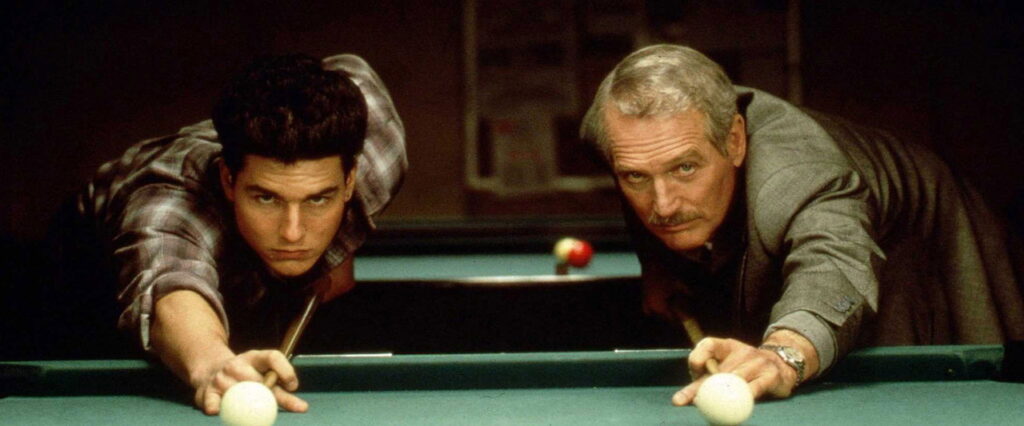
The Color of Money plays at the Trylon Cinema from Sunday, August 16th, through Tuesday, August 18th. For tickets, showtimes, and other series information, visit trylon.org.
Maybe nothing has raised the moviegoing populace to space-brain meta-awareness more than the sequel. The sequel presents itself as a new window into an already established cinematic universe, but in reality it exposes the moviemaking infrastructure to which that film was only ever secondary. This meta-layer has existed since the invention of the camera, but it was the sequel that made it obvious to everyone that the real story of cinema is its production.
This runs contrary to the romantic perception of the sequel as a return to, and a deepening of, a narrative setting. The sequel doubles the complexity of the world of the original film, but only at the cost of making explicit the means of the original film’s production. With no access to an actual, continuously existing universe, sequels rely on replicating the cinematic techniques used to create the first film: soundtrack leitmotifs, reconstructed plots, cameo appearances, self-aware callbacks, “key jangling.” With referentiality comes a self-awareness that disrupts the possibility of unmediated representation. If an original film can be coy about its produced nature, the sequel has no choice but to make it obvious.
The financial incentive behind all of this is obvious, and the meta-qualities of the sequel invites the audience into the speculative mindset of a studio executive. The audience leaves the theater not only hyper aware that we’ve just seen A Movie, but A Movie created by a studio system whose fundamental purpose is risk-averse profit. This is particularly true of the lega-sequel. The Devil Wears Prada 2, the twenty-year follow-up to 2006’s The Devil Wears Prada and currently the no. 7 film of 2026, is a straightforward example. Celebrated to some degree for its loyalty to the original film, DWP2 works for two hours by repeating plot points, laugh lines, scene settings, and performances familiar to fans of the original. The audience, like the studio, never runs the risk of encountering something unfamiliar—in fact, we’re regularly reminded that we’re participating in the profit squeezing of a piece of still-valuable intellectual property. Your mind turns to market comparisons (did the sequel do better than the original?), which quickly leads to contemplation of product placements, the incentives behind the celebrity cameos—in other words, the reduction of the film to nothing more than a property on a speculative market.
Is it possible for a sequel to escape this condition? Forty years before The Devil Wears Prada 2 came The Color of Money, arguably Hollywood’s first lega-sequel, the 25-year follow-up to Robert Rossen’s The Hustler. The financial origins of The Color of Money are evident in its name: Touchstone wanted to explore new venues for capital, Martin Scorsese wanted to convince the studios that he was worth the risk to finance The Last Temptation of Christ, Paul Newman wanted the Oscar he should have won for the original. Artistically, nothing about The Hustler calls out for a follow-up. It ends as a closed universe: Fast Eddie is forced out of his pool career, his girlfriend is dead, his relationships are severed, his integrity is squandered, hustling is exposed as a morally vacant and best-lest-alone depravity.
The Color of Money makes almost no attempt to breathe life into The Hustler’s dead universe. It’s remarkably light on visual or audio cues, plot references, callback humor, or character continuity. Richard Price’s script makes a handful of references to establish continuity with the original but doesn’t linger on clever allusions, callbacks, or themes. Michael Ballhaus’s cinematography and Thelma Schoonmaker’s editing replaces the noirish poetic realism of the original. Robby Robertson’s blues jukebox replaces Kenyon Hopkin’s jazz.
Instead, Scorsese gives us a movie about how much the game has changed in the past 25 years. We play 9-ball now instead of straight pool. Everyone does coke. The young gun wears a t-shirt with his name on it. Women don’t drink themselves to death at home, they manage their boyfriends’ accounts and contemplate robbing them blind. The set has expanded from one pool hall in New York to a cross-country road trip. Post-war ennui is replaced by Reagan-era money-power ruthlessness.
The biggest transformation is obviously Paul Newman, who was an on-the-rise hotshot in 1961 and had established himself as an elder statesman by 1986. The script identifies him as the same character as Rossen’s Fast Eddie, but beyond his name, his charm, and his ability to play pool, he’s hardly the same person. In The Hustler, Newman is a man with all skill and no character. In The Color of Money, Tom Cruise takes on that role while Newman becomes Jackie Gleason, George C. Scott, and Myron McCormick rolled into one. The game has changed, and the players have too—not just the new ones who have replaced the old, but the old ones who have become entirely different people to an audience who will know them first and foremost as the faces on salad dressing bottles.
It’s pretty obvious what this is all about: The Color of Money is a movie about the transformation of cinema, a making explicit the inherent referentialism of the sequel that emphasizes the transformation of the industry instead of sheltering in the safety of nostalgia. It accepts the inescapable meta-ness of the sequel, but instead of creating a heritage site of the original it implicates it as just another moment in the constantly evolving art and business of making movies. Resonances echo through generations, young guns age to elders, filmmakers who grew up on noir invent new techniques without abandoning the old, Phil Collins and Warren Zevon fit in at pool halls just as well as late 50s jazz. The world is an interconnected place full of resonances, but the only rules it abides by are the ones imposed upon it by the person looking at it. Every look onto the world is a sequel, and the healthiest lookers are the ones who remember that things stay the same as they change.
The Color of Money is Scorsese’s only sequel, but it’s hardly his only film that functions as meta-commentary on the films that came before it. In that regard, it’s one of his most honest films. It’s a confession of a perspective that can only see the world through cinema, a frank interpretation of the world through the medium that literally saved his life. And as a harbinger of what would become his obsession with film preservation, it’s fitting that it would end with a relic of an older Hollywood declaring his eternal return. Scorsese’s New Hollywood and its aftereffects were never genuinely novel—they were a self-aware reinterpretation of what came before, a forward motion built on Orpheus eyes that couldn’t focus on the future long enough to move beyond the past. Every film is its own point in the same in the same story, a negotiation between the finance of the hustle and the art of the perfect shot. There was no original Fast Eddie—he was always saying “I’m back.”
Edited by Olga Tchepiokva-Treon