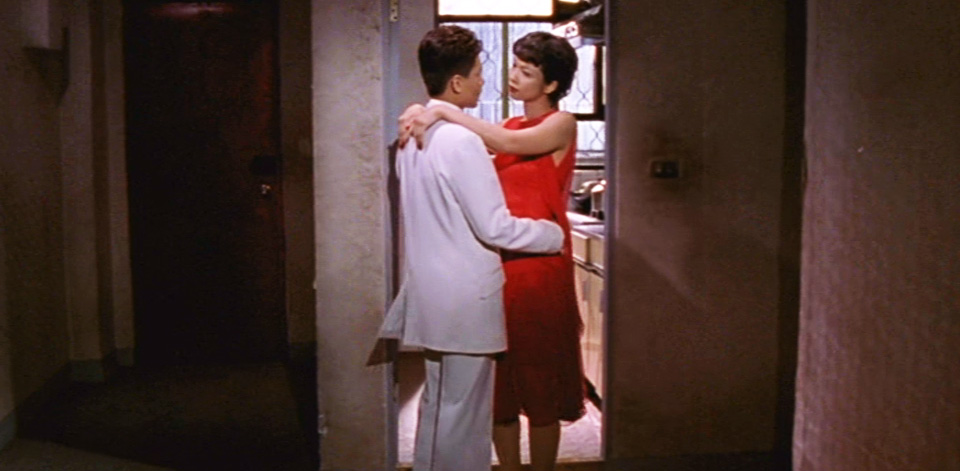
| Cole Seidl |

The Hole plays in glorious 35mm at the Trylon Cinema from Friday, August 14th, through Sunday, August 16th. For tickets, showtimes, and other series information, visit trylon.org.
There’s a very specific existential crisis that happens to many film students. It occurs with such frequency as to almost feel like a cliché. You spend 4 years drowning in film. Film history, film theory, film production, film conversations. Then, you suddenly find yourself graduated with no idea what the next step is. The obvious, and largely financially unfeasible, option is to simply move out to Los Angeles and start trying to find your way onto film sets. More commonly, students take a job with Wells Fargo Home Mortgage or similar, promising themselves it’s only temporary until they figure out how they should proceed. When faced with this crisis, upon graduating from Augsburg College in 2012, I looked towards specific films rather than the general idea of “movies” to decide my fate.
While in college, I embarked upon a love affair with “Contemporary Contemplative Cinema” or what has come to be more frequently called “slow cinema” (a term that I think greatly misrepresents what I found so intriguing and invigorating about the films). I was enamored with two filmmakers in particular: Chantal Akerman and Tsai Ming-Liang. So, when faced with the standard post-graduation crisis, I made the obvious decision. Move to Taiwan in the hopes of finding a way into that specific film industry, and maybe even on to the set of one of Tsai’s films.
That never happened. Though I did find myself at the premiere screening of what was, at the time, his purported final film Stray Dogs. I watched a beautiful 35mm print of I Don’t Want To Sleep Alone that had no subtitles, and listened to an hourlong Q+A with Tsai, without an interpreter, and thus gleaned almost no valuable information. I sat in some of the seats from the torn down Fu-Ho theatre, where Goodbye, Dragon Inn was filmed. I visited the shooting locations of The Wayward Cloud in Kaohsiung. I immersed myself in as much of his world of film as possible.
Then, one day, I decided to pay a visit to his film company offices. They were located in Yonghe, the very same neighborhood in Taipei where I was living. It was about a 12-minute walk from my apartment. Me and my girlfriend made our way to the address, and ended up at a large cement husk of a building. We double checked the address, and it was correct. So we went inside. It was filled with some metal barrels, rebar, and pools of liquid that had turned blue, possibly from some sort of chemical reaction. It appeared abandoned. In short, it was the single most Tsai Ming-Liang location I could have imagined.
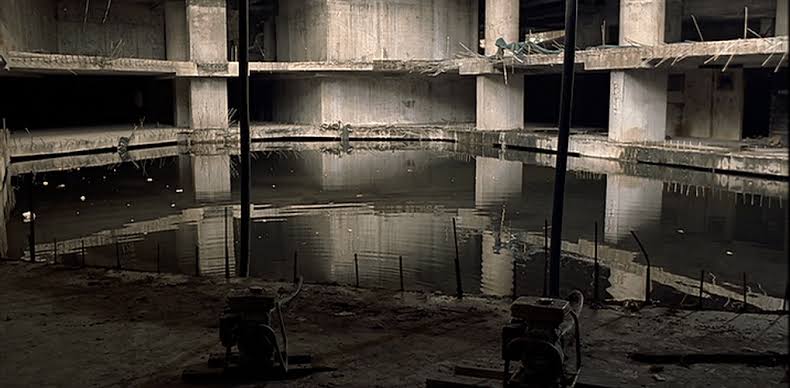
Urban decay is one of the quintessential components of Tsai’s film work. I’m still not certain if the address given was some sort of a joke, a mistake, or simply out of date information, but it was enlightening to me. This strange liminal world that he creates in his films is fully present in the real Taiwan if you choose to look in the areas most people ignore. The areas that normally extend just outside the edges of the frames, or in the case of Tsai’s films, the moments that occur just after most other films would cut.
The Hole is a major Tsai film for me. It really functions as the fulcrum between his earlier, slightly more social-realist works and his later, more formally extreme styles. It’s possibly one of the best entry points into his filmography. It was produced in 1998 by the French Production company Haut et Court, who set out to produce a curated slate of films focused upon the impending new millennium from ten different global perspectives. Their project saw the release of films by Hal Hartley (his wildly underrated The Book of Life), Walter Salles, and Ildyko Enyedi. However, The Hole is the standout film of the bunch; a film so firmly rooted in a specific time and place that it feels timeless.
One of the most striking features of the film is that it’s a musical. This would have been sort of shocking to anyone following his career up to this point, but experimenting with musical numbers led to formal invention that he built upon (and subverted) to great effect for years to come in films like The Wayward Cloud, and Face.
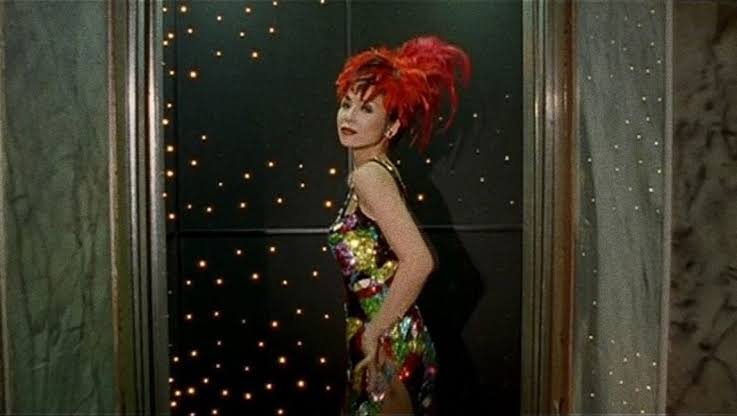
All of the music in The Hole is by Grace Chang, an astronomically popular actress and singer in Hong Kong throughout the 1950s. Tsai even gives a special dedication to her music at the end of the film, positioning her work as a small beacon of light in the dark tunnel of the future of humanity. It is hard to disagree. If you are not familiar with Grace Chang’s music, I recommend you go see The Hole simply to fall in love with it. Or to it.
I moved back to Minnesota from Taiwan and promptly got married. I knew that I found my person, because she had moved with me to Taiwan, and trekked around the country searching for artifacts of Tsai’s filmography. In fact, she was the one who first introduced me to Tsai Ming-Liang after she had found herself under the influence of her first viewing of The Hole. When it came time to choose the first dance at our wedding we made a natural choice: Grace Chang. The one that felt the most authentic and natural to us was “I Don’t Care Who You Are,” which is the final song in The Hole.
There’s a lot to say about Tsai Ming-Liang, and a lot that has been said about him. He’s the type of filmmaker that people write entire dissertations on. I encourage people to do more of this. However, for me, he’s the embodiment of the Robert Bresson quote “I’d rather people feel a film before understanding it.” Tsai’s films may be slow. They may bring “an outsider’s gaze” to the decay and loneliness of urban life. But for me, they are vibrating with feeling. To watch Tsai’s film is to experience falling in love. With the movies. With the world. With my wife. I can’t promise you’ll feel the same way when you watch them, but I hope you do.