
| Ben Tuthill |
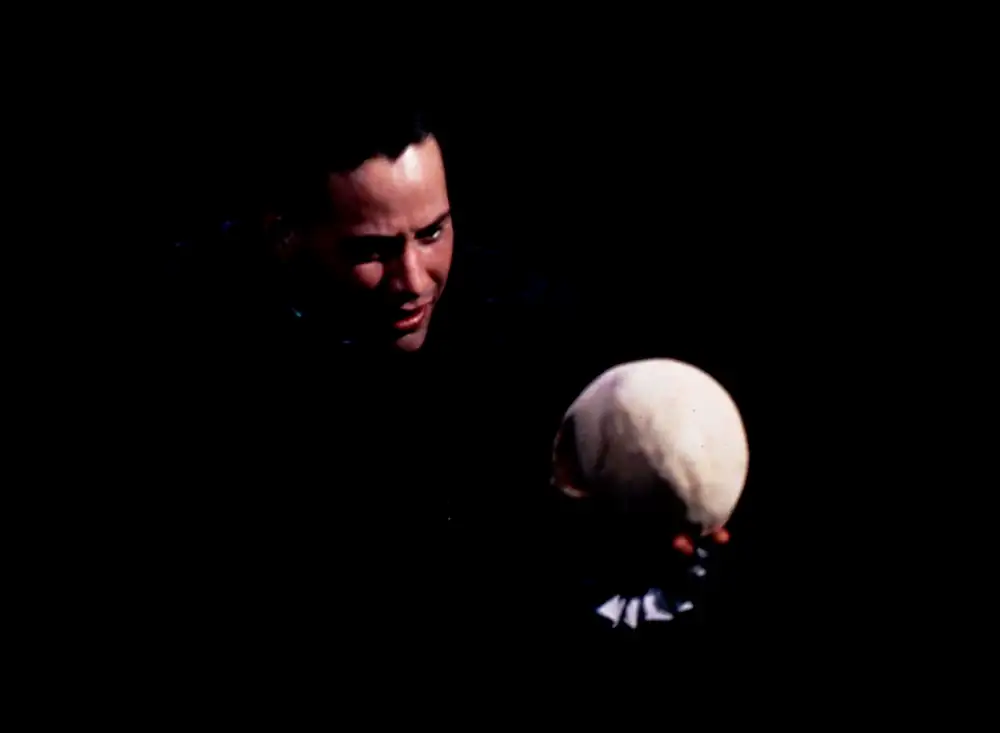
Keanu Reeves as Hamlet for the Manitoba Theatre Company, 1995 (Winnipeg Free Press).
My Own Private Idaho plays in glorious 35mm at the Trylon Cinema from Sunday, August 23rd, through Tuesday, August 25th. For tickets, showtimes, and other series information, visit trylon.org.
In late 1994, high off the box office fumes of Speed, Keanu Reeves took a break from movies to play Hamlet in a two-month run for the Manitoba Theatre Centre in Winnipeg. Opening night was by all accounts a disaster, but Reeves found his nerve in the coming weeks as he settled into the role. By his second month, Roger Lewis, critic for the Sunday Times, reported that Reeves was one of the top three Hamlets he’d ever seen: “He has a gift given to few; like Garbo, he is an actor who can register, simultaneously, both pleasure and pain…he is Hamlet.”
Even a modicum of theatrical success for Reeves, who, by 1994, was pegged as a beautiful joke: a staggeringly attractive idiot and one of the worst actors in Hollywood. 1994 was the culmination of three bad years. Outside the box-office success of Speed, he’d stumbled through some of the most poorly received performances of his career: Bram Stoker’s Dracula, Little Buddha, Even Cowgirls Get the Blues, and his Razzie-nominated first attempt at Shakespeare in Kenneth Branagh’s Much Ado About Nothing. His Canadian Hamlet turn seemed like yet another ill-fated career decision—but anyone with the capacity to reach more than three years into the past could have seen it as a natural progression for an actor who, at the end of the 1980s, was one of the most promising young stars of his generation.
In a post-John Wick world, it’s hard to remember how little respect Keanu Reeves got before the internet transformed him into the national treasure meme he is today. It’s even harder to jump back to the years before he’d reached overexposed humiliation. After a string of TV and low-budget Canadian movies, Reeves made his first significant performance in River’s Edge, a noir-ish 1986 teen drama that introduced the world to his distinct persona: easy-going but subtly tormented, beautiful but probably stoned, stupid but somehow wise. He expanded that role for the second half of the 80s in a series of teen films of varying quality, all anchored by his beauty, his physical comedy, and his disarming affect. It culminated in Bill and Ted’s Excellent Adventure, his first genuine hit, in 1989.
Bill and Ted introduced mainstream audiences to a Keanu reduced to the lowest common denominator—a true idiot stoner that rolls any of the nuance of his 80s into a caricature. It made him a star, but it would saddle him for the rest of his career. As he entered the 90s, Reeves had to either accept Theodore Logan, move beyond him, or undo him. 1991 presented him with the opportunity to explore all three routes. Rarely do scholars get the opportunity to contemplate three such divergent courses of history.
The most obvious choice was to double down. Bill and Ted’s Bogus Journey, released in July, adds an element of absurdism to Excellent Adventure but does nothing to advance Reeves’s career. Theodore Logan, the perpetually stoned son of the chief of San Dimas police, never experiences anything that brings about significant character development despite a plot that features existential terror, evil doppelgangers, and encounters with God, Satan, and Death. Reeves rises to the occasion, but the role doesn’t provide any opportunities for him to stretch as an actor. If anything, it solidifies his public projection as a one-note performer and a real-life idiot.
Despite its modest box-office success, Bogus Journey could have ended Reeve’s career—it certainly ended Alex Winter’s. What saved Reeves from being typecast to death was the simultaneous release of his first attempt as an action star in Kathryn Bigelow’s Point Break. His casting in Point Break reads almost as an explicit attempt at reverse psychology: a straight-laced FBI agent goes undercover as an LA surfer and loses himself in the performance. The Keanu we’ve seen is a performance—his true identity is action hero. The fundamental flaw of Point Break is that this doesn’t make any sense. Reeves’s surfer cover is too convincing for his performance as a D1 quarterback turned Ivy League law student named Johnny Utah to be believable. There’s no tension as he works through his identity crisis. When he finally throws his badge into the surf at the end of the movie, the only response is “well, duh.”
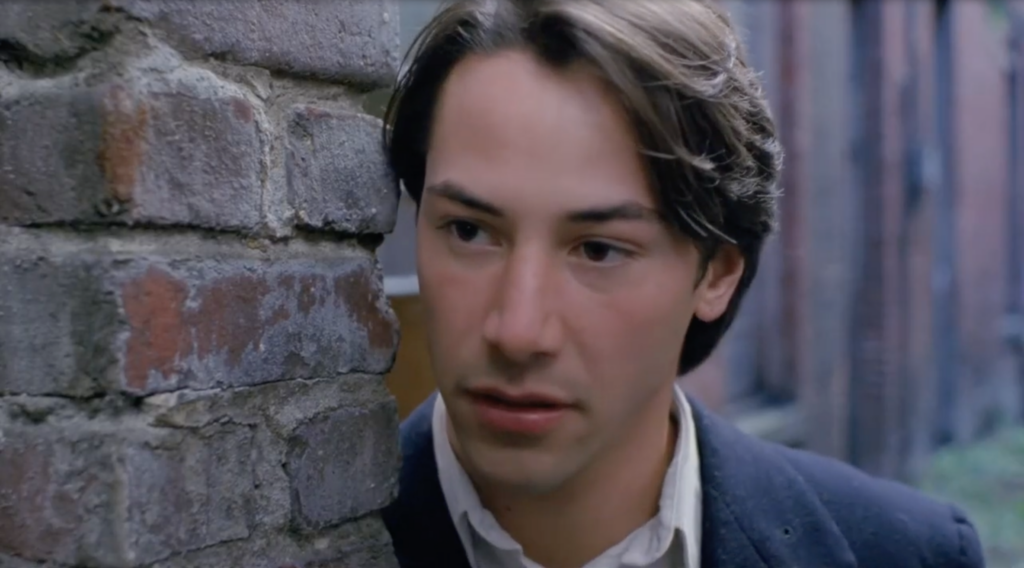
The subtext of both Bogus Journey and Point Break is that the stoner act is a phase that will eventually end so long as no one commits to it. Gus Van Sant’s My Own Private Idaho, released three months later at the Venice Film Festival, makes that text. If Bogus Journey is the debasing of Reeves’s 1980s, My Own Private Idaho is the fulfillment of his potential. Reeves plays Scott Favor, a rich kid on the cusp of his 21st birthday LARPing as a bohemian sex worker. It’s Keanu in peak form—beautiful, physical, stupid, charming, sad. He moves through distinct modes of the same character: theatrical with his street mentor James Russo, loving but guarded with his best friend River Phoenix, stumblingly romantic with his Italian girlfriend, unsettlingly straight with his Fortune 500 father. He does all of this in the style of a Shakespeare without dropping his West Coast affect. It’s no wonder why he wanted to play Hamlet: he was good at it.
Of the three 1991 movies, My Own Private Idaho the only one where the straight man wins out. If all three movies are arguably about growing up, it’s the only one that actually confronts just how sad that can be. Bogus Journey proposes eternal adolescence for all humanity. Point Break pulls a reverse fake. But My Own Private Idaho reveals moving on as heartbreak. When Scott’s old friends come to harass him at a fancy restaurant, he tries to ignore them, but he can’t resist a brief return to their Shakespearean mode: “Although I love you more dearly than my dead father, I have to turn away.”
My Own Private Idaho showed in less than 100 theaters for a few weekends and disappeared into VHS land. Bogus Journey and Point Break didn’t do exceptionally well either, but in the end Point Break won the secret Keanu box office war by a couple million. Reeves was fast-tracked for mainstream stardom. He did everything he could to tank it in the next three years, taking on increasingly bizarre stretch roles before finally accepting his fate and taking on Jan de Bont’s Speed. He would continue to experiment for the rest of his career, but from Speed on he was first and foremost an action star.
1991 was the last time the world had the opportunity to see what could have been. My Own Private Idaho was the peak of Reeves’s career, the culmination of everything he could have been as an actor before the weight of stardom transformed him into the actor Hollywood wanted him to be. He would eventual find himself again, but it’s here, the seeds already sewn for what’s to come but yet to take root, that we see him working at his fullest potential. There’s a mono no aware bittersweetness to watching My Own Private Idaho that’s existed alongside it for nearly its entire existence, a sweetness for what was and a sadness that it could never have lasted. In two years River Phoenix would be dead. Reeves was filming Speed when he got the news. Jan de Bont had to do everything he could to keep him from quitting the production. Reflecting on it in 2024, de Bont said, “He was more like a happy-go-lucky guy at the time, with high aspirations for dramatic theater … He said, ‘Oh, I’m not an action hero. I don’t like it. I don’t know how to do it.’” And in a contemporary interview for Entertainment Weekly: “I felt like he had to grow up. In this movie he is really coming of age.”
Keanu said it better as he quietly prepped for his Shakespearean turn under Gus Van Sant’s camera. About a third of the way into My Own Private Idaho, he turns away to perform a soliloquy. “When I turn 21, I don’t want anymore of this life,” he says, gazing into the distance. “My mother and father will be surprised by the incredible change. It will impress them more when such a fuck-up like me turns good than if I had been a good son all along. All my bad behavior I will throw away to pay a debt. I will change when everybody expects it least.”
Edited by Olga Tchepikova-Treon