
| Victoria Breshears |
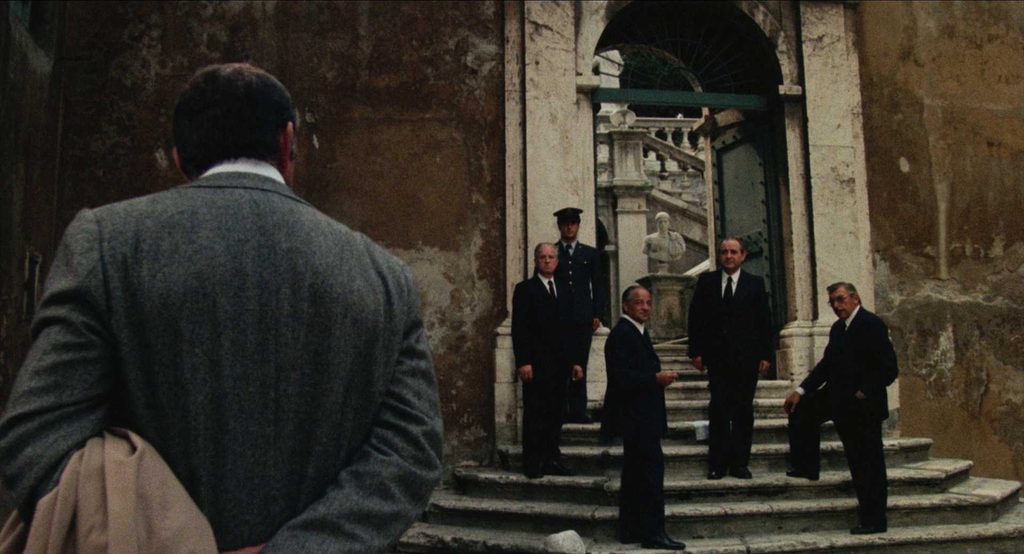
Illustrious Corpses plays in stunning 4K at the Trylon Cinema from Friday, September 4th, through Sunday, September 6th. For tickets, showtimes, and other series information, visit trylon.org.
Francesco Rosi’s 1976 political thriller Illustrious Corpses begins with us watching a high court judge move past rows of clothed, desiccated mummies within the Capuchin Catacombs. While this opening scene signals mortality to be an important theme for the movie, Rosi also uses this visual metaphor to set the stage for a discussion of calcified power structures. Fifty years later, that suffocating dread doesn’t feel distant; it directly echoes the political anxieties dominating us today.
Living in our current political atmosphere is to live in a world of manufactured anxiety. As the political theorist Sheldon Wolin observed, modern authoritarianism doesn’t conquer us through theatrical displays of power; it simply keeps us exhausted, isolated, and constantly reacting. By manufacturing a perpetual state of emergency, the system paralyzes us with relentless panic, manipulating our anxiety until we abandon demands for real systemic change and settle for top-down enforcement.
I know that exhaustion intimately. Our fascist federal administration treats neighborhoods across the country as live-fire testing grounds for state-sanctioned violence by turning local streets and immigrant communities into targets for brutal federal enforcement. It is a crushing weight, squeezing the air out of my lungs! We witnessed this when federal authorities launched Operation Metro Surge, flooding the Twin Cities with thousands of masked agents who operated completely outside transparent warrants, leaving a legacy of deep trauma and community rage. It changes the baseline of your life. Even now, more than seven months after the initial attack on Minnesota, I carry a go-bag in my car as a matter of routine, packed with shatter-resistant masks, goggles, a first aid kit, and Sudecon wipes as tactical shields against a government that treats its own citizens as an enemy population.
Rosi’s film maps out the exact mechanics of this strategy, showing how a desperate ruling elite leverages a crisis to build an inescapable net of surveillance. When Inspector Rogas (played by Lino Ventura) investigates a string of murders targeting high court judges, the Centrist government quickly hijacks the panic to justify militarized police crackdowns, wiretaps, and constant tracking. This cinematic blueprint maps perfectly onto our immediate local reality. Just within the last couple months, our neighborhoods had to pack City Hall to aggressively halt a proposed contract that would have turned North Minneapolis into a corporate testing ground for autonomous police drones, a pilot program rushed forward under the guise of public safety staffing shortages (not to mention the use of Flock cameras in communities across the metro). In both cases, the state actively threatens to erase public anonymity, seeking to turn the simple act of walking down the street into a live-monitored tracking system.
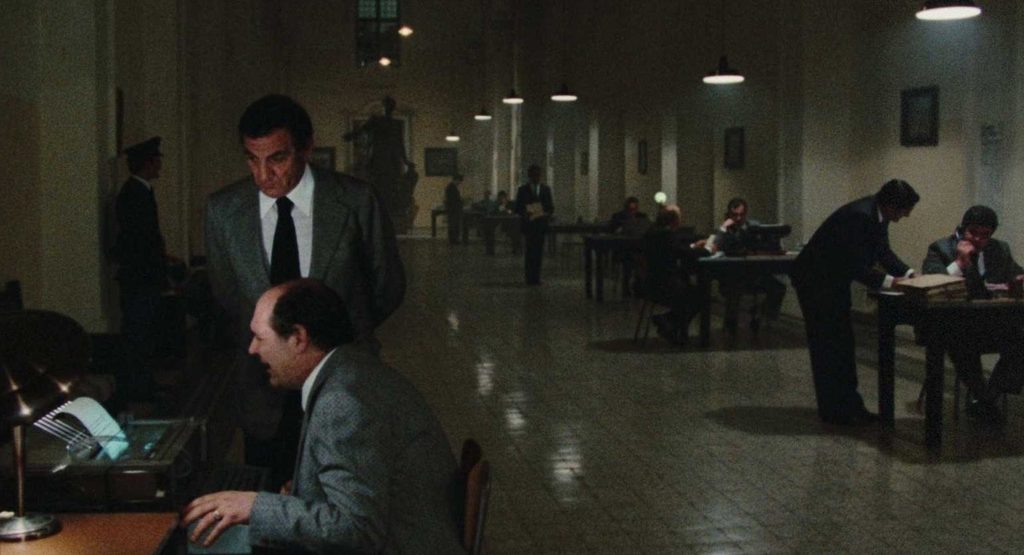
Rosi does a great job capturing the weight of bureaucratic power through employing agonizing and hyper-deliberate pacing throughout the film to build tension. Characters walk down echoing hallways, sit in silence, and wait in vast rooms. One critique to note is that this dead time might appear to be a flaw of the film, but Rosi appears to purposefully use it to emphasize the seriousness of this piece as it is not some basic police procedural to be entertained by, rather, this film needs space to allow the viewer to process the truth. The antagonist is not the murderer; it is the institution surrounding Rogas.
This structural pacing is given physical weight by Pasqualino De Santis’s paranoid cinematography. Rather than relying on sudden shocks, De Santis systematically isolates characters within vast interiors, shrinking human bodies to near-insignificance against massive stone pillars and cavernous halls. The camera constantly uses deep-focus wide shots to frame individuals as small targets trapped inside the machinery of power. As critic Tony McKibben observes in his essay “Illustrious Corpses”, the film develops an “implicative perspective,” where the camera goes beyond just showing us the plot and instead frames the action so that we are textually trapped inside the point of view of an invisible assassin’s gaze. The lens forces the viewer into the position of the threat, turning audience vision into a tool of surveillance.
We see this perfectly when Inspector Rogas searches the apartment of the prime suspect, Cres, and finds that the man has been (literally) sliced out of every single photograph. By erasing the suspect’s face, Rosi reveals how the state engineers panic by turning an empty silhouette into an abstract bogeyman, a blank canvas onto which any threat can be projected. He captures the fundamental logic of modern fearmongering: define the threat as an abstraction, and the state’s power becomes unlimited.
The psychological toll of this landscape is driven home by the incredible use of sound design and Piero Piccioni’s unsettling musical score. The film relies on a sparse, metallic soundscape that emphasizes heavy footsteps echoing through concrete tunnels, the click of surveillance tapes turning, and abrupt electronic hums. When the music does arrive, it is a haunting, repetitive motif that offers no melodic resolution. If the score acts as an alarm, Max von Sydow’s Chief Justice provides the chillingly quiet voice behind it. By framing the Court’s rulings as a divine sacrament, he argues that questioning justice itself would dismantle the entire illusion of order. He further argues for the use of decimation, showing that fascism and brutality do not solely live on the streets in combat boots and behind police badges, but also inside the country’s courts and governing institutions.
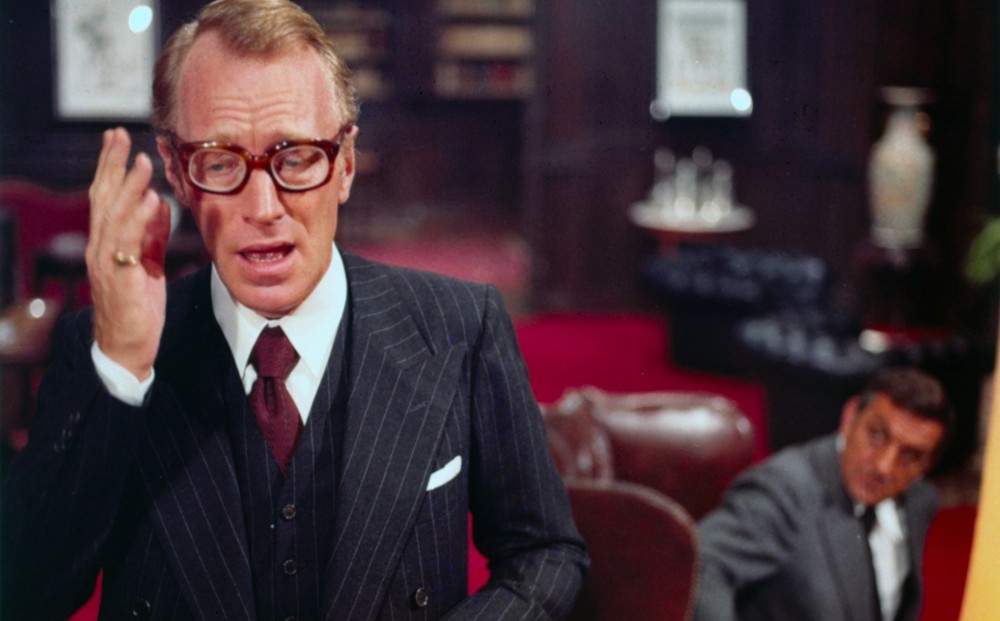
His critique extends far beyond state corruption, turning inward to expose how official opposition parties abandon systemic change to safeguard their own power. Halfway through his investigation, Inspector Rogas uncovers definitive proof of the high-level state conspiracy. He hands the evidence to the leaders of the Communist Party, assuming the official Left will “expose the rot and rally the public.” Instead, they actively hide the truth, revealing that the institutional Left is not an alternative to the regime, but its ultimate line of defense.
Rosi was offering a contemporary critique of Italy’s “Historic Compromise,” which was the moment the official Left abandoned revolutionary change to secure its own integration into the ruling class.1 The party bosses choose institutional survival over truth, cementing their role as custodians of the very system they promised to dismantle.
Although it responds to the specific betrayals of 1970s Italy, Illustrious Corpses feels strikingly modern in how it depicts power absorbing its own critics. This visual is dynamically captured as party bosses and state elites sit in the same rooms, quietly agreeing to suppress the truth for their mutual benefit. This is the logic of a cartel party system: political rivals acting as joint gatekeepers to keep outside disruption at bay.2
Decades later, Rosi’s critique still lands, describing a world where mainstream parties in the US collude to manage public outrage rather than fix a broken system. The opposition isn’t trying to break the machine. It has become one of its gears. Mainstream Democrats don’t fight this machine; they manage it. They demand our silence and market false opposition, asking us to politely spectate while our communities are gutted and our natural resources are depleted. We cannot pretend this system is broken when it is functioning exactly as intended.
I refuse to look away. I refuse to be complicit. While local investigators were actively blocked from accessing hidden hard drives and bodycam footage after the murders of Good and Pretti, mainstream leaders simply stood by in silence to protect their own standing. There is no moral authority left in a political class that treats our lives as collateral, watching us get targeted while choosing to do absolutely nothing. Rosi didn’t offer a clean resolution because the trap is real but understanding that the institutional Left (I’m talking to you, Democratic Party!) will never save us is where our real agency begins. We stop managing the crisis the moment we stop asking the machine to fix itself.
Footnotes
1For a historical analysis of the Italian Communist Party (PCI) and the “Historic Compromise” (compromesso storico) during the Years of Lead, see Paul Ginsborg, A History of Contemporary Italy: Society and Politics 1943–1988 (Palgrave Macmillan, 2003), 348–397.
2Richard S. Katz and Peter Mair, “Changing Models of Party Organization and Party Democracy: The Emergence of the Cartel Party,” Party Politics 1, no. 1 (1995): 5–28.
Edited by Olga Tchepikova-Treon
Great review! SPOLIER WARNING IF YOU READ BEYOND THIS LINE!!
Your note of the empty spaces rings true in one scene that calls back to me every time I think of this film. Nearing the end, when the Inspector and the Sec-Gen are to meet in the museum, we are shown a direct view into the minds of the two men; one analyzes the art around him, taking in every second, breathing the same air as the faces sitting on each column once did: I view the sec-gen as trying to encapsulate himself with the world around him. However, the investigator does none of the sort. He enters the building, paying no attention to surrounding art: he cares only for his goal, and I feel as if he becomes disillusioned with everything around him. These details propel this film past The Mattei Affair for this reason: although Mattei Affair is more “interesting” the shots, and how they are held for so long. The amount of long shots that were not needed, but slightly compound the dread, was beautiful