
| Wil McMillen |
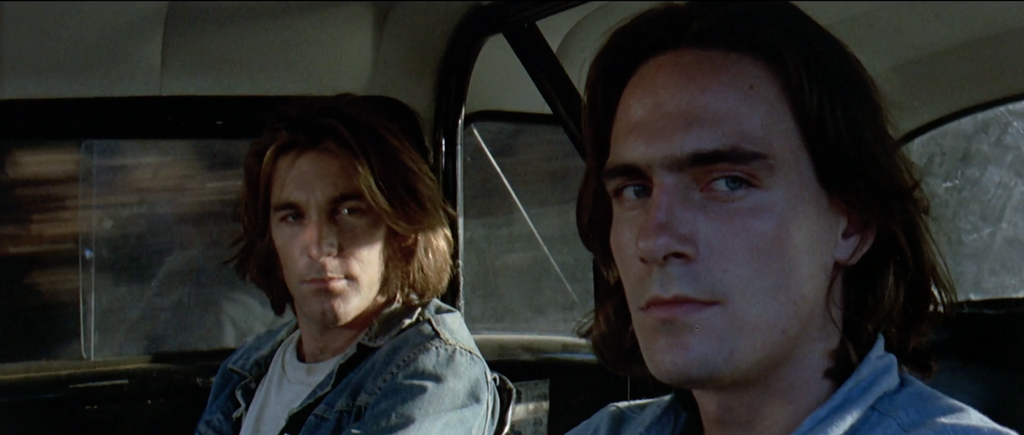
Two-Lane Blacktop plays in glorious 35mm at the Trylon Cinema from Sunday, September 6th, through Tuesday, September 8th. For tickets, showtimes, and other series information, visit trylon.org.
Two-Lane Blacktop is a curious, dense race movie in which almost no racing actually happens. Instead, the film is haunted by the passage of time, by the feeling that life has passed you by, and ultimately, by death itself. Tragically, for three of the film’s actors, those themes would become reality sooner than anyone could have imagined.
There’s a haunting video I keep coming back to. It’s a Good Morning America interview from 1980 with the Beach Boys, and it feels like a perfect encapsulation of the band’s dynamic. Brian Wilson sits at the center, uncomfortable and clearly ready to escape the studio and hide the second the interview is over. When asked questions, he mumbles a few words when asked but rarely speaks. Al Jardine sits on the end, the most coherent of the group, answering questions as you would expect in a normal interview. Carl Wilson sits as the family mediator, trying to maintain some sense of normalcy. Mike Love is all quiet seething, a pent-up cauldron of rage.
And across from him sits the target of that rage.
Well, not actually sitting. He’s leaning. He’s practically laying down. He’s drunk out of his mind, rambling and incoherent.
He’s Dennis Wilson.
Within three years he will be dead, having drowned while trying to dive for possessions he had thrown from his boat into the waters of Marina Del Ray.
Two-Lane Blacktop was supposed to be a breakout role for Dennis Wilson. The film was promoted as the next big thing. Esquire Magazine even went so far as to print the entirety of the script within its pages, proclaiming it the next Easy Rider. But what the film turned out to be was something very different: an oblique, abstract art film filled with long stretches of silence and contemplation. It’s the kind of movie some critics would simply call “difficult.”
It didn’t give Wilson the boost he was looking for. Two-Lane Blacktop was a colossal flop and, for many years, was nearly impossible to see.
“Who are you guys, the Zodiac killers?”
The line is spoken by The Girl (Laurie Bird) as she climbs into the 1955 Chevy 150 belonging to The Driver (James Taylor) and The Mechanic (Wilson). The dialogue comes early in the film, and it provides one of the keys to unlocking this strange labyrinth of a movie.
It’s the first time death is explicitly hinted at.
It also has another layer.
Dennis Wilson had been friends with Charles Manson.
Perhaps “friends” is too familiar of a word for what their relationship was. They first met in 1968. Manson supplied Wilson with LSD and women, while Wilson provided housing for the so-called Manson Family. Wilson also gave Manson access to the recording industry, which Manson desperately wanted to enter. By introducing him to people like Neil Young and producer Terry Melcher, Wilson gave Manson the impression that he might actually have a path into the music business.
That was the plan until Manson and his followers blew through $100,000 of Dennis Wilson’s money. Wilson had them kicked out. A few months later, he took one of Manson’s songs, “Cease to Exist,” claimed credit for it, and recorded it with the Beach Boys under the title “Never Learn Not to Love.”
Manson was incensed. Blaming Terry Melcher for failing to give him a recording contract after the Beach Boys recorded his song, he sent his followers to Melcher’s house at 10050 Cielo Drive.
The problem was that Melcher had moved out of that house.
Roman Polanski and Sharon Tate had moved in.
The rest is history.
(If you would like to learn more about this bizarre story, it’s detailed in one of the best podcast series ever made, Karina Longworth’s “Charles Manson’s Hollywood,” a part of her You Must Remember This podcast.)
So it’s no coincidence, in my mind, that the person who turns and responds to The Girl after she references another serial killer of the 1960s is Dennis Wilson.
The Girl is played by Laurie Bird. She is a drifter who exists somewhere between presence and absence. She has no name, no established home, and seemingly no destination. When she asks which way they’re headed, the Mechanic simply replies “East.”
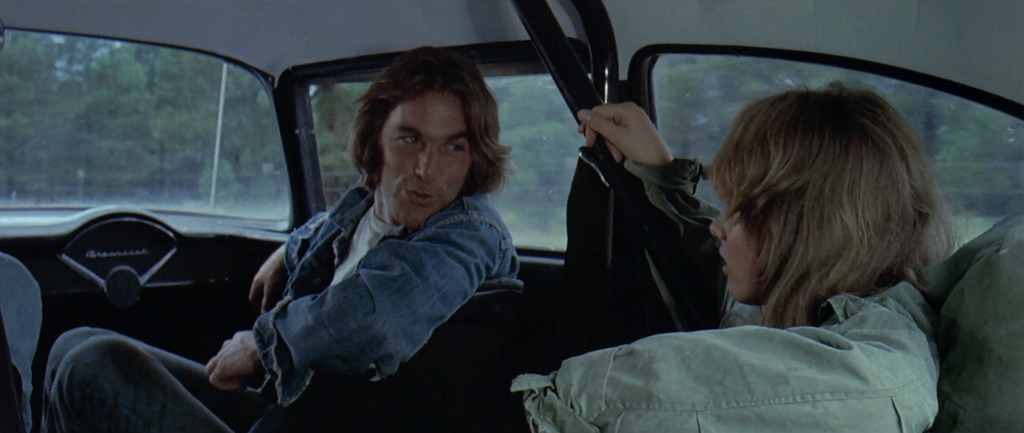
“That’s cool. I’ve never been east,” she replies.
The line makes it sound like they’re embarking on an adventure together, but the movie refuses to turn it into one.
The Girl is a drifter because the world of Two-Lane Blacktop is populated by drifters. People move in and out of each other’s lives with little regard for each other, but at the same time they seem entirely capable of pulling apart.
The Girl rides with The Driver and The Mechanic for a while. Then she rides with GTO. Eventually, she rides away from all of them. In the closing minutes of the film, without explanation, she will climb onto the motorcycle of a man she has never spoken to at a diner, and will ride away from them without a word, leaving her possessions behind in the parking lot.
And when you know Laurie Bird’s story, that scene becomes a million times more poignant.
Bird was born in New York in 1952. Before she was a year old, her mother had committed suicide. Her strict father raised her with a restricted social life, and by the time she was 12, she had run away from home so many times her father placed her in an institution for troubled girls. She left school at 15, eventually making her way to Hollywood and into the orbit of writer Rudolph Wurlitzer, who was writing the screenplay for Monte Hellman’s Two-Lane Blacktop. He recommended her for the role. She not only got the part; she also began a relationship with Hellman.
When that relationship had run its course, she moved in with Art Garfunkel. While he was away in Paris shooting Nicholas Roeg’s Bad Timing, Bird killed herself with an overdose of valium. She was 25, the same age her mother had been when she killed herself.
Like her character, she left without explanation.
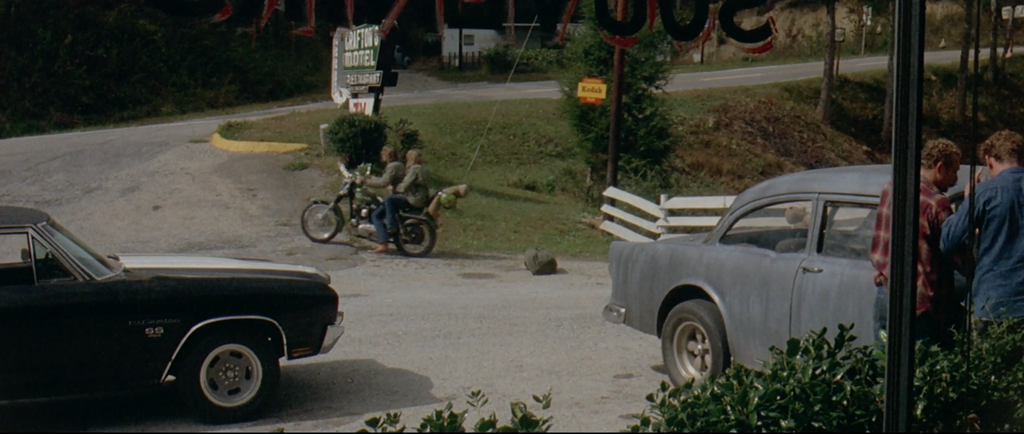
Warren Oates was nearly twice the age of the other actors when the film was shot, and he carries a completely different relationship to time. He lived life as fast off screen as he did on. Trying to outrun the pain of an abusive father, Oates was a heavy substance abuser. For years he was a part of the Hollywood group known as The Mad Dogs, consisting of notorious drug abusers Dennis Hopper, Peter Boyle, and Ben Johnson. As an example, according to Susan Campos in her book Warren Oates, A Life, an average day on the set of Kid Blue would begin with “magic mushrooms on toast followed by crushed up Dexedrine flambeed in brandy. The snack was rounded out with spoonfuls of vanilla flavored LSD. A few days later, two tanks of nitrous oxide, ordered from Mexico City arrived.”1 This wasn’t an uncommon occurrence for the group.
The fast life finally caught up to Oates. On April 3, 1982, Warren Oates laid down for a nap and never woke up. He died of a massive heart attack at the age of 53.
Much like Oates, GTO feels like a man trying to outrun his past. He invents stories about himself. He changes details about his past. He tells people what he thinks they want to hear. Every time he encounters someone, he seems to construct a slightly different identity.
His stories contradict one another because he is continually rewriting himself, much as many of us do as we grow older. Our stories get bigger. They become more exaggerated. One of the things the movie understands so well is that as we get older we begin writing our own stories the way we want them told.
We don’t want to be forgotten.
But the movie also understands something else: as we get older, we become increasingly aware of how much time we have left. That realization has come to haunt GTO.
In a pair of scenes late in the film, we see the facade of GTO break. We see the fear he has of time running out for him.
The scenes are back-to-back. First, GTO picks up a hippy who, in a callback to the Girl’s earlier question, tells GTO he’s headed “East.” GTO responds that he can take him 200 miles.
“It doesn’t matter. What do we have? Thirty, forty years?” the hippy replies.
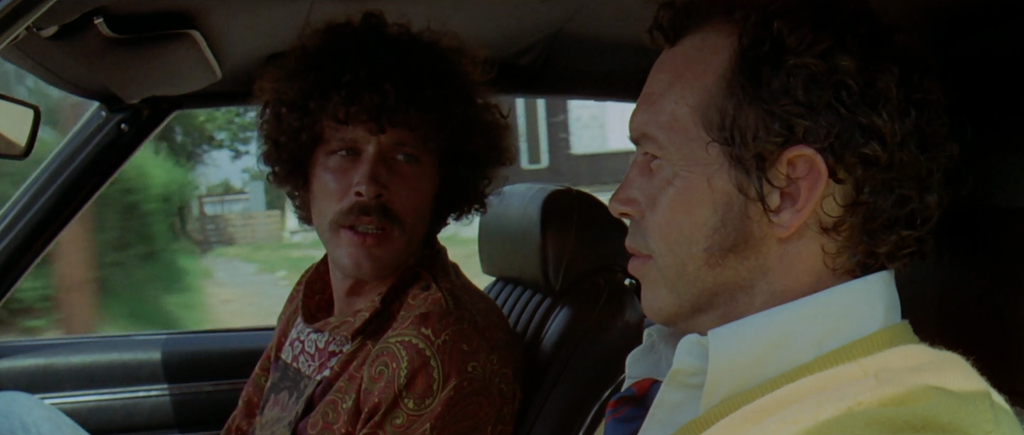
“I don’t think you read me right. I’m on a little caper of my own,” says a clearly agitated GTO. “Sick and tired of picking up creeps off the road and puttin’ me on.”
The hippies seemingly casual question has struck a nerve.
GTO is trying to ignore his life racing by, and this stranger has climbed into his car and reminded him that he only has a limited amount of time left.
Warren Oates, who played GTO, couldn’t have been aware how much time he had left either.
The next time we see GTO, he’s picking up another hitchhiker. This time it’s a grandmother and her granddaughter.
“Going to the graveyard,” the grandmother says. Then, gesturing toward the little girl in the back seat, she explains, “Her folks are buried there. Both of ‘em. Killed on Saturday night. Out of state. City car.”
GTO, either not understanding or not wanting to understand what she means replies, “Well yes, this could either be a city car or a country car, ma’am. Folks all over have them.”
“City car is what killed them.”
GTO goes silent for the first time in the movie.
We next see him quietly helping the grandmother and her granddaughter out of the car, holding an umbrella to protect them from the rain. He watches as they enter the cemetery to pay their respects.
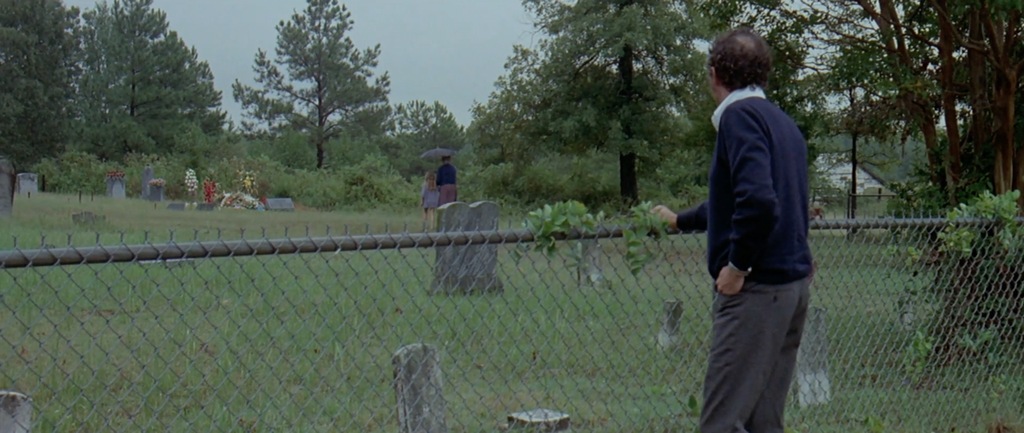
Interestingly, he doesn’t go inside. He remains at the fence line, almost as if entering the graveyard would mean admitting that one day he will end up there himself.
For GTO, death is always in his rearview mirror. His storytelling, his constant talking, and his bravado mask his terror. These two scenes finally break through that mask.
After this point in the film, it becomes clear that GTO is no longer driving to win the race.
He is driving to outrun the grave.
The Driver. The Mechanic. The Girl. GTO.
Death surrounds all of them.
It’s inescapable.
The towns they pass through along their journey are constant reminders that time moves on and things are left behind. People often talk about the charm of small-town America, but very few people who romanticize it have actually lived there.
Two-Lane Blacktop takes us through dying towns along an abandoned highway that the interstate system has rendered obsolete. The buildings are run down. The yards are unkempt. People in the background stop and stare at the car as it pulls into their town, suspicious of the outsiders. Signs have half of their neon not working, flashing like a dying heartbeat.
For the people in these small towns, there’s little hope of escape. Time has moved beyond them. The road is the only way out, but that road only leads to another dead-end town.
The final race in the film takes place on an airstrip. We don’t know how we got there or how this race was organized. Importantly, this is the only time we see the world exactly the way The Driver sees it.
The sound drops away. We watch the signalman from The Driver’s point of view. And then suddenly they’re off.
But something is wrong. The film slips into slow motion, vibrations shaking the screen until the film seems to disintegrate. The Driver does what he does best, but he never reaches finish line.
The film burns out before he can get there.
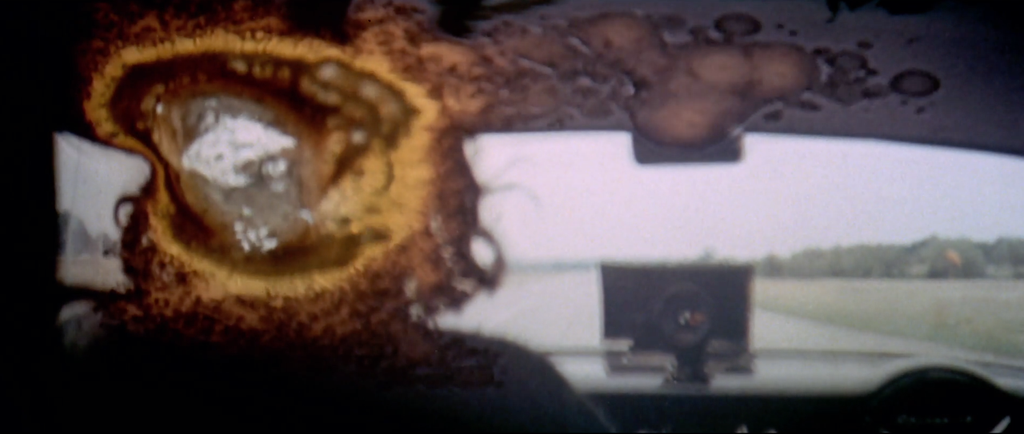
This notorious ending was edited out by projectionists in the film’s early theatrical run, but it’s the key to understanding the entire film.
The Driver, The Mechanic, and GTO never reach their finish line.
They drive and drive, but they’re constantly pulled off the road. The Driver and The Mechanic end up in a ditch, avoiding an obstruction in the road. GTO takes a grandmother and her granddaughter to a graveyard.
They never make it to Washington D.C. Their journey only ends because the film ends. Which is how most of life works.
We have plans. We have goals. We have places we want to see. But most of us never actually get there. Some of us are lucky enough to drive long roads, with plenty of scenery and stories to tell. We meet people along the way. We get to know them. And then, eventually, they disappear from our lives. We race all of our lives, hoping to achieve yet another goal we’ve made for ourselves.
And then, when we least expect it, it all just ends.
The film of our life burns out. Our story is over. Roll credits.
Footnotes
1Susan Campos Warren Oates: A Life, p 246.
Edited by Olga Tchepikova-Treon