
| Penny Folger |
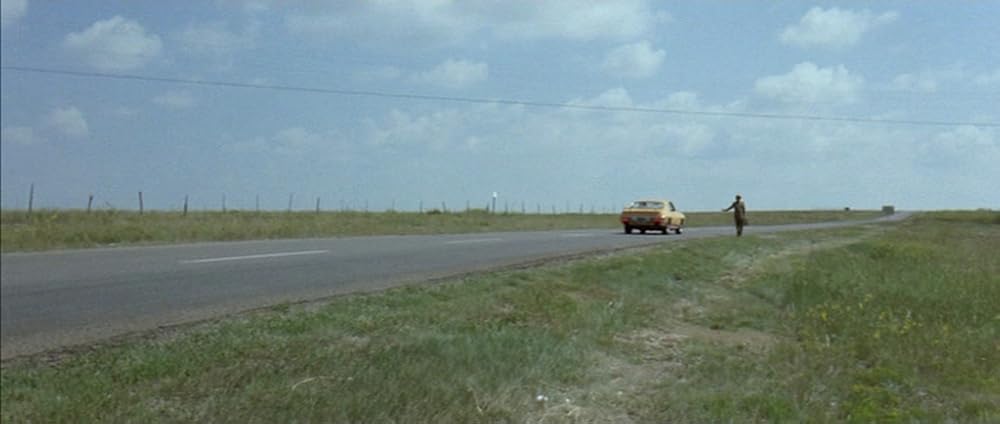
Two-Lane Blacktop plays in glorious 35mm at the Trylon Cinema from Sunday, September 6th, through Tuesday, September 8th. For tickets, showtimes, and other series information, visit trylon.org.
“You can never go fast enough,” declares James Taylor’s character in Two-Lane Blacktop, known here simply as The Driver. He occupies a world where he and his righthand man, The Mechanic, played by original Beach Boys’ drummer Dennis Wilson, make their living driving across the greater United States, drag racing and placing bets with strangers.
Two-Lane Blacktop opens with automotive sounds before we even see an image. It bothered Universal that the sound of cars revving up eclipsed their studio logo, but that audio sets the tone of the film: one that takes place entirely on the road. In a sense, its two featured cars: one paired down 1955 Chevy and a 1970 Pontiac GTO, are major characters, in the way that the house in Kubrick’s The Shining was that film’s antagonist. While these cars don’t talk—this isn’t some fantastical children’s film—neither do most of its human characters much, excepting practical exchanges about cars. In a sense, the cars here are more demonstrative than their human counterparts, a theme that is further underlined by the fact that we’re never given characters’ names. They are simply: The Driver, The Mechanic, The Girl, and GTO—a person whose identity is so enmeshed with his car that they share the same name.
With the aid of cars, the humans in this film are forever in motion: driving, hitchhiking or picking up strangers along the roadside. Said screenwriter Rudy Wurlitzer, who threw out the film’s original screenplay before penning his own, and actually appears in the film as a hot rod driver who challenges its leads to a drag race, “The characters could have as easily gone north or south as east. It didn’t matter to them. They just go where the wind blows. Where the road takes them.”1 Quipped Wilson, who really could work on cars, after the film’s release: “It’s a story about two fellows that really can’t make a decision.”2
In the early 1970s, young people hitchhiking across America was more commonplace, though not necessarily without peril. As Laurie Bird, who plays The Girl (or “Hey sweetheart!,” as The Driver yells after her at one point) asks after she’s already in a car with strangers, “You guys aren’t like the Zodiac killers or anything, right?”
The Girl’s mode of transportation is getting into and out of whatever parked car strikes her fancy, for whatever reason, often before its driver has returned (apparently people locked their cars much less in the 70s). The Girl asks The Driver and The Mechanic in whose car she’s recently materialized, “Say, which way are we going?” to which The Mechanic simply replies, “East.” Her only response is, “That’s cool. I’ve never been east.”
Said indie filmmaker Allison Anders about the film, “With them [Driver and Mechanic], I kind of know where everything is and how they are, but she’s a complete mystery. And of course, then she changes everyone around her and they’re not quite the same.”3
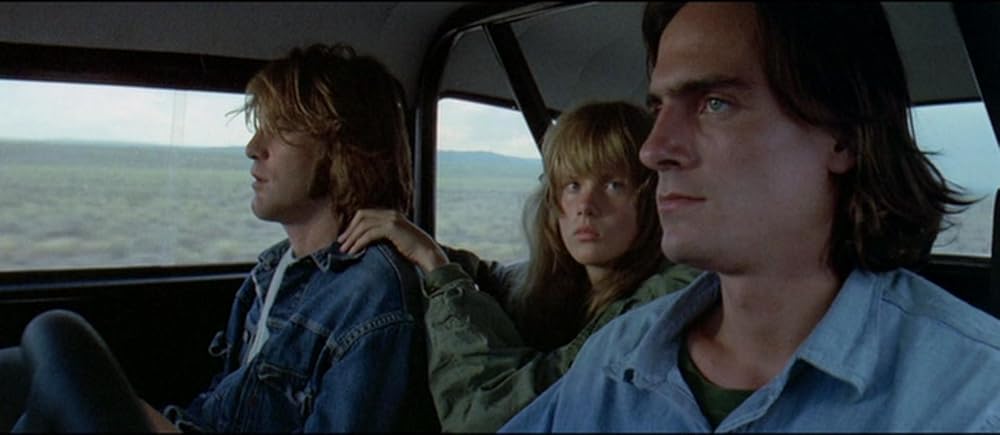
Wandering Strangers: The Mechanic, The Girl, and The Driver
“She’s actually the driver of the film in a weird way,” said Anders. “She motivates everybody else. She enters the picture and everything changes.”4
The Girl seems to switch vehicles every time she’s had enough or wants a change of scene, drifting freewheelingly between drivers without apology or explanation. Her carefree agency and autonomy are unusual for a young female character in this, or arguably any era. Points out Anders, “The Girl is this phenomenally empowered, self possessed girl that you didn’t see on the screen then.”5 Bird, who only appeared in two other films: Annie Hall and Hellman’s Cockfighter a few years after Blacktop, moved in with Art Garfunkel, and took her own life at the age of 25 as her mother had eerily done before her. Her character in Blacktop challenged societal expectations of what a woman is supposed to do and be in a movie, not to mention real life, and she’s progressive, even by today’s standards.
Said Anders, “She’s the real wanderer in the piece.” About the Driver and Mechanic, Anders continued, “In a way they’re kind of stuck in their ways. She’s actually the one up for the risk and up for adventure. And she can leave whenever she wants. They’re part of the system. They have a car that they have to take care of. They have responsibilities.”6
Bird, Wilson, and Taylor were all novice actors: the latter two primarily musicians, which is ironic considering Bird was not, yet she is the only one who sings in the film. As an “experiment,” Hellman never let them read the script, only giving them each day’s pages on the day of filming. This in part, noted Wurlitzer, accounted for some of their awkwardness on screen. Shooting the entire film in sequence, with the production traveling across the country as the characters did, the lines were more blurred between reality and fiction.
Furthering this, Hellman often had real-life bartenders and shopkeepers playing themselves in the various roadside establishments the characters patronized. In a way, the traveling production was living the same experiences the characters were. Said Taylor, “None of us were actors really. And so they wanted the experience of our making the movie to be as close to the actual movie as possible. So in a sense it was just sort of like a semi-documentary.”7
Taylor famously didn’t see the movie for decades, because he didn’t feel comfortable watching himself onscreen. Hellman said Taylor approached the role more intellectually than Wilson, who was “so unselfconscious, he had no awareness of the fact that there was a camera, or even that he was acting in a movie.”8 Nevertheless, Taylor achieves a quiet emotional intensity here. He reflected back decades later, “I didn’t have a character. Neither did Laurie or Dennis, other than their personalities in the circumstances in which they were being filmed.”9
Whether the point was to give amateur actors less lines to learn last minute, The Driver and The Mechanic are responsible for the nonverbal reputation this movie has. They function as a unit, like the old married couple who don’t bother to make conversation when dining out. (We literally see them at roadside diners, chewing silently.) This lack of dialogue is almost humorous at times, such as when they return to their car to find The Girl, who they’ve never met or seen, sitting in the backseat. No one introduces or explains themselves, or even says “Who the hell are you?” They simply start the car.
It’s no surprise Wurlitzer was a fan of the works of Samuel Beckett. This American film feels much more European arthouse in its sensibilities. Its characters endlessly cross the landscape, wandering into and out of each other’s lives. Said Hellman about the wide expanses and the lack of dialogue, “I always likened the dialogue to an FX or a music score. The plot is not propelled by the dialogue. You don’t learn anything from the dialogue. You learn everything from watching rather than listening.”10 The movie is akin to a Western in this way, and the character’s idiosyncratic behavior jumps out at you the more you watch rather than listen. The great Warren Oates, who plays GTO, buys a coke at a gas station and still sipping it, absentmindedly puts the full bottle of coke into the rack of empties when he sees The Girl. He awkwardly pulls it back out again five seconds later. It’s a funny bit of character business that might be lost in a louder, faster paced movie.
While the others are young and practically monosyllabic, GTO is middle aged, polished, dapperly dressed, deeply insecure, and carries with him an air of loneliness. He continually picks up hitchhikers in a desperate unconscious attempt at connection. He’s also one of the only real actors in the film. Said Wurlitzer in conversation with author David Meyer, “Laurie and James were so awkward, that every time you go back to GTO there’s tremendous relief.” Agreed Meyer, “It is in a sense, even though he makes you nervous, too.”11 Unlike the other characters, GTO fills the air with a constant stream of words, but you’re never sure of the truth in anything he says. Still, he has a knack for talking himself out of tight situations, which the others come to appreciate, in as much as they can express appreciation.
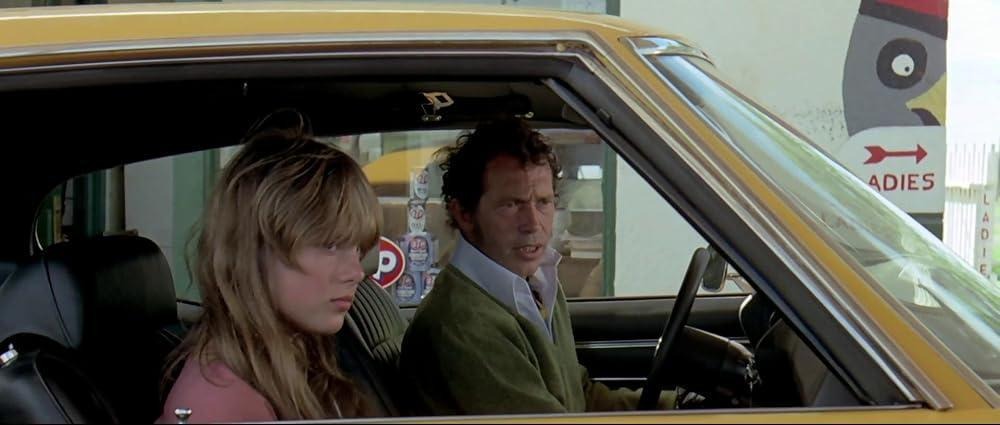
GTO councils The Girl on other men.
Motivated by rivalry, GTO advises The Girl about The Driver and Mechanic: “They’re not for you. All they think about is cars.” He has a point. In this movie, the most intimate thing you can do with someone is teach them how to drive a stick shift. The Girl heightens the tension and the stakes between these men, although as previously stated, what she does is always 100% her choice, regardless of whatever chaos she leaves in her wake. At one point she even leaves the bag which presumably houses the majority of her clothes behind, because it doesn’t fit into where she’s going.
German director Wim Wenders was admittedly extremely influenced by Blacktop for his own road movie, Paris, Texas. (Which I shall be writing about and is showing at Trylon later this month!) Both films, perhaps not coincidentally, also contain Harry Dean Stanton, credited here as “HD.”
Reflected Hellman about Blacktop before he died in 2021 at the age of 91, “I’m amazed at how much emotion I find in it, looking at it again. There’s so little here, story-wise. And yet it really has a lot of power that comes out of the characters.”12
Wurlitzer, who has a dramatic scene in the film with Hellman’s real-life wife at the time, appreciated what Hellman, who shot practically his entire script, did with his material. “It’s an amazing film for an American director to make. I don’t think there’s ever been an American film like it, in a way.”13
Footnotes
1Two-Lane Blacktop, commentary by screenwriter Rudy Wurlitzer and David N. Meyer, Criterion, 2007.
2Interview with Dennis Wilson, The David Frost Show, May 7, 1971.
3Two-Lane Blacktop, commentary by director Monte Hellman and Allison Anders, Criterion, 2007.
4Two-Lane Blacktop, commentary by director Monte Hellman and Allison Anders, Criterion, 2007.
5Two-Lane Blacktop, commentary by director Monte Hellman and Allison Anders, Criterion, 2007.
6Two-Lane Blacktop, commentary by director Monte Hellman and Allison Anders, Criterion, 2007.
7Interview with James Taylor, The Tonight Show Starring Jimmy Fallon, May 19, 1997.
8On the Road Again: Two-Lane Blacktop Revisited, Eureka, 2007.
9Make It Three Yards, James Taylor interview by Monte Hellman. Criterion Collection, 2007.
10Two-Lane Blacktop, commentary by director Monte Hellman and Allison Anders, Criterion, 2007.
11Two-Lane Blacktop, commentary by screenwriter Rudy Wurlitzer and David N. Meyer, Criterion, 2007.
12Two-Lane Blacktop, commentary by director Monte Hellman and associate producer Gary Kurtz, Eureka, 1999.
13Two-Lane Blacktop, commentary by screenwriter Rudy Wurlitzer and David N. Meyer, Criterion, 2007.
Edited by Olga Tchepikova-Treon