
| Casey Jarrin |
“What are you waiting for, lover? Let’s open these neural floodgates.”
– Debbie Harry as Nicki Brand in David Cronenberg’s Videodrome (1983)
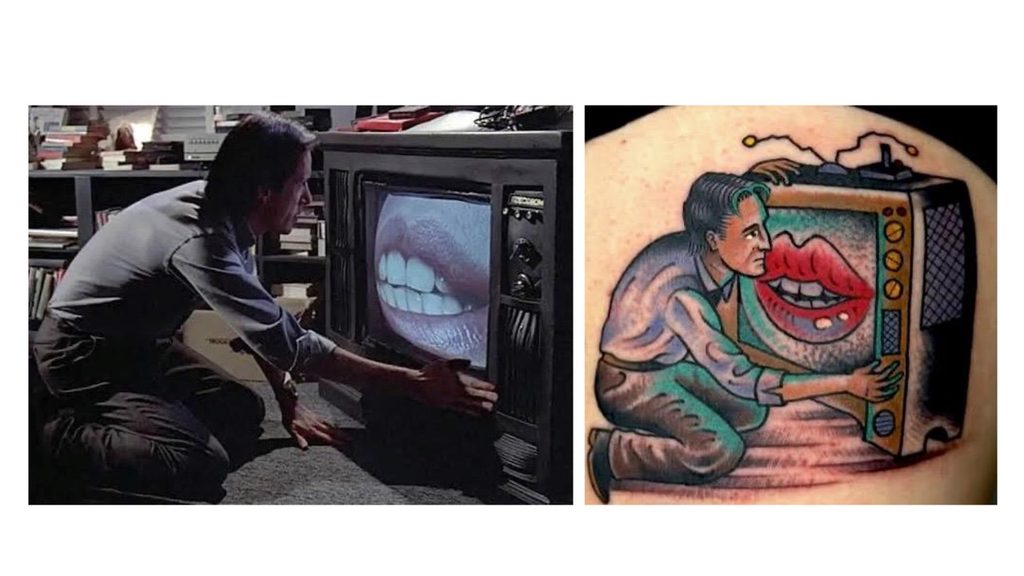
Above left: Max Renn (James Woods) zooming in for the kiss. Above right: Tattoo rendering of the scene.
Videodrome plays on 35mm at the Trylon Cinema on Friday, November 20th and Saturday, November 21st. For tickets, showtimes, and other series information, visit trylon.org.
Most people don’t just end up seeing Videodrome; it’s a choice and a rite of passage.
I knew about Videodrome years before I first devoured it on the Carolina Theatre’s 30-foot screen. It’s one of those post-industrial, pre-CGI body horror classics like Tetsuo: The Iron Man whose midnight cult reputation precedes it. Once upon a time, it was my cinematic litmus test. Along with Antonioni’s Blow-Up, I’d use it to screen out new friends and lovers: if you could take Videodrome, you were worth kissing.
Videodrome stands out in the pantheon of David Cronenberg’s orgiastic body horror as his most direct immersion in our voracious hunger for screens and most brutal indictment of our desire to consume ever more images of sex, death, and bodily undoing. This obsession-worthy film lives at the blurry techno-crossroads of pleasure and pain, voyeurism and empathy, sadism and ethical sympathies. Yet, as part of its cult mantra “Long Live the New Flesh,” Videodrome also turns the camera on us: spectator-participants in darkened theaters throwing popcorn in our gob holes while we watch a pre-MAGA James Woods and non-blonde Debbie Harry scream, bleed, and possibly die. We have chosen to be there and we’re not innocent in where we focus our gaze. Through each scene of bodies engulfing VHS tapes, skin and muscle morphing into a gun, we are entertained.
On one hand, Videodrome is a film geek’s neo-noir wet dream, complete with Godard’s two-step cinema recipe of “a woman and a gun” (in this case, literally swallowed by our hero’s insatiable flesh). Stylized and strategic in its peepshow aesthetic, the film’s visual language oscillates between a grotesque fleshiness and the neon lights of a Duran Duran album cover. Though in its most sobering moments, Videodrome also offers a livestream of scenes of “real” torture happening in military black sites and prisons, two decades before the Abu Ghraib Prison photos flashed across laptop screens. As public access channel CIVIC-TV’s “Torture-Death-Immolation” carnival plays on, the film asks serious questions (hauntingly prescient and relevant now) about how and why we sit on our couches doomscrolling, binging True Crime murder porn, watching others die—and live.
Reality of the Senses: “What you see on the screen is for real, it’s not acting”
Once upon a time, in a galaxy far, far away, before the dawn of Netflix and chill, we watched TV. Some of us, those without Cinemax/Skinemax or MTV, flipped the channel to late-night public access, a Wild West of underground culture: Robin Byrd interviewing fire eaters in her crocheted bikini, “tomorrow’s stars today” singing their souls into a microphone on Stairway to Stardom, Debbie Harry demonstrating a pogo stick on Glenn O’Brien’s live and uncensored TV Party. (Videodrome’s Brian O’Blivion is no doubt the mirror double of Glenn O’Brien, a refracted cultural cousin by way of Marshall McLuhan.)

Top left: Debbie Harry backstage at Glenn O’Brien’s TV Party. Top center: Debbie Harry as Nicki Brand in Videodrome. Top right: Claudia Summers of the band Dragon People with Glenn O’Brien, TV Party June 13, 1982. Bottom left: Channel J legend, Robin Byrd. Bottom center: Chris Stein of Blondie (accordion) and Patrick Geoffrois (guitar), TV Party February 17, 1981. Bottom right: Late-night crooner featured on Frank Masi’s Stairway to Stardom, early 1980s.
Public access was glorious, messy, transgressive.
Transgressive: to push beyond the limit, to violate a law or norm, or in moral terms, to sin. An apt word to describe CIVIC-TV’s late-night transmissions of whips, chains, and cloaked figures. Public access meets the Inquisition.
Pushing beyond what we can fully know or comprehend? Absolutely.
Illegal? Maybe, though by the standards of Guantánamo or Alligator Alcaraz, hard to say.
An act of sin? Quite possibly, though depends entirely on your kink.
Torture and Taboo: “CIVIC-TV, the one you take to bed with you”
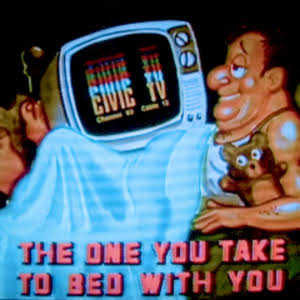
Late-night CIVIC-TV television ad in Videodrome.
Videodrome begins with television static and a channel switch to CIVIC-TV, Cronenberg’s homage to the beautiful disaster of public access television. Before we meet James Woods channeling a coke-addled version of Sam Spade or Debbie Harry’s femme fatale body double Nicki Brand, an announcer proclaims, “CIVIC-TV, the one you take to bed with you.” Wink, wink.
Cronenberg’s camera is a sadist with a far-from-subtle Asian fetish and a heart of 14K gold.
Exhibit A: In Videodrome, all TV is pornography. In the first full scene of the film, we see leading man and CIVIC-TV station president Max as he smears traces of jam from his toast onto black-and-white film stills from a low-budget porn series he’s about to acquire, Samurai Dreams. A soft-focus rabbit enticing us into Wonderland descent. Then, just seven minutes later, Max sees the mystery transmission from an indeterminate country-of-origin, the dungeon at the heart of the film’s desiring machine. Figures in black cloaks and hoods whip bodies in chains and torn orange prison smocks. Women’s bodies. Cronenberg doesn’t waste any time.
Exhibit B: Red lips are a “come hither” enticement to danger. If we’ve learned anything from nearly a century of cinematic misogyny, it’s that women with shiny pouty lips can’t be trusted. They’re a recipe for disaster, and sex, or both if you’re (un)lucky. Even and especially if they’re brilliant therapists and accidental cultural theorists channeling Halston-fabulous, a woman who makes intentional choices with her mind and body is a femme fatale.
Exhibit C: Your television is a weapon, filled with a cathode ray tube and wires for guts (my god, the ecstasy of imagining the actual guts that used to fill our TVs). A tube which might, at any moment, morph into a fleshy gun pointed directly at you.
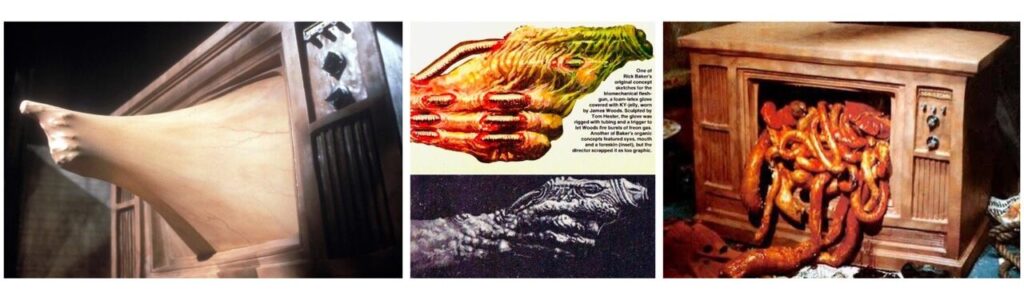
It’s alive!: Before CGI, everything was “real.”
Left: Videodrome’s curious TV screen. Center: Two of special effects master Rick Baker’s original concepts for the biomechanical flesh-gun: sketch (top), clay model (bottom), both rejected by Cronenberg for being “too graphic.” Right: Videodrome’s cathode ray tube and electrical wires revealed as a box of sculpted guts.
Exhibit D: A VHS tape is alive with whatever it contains. In Videodrome, no image has the innocence of 2D. At any moment, the tape might start to gasp and breathe, become a sensing machine. Sorry, Ringu. Videodrome got there first.
Exhibit E: Military black sites are sex dungeons by another name. Whether or not you consider Videodrome a political film, viewing it through the eyes of 2026, it’s impossible not to see a continuity from CIA torture guides of the 1960s and 70s, Reagan-era violence at the time of the film’s release in 1983, and our 21st-century moment which forever lives in the shadow of Abu Ghraib and the Hooded Man holding electrical wires in his hands. Like these harrowing political contexts, Videodrome requires anonymity, mind control, and the undoing of bodies.
Exhibit F: A television studio is a torture chamber by another name. If there’s a mystery to unravel at the heart of Videodrome, its key lies here, in this room: a black site and dungeon of the mind, a black box the shape of a television screen where the unthinkable happens.
Or does it?
Edited by Olga Tchepikova-Treon