
| Sophie Durbin |
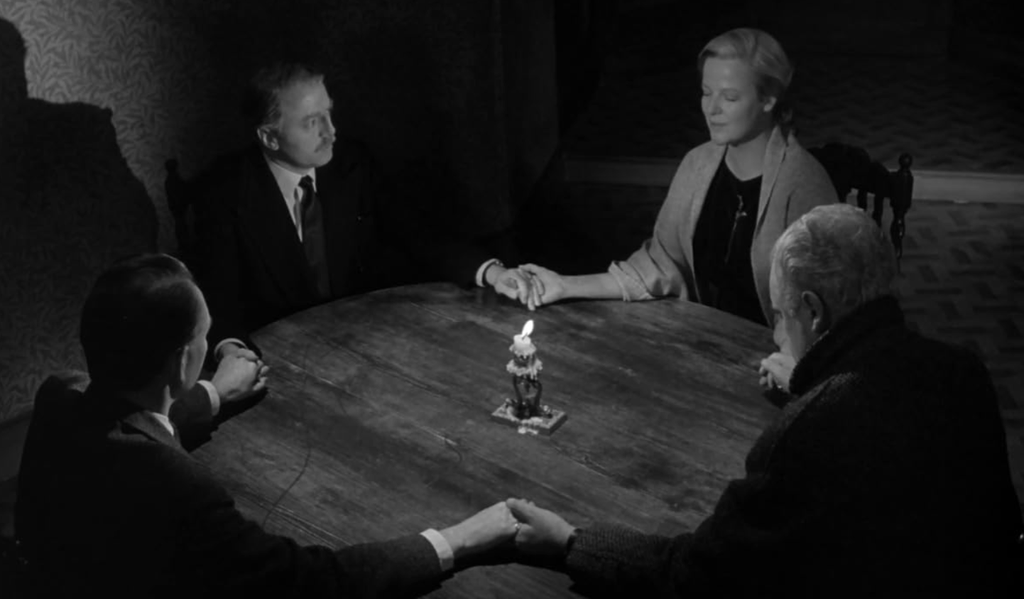
Seance on a Wet Afternoon plays in glorious 35mm (with a missing reel!) at the Trylon Cinema on Thursday, November 19th. For tickets, showtimes, and other series information, visit trylon.org.
I jumped at the opportunity to write about Seance on a Wet Afternoon, one of only six films starring the legendary Kim Stanley. Ms. Stanley is something of a holy grail for midcentury acting nerds, with Seance being her Superbowl (though some might prefer her turn in The Goddess from 1958, which is a little more raw). In this kitchen sink-adjacent British thriller about a traumatized and perhaps fraudulent psychic, the whole cast is operating at full voltage, with Kim Stanley functioning as the central battery. She was renowned for her stage work, having trained at the Actors Studio under Lee Strasberg and Elia Kazan; she would later draw comparisons to Marlon Brando, who also studied there, and who shared her qualities of talent and self-destruction in equal measure. After Stanley retired from the stage and her film and television career slowed down, she turned to teaching. She centered her acting approach around relaxation-based preparation techniques grounded in the teachings of Sanford Meisner, as well as seven primal “Needs”: to charm, to celebrate, to seduce, to entice, to plead, to accuse, to destroy.1 In Kim’s method, every human action could be assigned to one of these Needs. Here is how these Needs play out in her performance in Seance.
To Celebrate
Myra wants to be adored. She thinks this is what she deserves. She already celebrates herself. Stanley conveys this with everyday dominance. She is light on her feet, with nothing to prove; she collapses into a chair and flicks on a Mendelssohn recording, the volume a little too high. Myra often asks her husband Billy, who she controls, for validation: tell me you love me, tell me that this room reminds you of a hospital. Stanley always plays these moments with an undercurrent of perfunctory confidence that shows how she is not actually asking for reassurance. These requests come from a place of demanding constant affirmations of loyalty which she takes entirely for granted.
To Entice
It doesn’t take much for Myra to convince Billy to go through with the kidnapping plot, but he gets chilly feet soon before he snatches Amanda from her chauffeur at school. This is unacceptable to Myra, and Stanley draws upon the Need to Entice to make her argument convincing. This is an elaborate process, filled with platitudes. She sticks the landing: “We’ve had so much sorrow Billy. Too much sorrow. But it’s all going to be changed now. Everything’s going to be different.” Her voice is insistent, persistent, robotic. Stanley’s delivery, which juxtaposes utter regularity with unshakable insistency, suggests that speeches like these happen regularly in their household and have the same Pavlovian affect on Billy each time. Of course, what she’s proposing isn’t going to change anything at all in their marital dynamic; Billy will remain subservient, and Myra will still be a narcissistic psychic – a famous narcissistic psychic.
Contrast this moment with an odd instance when Myra appears to humble herself but is actually entirely hubristic. She pays a visit to Amanda’s aggrieved parents, who have been searching for her for days. She reports to them a dream she had about their daughter, breadcrumbing them with information she gleaned from Amanda while captive in bed. Stanley shares these details innocently and kindly, and the Claytons don’t seem to take the bait at first, but with her skill we can see that she is imbuing Myra with master powers of manipulation.
To Plead
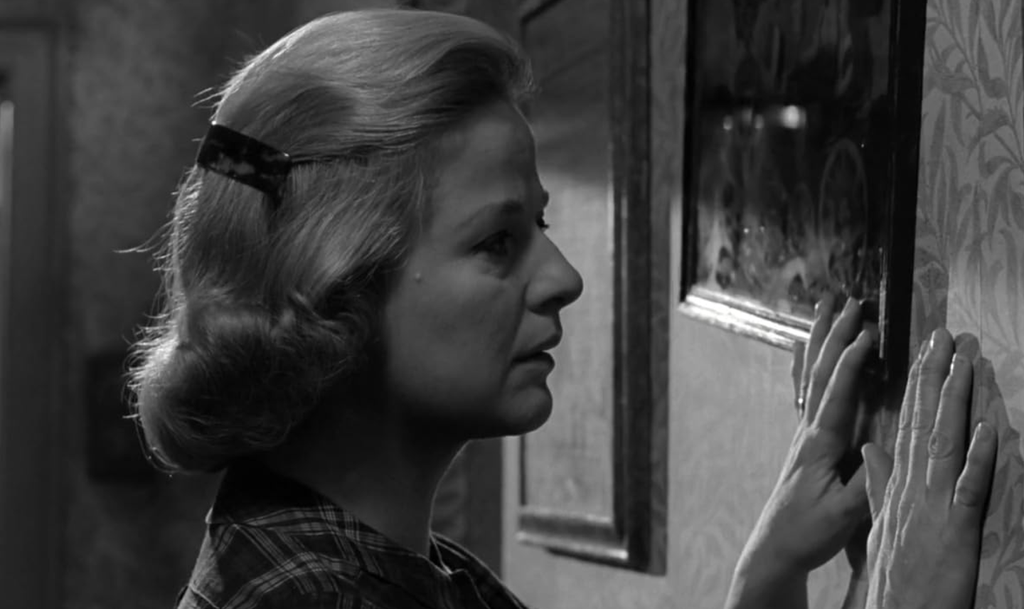
Myra is not accustomed to pleading. It is only in her most desperate moment that we see Stanley select this Need. She has made wilder and wilder demands of Billy throughout the story, but one is a bridge too far when she claims that their stillborn son Arthur has asked her to kill Amanda to “send her to him.” For once, submissive Billy cannot abide by one of her instructions, crying out, “Myra. Arthur didn’t say anything. You said it, it was you, it’s what you’ve been thinking.” This is a tour de force moment from Attenborough, and a testament to Stanley’s genius, as she has given him everything he needs to finally and immediately boil over. Her body crumples in on itself and she begins to beg. Marlon Brando could have been describing this exact moment in his poignant description of her acting style: “There was a sense of embarrassment in watching Kim when everything worked, because you felt you were violating the confidences of a vulnerable woman, reading the pages of a diary carelessly left open for other eyes.”
To Accuse
Through one lens, this is a crime thriller. Through another, it is a gender-bent rendition of Gaslight. Part of Stanley’s job is to help the audience understand how Billy can withstand life with Myra, as well as just how she is able to control him so thoroughly. Her Need to Celebrate herself is equally joined by her Need to Accuse Billy. See her turn off the Victrola herself, and then casually ask him why he switched off the music. Her tone is light, confused, but there is a threat buried beneath it. He tries to explain that she turned it off, but her gentle insistence is so persuasive that we understand when he immediately caves. The audience realizes that his days must be filled with small battles like this one.
To Destroy
In the film’s final sequence, Stanley leads a seance requested by the local police, who suspect that this will lead her to leak valuable information about the child’s whereabouts. In her trancelike state she seems to relive her unhappy childhood and the stillbirth that still haunts her. As she cradles a bundle of cloth in her arms, it seems she’s lost her grip on her current time and place. Miraculously for the police, her trance then turns into a confrontation, a confession, in which she cries out in anguish at Billy, chastising him for not killing the child like she demanded. In doing so, she immediately incriminates her husband and gives the police the clue they were after. Is her confession an accident, a symptom of how she loses control while “making contact”? Or is it a calculated stab in the back, a punishment doled out to her husband that finally abandoned her orders? The script leaves this ambiguous, and so does Stanley’s performance. Her minute hand gestures, her unpredictable groans and sighs, her empty stare and her stray tears seem to suggest that she is fully immersed in a transcendent state, but throughout the film we have seen how Myra’s mediumship is actually a vehicle for her cruelty. The audience is left to contemplate this as the credits roll.
Footnotes
1I waited many years for The Needs of Kim Stanley, a Kickstarter-funded documentary, to come to fruition but it never did. I summarize what I know of Kim Stanley’s method here.
Edited by Olga Tchepikova-Treon