
| Hannah Baxter |
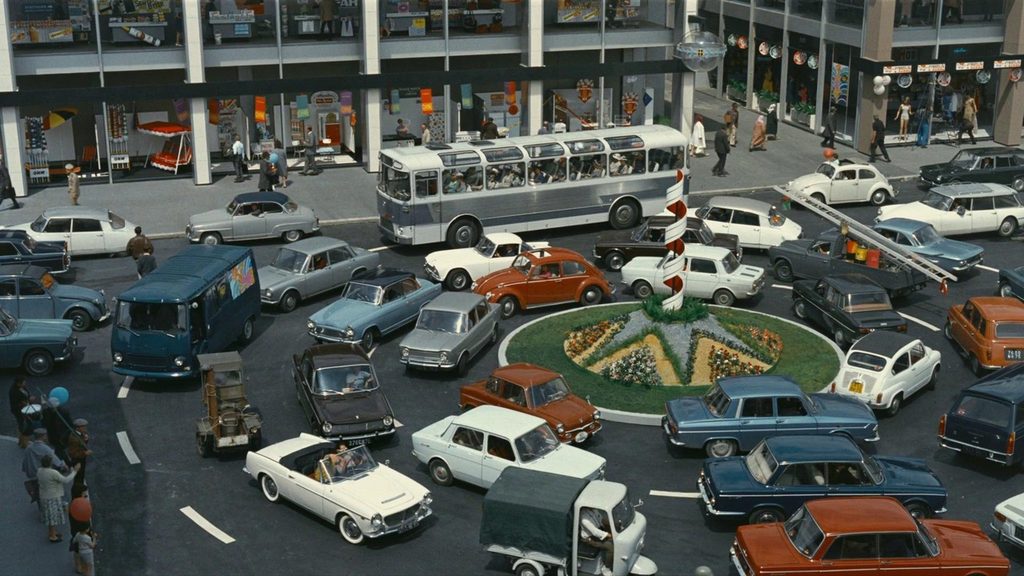
A street scene in Tativille
Paprika plays in glorious 35mm at the Trylon Cinema on Saturday, November 21st and Sunday, November 22nd. For tickets, showtimes, and other series information, visit trylon.org.
1967: How I Got There and Why I Never Left is a memoir by the surrealist English folk rocker Robyn Hitchcock. The book focuses on a defining year of Hitchcock’s adolescence, one in which he discovered the musicians—Bob Dylan chief among them—who would shape his own artistic aspirations.1 I want to say that after 1967, Hitchcock would never be the same. But it’s more accurate to say that he would always stay the same as things around him changed. While the English music scene evolved, or maybe devolved, into the raucousness and shock tactics of punk rock, Hitchcock remained a devotee of the inward-looking, psychedelic precedent set by the likes of Dylan, Syd Barrett of Pink Floyd, and the Incredible String Band. And it’s that sense of being a holdover from a different era that Hitchcock discusses in his fictionalized follow-up, Stranded in the Future (2026).
“Stranded in the future” is also an apt description of Jacques Tati’s hapless Monsieur Hulot as he navigates a disorienting series of futuristic urban vignettes in Playtime, a film that was released in, you guessed it, 1967.2 The title Playtime captures the film’s lightly ironic spirit, given that it takes place mainly in workplaces. The film opens in a vast, spare, and spotless waiting area that’s hard to place. Are we in a medical complex of some sort? A convention center? Eventually we learn it’s an airport, whence a group of American tourists are whisked away to, of all things, a showroom filled with consumer gadgets (“C’mon, girls, wait till you see how modern it is!”).
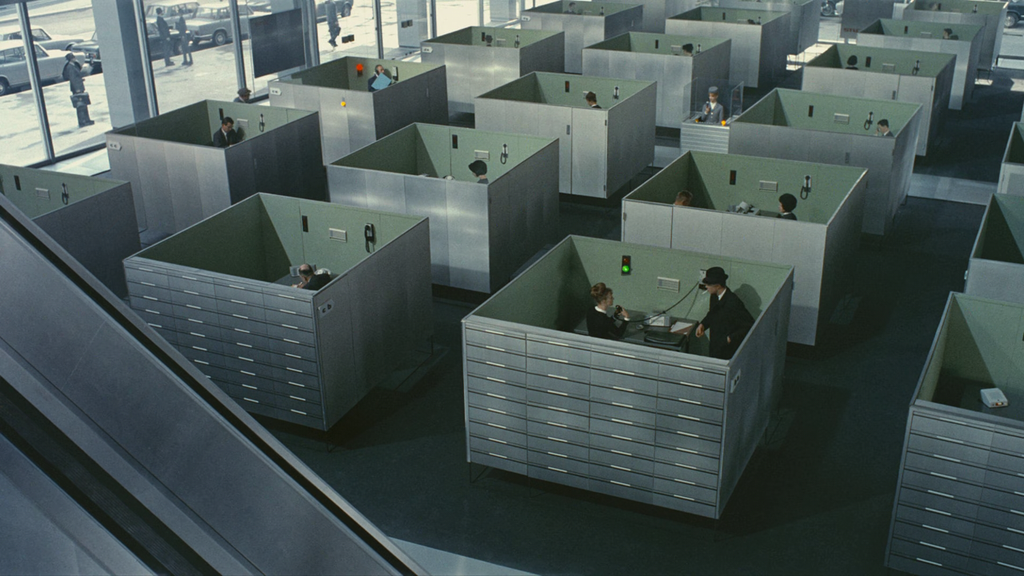
Don’t worry, these have doors!
In a parallel throughline, Hulot arrives at a neighboring building for an important meeting with a Monsieur Giffard—a meeting which he’s repeatedly thwarted in reaching. He gets trapped on an elevator to the wrong floor and emerges on the mezzanine, from which he glimpses Giffard bustling around below in a warren of cubicles. Later, Hulot finds himself on the wrong side of an atrium, trying to signal through several layers of glass for Giffard’s attention. We never learn what the appointment was about, and there’s a refreshing lack of repercussions for missing it; I suspect that anything resembling consequences would come too close to a plot element for Tati’s style of filmmaking.
Although the only sign of the natural world we glimpse in Playtime is a manicured strip of lawn outside an apartment building, some scenes are reminiscent of a microcosmic view of nature: the bird’s-eye view we get of those cubicles stretching into the distance, busy with typists and traders like bees at work in honeycomb cells; dancers on the floor of a chic new restaurant, vibrating and circulating like particles in Brownian motion. The gleaming glass-and-steel structures might at first appear cold, but the humans inside them—not least that charming bumbler, Monsieur Hulot—warm them up.
One of the American tourists, Barbara (Barbara Dennek), is a kindred spirit: like Hulot, she is out of step with her group, even with the rest of the world. Trailing the others as they get off the bus, she becomes enamored of a quaint flower seller, a remnant of a bygone France that she wants to capture on her camera while the rest of her tour piles into the showroom to look at a vacuum cleaner with headlights. She and Hulot circle each other like bits of flotsam caught in an eddy. They meet briefly in a bustling supermarket, enjoy a moment of connection, and then drift apart again.
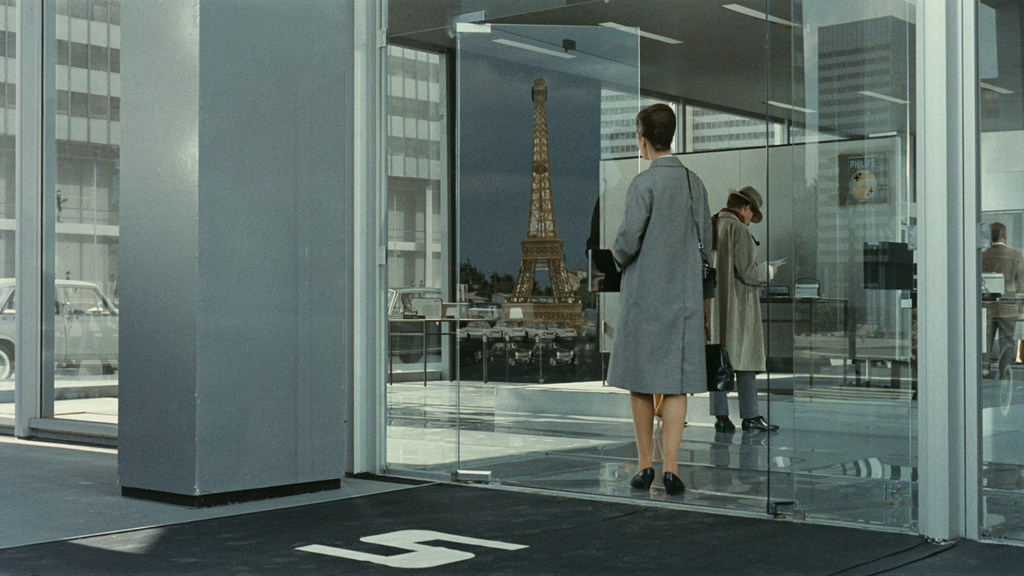
Barbara catches sight of Paris’ signature tourist attraction on her way into a home goods expo.
Through Barbara’s eyes, we get glimpses of the Eiffel Tower and of the Sacre-Coeur basilica—reflected in windows and doors, of course, rather than seen directly. Because despite the presence of Barbara and the other Americans, we aren’t in the Paris that tourists flock to see. In fact, we aren’t in Paris at all. Rather, the whole film was shot on a giant set that Tati had purpose-built for this film—and that bankrupted him.
In 1964, when Tati started scouting locations for Playtime, Paris did not have a neighborhood that matched his ultramodern concept. He toured a Ford factory, an airport, skyscrapers, and other large industrial and commercial sites both within and outside of France. These offered the look and scale that he wanted, but no working factory or bank or airport could afford to shut down for months for filming.
A friend told Tati he should actually establish a real property development company, construct a building to his specs, and sell it after shooting was complete. Tati took this idea and ran with it, constructing two main buildings of concrete and steel, powered by a real power plant and served by real roads with working traffic lights. To create the illusion that these buildings were part of a larger development, he used cleverly painted wood and plastic flats that could be shuttled around on wheels to create different backdrops and skylines.3 The set became known as Tativille.
Instead of selling Tativille, Tati wanted to gift it to France’s filmmaking industry as a studio complex. Sadly, that was not to be. The Paris city council did agree to lease Tati’s production company, Specta-Films, land on the outskirts of the city, where he could build his studio complex. But they already had plans for that land, and they wanted it back a few years later to build a cloverleaf intersection.
Meanwhile, in fall 1964, Tativille was almost finished when a storm blew through and damaged large portions. This problem was compounded by the fact that Specta-Films’s insurance had been cancelled due to non-payment; that meant the company had to foot the bill for rebuilding the set. Even after filming began, the production was plagued both by weather delays and, again and again, by Tati running out of money and pausing the shoot for a fresh round of fundraising. Ultimately, Tati mortgaged not just Specta-Films’s assets (such as the distribution rights to his previous movies) but his own, including his house. By the time he wrapped up filming in October 1966—with bulldozers already starting to demolish portions of the set—he was “in debt to almost everyone he knew.”4 Adding real-life irony to the ironies embedded in Playtime, by the time Tati’s futuristic vision was seen onscreen, the place where it was effortfully brought into being was a thing of the past.
Playtime is generally described as a satire, but if so, it is of the gentlest possible variety. Certainly, the movie finds humor in modern “conveniences.” An intercom system so complex that operating it takes longer than tracking someone down on foot. An apartment building where, at a given point in the evening, all the inhabitants orient themselves toward the glow of their wall-mounted television screens. Seen from outside the building, they are facing each other, but of course, a wall of entertainment separates them. Towards the end of the film, Parisians and Americans gather at a fancy restaurant where the architect’s avant-garde design choices trip up the staff (sometimes literally). The restaurant starts to fall apart around the patrons: a glass door shatters, leaving a bewildered doorman holding the knob; the HVAC goes haywire, making everyone sweat; ceiling tiles drop and wires dangle. They don’t make ’em like they used to, Tati seems to be saying. But the restaurant-goers adapt, filling their glasses again and again, dancing and singing till the wee hours. Barbara ends up at the piano, accompanying a chanteuse who spontaneously climbs onstage to sing about the charms of Paris.
It’s a disaster. It’s chaos. But it’s fun. And that, I think, gets to the essential meaning of Playtime. The point is not to lament change, it’s to appreciate what doesn’t change: people, or what’s good about being around people: art, friendship, love.
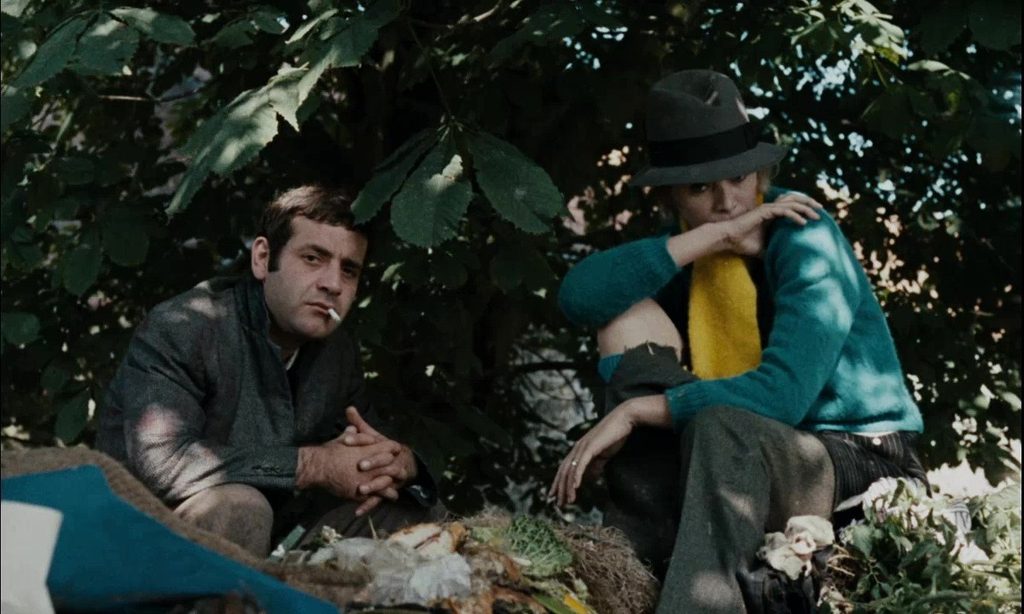
Prolific actors Jean Yanne (left; also a director) and Mireille Darc (right) play murderous road trippers the Durands in Weekend.
Contrast this with Weekend, a Jean-Luc Godard joint released just a couple of weeks after Playtime in December 1967. Weekend concerns married couple Roland and Corinne Durand (Jean Yanne and Mireille Darc), who at the start of the film are seen plotting each other’s murder with their respective lovers. Corinne coolly observes as a brawl breaks out in the street over a minor traffic accident, then she gives the most joyless account of a threesome imaginable. It’s basically all downhill from there.
Weekend pokes fun at the bourgeois preoccupation with material goods as Playtime does, only in a much more scathing way. At one point, a woman stands shrieking by a wrecked car in flames. But she’s not upset about whatever’s happened to the other passenger; she’s crying for her lost Hermès handbag.
Both Playtime and Weekend seem to anticipate a version of France that didn’t yet exist in 1967 but that the filmmakers must have thought contemporary trends were pointing to. Both films have English titles, for example, and cars figure prominently in them, perhaps acknowledging the cachet that American culture, with its automotive obsession, had at the time. Tati’s future France is a technocrat’s paradise, but one that leaves room for beauty and laughter and eccentricity. Godard’s is Lord of the Flies aged up enough to have a driver’s license.
Weekend’s most recognizable scene, filmed in one shot, follows the Durands through an interminable traffic jam that makes Hiawatha Avenue at 5:30 on a Monday evening feel like Mario Kart’s Rainbow Road. On the margins of a highway strewn with elaborately staged, blood-bathed automotive pileups, gangs of children run wild, and adults do worse, cursing and attacking each other with whatever’s handy. All of this is set to a soundtrack of honking horns. Weekend takes place in a hellscape populated by barnyard pianists, postcolonial theorist garbage collectors, and psychotic student revolutionaries. It’s a world without authorities, emergency services, or empathy. When the movie finally ends, having thoroughly worn out its welcome, the last title reads “Fin de cinéma.” Fortunately, that wasn’t the case, but perhaps not for Godard’s lack of trying.
Is Tati, in fact, the auteur equivalent of Robyn Hitchcock? 1960s French filmmaking is defined, in my mind at least, by New Wave directors like Godard, by the rawness of their techniques and even by the unsavoriness of the stories they often told. In May 1968 (as in October 2026), France famously experienced student protests that led to widespread strikes. Although these events at times turned violent and destructive, the consensus seems to be that, much like contemporaneous youth-led protests in the United States, they led to positive changes in French culture, making it more open and liberal. Within that context, Tati’s magnum opus feels almost like a throwback, and Hulot, smoking his pipe and tipping his perpetually squashed hat, looks old-fashioned. Conservative, even. Still, if asked to choose between a road trip with the Durands and a shopping trip with Monsieur Hulot, I know which I’d pick.
Footnotes
1Hitchcock made a Spotify playlist to accompany the book to get you in that 1967 mood!
2And it’s also the title of a song included on Hitchcock’s aptly named I Wanna Go Backwards box set.
3Getty Images has photos of Tativille that give a sense of how this worked.
4 David Bellos, Jacques Tati: His Life and Art, The Harvill Press (1999), pp. 243-248.
Edited by Olga Tchepikova-Treon