
|Matthew Tchepikova-Treon|
Seance on a Wet Afternoon plays in glorious 35mm (with a missing reel!) at the Trylon Cinema on Thursday, November 19th. For tickets, showtimes, and other series information, visit trylon.org.
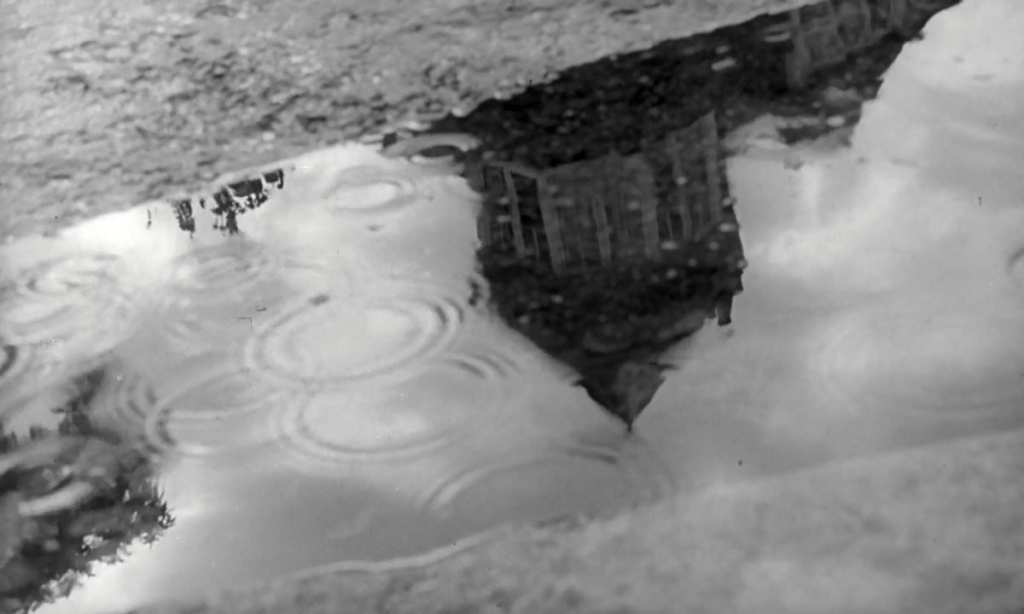
I’ve only ever seen British rain in the movies, a particular kind of rain that seems intent on keeping people indoors. Damp quietude where a slow-motion tempest may come forth, a private fantasy. What happens if it just sits in the parlor? What happens when it goes outside? In Bryan Forbes’s Séance on a Wet Afternoon, the dampness that clings to the suburban gutters of Wimbledon eventually gets inside the woodwork, soaks into the carpets, the heavy drapes, and fills the Victorian villa where a medium, Myra Savage, and her devoted husband, Billy Savage, live. This is a crime thriller, yes, dressed in the sophisticated attire of an intimate chamber piece about grief and illusion.
Kim Stanley’s performance as Myra serves as a metronome, setting the emotional pace of the film while growing ever more disconcerting in its steadiness. (To better understand her mesmerizing presence, I’ve been studying up by reading Sophie Durbin’s essay on Stanley’s training method and acting techniques.) Forbes and cinematographer Gerry Turpin’s shadowy, claustrophobic framing throughout the Savage house, as well as Richard Attenborough’s hauntingly diminished performance as Billy, offer us very little reprieve from Myra, from the metronome. All the while, John Barry’s score acts as an internal monologue, intrusive repeating musical fragments that mimic compulsion and static obsession.
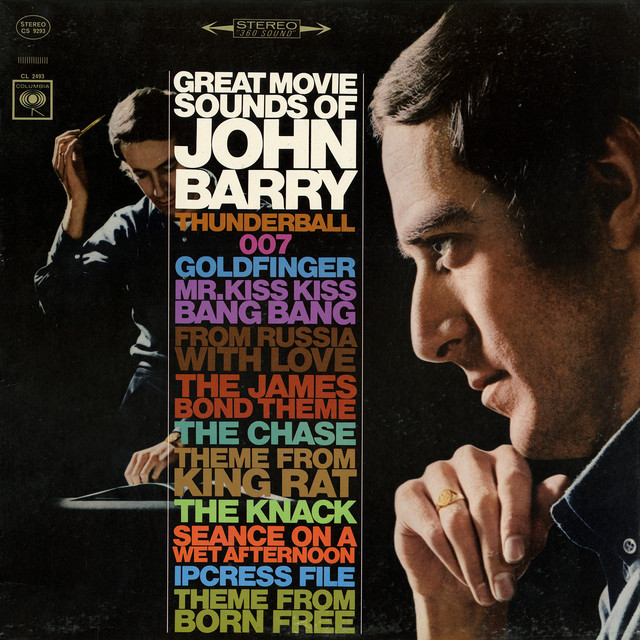
By 1964, John Barry had emerged as the chief musical architect of British cinematic cool, scoring and arranging music for James Bond films full of gleaming brass and electric guitar-strut. He was the composer who made the London sixties sound like sleek sports cars, vodka martinis, and glossy pop-art. For Séance, though, Barry turned down, turned inward. Here his score is at times so sparse that it feels almost indecent to eavesdrop on it. Yet, trapped in the house with Myra, we are indeed forced to eavesdrop. And it’s quite fitting to have learned just now that the obsolete original use of eavesdrop as a noun meant “the ground on to which water drips from the eaves.” From under the eaves, we hear muted brass that sounds like a foghorn in the distance with woodwinds and strings. Inside the house, a piano and harp trade off playing the score’s main theme—a melody that never feels quite complete in its cadence, a minimalist motif that mimics a mind on loop, pacing the dining table at midnight.
Against this damp anxiety, Forbes and Barry set a musical artifact from an older, more pious England: Felix Mendelssohn’s 1844 sacred anthem “Hear My Prayer,” specifically its famous section, “O for the Wings of a Dove.” Ever since the boy soprano Ernest Lough recorded it at Temple Church in 1927 (a recording that sold millions of copies, setting the gold standard for the classic English choirboy sound), the track had served as national shorthand for pristine, domestic innocence. “O for the wings, for the wings of a dove! Far away, far away would I rove…” The song’s text is taken from Psalm 55, a lament about grief and deliverance, the desire to escape anguish and fly away to find rest in the wilderness.
“My heart is sore pained within me: and the
terrors of death are fallen upon me.
And I said, Oh that I had wings like a dove!
for then would I fly away, and be at rest.
Lo, then would I wander far off, and remain in
the wilderness. Selah.”
With ancient Greek origins (διάψαλμα), the enigmatic word “selah” there is often considered a linguistic-musical sign that calls for a sudden instrumental interlude or rhythmic modulation.
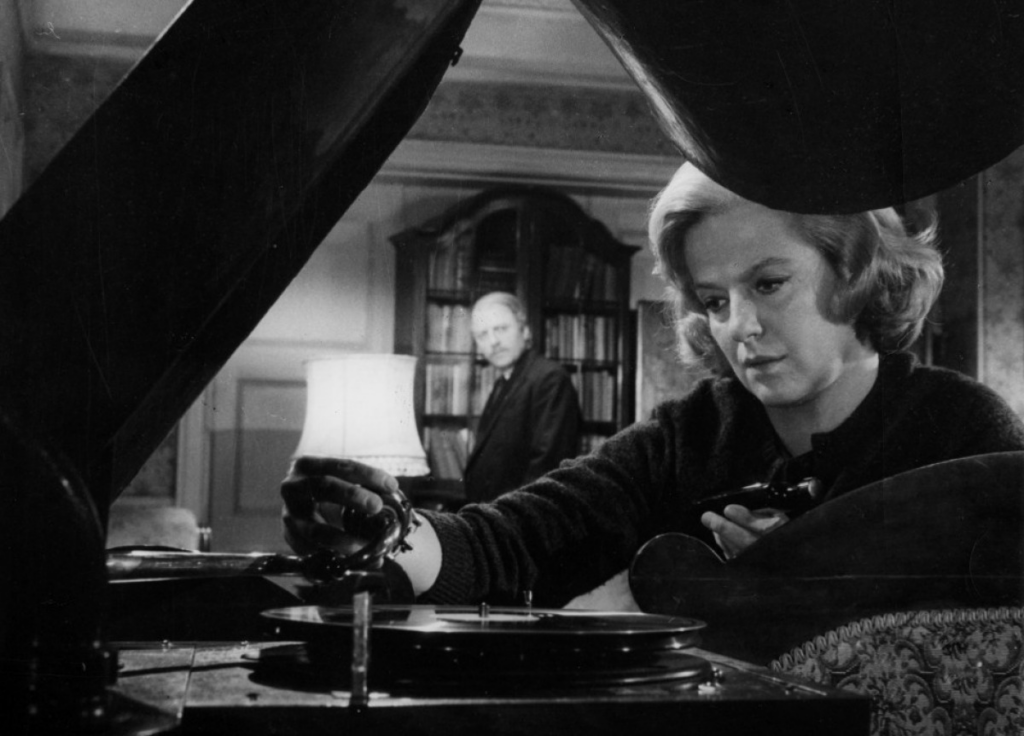
Myra repeatedly plays the song on the Savages’ parlor gramophone. The boy’s voice evokes an idealized childhood, a tragic irony in its own right. But there’s also a fascinating spiritual dissonance that comes from hearing a piece of orthodox sacred music played as preparation for séances inside a home devoted to mediumship and the occult. The physical act of Myra placing the needle on the vinyl record turns a holy hymn into a mechanical, repetitive domestic ritual. Mendelssohn’s liturgical music offers the illusion of vertical ascent, a soaring plea and promise to rise above human suffering. While Barry’s cyclical score grounds us in the relentless horizontal reality of the Savage house. It’s no wonder that stairs play such an architectural role in this film.
For the Cult Film Collective’s presentation of Séance on a Wet Afternoon at the Trylon, we are experimenting with a unique format, the inauguration of a new series: “Missing Reels.” We recently bought our 35mm print of Séance from Tom Letness, former owner of the Heights Theater. Over time, one of the seven reels was either damaged or lost, which often deems a print essentially worthless. So, we decided to present our incomplete print in the spirit of the Collective—live and in person. During the screening, the missing sixth reel will be conjured live in the theater with music and a cast of local actors featuring Madeline Lenarz-Hooyman as Myra Savage, Riley Moynihan as Bill Savage, Sophie Durbin as Detective Walsh, and Greg Hunter as Narrator.
Edited by Olga Tchepikova-Treon