
| Terry Serres |
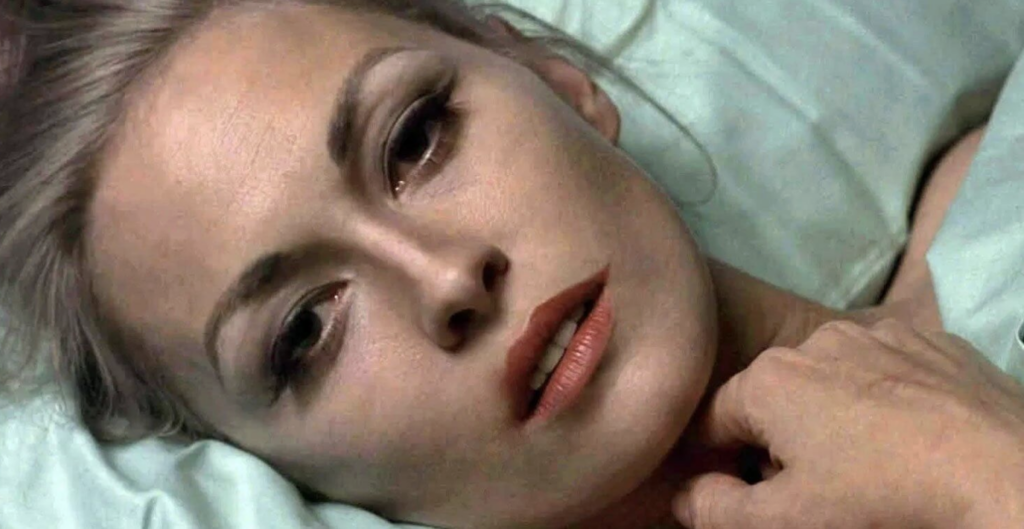
Puzzle of a Downfall Child plays in glorious 35mm from Friday, December 19th, through Sunday, December 21st. For tickets, showtimes, and other series information, visit trylon.org.
Lou Andreas Sand (Faye Dunaway) is a former fashion model, retired after a nervous breakdown. Still vain and insecure, we find her holed up in her beachside aerie, where she is interviewed at length by a collaborator from her heyday, the photographer Aaron Reinhardt (Barry Primus). The reel-to-reel tape is a metaphor: for the transfer of information and impressions from one party to the other, but also for Lou’s unraveling. Her story is told through these dialogs with Aaron intercut with flashbacks (and flashbacks within flashbacks) from Lou’s professional and personal life: her début and rise in the cutthroat fashion world, her troubled and troubling relationships with men.
The stark setting reveals much. We see Lou “washed up” on the beach; her last name is “Sand” and she is in fact surrounded by sand. Her hair color is sandy and lacking in luster, and her complexion is dull. From the vantage point of the shore in the first shots (made even more obvious in later shots), the grassy slope and modest cottage resemble another beachside scene: the canvas of Christina’s World, Andrew Wyeth’s mid-century masterpiece depicting a girl recumbent, looking away from the viewer and up toward the house perched atop the slope, as though crawling in that direction. (The real Christina Olson, unable to walk, famously refused to use a wheelchair to get around.)
All of this helps to establish Lou’s isolation. Throughout the narration and flashbacks, Lou calls herself a recluse, and we are inclined to believe her. Even her given name, Emily, is suggestive of another famous recluse. This veracity is important, because our protagonist is the classic unreliable narrator otherwise. Her tether to the truth is tenuous at best. This emerges early on during a flashback to her account of a formative affair—with a wealthy, famous, and much older man when Lou/Emily was just a schoolgirl of sixteen. Later on (still in flashback), Aaron asks Lou, “Did you really have an affair with an older man when you were sixteen? Is that true?” To which Lou curtly replies, “I was fifteen.”
Another flashback scene again brings Lou’s unreliability as a narrator to the fore, and connects it to her vulnerability. Lou has been lassoed into dinner with Aaron and his fiancée, a dancer, just after meeting her. Given Aaron’s past with Lou, the situation feels forced, and Lou leaves the restaurant early. Instead of going straight home, Lou stops at a bar. Under the circumstances, we understand her impulse to seek companionship elsewhere. Here Lou appears at her most glamorous in the entire film—in a slinky red sheath surmounted by the bulb and brim of a red fedora. But a prize fight is being televised, and not a man in the joint notices Lou. She leaves, sweeping dramatically toward her red convertible, when a man calls out to her from a vehicle across the street, recognizing her as Emily. Perhaps intent on confronting her with her past, he trails her to her apartment; he is waiting outside in the running vehicle when Lou takes a call from Aaron. Her peril feels genuine, but Lou’s embellishments veer into the improbable: “He’s in my apartment right now! He thinks I’m a communist!” To demonstrate, she holds the receiver out the window, calling out to the distant stalker to say something—one floor down and across the street and obviously not embedded in Lou’s apartment. While patently false, Lou’s flourishes accentuate the immediacy and randomness of the situation, Lou’s emotional truth. Aaron is dubious about her situation and brings up past untruths: her response when cornered is, “I did not lie in Paris, I just made it up!” She is oblivious to how comically jarring this confession is: the two halves of the sentence coexist without conflict.
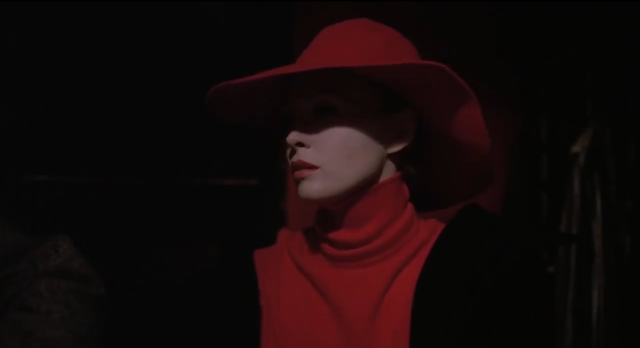
All dressed up and nowhere to go: Lou seeks refuge in a sports bar, after an awkward dinner with her photographer and his brand-new fiancée.
Back to Lou’s isolation. What’s striking is that the depiction of Lou’s downfall, even her slide into drug and alcohol abuse, diverges from fashion-world tropes of hard-partying girls soaring a little too close to the mirror ball. This isn’t the delirious, swirling spiral depicted in films like Mahogany and Gia. Lou isn’t snorting coke or shooting heroin, she’s popping pills and drinking rosé. Lou’s troubles seem rooted less in the compromises to her spirit required of her profession, though these are not underplayed, but in her unresolved issues around men. These relationships are such a tangle in Lou’s mind and soul and even in her memory, that the men’s identities conflate in the late scenes depicting her post-breakdown hospital stay. The conflation is focused on, but not limited to, the psychiatric and emotional caregivers in her life. (If anyone ever needed a therapist who wasn’t a man, it’s Lou.) These nightmare scenes are shot in blinding, fluorescent white: everyone’s clothes, the surrounding walls, all the furniture, even the flowers in their vases are institutional white.
The film, constructed from fragments of memory, is indeed a puzzle whose pieces suggest the downfall, the disintegration of a childhood. There are numerous signs, tragic signs, pointing to a trauma that cannot be stated outright. The most explicit indication, perhaps, is a statement that Lou makes on more than one occasion, its almost word-for-word repetition conveying the sense of a credo: “If a person wants something, he should just take it.” The first time we hear this is during a flashback to when Aaron, early on in their collaborative life, asks Lou if she is attracted to him. Lou’s panicked response—a man should just take what he wants—suggests that the mere notion of consent instinctively repels her. The scene segues into a double-flashback illustrating the root of Lou’s lack of agency: Lou describes the older man’s attentions, his proposal of marriage before leaving on a trip to Las Vegas that ends in a fatal plane crash. But the accompanying visuals suggest something darker: a girl in a maroon parochial-school uniform walking along, being slowly trailed by a hulking black sedan; the memory cuts to images of an older man in a trenchcoat looming over Emily on the ground hidden in tall grasses. Remarkably, in the flashback framing this double-flashback, Lou is dressed similarly to her younger self, in a red cardigan and broad-pleated grey skirt; this device repeats during another scene revisiting this affair. The choice to have Dunaway appear not a day younger than her already mature-looking 29 years only makes these scenes creepier, as though the adult Lou is stuck in her past. Cumulatively, we are left with the understanding that what occurred was not just statutory rape but sexual assault the direct memory of which Lou cannot access. Lou has recast her rape as a meaningful affair complete with marriage proposal.
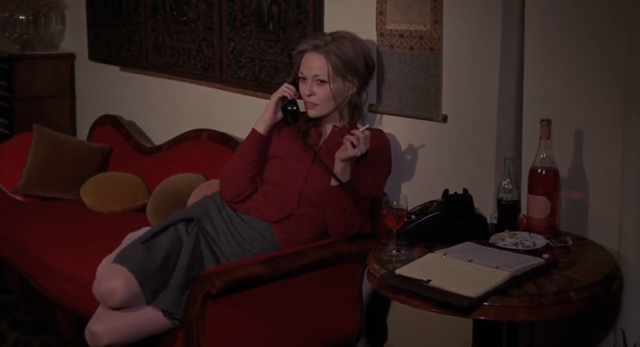
Downfall Child: Lou in her emotional spiral, wearing the cardigan and pleated skirt of a parochial schoolgirl.
Numerous other pieces to this puzzle litter the film. Perhaps the most overt example, symbolically, is her first fashion shoot. Up to this point, her main contacts in the world of fashion have been women—an agent, an art director. Here she is on her first shoot with the renowned photographer Falco (Emerick Bronson). Falco discusses his new model with his colleagues on the shoot, using the most dismissive and dehumanizing terms—and indirectly, in the third person, as though Lou weren’t standing there right in front of him. But not only is Falco the namesake of a raptor, an apex predator, the shoot itself involves the trappings of falconry! The crew foists upon the novice model a gauntlet with a live bird flapping violently at the end of the jess or leash, provoked by Lou’s extravagant headpiece fashioned from raven’s feathers.
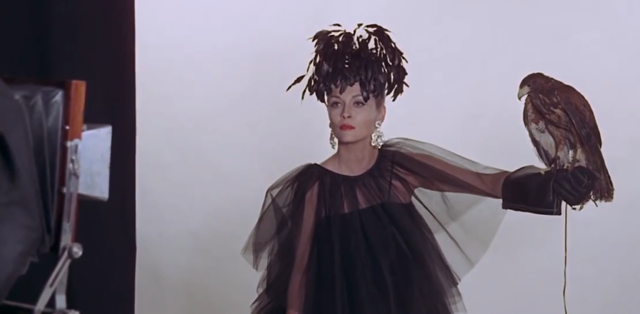
Caveat raptor: Lou Andreas Sand’s first fashion shoot.
After two viewings, I don’t notice suggestions of sexual assault in Lou’s engagement with an ad executive named Mark (Roy Scheider at his most suave). But physical assault is suggested after the ambivalent Lou (in a dress reminiscent of Jeanne Moreau’s in The Bride Wore Black from two years prior) jilts Mark at New York City Hall. No character’s name in Puzzle is random, and “Mark” does double duty by denoting both a trademark professional and the black eye that is his parting gift.
Aaron Reinhardt, the interviewer who is also a key player in many of the flashbacks, is clearly Lou’s richest and most layered relationship. He is ostensibly researching a film based on Lou’s career, but we wonder what else may be motivating his excavation of the past in these interviews. Sometimes it feels as though he is trying to coax Lou through her trauma by giving her voice. But there are flashes of selfishness: he refuses to hear Lou recount her work in Paris (with a boy-toy in tow), insisting that his film’s budget prevents shooting on location in France. Cobbling together the fragments of memory, we come to understand that each of them did meaningful work in Paris, but separately. The feeling hovers over their connection that a collaboration in the City of Light may have led to an artistic and romantic highpoint that they conspired stubbornly to avoid. (The film’s byline could have been: “We’ll never have Paris.”) At film’s end, it emerges that Lou and Aaron likely did have a brief affair—one that Lou has either forgotten or assumed to be one of her distortions of truth, or that Aaron himself fabricated to coddle his ego as the only man in Lou’s orbit not to have slept with his muse. However, if the theory of character names is to be trusted, then we must assume Aaron Reinhardt to be “pure of heart.”
There are hints at healthier affectional choices to be found in the flashbacks, but they are fleeting: she takes under her wing a young male model nervous about the sexual angle of their shoot, with a charming reenactment of a scene from Shanghai Express. She is touched by the chaste request of a handsome older gentleman for a single photo autographed by her. Then there is the elusive Mr Wong, a solitary Chinese man who fishes on the shore near Lou’s cottage each morning, whom Lou in her windswept isolation approaches with sparse and one-sided conversation. The stoic Mr Wong, whose name if not his very being is one of Lou’s inventions, remains indifferent to his neighbor—despite holding his fishing rod like an erection.
Despite the tony setting and trappings, Puzzle of a Downfall Child is less an exposé of the world of fashion and more a sensitive study of a woman whose beauty is matched only by her tremulous vulnerability. This is a film that insists we believe women while allowing that the woman in question is an unreliable narrator.
Edited by Olga Tchepikova-Treon