
| Dan McCabe |
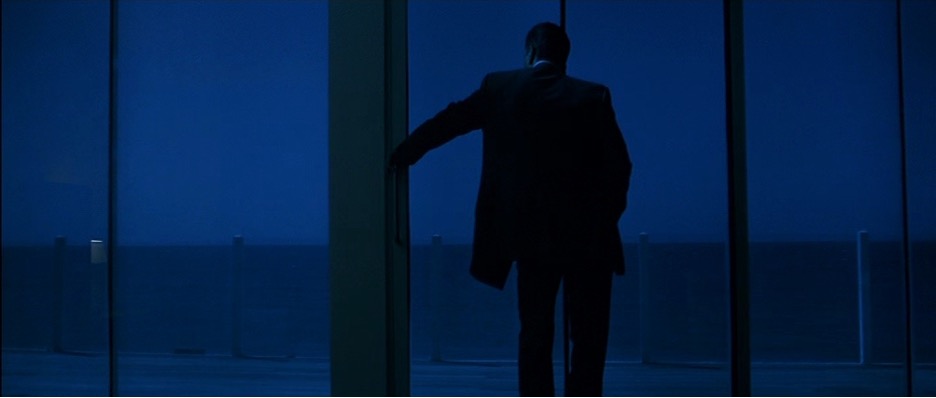
Robert DeNiro as Neil McCauley in Heat (1995). The dim lighting of scenes like this one help set the mood for Michael Mann’s classic crime drama.
Heat plays at the Trylon Cinema from Friday, April 10th, through Tuesday, April 14th. For tickets, showtimes, and other series information, visit trylon.org.
When I was a college student, I worked at the front desk of my dorm. The shelf beneath the window stored a few hundred VHS tapes, which residents could rent by dropping off their university ID card. One rather uneventful night, I browsed that collection for a movie to rent. If I recall correctly, only a handful of the available films warranted double VHS tapes. Titanic (1997) was one, of course, another was a movie that, at the time, I wasn’t familiar with. I decided to take a chance on Michael Mann’s Heat (1995).
What began with renting Heat that evening evolved into a tradition. At the end of every semester then on, I borrowed Heat and watched it in the background as I worked late into the night on my final paper of the semester. Because of this routine, in my mind’s eye the last scene in Heat takes place at about three or four o’clock in the morning, just before sunrise. You’d have to ask Michael Mann if this is true, but to me, Heat will always be a movie of a certain (late) time and place.
I’ll be writing about Heat in some detail below. If you want to avoid plot details (perhaps before you stop by the Trylon from April 10th through April 14th to see it), this is your warning.
Heat, of course, has much more than personal nostalgia going for it. It is often cited as one of the finest action movies ever made, and Michael Mann’s masterpiece. Of course, I didn’t know that when I first rented it on VHS. I revisited it this past summer after neglecting it for some years as a result of a bad DVD transfer (you could turn up the TV to full volume and still not hear it). What struck me immediately is how well it holds up. Action films of the 1980s and 1990s have a reputation of aging poorly for a variety of reasons, but Heat has a depth to it that makes it stand out. The time that Mann spends on the inner lives of the dual leads and the many secondary characters provides an impressive scope, which allows the film to transcend the typical police procedural fare that one might find in lesser movies of its genre.
Make no mistake, at near three hours, Heat is a long film. It wouldn’t have warranted two VHS tapes if it weren’t. The trick that great movies pull on the audience, though, is that long movies can feel short. Watching Heat again after a number of years, I think it’s because nothing in the film feels inessential. Sometimes there are scenes in movies that you watch and think, “well, they could cut this part.” Heat has no such inefficiencies. It is a masterpiece of structure.
Every scene in Heat builds to its three main set pieces: the coffee shop meeting between Detective Vincent Hanna (Al Pacino) and professional bank robber Neil McCauley (Robert DeNiro); the shootout at bank heist; and the conclusion at LAX. Every other scene is buildup to, or fallout from, one of these three scenes.
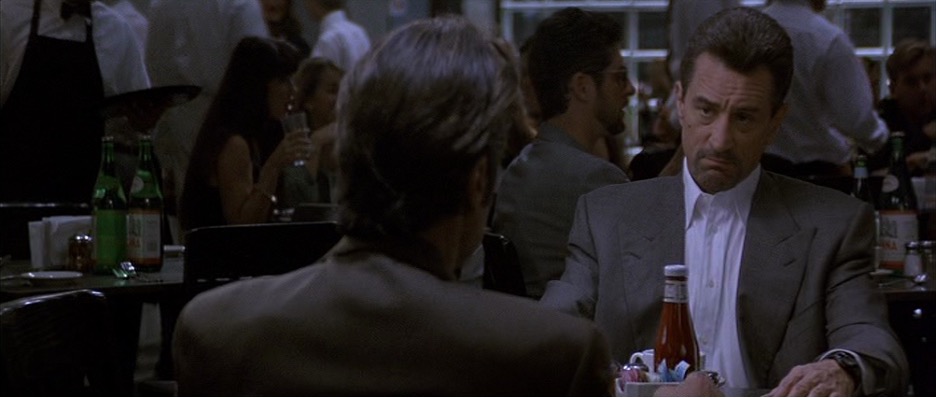
Robert DeNiro and Al Pacino in Heat. This scene was the first featuring both actors together.
The Face to Face Meeting
The meeting between Hanna and McCauley is the first scene where Robert DeNiro and Al Pacino play characters in the same scene. This happens again at the end of Heat, but the two actors wouldn’t share a scene together again until 2008’s Righteous Kill. I make this point because Heat is considered a genre classic, while Righteous Kill was a box office and critical failure. Hence, the mere presence of two great actors does not always result in a successful scene.
What makes the meeting between Hanna and McCauley so provocative is not the skill of the actors alone, but the time that the film takes building their characters. Heat has established that McCauley is a master criminal who lives by the mantra of not getting “attached to anything you’re not willing to walk out on in thirty seconds flat if you feel the heat around the corner.” He’s already started to break that rule by falling for a woman he recently met named Eady (Amy Brenneman). The scenes with Eady deepen the complexity of his character, showing that he’s more than a stock villain.
Hanna, in some ways, is less complicated. He doesn’t live by any mantra, he’s just looking to close his next case, and willing to set aside anything in his life that gets in his way. This is why he’s been divorced a couple of times and is well on his way to another one. Yet, he knows this. He’s acutely self-aware that his commitment to his job as an LAPD detective turns everything else in his life into a disaster zone. When he confesses that to McCauley, we’ve seen it already in previous scenes, and his self-awareness brings the character closer to the audience.
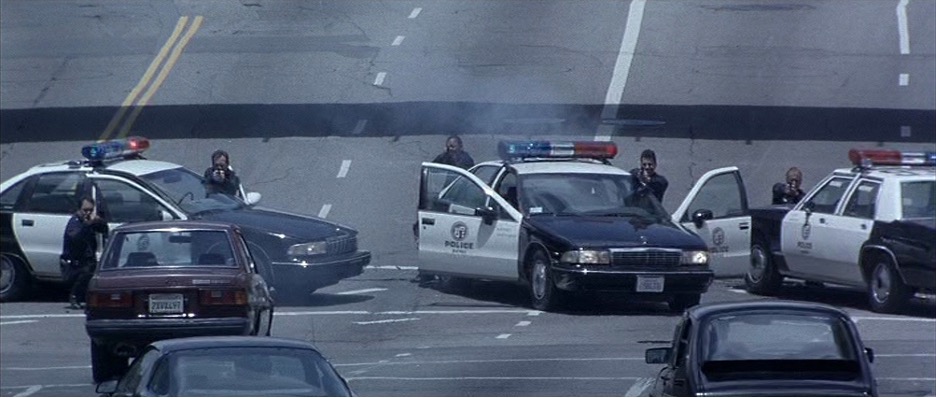
The bank heist shootout is the key action sequence in Heat. It’s loud and compelling.
The Bank Robbery
The bank shootout in Heat is a pinnacle of action cinematography. Breaking down that scene alone could easily warrant its own article — it’s that good. However, like the coffee shop meeting between McCauley and Hanna, the scene works especially well because of the foundation of character development.
Mann spends considerable time building up secondary characters in Heat. We see the deteriorating relationship between Chris Shiherlis (Val Kilmer) and spouse Charlene (Ashley Judd), which Mann directs in a way to make Chris sympathetic. When Chris is seriously wounded during the shootout, the audience knows that there are real stakes behind whether he lives or dies.
Likewise, there’s the sad backstory of Don Breedan (Dennis Haysbert), an ex-con trying to stay clean. When Neil needs a getaway driver at the last minute, Breedan signs up for one last score, which claims his life. Mann could have easily cut Breedan’s backstory. By keeping it in the film, he raises the stakes of the shootout scene because it gives the audience another point of attachment to the secondary characters.
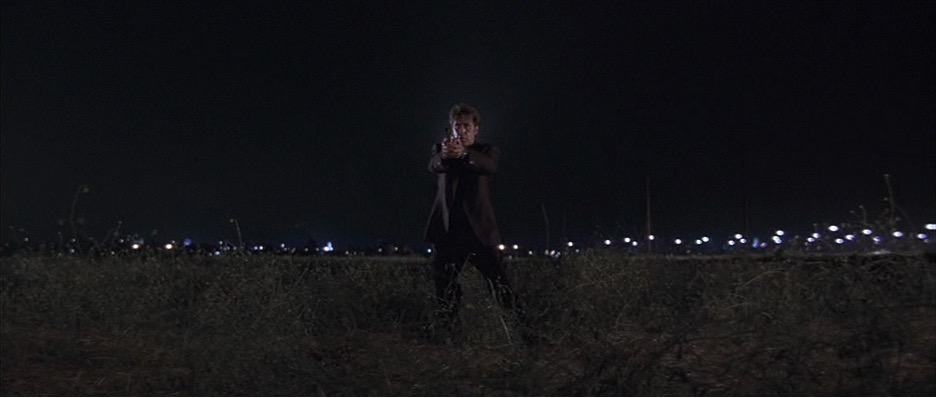
Al Pacino in Heat, during the film’s end sequence.
The Final Confrontation
The ending of Heat sticks with me more than the end of most films, and I don’t think it’s only nostalgia for the way I first experienced it late at night back in college.
At this point in the film, who doesn’t want McCauley to get away? The only reason he doesn’t is that he goes back for revenge, to kill the man who set up his crew (the atrocious Waingro, played by Kevin Gage). In doing so, he exposes himself to Hanna’s task force.
McCauley broke his own rules to go after Waingro moments before he would have fled the country with Eady. Mann does go out of his way to portray Waingro as sadistically evil, as if to ask the audience how McCauley could resist doing so.
Hanna has all but given up on tracking down McCauley, and he’s had a horrible night. Still, he leaves the hospital after a family tragedy to continue his pursuit of McCauley. He confesses to his wife Justine (Diane Venora) that, “All I am is what I’m going after.” He goes to the airport hotel where his task force is waiting for McCauley to come after Waingro and catches a glimpse of McCauley.
What follows is a chase through the backlot of Los Angeles International Airport. Like the bank shootout, it is a masterpiece of tension. Mann chooses the right angles and background elements to keep the audience glued to the scene. But what strikes me most is not the chase but the resolution.
After Hanna fatally shoots McCauley, he stands over the dying bank robber. McCauley reminds him of what he told Hanna during their face-to-face meeting earlier in the film, that McCauley would never go back to prison. McCauley reaches out his hand, which Hanna holds as McCauley dies. The camera zooms out to show Hanna standing over McCauley for several seconds as Elliot Goldenthal’s score builds to a crescendo. I don’t have to watch this scene to imagine it clearly in my mind.
Hanna was always going to hunt down McCauley until he couldn’t hunt him anymore. All it took was one out-of-character choice by McCauley. Still, as Hanna stands over his slain quarry, he doesn’t look particularly satisfied. There’s no joy in Pacino’s eyes, and no satisfaction. Tomorrow, he’ll find a new criminal to track down.
Why is it so effective? Because of the work that Mann, Pacino, and DeNiro put in building these characters up. Everyone and everything around them has been so richly detailed for the previous three hours that the resolution of the film feels fully alive. Did McCauley deserve to escape or to perish? Did Hanna deserve to catch his man or not? The fate of both men logically and compellingly flows from the actions they take throughout the film.
Overall, Heat is a masterpiece because all of its pieces fit so well together. Scenes that other directors might have cut to keep the runtime down add to the depth. It remains a long movie, but an exceptionally good one, even if you’re not watching it at 3 am after finishing your last paper of the semester.
Edited by Olga Tchepikova-Treon