
| Lucille Hanson |
Je Tu Il Elle plays at the Trylon from Sunday, September 27th, through Tuesday, September 29th. For tickets, showtimes, and other series information, visit trylon.org.
The following piece contains spoilers for Je, Tu, Il, Elle and also contains descriptions of sexual content.
“It snowed. I figured that, in any case, life had come to a halt, that nothing more would happen, and that I should wait for the snow to stop and then melt. It snowed for a very long time. Four days.”
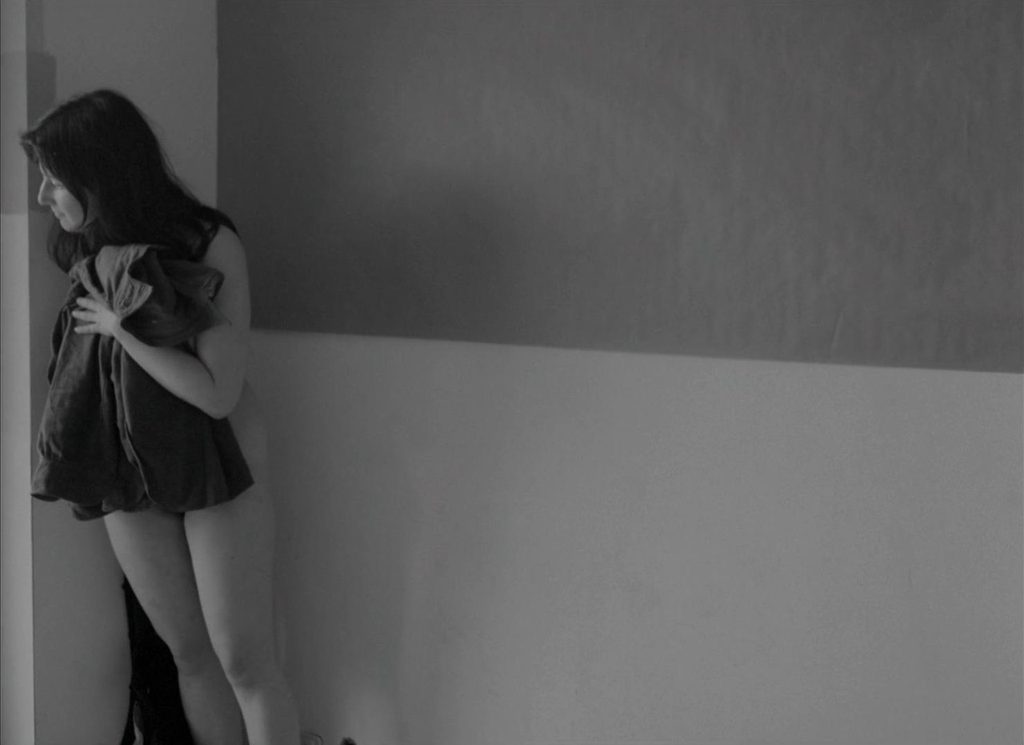
Impulse is a fascinating urge to me. Acting on instinct, where it’s hard to distinguish Want from Need. It’s something I struggle with constantly, which is why I’m drawn to depictions of it. In Je, Tu, Il, Elle, Julie (writer-director-producer-actress Chantal Akerman) eats sugar out of a paper bag by the spoonful, writes and rewrites a letter for no one, paints her furniture (and repaints it the next day) and stares at her wall. What else is there to do when you’re severely depressed in a way that’s hindering your life from progress? It’s a distraction from the thoughts burdening your mind, a quick moment of “productivity” to make you seem busy. I want to write this letter. I want to paint this chair. I want to eat something sweet. I NEED to write this letter. I NEED to paint this chair. I NEED to eat something sweet. After it’s done, what’s left? You did the deed, but effectively what did that do? You’re still stuck in a room, naked and alone, watching the snow fall around you.
I’ve been really vulnerable with some of my writings recently. Back when the Trylon screened Cisco Pike in June, I was an emotional wreck, which slowly spiraled into something worse that was still going by the time I started writing this piece. I told myself I didn’t want to do that with Perisphere, but I find it impossible to not do that here. How the hell do I write about this movie without getting personal? One of the last times I watched Je Tu Il Elle was shortly after I had the worst mental breakdown that I’ve ever had, and the movie just struck an even deeper chord than before. One where I isolated myself, and was so scared to even move, let alone do anything. I hadn’t seen the movie in 5 years.
When I was younger and getting into writing, I remember being told that writing about your emotion towards the piece was a bad thing. You needed to focus on what you were writing about more than what it made you feel. As I’ve gotten older, I’ve realized that’s a load of bullshit. Yes, you should write about the topic at hand (in this case a movie), but the reason why we love movies is that every way you watch, enjoy, or dislike a movie is because of an emotional connection. I go to this theater because it makes me feel happy. I prefer watching stuff on Blu Ray because I like the better picture quality. I hated this movie because of how it made me feel. There is no way to separate your own emotions from a piece of media, so how could you expect to do that whenever you’re writing about it? To write without emotion is to become a robot, a husk of a person. You write about why the movie works to YOU. I have to accept that about Je, Tu, Il, Elle. The entire movie works so well especially if you’ve dealt with this kind of stagnant loneliness: the kind where you don’t know what to do, except whatever keeps you busy, to distract from thought. Painting the wall one color, and then repainting it the next. Rearranging your furniture. Eating sugar out of a bag. It’s an impulsive act, all to keep yourself from spiraling. So why do I expect myself to be able to look at this and separate my own emotional connection?
About a month ago, I broke up with my long-distance boyfriend of 4 and a half years. We’re still very close friends, talk and hangout whenever we get the chance, and by the time this piece is posted I’ll be seeing him in 2 weeks. I still miss the romance, even though I know I can’t handle it right now, especially at such a distance. As much as I know that I needed it to help readjust myself, and put myself back on the right track, I always feel like it was a mistake. I’m still not used to the big change of it all. There are times where my impulsive urges hit strong. I hold myself back because I’ve been there before, and I’m sure Julie had that impulse multiple times in her head, holding herself back, thinking something like “No, that’s stupid. Why would I do that?” But sometimes, like in Julie’s case, that impulsive tension gets too much to bear, and you act on them because it feels like you have nothing better to do than act.
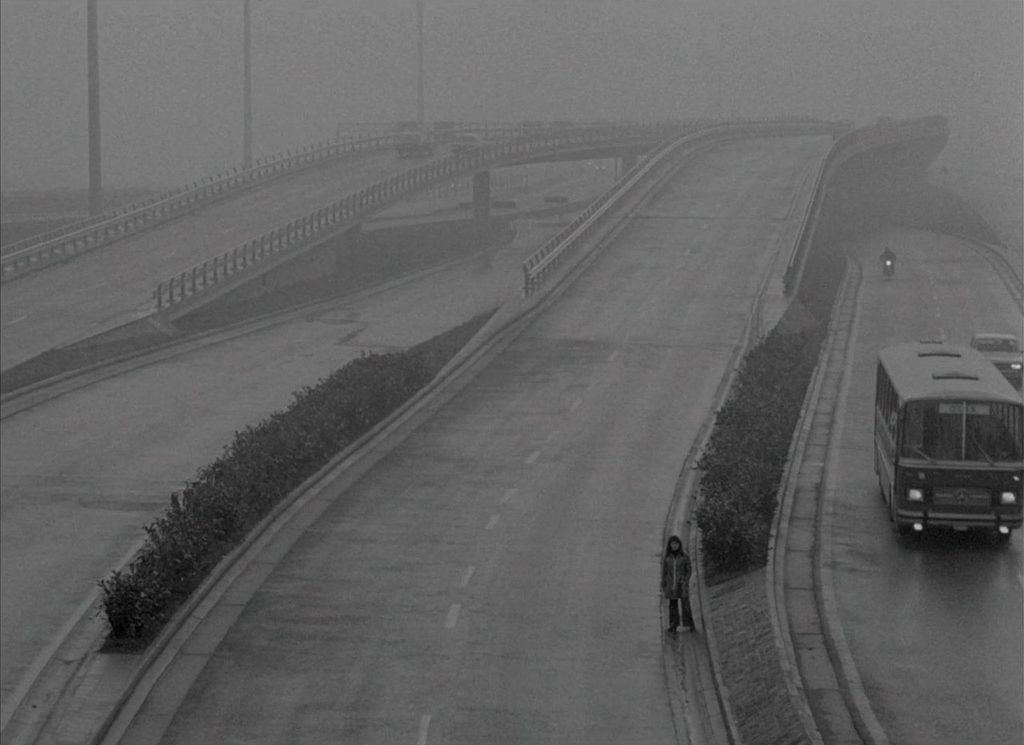
Julie’s biggest impulse starts with her admiring her own naked body in the reflection of her window. Then suddenly, she’s putting on clothes, and we cut to her standing in the highway, hitchhiking. It’s an impulse that I’m sure people can relate to, even if even if you’ve never actually done it or acted upon those urges yourself: Abandoning the “comfort” of your own home to pursue an urge that you feel unsure about. The lonely urge to be desired so bad that you would do anything to make it happen. She gets picked up by a truck driver on the side of the highway, and sleeps in the back of his truck. She only has two thoughts: “He said I could lie down on his bed because I must be tired.” and “I thought I wanted to kiss him.”
Julie has two sexual experiences in this movie: one with the truck driver who picks her up, and one with her ex. With the truck driver, Akerman and one of the 3 cinematographers (Bénédicte Delesalle, Renelde Dupont, and Charlotte Szlovak) frames the action as solely focused on him: a side view shot from the chest up as he receives a handjob. The truck driver is self centered, seeing the idea of sex as merely stress release. His gross comments and the way Julie is just outside the frame goes to show that to Julie and especially the driver, this is all about him. When they stop at a rest stop to get some food, they make no communication. When he rambles about his wife and previous hookups, Julie sits and listens, not saying a word. Julie mentioned in voice over that she “thought (she) wanted to kiss him,” and that’s true. Everything that they do feels like the vague semblance of emotional or physical intimacy, as if this was all purely transactional, and nothing more. When it’s over, it’s over: just thoughts and urges. They have no connection outside of a means to a destination.
When Julie and her ex meet, her ex asks her to leave. The two hug, but Julie can’t get herself to leave, and her ex can’t bring herself to ask again. They stare at each other with an awkward sapphic tension, share a meal, get a little handsy and then we get 13 minutes of their naked bodies intertwining on their mattress. Unlike the truck driver, they’re both always in frame. It’s not about one or the other, it’s about them both. Both of them combined in a moment of connection, drowning out life around them, focusing on each other. But again, like the truck driver, when it’s over, it’s over. Julie gets out of bed in the morning, grabs her clothes and leaves. There’s no catharsis, no grand revelation. It was all just impulse—like eating out of a bag of sugar—desire overtaking them both, their loneliness temporarily turned into hunger. I want to have sex with my ex. I NEED to have sex with my ex. Okay, you’ve acted on your impulse. Now what?
When all the impulse and desire leaves your body, what is there left to do?
Edited by Olga Tchepikova-Treon