
| Caitlyn Speier |
Wargames plays at the Trylon Cinema from Friday, November 6th, through Sunday, November 8th. For tickets, showtimes, and other series information, visit trylon.org.
Growing up as a child of two soldiers, conversations about politics were sparse. My father graduated from West Point and maintained the rather officerly position that soldiers shouldn’t really speak about politics openly, because they were expected to serve under the commander-in-chief- whoever that may be. I did, however, know that War Games (1983) was one of his favorite movies. In discussing the movie with my parents for this article both enthusiastically shared that they first watched it on cable (via Starz specifically) when it came out and then again in the mid-90s on VHS while they were dating and stationed in Germany. My dad has always had a bit of a penchant for anti-war sci-fi. Starship Troopers (1997) is another all-timer for him. I don’t always agree with my dad, but I remain eternally curious about his insights and experiences. As gen-Xers, my parents grew up during the Cold War and then spent their adult lives in the military witnessing the Gulf War, reunified Germany, the Bosnian Genocide, the Iraq War, war in Afghanistan and even got to see what maintaining the armistice between North and South Korea consisted of. Even through all of this, today they are tied to the news, confused and distressed about the world before us.
Recently, I attended a reading for a well-known author. On a few occasions he stopped to lament how unprecedented the times we’re living in are and that he simply cannot believe what he is witnessing. It’s a sentiment almost all of us have undoubtedly heard on repeat since at least 2016. And for whatever reason, this was the time it dawned on me… this is the same thing I’ve been hearing since 2016. It’s the same thing people said after 9/11. It’s the same thing people said after Watergate, after the assassination of JFK. Hell, I’m sure they said it about the Cold and Revolutionary Wars. When I was discussing recent news stories about the potential for AI to exterminate all of humanity with a friend, he expressed something similar: “Haven’t they been saying x,y, or z is going to wipe out all of humanity for our whole lives?”
It’s a disillusionment and borderline apathy that neither my dad nor this author seem to share. When I asked him about it, he was a bit exasperated trying to explain, “no, this is unprecedented.” In my more cynical moments, I ask myself after witnessing such a slew of American fuck-ups and atrocities, what could be filling this seemingly never-ending well of shock and disgust?
There are, of course, still news stories that shock and disgust me. Most recently, conversations about AI have been making my skin crawl and to a certain extent I find them boring. Seemingly every piece of science fiction since the conception of the computer has warned against the theoretical dangers of such technology. War Games is one of many entries in this sub-genre of science fiction. It maintains the soothing and familiar position that AI is scary, but it is also uniquely one of the lighter forays into the subject. Sure, Global thermonuclear nuclear war looms over this movie, but it never really feels like a potential reality—much in the way the computer views it, it’s just a game! And now that the technology has become slightly less theoretical, it’s weaseled its way into seemingly every corner of our industrial society, always with the background echo “hey, this could directly lead to the extinction of the human race.”
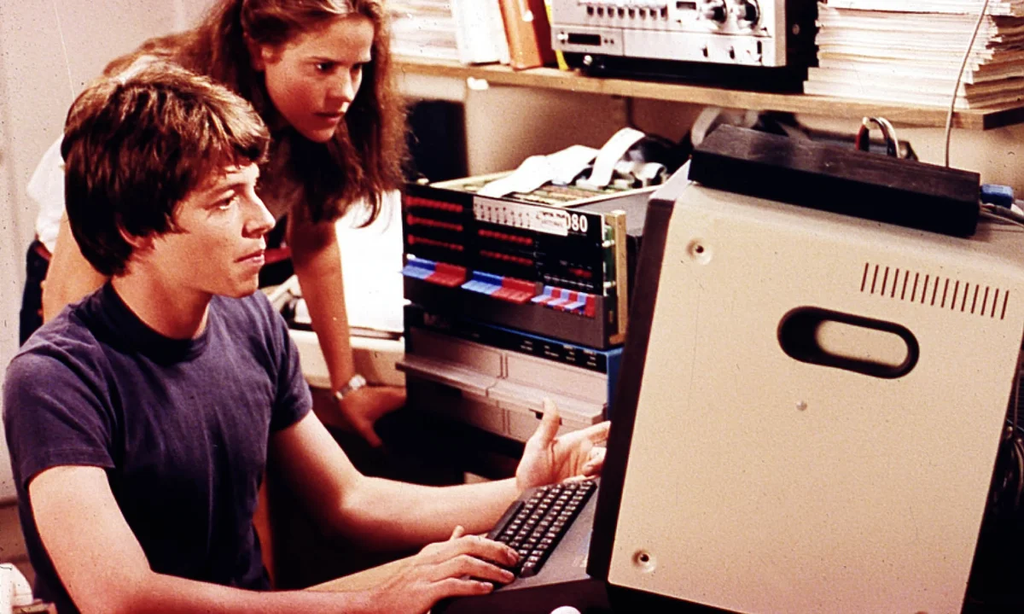
In order to perform this specific mental exercise in imagining ways AI could destroy all of humanity, we’re introduced to David (played by Matthew Broderick) as a computer-savvy, semi-slacker who has his sights set on accessing a pre-release collection of computer games developed by a private company. Instead, thanks to his broad sweep and an undisclosed backdoor, David unwittingly accesses a semi-autonomous game simulator that had recently been granted control of the United States’ store of nuclear weapons, and is tasked with launching them in accordance with potential simulated outcomes.
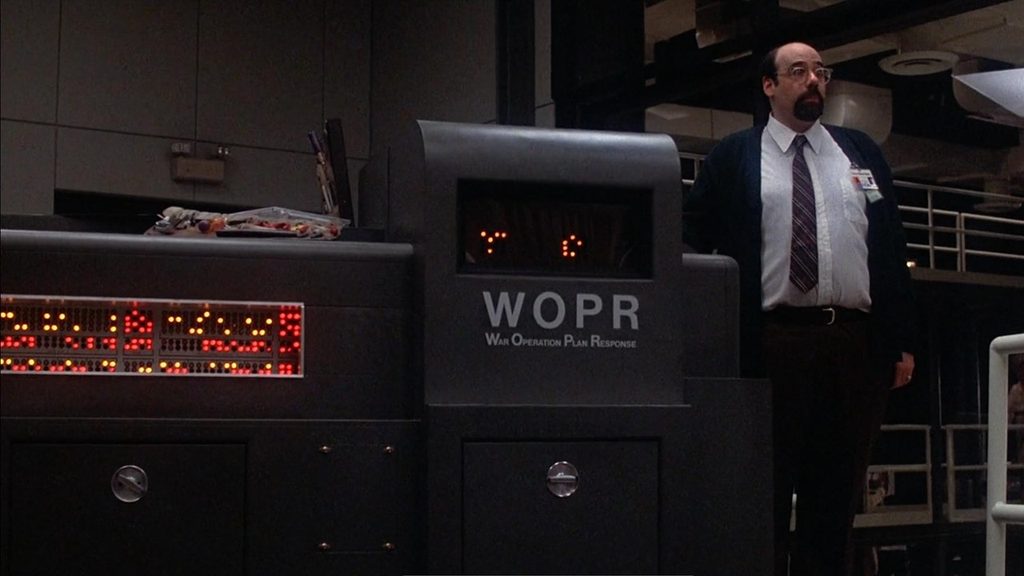
The move to computer automation occurred after a test of nuclear launch protocols revealed human agents (even highly trained ones) might defy an order to launch without sufficient information or confirmation. It’s a bit of a heavy-handed setup, especially considering the amount of unjustifiable violence committed BY humans on humans, yet it remains relevant. In recent memory, 168 people (110 of them being children) were killed this February after the US conducted an aerial campaign targeting an elementary school in Minab, Iran. Questions about the role of AI in this attack arose almost simultaneously with the Department of War announcing it would be cutting ties with Anthropic due to “supply chain risk.” Anthropic cited their concerns related to “maintaining guardrails over Claude’s use, forbidding the technology from being used in fully autonomous weapons or domestic mass surveillance” as being the source of the conflict.
Concerns about the effects of AI on the world run the gamut from psychological to environmental, but my concern at this moment is its role in conducting violence—because that is what War Games is about and that is what I discussed with my dad! Toward the end of the conversation, he mentioned the war theorist Carl von Clausewitz because we’d fallen pretty deep into our own personal rhythm of terminal philosophization on the meaning and politics of war and governance. He was referencing Clausewitz for his proposition that war can never be won in absolutes and in reality can only exist in a limited fashion. This was relevant in the context of American satellite wars, but is interesting in the context of nuclear war and AI. Notably, while conducting a bit of my own research on Clausewitz to better get a sense of this guy, I learned “Eisenhower was intrigued by Clausewitz’s denial of the existence of ‘absolute war’ and by whether or not the advent of nuclear weapons had changed the fundamental nature of major power conflict.”1 War Games is unique because it is focused on Cold War anxieties, centers around a child, and the semi-autonomous computer program isn’t omnipotent, otherworldly, or malicious. It does, however, seem to have the ability to wipe out the human race if you enter the wrong prompt.
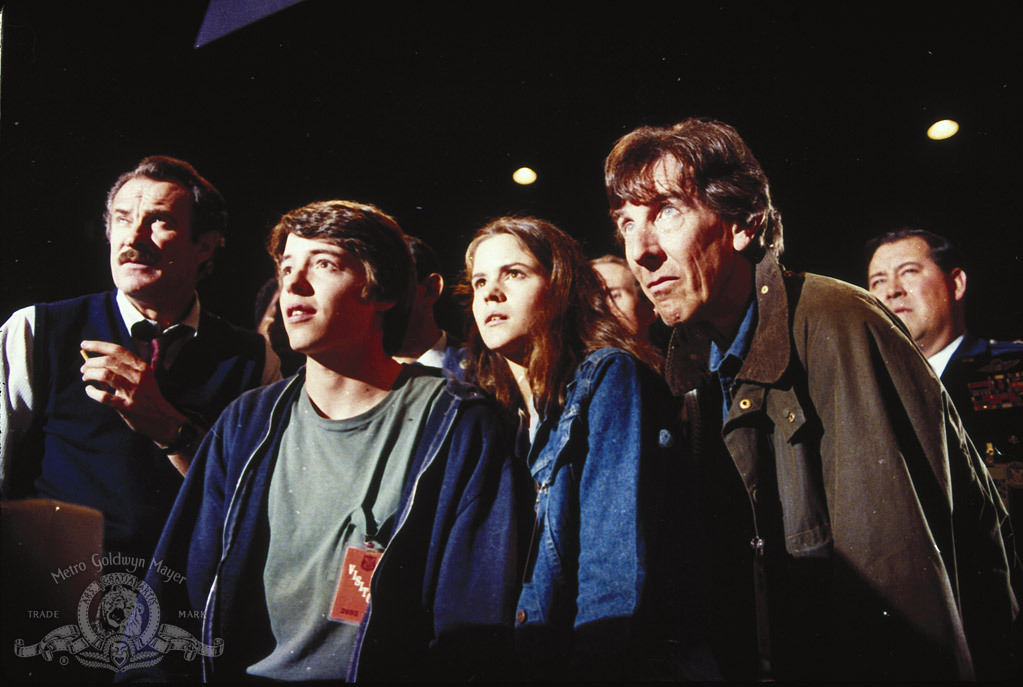
At the heart of this movie is the inventor of Joshua (the new name given by David to WOPR (the War Operations Plan Machine) who, after the loss of his family, moves off-grid. David and his partner in crime Jennifer (played by Ally Sheedy) desperately seek out Dr. Falken (played by John Wood) convinced he will know how to stop the machine from attacking. Much to their astonishment, when they find Dr. Falken he is a beacon of apathy (not much unlike what I described earlier), making claims like “Nature knows when to give up” and “Extinction is a part of the natural order.” David pleads and insists there is something that can be done and that HE personally has a lot to live for. Falken is steadfast enough in his position that David begins to mourn his and the rest of the world’s death. Hope is miraculously restored once Falken appears in a helicopter ready to at least try and stop Joshua on his war path. The problem remained: Falken was never able to teach the machine the concept of futility. How can you convince a computer programmed to win every game that there are some games where no one wins?
Day to day in 2026 can feel like having a front row seat to a parade of unsolvable problems. In response, our modern auteurs are asking us to consider what stories we are telling ourselves and how they will live on. Most recently in Digger (2026), Tom Cruise delivers the performance of a possessed man, defending his role in the recent catastrophic natural disaster that occurred as a result of the drilling and gas emissions of his company. Digger stands at a podium insisting the world can’t stop using fossil fuels because we don’t want to, that we’ve become utterly reliant on the comforts provided by oil. Beyond the realm of storytelling, exists a similarly possessed man on the other side of the conversation. Ted Kaczynski, more commonly known as the Unabomber, took to terrorizing the nation for over a decade to evangelize our need to disconnect from industrial systems before we destroy the world. I reference these two figures because they represent the most extreme edges of conversations about the future of industrial society. Both understand the potential threats; one is content to profit from them, the other violently and erratically rages against them.
These are some of the more nihilistic approaches to the question, but again, we have to give War Games its props for positing a much friendlier and optimistic approach- challenge the computer to a game of tic-tac-toe! Once prompted, WOPR is unable to beat itself in a game that consistently ends in a tie, goes into a terminal spiral, and reboots with a request to play Poker instead. How can we convince ourselves of the futility of war and extraction without running through the simulation ourselves?
The best I can make out, this is where stories matter. Every experience we have exists as a story for us to make meaning from and every story we hear transports us into the experience of another. We are all our own little simulations racing towards developing our own strategy for life. My parents grew up with stories that tic-tac-toe can stop nuclear war and so far the human race lives on. Maybe, on the bright side, unprecedented times call for unprecedented stories.
Footnotes
1R. Gerald Hughes, “Carl von Clausewitz and his Philosophy of War: The Evolution of a Reputation, 1831—2021,” The Journal of the Historical Association, Vol. 105, No. 368 (December 2020), pp. 773-805, https://www.jstor.org/stable/27187309.
Edited by Olga Tchepikova-Treon