
| Eric Sorenson |
Red Dawn plays at the Trylon Cinema from Friday, November 6th, through Sunday, November 8th. For tickets, showtimes, and other series information, visit trylon.org.
***Spoilers Ahead***
As a teenager in the early 1980s I drew bullseyes on a Rand McNally road map of Minnesota, centered on the Minneapolis-St. Paul airport and the Arsenal in Arden Hills, the two most likely targets of Soviet warheads, with each ring representing a different level of destruction. My friends and I made plans in the event of war to go to Aaron’s house (his dad had the most guns) and then drive up north to hide out, even knowing that northern Minnesota would likely be blanketed by fallout from massive strikes on the missile fields and bombers in North Dakota. Our heads were filled with terms like First strike, MAD, high yield, low yield, limited nuclear war, launch on warning, and we had dreams of Armageddon. How could you help but be scared for the future during the Cold War? What outlet did we have for all of this fear?
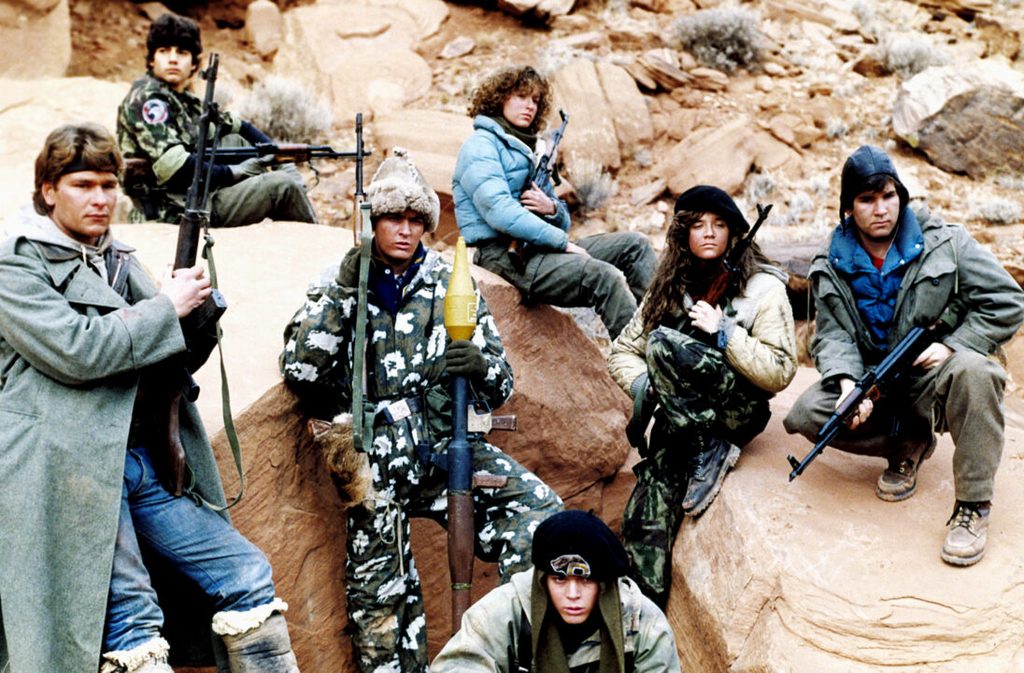
Red Dawn (1984) is dumb fun, but it reassured us that everything was going to be okay, even if the war we feared actually came to pass. It seems to scratch every itch of director John Milius: gratuitous violence, over-the-top patriotism, and male bonding. Not every hit from the past is worth watching today, but Red Dawn has its rewards if you can accept the jingoistic schlock it peddles as the price of admission. Released in the late summer of 1984, it pits a ragtag bunch of teenagers in Colorado fighting a guerrilla war against an invading Communist horde. And fight they did. Fittingly, it was the first film released with the new PG-13 rating, and the National Coalition on Television Violence condemned it as “the most violent movie ever made,” counting 134 acts of violence an hour. Charlie Sheen appears in his first major role as one of the teens alongside Patrick Swayze, C. Thomas Howell, Jennifer Grey and Lea Thompson.
With the assistance of General Alexander Haig and the Hudson Institute—a conservative think tank—Milius concocted a narrative of U.S. isolation followed by an invasion using commercial airliners carrying paratroopers from Central America and Cuba. The concept is ludicrous on its face and raises the questions of why it was made and why it was a success.
An argument could be made that the fall of 1983 was the peak of Cold War tensions, rising to a level not seen since the Cuban Missile Crisis in 1962. Anyone following international affairs at the time lived in a state of what we’d now call hypervigilance, fearing that each new confrontation (the shoot down of KAL 007, Operation Able Archer) could trigger what WarGames (1983) (also showing at The Trylon November 6-8) called “Global Thermonuclear War.” This was before Glasnost and Perestroika, with only the Solidarity movement in Poland providing a glimpse of what was to come. The idea that the Soviet Union would cease to exist in less than a decade was unimaginable.
It was in this environment that principal photography began on Red Dawn in Las Vegas, New Mexico, on November 14, 1983. For everyone not on the film’s crew, the invasion that would have been on people’s minds that day was Operation Urgent Fury, the previous month’s airborne and amphibious assault on the tiny Caribbean island of Grenada by the United States. Within days, the local Grenadian forces along with their Cuban advisers had been defeated and the island’s revolutionary military council had been captured with only some small pockets of resistance remaining. Although the U.S. had intervened ostensibly to protect 600 medical students from the unrest which had led to a military coup, it was hard to ignore that the Grenadian government was constructing, with the help of the Cubans, a new airport with a 9,000-foot runway that could handle landings of the Soviet Union’s largest military aircraft.
For those who saw the world in black and white this episode was more evidence that U.S. President Ronald Reagan was correct in his depiction of the Soviet Union as an “evil empire” that was bent on world domination. A military airport in Grenada could be used in the launching of an assault on the mainland of the United States, along with bases in Central America and Cuba.
Red Dawn starts by pouring gasoline on these fears with title cards that read as a laundry list of the worst nightmares of right-wing hawks:
- Soviet Union suffers worst wheat harvest in 55 years.
- Labor and food riots in Poland. Soviet troops invade.
- Cuba and Nicaragua reach troop strength goals of 500,000. El Salvador and Honduras fall.
- Greens Party gains control of West German Parliament. Demands withdrawal of nuclear weapons from European soil.
- Mexico plunged into revolution.
- NATO dissolves. United States stands alone.
Enter Patrick Swayze as Jed Eckert, football star and future freedom fighter. From the opening paratrooper assault on Calumet High School, Jed comes to the rescue in his Chevy pickup, embodying the never-say-die spirit American culture aspires to, while also showing a softer side in his love for his father, Ted (Harry Dean Stanton), who was taken prisoner early in the invasion and is later brutally executed. Jed and his brother Matt (Charlie Sheen) flee to the mountains to hide out along with other refugees. As winter sets in they begin waging a terror campaign on the occupying soldiers, painting their group’s name “Wolverines” (their high school mascot) on the burnt-out remains of the vehicles they destroy.
We’re halfway through the movie before we learn what exactly has been happening over the past six months when the Wolverines rescue a downed U.S. fighter pilot, Lt. Col. Andrew Tanner (Powers Boothe). Drawing in the dirt with a stick, Tanner relates details of the initial attack by paratroopers, nuclear strikes on missile silos in the Dakotas and the subsequent land invasion through Mexico which ultimately ends up capturing the territory between the Rocky Mountains and the Mississippi. We can excuse his audience of high schoolers from asking tough questions like, “If they nuked our missiles why didn’t we just use tactical nukes on the invading army?” Or, “How are the Soviets supplying their troops?”
The movie gets away with its illogical plot because it is full of action and Milius doesn’t pull any punches, with major characters dying and a lot of violent clashes between the Wolverines and soldiers, including terrorist bombings, ambushes of supply and troop convoys and even the destruction of some Soviet aircraft.
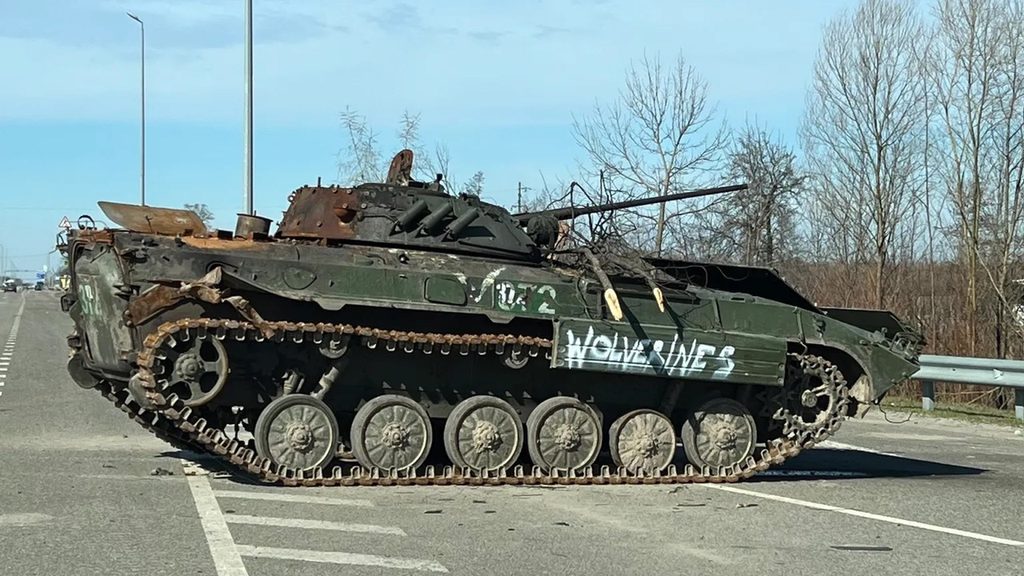
While leaving the particulars of the outcome of the war vague, it’s clear that the United States was ultimately victorious based on the monument to the Wolverines’ bravery shown at the end of the film. Who could have doubted that America would win against the Red Menace? For a scared teenager in Minnesota, that was the point: even if the worst happened, kids like us would fight back and win. This righteous fight was evoked in 2022 after Russia launched its full-scale war on Ukraine when at least one Russian armored vehicle was tagged with the graffiti “Wolverines!” One can only hope Ukraine’s defenders prevail as the Wolverines did on screen.
Postscript: Eerily, the most frightening incident of 1983 was a real-life version of the film’s nightmare, and no one knew about it. On September 26, Soviet Air Defense Forces Lt. Col. Stanislav Petrov chose not to follow protocol when the Oko satellite warning system alerted. Initially it gave a “LAUNCH” warning of one inbound U.S. ICBM.[i] It was followed minutes later by something he’d never seen before, the words “MISSILE ATTACK” on the giant wall display warning of the detection of four additional missiles headed towards the motherland. Petrov doubted the system, which had been plagued by failures from the start, and he couldn’t believe the Americans would open with such a small first strike. He gambled that it was a false alarm, and chose to wait.[ii] He was proven right minutes later when no missile impacts occurred. It was later found that the satellite had mistaken sunlight reflecting off clouds for rocket exhaust. The world wouldn’t know for years just how close it was to ending, save for the intuition of one man.
[i] David E. Hoffman, The Dead Hand: The Untold Story of the Cold War Arms Race and Its Dangerous Legacy (Doubleday, 2009), 10.
[ii] Hoffman, The Dead Hand, 11.
Edited by Olga Tchepikova-Treon