
| John Costello |
Wargames plays at the Trylon Cinema from Friday, November 6th, through Sunday, November 8th. For tickets, showtimes, and other series information, visit trylon.org.
When I began working on this piece, I wanted to dig into what I see as the dichotomy of rational computers versus irrational humans struggling over nuclear war in WarGames (1983). I wanted to contrast a previous era’s acknowledgement that computers are programmed, not intelligent, can be trained, and otherwise follow instructions, against our current moment of AI mania. I thought I’d consider the AI mania of the 1980s, similar in bombast if less pervasive than at present. I expected to add more personal asides about being a Cold War kid interested in computers.
Instead, I want to focus on the movie’s corn cob scene and examine how WarGames is a kind of Wonderland—a concept expanded by Minnesota author, teacher, and mentor Charles Baxter (just Charlie hereafter) in his essay “Wonderlands” from the book of the same name (Baxter 2022). In Charlie’s conception, Wonderlands are subjective, confusing, and haunted places stemming from a condition he calls “Life-in-Death” (165)—an absence of joy and love. Wonderlands are “a kind of alternate world, a mirror of ours” (169) marked by isolation, imminent violence, constant surveillance, closed systems, and “the grip of some mania” (167). People ignore facts in favor of impressions and feelings. Charlie probably would disagree with some of the ways I see WarGames as a Wonderland, and I’d counter that his essay is more descriptive than prescriptive.
WarGames opens on a car driving through a howling windstorm to an ordinary clapboard house, probably in the Midwest, where two men rush inside, navigating kitsch furnishings to access a hidden underground U. S. missile base. After the men take their posts, a war alert interrupts their routine checklist. They step through the process of launching missiles as part of a global thermonuclear war. The scene ends with one man refusing to be responsible for killing 20 million people and the other pointing a gun at the first man’s head.
Without resolving the opening conflict, the action pivots to NORAD (short for North American Aerospace Defense Command, the center of nuclear war operations in North America), where computer scientist John McKittrick (Dabney Coleman) argues with politicians and NORAD commander General Beringer (Barry Corbin, being irrepressibly jolly) about removing the soldiers in the silos from launch responsibilities. Instead, launch control should be handed over to the War Operations Plan Response (W. O. P. R., pronounced “Whopper”) supercomputer, which McKittrick helped build. Humans will retain control over the Whopper, and the Whopper will efficiently manage the launch of nuclear missiles.
Like so much in the movie, the Whopper isn’t what it initially appears to be. The Whopper hides a secret—an alter ego. Over the course of the movie, other characters begin referring to the Whopper by this alter ego and treating it as a person instead of a programmed machine. McKittrick knows and refuses to accept evidence about the Whopper’s secret until almost the end.
McKittrick and Beringer fail to question whether nuclear war is futile, whether it should be fought at all. They argue about how they will fight what they think is inevitable. They are trapped within their belief system.
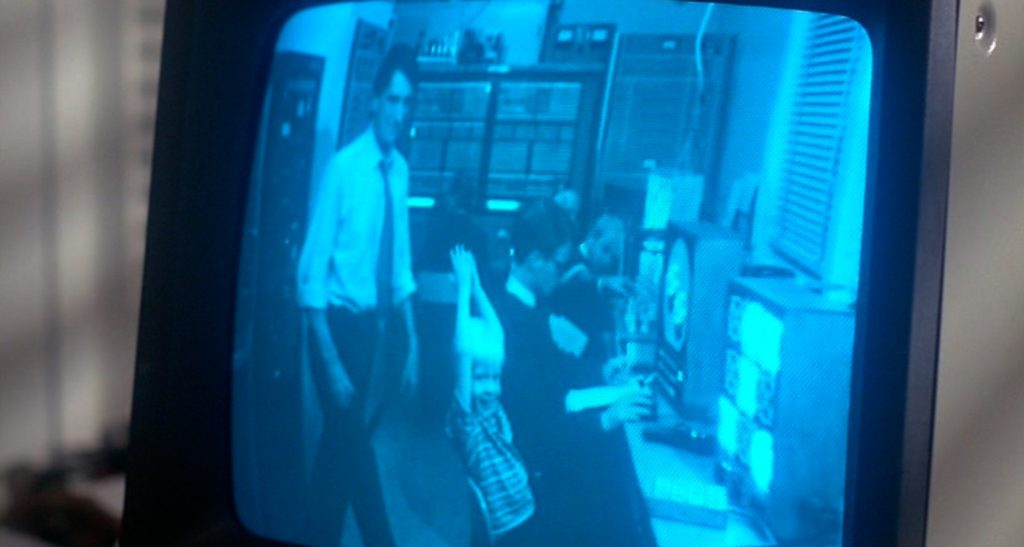
The second plotline opens with a shot of Seattle at golden hour, the Space Needle standing alone in then-underdeveloped South Lake Union, and moves inside one of my generation’s third places, a video arcade. We see young protagonist David Lightman (Matthew Broderick) playing Galaga before school starts. I began using computers by playing games, and David probably did, too. Later in the film, when David and Jennifer Mack (Ally Sheedy) watch a black-and-white video of Whopper creator Dr. Stephen Falken (John Wood) teaching his young son to play a computer game, David displays a flood of emotions, recognition of the game experience, but also sorrow and inspiration.
Like David, I escaped into video arcades, blinking cacophonous rooms of crowded cabinets gobbling quarters the way we consumed soda, candy, and ice cream to fuel our manic efforts. Navigate a race car. Pilot a chomping yellow circle through a ghost-filled maze. Futilely defend cities by shooting down nuclear missiles with interceptors that, in reality, did not exist. Missile Command always ends with expanding circles representing nuclear explosions, a scene visually echoed late in WarGames. We knew we were living in the shadow of nuclear war, and we didn’t think there was anything to do about it.
In the arcade, David battles unending waves of attacking spaceships. Realizing he’s late, he runs from the arcade to his high school Biology class, where the teacher informs him and Jennifer that they’ve flunked a test, and likely the class. David’s smartass comment gets him sent to the school counselor’s office (perhaps on purpose), where he searches for and finds the latest school computer password. After school, Jennifer flirts with David by almost running him down with her moped, then gives him a ride home, where he shows her how he can hack into the school computer and change their grades.
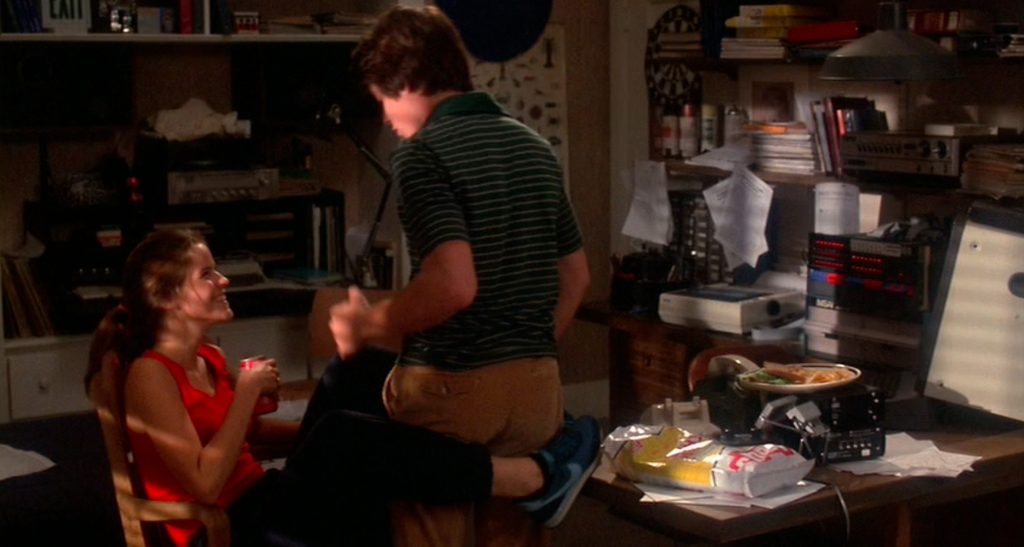
David isn’t the slick teen of a later Broderick role. He’s a dreamy-eyed screw-up. When he invites Jennifer up to his room, saying, “I want to show you something,” and shrugs off the fact that they are alone (both his parents work), he reveals an eagerness for connection through his computer hobby. He isn’t even flirting—a surprise to Jennifer. Jennifer’s cautious questioning, “What do you want to show me?” and “Your parents aren’t home?” indicate her own expectation of what teen boys are like. David is different than boys she’s used to, and this encounter begins a partnership they both need. Both are lonely. What David and Jennifer will realize is that they’re living in a Wonderland.
In his essay, Charlie describes Wonderlands as an invaluable tool for artists who want “to signal an estrangement from a given reality, to express a feeling of not belonging, and of menace…. Wonderlands are caused by, or expressive of, emotional instability, estrangement, fantasy, and solitude. Genuine love is the antidote to any Wonderland” (160). In a Wonderland, reality gives way to unreality, a reflection of “an entire generation’s conviction that the world they have inherited is a crummy second-rate duplicate” (171). For my generation, this second-rate world involved the Sixties’ distrust in authority and our own conviction that the people in charge were idiots leading us toward total nuclear annihilation.
WarGames actively undermines objective reality, beginning with the disorder of the windstorm. The house hides a missile base. The soldiers are potheads, always late for their shift. The war alert is a fake. At NORAD, false war alerts recur until soldiers and scientists lose the ability to discern whether the enemy has attacked. The adults seem spellbound by routine. Later, someone reported dead turns up alive. These are examples of a key aspect of Wonderlands identified by Sally Franson, one of Charlie’s former MFA students and the author of a seriocomic Wonderland novel. In an email to Charlie quoted in the essay, Sally identifies that a Wonderland begins when “a metaphorical (or literal) door closes, whether in the mind or in the physical universe, and subsequently reality becomes destabilized” (159). Reality destabilizes from the first scene.
We the audience should recognize that the movie mirrors our daily reality, where real people stand ready to launch thousands of nuclear missiles. “When a landscape becomes sentient, there is nowhere to hide” (163). “Nature is out of kilter here” (161). The sentient landscape manifests in the Whopper, which reveals a persona and begins stalking David while also pursuing independent control over nuclear missiles to fulfill its programming. The sterile, machined world—the war bunker and computing—threatens to transform the natural world—Seattle at golden hour, mythical Goose Island—into a dead landscape. While the Whopper rationally pursues its programming, the adults at Norad irrationally react to what they expect.
This brings me back to David’s sense of isolation. Although my family couldn’t afford a computer, I knew kids who owned them, usually IBMs, Apples, or the very popular Commodore systems. Like David, I knew adults who gave computer advice freely. I knew kids who frequented bulletin board systems (BBSes), where they read about hacking techniques, where people posted stolen calling codes used to avoid long-distance charges, where people explained ways to bypass technology. However, I never knew anyone who owned an IMSAI—the computer in David’s bedroom.
The IMSAI was a 1970s computer that cost as much as a new car, several times more than typical home computers of that era. You can argue that David withdrew into his computer, but I think his parents were so emotionally absent that they gave him the computer and ignored him.

In the corn cob scene, about one-third of the way into the movie, David sits reading a computer magazine at a small dining table with his father (William Bogert). Mr. Lightman slathers butter on a piece of bread like he’s stuccoing a wall. David’s mother (Susan Davis), identifiable as a real estate agent by her Century 21 Real Estate gold coat, stands by the sink talking to a client about “creative financing.” (In 1983, mortgage rates were over sixteen percent.) Mrs. Lightman mentions a property’s “jacuzzi in the Master bedroom. You know what that means,” she leers. David’s parents interrupt what they’re focused on to lecture him about taking out the garbage and shush him when he says for the second time that he will do the chore. So far, it seems like a typical parental reaction to an unreliable teen, except for the conversational innuendo and the butter slathering.
After David leaves the table to investigate a computer game company mentioned in his magazine, the scene lingers on his parents. Mrs. Lightman sits down at the table to eat. Mr. Lightman, still holding the bread plastered with butter, picks up a corn cob. The camera switches to Mr. Lightman’s viewpoint and shows how he carefully twists the corn against the buttered bread, buttering his corn cob in the process. Then he discards the bread. When Mr. Lightman bites into the corn, he discovers that it is uncooked. “I know, isn’t it wonderful? So crisp. You can just taste the vitamin A and D,” Mrs. Lightman says with a smile.
In the same scene, the Lightmans reveal that they don’t understand their son or his computer hobby. When Mrs. Lightman expresses worry about David, she admits that her fear isn’t about his well-being but that they will be electrocuted. David’s parents fear the new technology, computing, without understanding the actual reason they should fear it. They are typical of the adults in WarGames. No wise adults are going to “show up to bring back common sense” (161).
You can make the argument that the corn scene mocks urban food fads, professional women, the breakdown of family discipline, city dwellers, affluent people, and the dissolution of the nuclear family. It probably does. But there’s something more at play than simple satire about changing social habits. By switching to Mr. Lightman’s viewpoint, you see a mockery of the adult tendency toward unthinking habitual behavior. In a Wonderland, even a corn dinner isn’t what it seems. More to the point, the corn scene demonstrates how little David’s family communicates with one another. They are caught in the grip of isolation.
In his bedroom after the corn dinner, David starts a scanning program, the beginning of his quest to break into the system supposedly containing future game releases. Thanks to Jennifer’s constant prompting, David and Jennifer eventually access a computer system featuring games including FALKEN’S MAZE, CHESS, and GLOBAL THERMONUCLEAR WAR. Later, playing GLOBAL THERMONUCLEAR WAR while eating snacks and drinking sodas, they gleefully stage a nuclear attack as the Soviet Union, choosing Las Vegas and Seattle for their targets. “Yeah, give ’em the works,” Jennifer says, egging David on. They are goofing off together, unaware that they’re triggering a war simulation at NORAD. Eventually, Jennifer and David will uncover the terrible secrets of Dr. Falken and what the Wonderland promises.
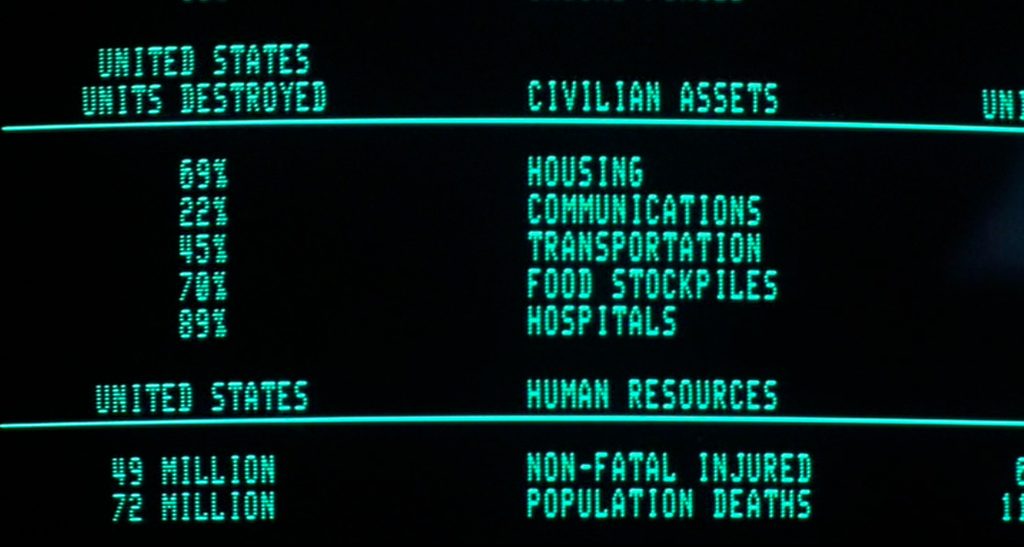
What makes Jennifer and David so valuable to each other is their communication and connection with each other. Jennifer is in her own way as much of a dreamy-eyed screw-up as David is. Only when Jennifer is with him does David make progress toward accessing the supercomputer and discovering the nature of the Wonderland. I’ll tell you that Jennifer provides a physical link for David to the living world, Seattle, in contrast to the life-annulling world of computing and war and grief. She keeps coming back for him. He may be a computer wizard, but she is the knight. He, in turn, probably views and treats her better than any other boy has. They give each other someone to connect with when the world is about to end.
Escaping the Wonderland requires more than their budding love. They must inspire others and, in a sense, bring back from the dead one of the few people who can help escape the Wonderland. David and Jennifer must strive and love together.
The strengths of WarGames include the onscreen chemistry between Broderick and Sheedy. The cost is the reminder that we constantly live with the threat of nuclear war. WarGames foregrounded this threat for my generation, although it was a later 1983 TV movie, The Day After, which graphically portrayed the aftermath of nuclear war in a Midwest community, terrifying viewers. We humans can choose to avoid nuclear war, just as we can choose not to surrender our actions and responsibilities to computers. As one of the characters tells Beringer about the Whopper, “General, you are listening to a machine. Do the world a favor and don’t act like one.”
References
Baxter, Charles. 2022. Wonderlands: Essays on the Life of Literature. Graywolf Press.
Edited by Olga Tchepikova-Treon