
| Victoria Breshears |
Kanał plays at the Trylon Cinema from Sunday, November 8th, through Tuesday, November 10th. For tickets, showtimes, and other series information, visit trylon.org.
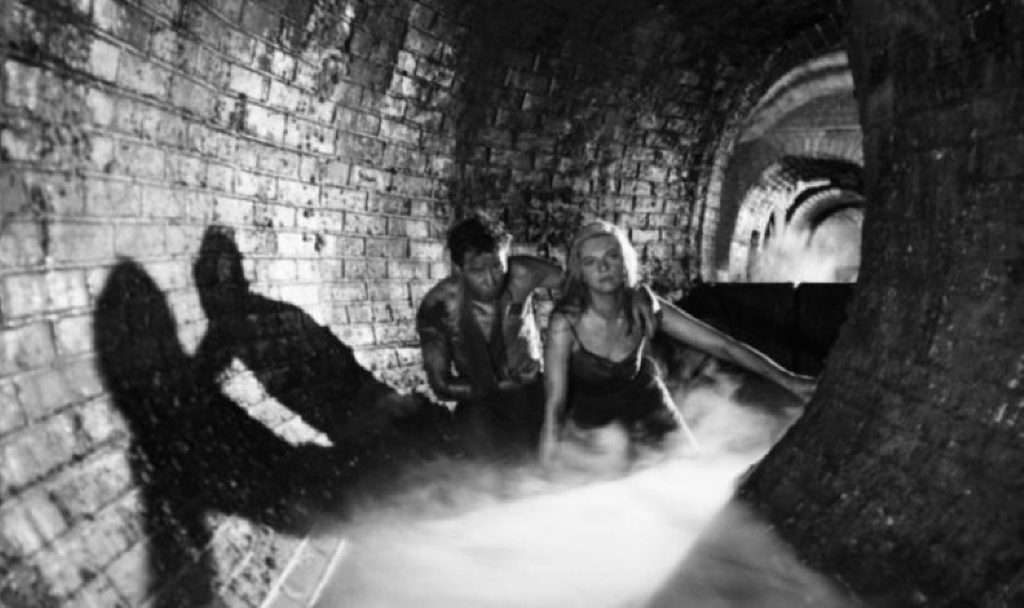
War films usually batter the senses with concussive noise from above, but Andrzej Wajda’s Kanal smothers them from below.1 The true horror begins only after conventional battlefield noises disappear, replaced by the wet, suctioning drag of submerged boots, frantic whispers bouncing off curved stone, and the agonizing moans of dying men echoing through unlit culverts.
The shift in audio leaves traditional combat behind to focus on a slower, uglier physical breakdown. The sewers don’t just conceal the squad; they function like an external digestive tract, steadily stripping away stamina, senses, and skin until the fighters look no different than the waste they are standing in.
Working from a semi-autobiographical script by Jerzy Stefan Stawiński, who led an insurgent unit through these exact drainage conduits during the final days of the 1944 Warsaw Uprising, Wajda opens his 1957 classic on the sunlit surface of the Mokotów district. Surface warfare, as documented in historical accounts like Norman Davies’s Rising ’44, followed established military protocols. On the surface, Lieutenant Zadra (known to his fighters as “Splinter”) still commands an intact military outfit with a legible chain of command and ground under their boots.2 Once Zadra’s fighters pry open an iron cover in an alleyway and climb down the rungs, their military discipline falls apart. Moving an entire company through narrow drainpipes turns out to be impossible, and the planned retreat collapses into a slow, blind scramble through deep muck while their physical strength deteriorates with every step.
Ingestion and the Dead Air
I have spent time exploring wild caves, and the first shock underground is always the air. Without sunlight or weather driving atmospheric circulation, an underground passage holds a dead, mineral weight. The air does not move across your skin; it settles in your nose, carrying the sharp, metallic tang of damp limestone and standing groundwater. You take shallow, conscious breaths because the atmosphere feels trapped and stale.
In Kanal, that subterranean weight is weaponized by city runoff. Wajda plunges his characters from dry surface debris straight into an active municipal drain fermenting with raw waste, sulfur, and chemical smoke. The unventilated culvert stings open eyes, inflames bronchial tubes, and forces a shallow panting that only pulls more toxic fumes into their lungs.
Up on the surface, the composer Michał (Vladek Sheybal) is introduced as a man clinging desperately to civilian habits, sitting at a grand piano in a wrecked villa and trying to reach his wife on a severed phone line. Early in the descent, he attempts to process the stench by reciting Dante’s eighteenth canto from memory: “Thither we came, and thence down in the moat I saw a people smothered in a filth, that out of human privies seemed to flow.” The ceiling drops down fast, forcing everyone to stoop until their coats drag in the muck. In the dark, Zadra can’t see past the next two men in line, and his orders get garbled into useless echoes against the wet masonry. Within minutes, the unit loses its spacing and breaks into confused knots of people just trying not to slip.
Sensory Collapse and the Acoustic Trap
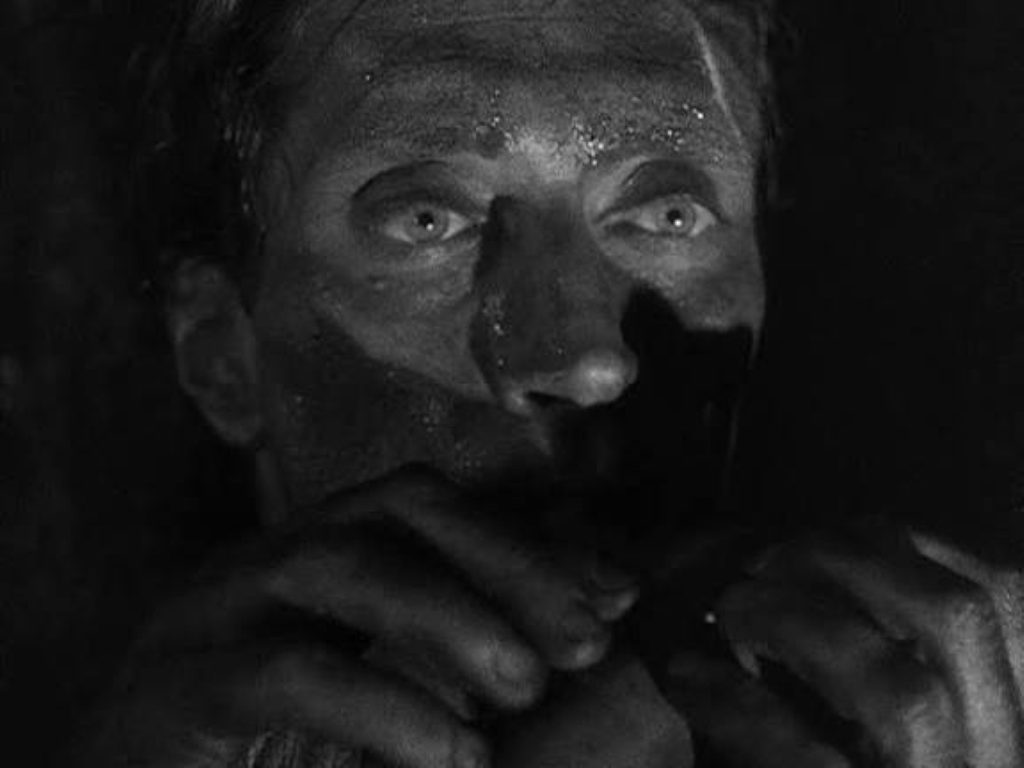
In the darkness of the tunnels, hearing replaces sight as the primary tool of survival. Curved brick masonry acts like a whispering gallery, carrying low-frequency sounds unpredictably around bends while distorting directional cues. Every necessary movement becomes an active hazard: boots sucking out of deep mud, water sloshing against hips, and the involuntary, wet coughs of soldiers breathing sulfur fumes.
Above them, German sentries listen at street-level storm grates, dropping grenades and poison gas canisters into the shafts whenever they register splashing water. Because there is no cross-ventilation, gas and smoke settle directly over the water line, blinding the soldiers and turning every cough into an audible target.
Underground, silence is the only real defense, which makes Michał’s breakdown an immediate disaster for everyone around him. Giving up on finding an exit, he takes a child’s clay ocarina carried down by a courier and begins trailing the company like an apparition, blowing strange, shrill melodies into the black water. Michał becomes the sewer’s first true casualty of the mind, his piping a mocking funeral dirge that drives home just how completely their civilized world has washed away.
The Labor of Flesh: Daisy and Liquefaction
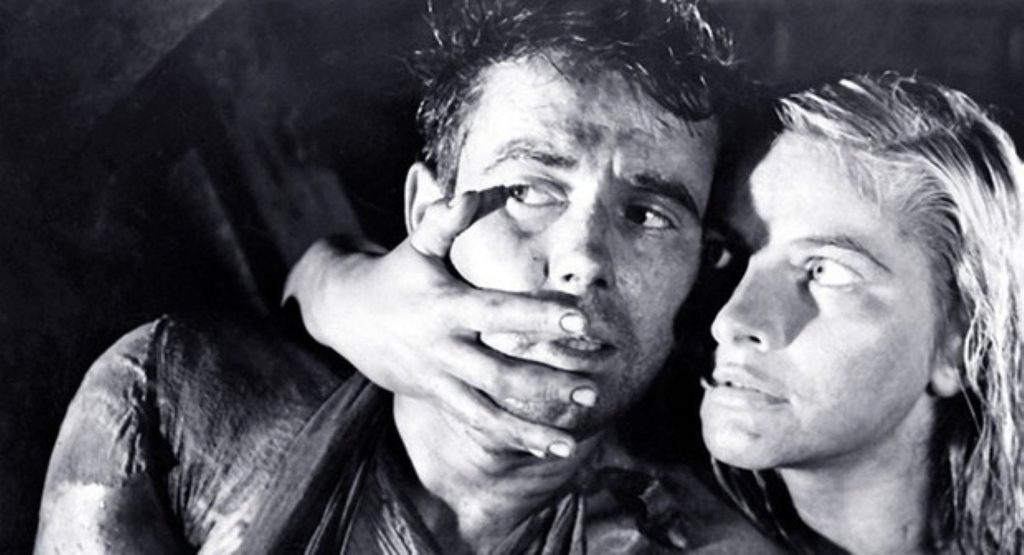
The retreat takes its most grueling toll on Jacek (Tadeusz Janczar), a cadet officer, and Daisy (Teresa Iżewska), a courier who knows the sewer layout. Daisy arrives at the company’s surface position before the retreat begins, refusing to leave Jacek after he is badly wounded in the street fighting. When the unit drops below ground, she enters the conduits specifically to stay with him. But as they fall behind the rest of the column, Jacek’s condition deteriorates rapidly.
Jacek’s torn flesh turns him into dead weight before they make the first turn. His bandages soak through immediately, and his heavy wool coat just traps the filthy runoff against his open wounds. Fever, shock, and blood loss quickly leave him unable to stand.
That leaves the physical labor of survival entirely to Daisy. Wajda shoots her effort with grueling, tactile attention. When Jacek collapses and can no longer stand on his own, Daisy refuses to abandon him. Her specialized knowledge of the tunnels narrows to brute physical endurance: wedging her shoulder into his armpit, digging her boots into the sludge, and dragging a dying, feverish soldier step by agonizing step toward an outlet that will never open.
The Sealed Gate
In the wider conduits, the network strips away the last remnants of organized resistance, replacing military cohesion with raw panic. Pockets of civilians and scattered fighters drift through the dark in choked, delirious confusion, blinded by tear gas and smoke settling over the water line. The physical architecture offers no salvation, only a series of dead ends designed to trap them. When an insurgent climbs an iron ladder to disarm stick grenades wired to the rungs, the booby-trap detonates in his face, leaving his broken body wedged on the iron while the blast seals the exit above. Deeper in the culverts, the pressure turns inward, eroding emotional survival along with physical endurance: a courier shoots herself in the stagnant water when her companion, a surviving officer, shatters her illusions of any shared future, leaving him to stumble up a nearby ladder directly into German captivity.
This total breakdown reaches its cruelest conclusion in Lieutenant Zadra. His authority depends entirely on the myth of an intact command, a delusion maintained for hours only because his sub-commander lies about the company following behind in the dark. Surfacing alone into a ruined, sunlit square, Zadra discovers he is a commander of ghosts. Rather than accept survival on the surface as a shattered remnant, he executes the subordinate for his betrayal and crawls back down into the open manhole. His retreat back into the muck is not an act of battlefield valor, but an acknowledgment of complete digestion: the sewer has claimed his company, and he submits to being swallowed alongside his men.
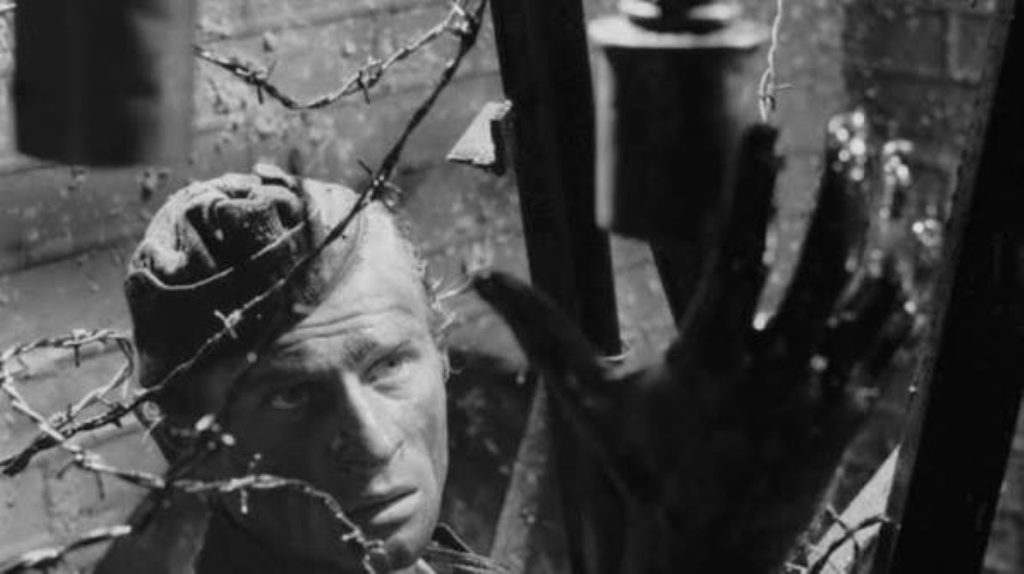
Daisy and Jacek’s journey reaches its end just before that final collapse. Dragging Jacek toward the faint light filtering through a drainage outlet overlooking the Vistula, Daisy finds their path blocked by thick iron bars embedded directly into the concrete embankment. Across the water, the far bank sits in plain daylight, maddeningly close and completely out of reach. Jacek is too far gone to know they are trapped; his eyesight has failed, and he slumps into the shallow water believing they have made it through. Rather than shatter that peace, Daisy stares through the grate and describes the open water while they sit stranded in the drain. By denying these fighters an honorable battlefield death or an exit into freedom, Wajda strips combat of its romantic mythology, showing that total war ultimately reduces human beings to discarded organic matter inside the belly of their own city.3
Footnotes
1A note on spelling: While the original Polish title uses the stroked letter (Kanał), this essay adopts the standard English release spelling (Kanal) for consistency and ease of reading.
2Andrzej Wajda’s ensemble cast features over a dozen distinct members of Company Zadra and the civilian underground. For clarity and critical focus, this essay limits its direct analysis to the handful of figures whose arcs most sharply define the film’s spatial, physical, and acoustic breakdown.
3Upon its April 1957 premiere in Poland, Kanał faced intense backlash from domestic critics and Uprising veterans who felt reducing national martyrdom to physical filth and doomed panic was an insult to the resistance. Wajda later acknowledged that domestic audiences wanted a monument to spiritual victory rather than “death in the sewers.” That hostility only subsided after the film won the Special Jury Prize at the 1957 Cannes Film Festival (shared with Ingmar Bergman’s The Seventh Seal), whose international acclaim effectively shielded Wajda and repositioned the film as a foundational masterpiece of the Polish Film School.
Edited by Olga Tchepikova-Treon