
| Ben Tuthill |
Playtime plays in glorious 35mm at the Trylon Cinema on Saturday, November 21st and Sunday, November 22nd. For tickets, showtimes, and other series information, visit trylon.org.
It’s easy to attribute contemporary culinary culture’s preference for visual clout over substance to social media, but that would erase thousands of years of class struggle over food. Look at elite foodways at any point in recorded history and you’ll find evidence of beautiful, miserable dinners. We like to look at nice things, but we also like to be looked at alongside them, presenting some sort of caché as we commit one of the basic acts of being alive. There’s something alluring about being seen while eating, or maybe just imagining ourselves being seen, the feeling that the space surrounding us reinforces whatever image we want to present to our friends, acquaintances, and enemies.
Once upon a time we had grandmas and Emily Posts to teach us how to eat impressively—for the past century or so, we’ve had cinema. The crisis of cinematic dining is that, instead of etiquette books, we have the camera, a machine that’s remarkably bad at capturing the reality of lived experience. The combination of the space and lighting required to get an ideal shot mixed with the ability to create a crowded atmosphere within a small frame leads to an unrealistic expectation of restaurants. Beautiful and crowded, composed and populist—and in their ability to freeze time, cinematic restaurants also immediately become depictions of an idealized moment which, once we’re removed of it, becomes a lost past. There used to be bars like Rick’s Américain not because they existed but because Humphrey Bogart said they did. We’ve lost bars like the Road House not because space-age breweries chewed them out but because Twin Peaks was never a real place.
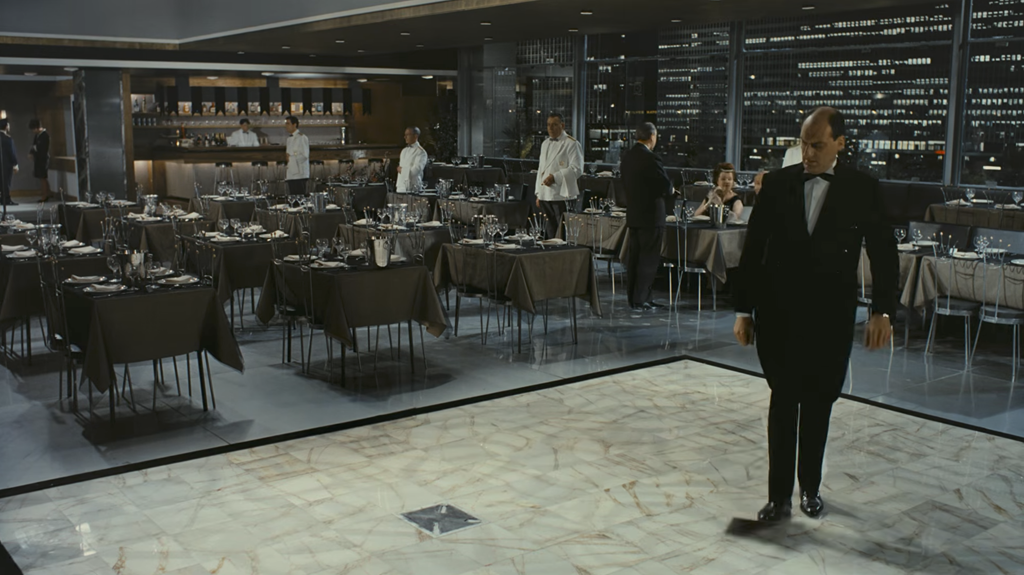
To capture the disappointment of an actual dining experience on film requires an equal obsession with cameras, architecture, human interaction, and the general movement of humans through space. Jacques Tati is probably the only man in history qualified for the job, and among its many virtues, his masterpiece PlayTime, is among our truest representations of the failures of the restaurant industry. About 50 minutes in, we’re invited into the opening night of the Royal Garden, a tourist-destination fine dining restaurant and nightclub. And for the next 50 minutes, we watch as it’s torn to shreds.
Does the Royal Garden seem like a nice place to eat? In many ways, it’s a club designed for cinematic appeal—immaculate color composition, well-spaced tables that allow for 70mm cameras, bright lights optimized for the deepest depths of field at any hour of the night. The picture windows allow intimate scenes to be shot against Parisian backdrops and also to shoot interiors from the exterior. Part of the reason Tati could get 50 minutes of perfect shots is because in a space like this, imperfect shots don’t really exist.
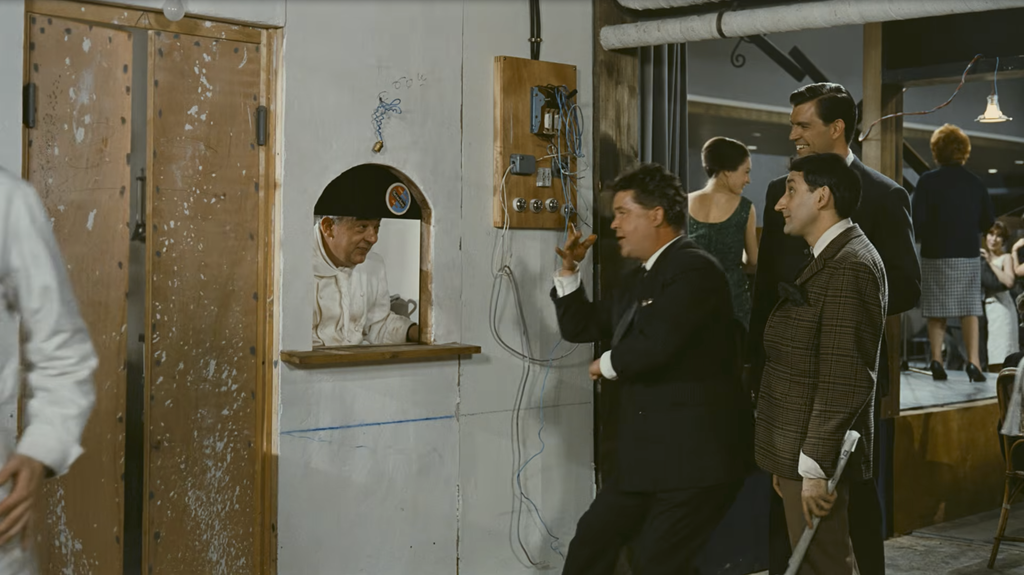
There’s an alternate use of this set, maybe in a Melville movie, that presents something breathtakingly cool—where all the well-designed interior is used to set up perfect shots and none of the cheapness and the inadequacy of the food makes it onto the scene. But Tati is too fascinated with spaces and the way humans interact with them to display his club in any state other than disintegration. The collapse is gradual but exponential, starting with the opening night jitters of the neon entrance sign. We’re quickly introduced to the unfinished plaster of the kitchen and a loose linoleum tile on the dance floor. It builds from there, to disintegrating uniforms, fights over reservations, shattered glass, shattered glass in the ice, mix-ups between alcohol and medicine, thermosat crises, and ultimately a complete collapse of the set as an initially empty frame fills up with people.
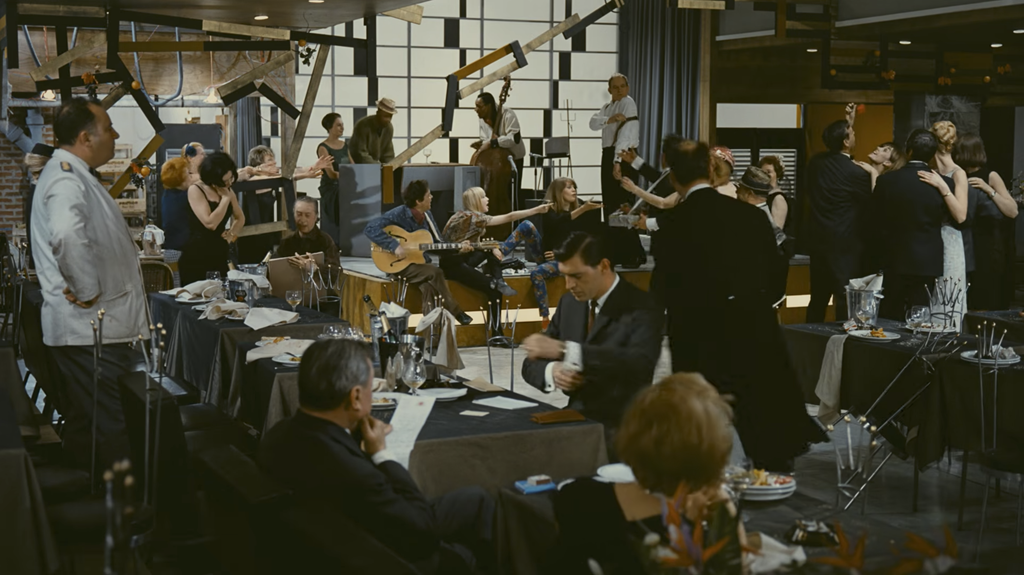
The destruction of the restaurant is partially a reflection of its cheapness, but more the result of humans occupying a space only sort of designed for humans. As humanity moves in, the restaurant attempts to manage them and fails spectacularly. The crown-shaped wire chairs brand their patrons like cattle, but no one seems to notice. The overwhelmed servers can’t direct their guests to appropriate tables, and the guests begin to self-select. When the guests start dancing at their tables and Monsieur Hulot, inspired by a jumping businessman, accidentally starts a chain reaction of falling veneers, it only inspires the dancing to overtake the entire restaurant, slats of wood hanging from the ceilings like party streamers. The band finally quits when one of the panels nearly takes out the drummer, but the most obnoxious patron, now master of ceremonies, pulls an isolated tourist and a lonely chanteuse onstage to hammer out singalongs of French standards. Out of the collapse of cool modernity comes classical communion as the international audience sings together. The coat rooms are opened for democratic processing, and the front door, which has long since been shattered, finally gives up its façade and lets the free flow of humanity in and out.
All of Tati’s color films could all be argued as man vs. machine movies, displays of the inability of gadgets and modern architecture to organize the bubbling inanity of humans. They succeed where other treatises on this topic become pedantic because of Tati’s respect for the form and aspirations of 20th-century modernism. He treats straight lines and plastic with a love that acknowledges all their utopian hopefulness, but his background as a clown means he can’t resist the joy of tearing them apart. There’s no revolutionary violence or even intentional destruction—just the inadequacy of plaster and German heating systems and orderly societal rules to contain the desire humans have to be together.
It’s a shame that the spaces designed for beauty don’t last while the ones that cram in soul and good food without any regard for lighting live on. But that’s life and I suppose it’s beautiful. For every clout-chasing new restaurant that comes and goes there’s a Mancini’s, a Quang, a Trieu Chou, a Matt’s, a CC Club—some restaurant with an impossible layout that survives because for whatever reason that vibe is still right. Life looks good in those spaces even though the light is bad or the angles aren’t right because eyes and ears adjust to what they care about and on top of all of that our mouths and noses are doing things that a camera will never be able to do for us. Design matters, but if you get enough humanity in the mix we can usually overcome its best intentions. PlayTime plays out both sides of the dialectic, and maybe it ends with a Hegelian sublation: if someone designed a restaurant that looked like the Royal Garden in its final form, I think it could be an all-timer.
Edited by Olga Tchepikova-Treon