
| Sophie Durbin |
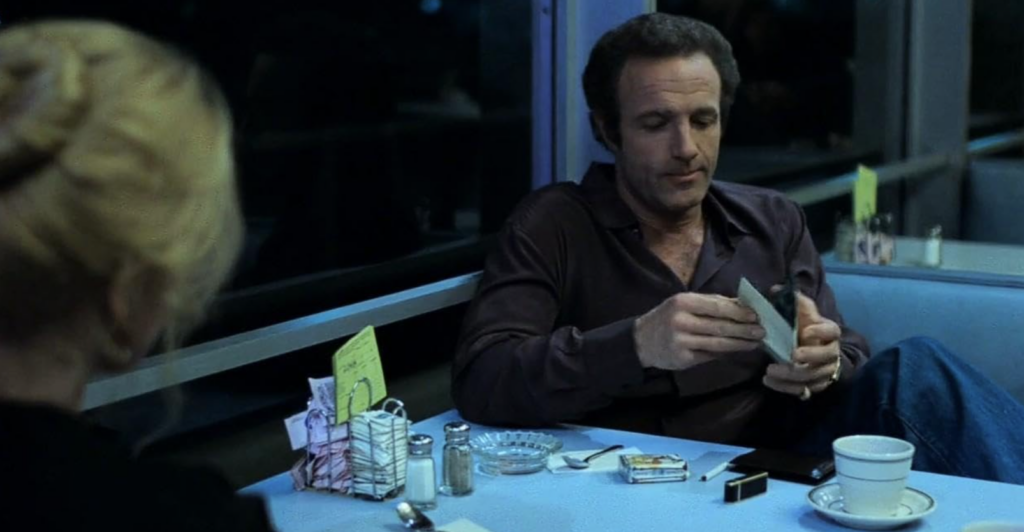
Thief plays in glorious 35mm at the Trylon Cinema from Friday, April 3rd, through Sunday, April 5th. For tickets, showtimes, and other series information, visit trylon.org.
“Frank unfolds his wallet to place the letter inside. A tattered paste-up collage is there, too. He opens it. There’s a white house from a magazine. A cut-out Cadillac is glued in front. Bits and pieces of trees are drawn in with green Pentel. A small baby from a Gerber food ad is near a woman—mother […] It’s weird. We don’t know what it means yet. Frank carries it with him wherever he goes.” (Excerpt from Michael Mann’s screenplay for Thief)
What do we make of this crumpled wallet collage of cut-out desires that carries Frank through his journey in Thief? First of all, it’s a gift that we get to know about what’s really driving him. The landscape of crime cinema in the 1980s is vast, but often has little to do with the interior lives of our heroes. There’s plenty of bombastic copaganda, of course, and a healthy variety of dystopian films where society buckles under a corrupt surveillance state. Throw in a steady stream of erotic thrillers and courtroom dramas and you might think that filmmakers of the decade were mostly interested in pure entertainment. But wait! There is also a smattering of movies that dig into the simple unpleasantness of crime for those on both sides of the law. Within this subgenre you’ll find a welcome home for the One Last Job trope: the goodhearted career criminal’s only ticket out of a life of crime is, ironically, one last risky heist with a generous payout (the inverse, where a retiring cop risks the whole retirement thing by taking on one last case, also happens frequently but isn’t the focus of this piece). Thief stands apart by allowing us to get inside Frank’s head to understand why he indeed takes that one last job, and what that tells us about the ironic codependency between crime and the American Dream he yearns for so much.
The One Last Job, at face value, is a tool to let the audience have it both ways. You get all the fun of watching a seasoned criminal do their work well without the guilt of rooting for the bad guys. He’s recognized that carrying on as a criminal is wrong, he’s on his way out, and he’s just flexing his skills one last time. What’s the harm in enjoying the show? Thief stands the trope on its head and turns the One Last Job from a pageant into a funeral march. Our hero, Frank, seamlessly inhabited by James Caan, wants to turn away from his hustle as a jewel thief so that he can be a husband and father with an above-the-table income. Unfortunately, he is an excellent thief, and, thanks to his scars from years in prison, he’s not so successful in civilian life. We learn this the hard way when he loses his temper at an adoption agency appointment. Defeated, he lets his jolly mob boss Leo secure him Chekhov’s baby on the black market. The more fully Frank realizes his dream of wife/house/3.5 kids, the more beholden he is to the criminal path that can finance it. Caan makes palpable the distaste and self-loathing with which Frank accepts his final gig. There is little joy in seeing our leading man do what he does best. We just want him to get out.
Even though we don’t want Frank to get stuck working for Leo, the meticulous theft sequences are purposefully mesmerizing. Watching his gloved hands, we are led into a bittersweet dream world where Frank enters his signature nihilist state to do what he does best. Caan famously studied up on the work of real thieves, thinking it would make his performance more convincing (spoiler: it does). Juxtaposed in gauzy slow-motion with the enchanting Tangerine Dream score, the labor of theft becomes glamorous. Mann is interested in the hands-on work of crime. Here, he’s clearly influenced by the heist sequences of the French
New Wave. But the labor of theft in, say, Bande à parte is meant to be experienced from a cool and artful distance, ideally by a viewer literate in Godard’s Marxist commentary. Mann’s depictions of hard work done by hand have a sincerity or even a conservatism to them. It’s with his gloved fingers that Frank makes the money that eventually affords him a very literal American dream: house, wife, baby. His One Last Job, then, is doubly tainted. It’s all tied up in his relationship with Leo, who sinks his hooks just deep enough into Frank by giving him so much that he can never walk away cleanly.
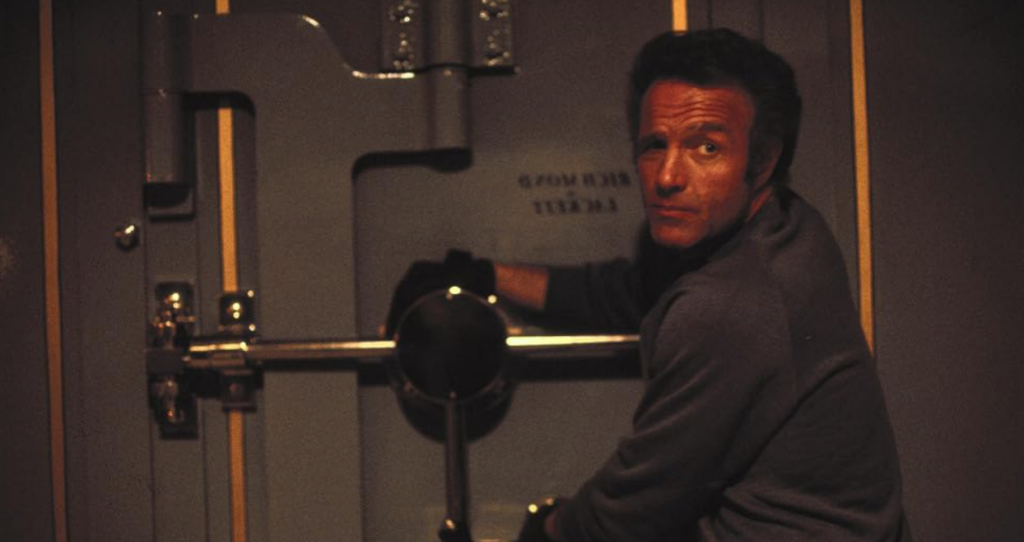
Frank slips a detail into an early speech which proves the key to the film’s (seemingly) unhappy ending: he’s a great thief because of his ability to turn off his survival instincts. By channeling a purely nihilist mindset, in which he doesn’t care if he lives or dies, he never loses his cool on the job. Ironically, it’s this instinct that allows him not just to successfully steal, but also to walk away completely when it becomes necessary. In the end, he severs his American Dream cleanly so he can exact revenge on his mob boss’s whole crew for daring to ensnare him in their web. He sends his wife and child away; he destroys his house. His intention is that nothing further can be taken from him. He emerges momentarily victorious at the closing of the film (by indeed exacting revenge on the Jolly Mob Boss Crew), but we know the mob machine is bigger than the players we see here, and they’ll probably catch up with him in the end.
It’s worth digging into one interesting aspect of the ending before I hang my hat on this simple analysis. We’re left with the understanding that Jessie and the kids will be safe, but Frank may not be, and they may never see each other again. As I was tying this article into a bow, I scanned Mann’s screenplay for anything I had missed. I was floored to find that in the original ending, Jessie knocks on Frank’s door after searching for him for five months. Their reunion remains ambiguous, but Frank’s reaction to being found gives away the other side of his nihilism: he assumes no one else cares, either.
FRANK (soft)
What are you doing here?
JESSIE
Finding you.
FRANK
How’d you get here?
JESSIE
By looking for five months.
Frank looks away.
FRANK
Why?
Jessie looks at him.
FRANK (continuing)
I have never expected you would find me. I did not expect you would look.
Thief is a masterful, prescient debut from Mann. How many other directors emerge onto the scene with a feature that includes all their aesthetic and emotional fixations, nearly fully-realized? A dark, moody city that he’ll return to repeatedly; a man just trying to do good, becoming a man having to do bad out before he walks away; a thrilling heist as a backdrop for exploring these ideas. Mann’s career hasn’t been a development of these themes so much as a constant meditation on their unknowableness, but Thief may somehow still be his most complete and tragic investigation of all of the above.
Edited by Olga Tchepikova-Treon