
| Natalie Marlin |
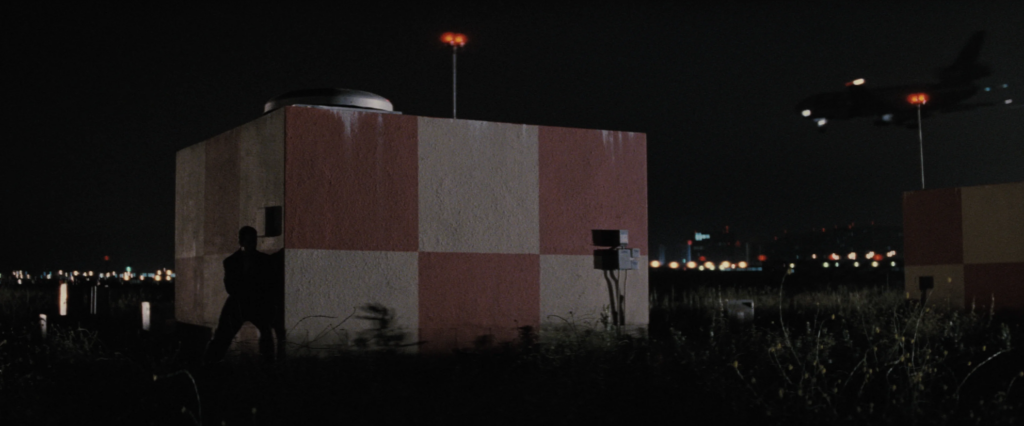
Heat plays at the Trylon Cinema from Friday, April 10th, through Tuesday, April 14th. For tickets, showtimes, and other series information, visit trylon.org.
Hamlet is no more a play about a prince seeking revenge than it is about any of its other threads—nationalistic aristocratic decay, melancholic humors, loss inciting psychiatric madness. Patsies cast off to certain death, mere pawns in power plays. Blood begetting more blood, until it is entirely what a palace is built upon.
The sprawl’s the thing, in which to thread the playwright’s intricate string. Much of what Shakespeare’s tragedies are able to accomplish with this breadth can be attributed to the dramatic structure that was commonplace for him and his contemporaries—five acts, which allowed any given work the patience to establish its social circumstance and rummage around all its many tendrils, before bringing everything to a head at a bloody finale.
Dramatic scholar John Howard Lawson saw this form as one that iterated and evolved the model upon which tragedies from a millennium before established: “Whereas the Greeks were concerned only with the effect of breaking an accepted social law, the Elizabethans insisted on probing the causes, testing the validity of the law in terms of the individual. For the first time in the history of the stage, the drama recognized fluidity of character, the making and breaking of the will. This caused the extension of the plot. Instead of beginning at the climax, it was necessary to begin the story at the earliest possible point.”1 In other words: the Elizabethan model of dramatic structure is an exercise in character psychology, in rooting around in the “why” of the chosen players or settings or subject matter, with all the space afforded in this medium. As Lawson himself puts it in the introduction to a later edition of Theory and Technique of Playwriting, “The structure of a play, the design of each scene and the movement of the action to its climax, are the means by which the concept is communicated.”2
This format is, understandably, one that is not so easy to translate when it comes to film. This five-act structure is made for epics and grand tragedies, less so for two-hour-long affairs wrestling with similar notions of power plays and murderous intrigue. Even cinematic adaptations of Shakespeare plays run into this impasse—when forced to fit the boundaries of a conventional runtime, these films often condense or remove scenes from plays entirely.3 The latent divide, mainly, originates from Syd Field’s studies on screenwriting, wherein the standard “call to action” and “climax and denouement” are fitted to a three-act model. The most instinctively understood plot and tonal beats are often prescripted to occur at certain places in the runtime, to captivate and keep an audience’s attention. But some films are not so easily mapped onto this diagram.
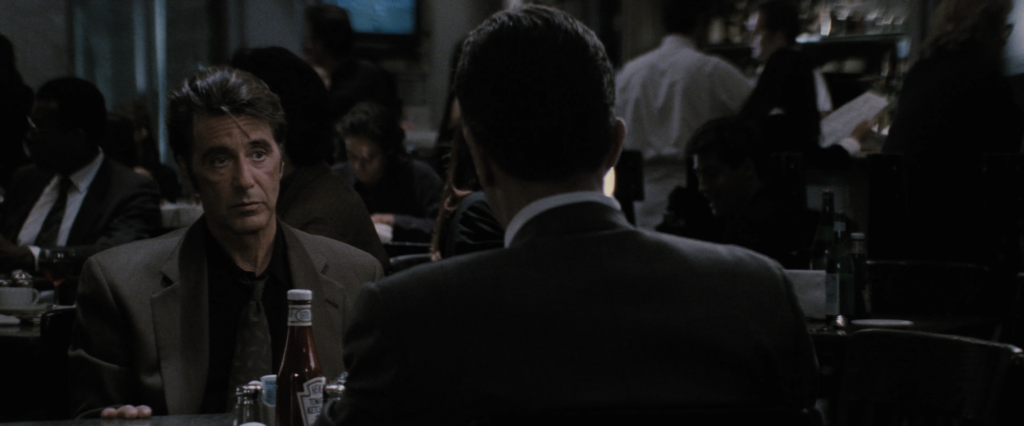
Heat is no more a film about the obsessive conflict waged between a bank robber and a police officer than it is about any of its other threads—manic occupational devotion as antithesis to the domestic, honor and the impropriety thereof, unshakably fatal descent into revenge for the breach of said honor. Whether redemption is possible on the other end of fixation, fixation to the point of human bankruptcy.
The more I’ve come to make sense of Heat, the less it seems to conform to Field’s three-act model of cinematic storytelling. Its span across its nearly three-hour runtime dedicates as much to meandering and lingering on the peripheral moments in the lives of both thief Neil McCauley (Robert DeNiro) and detective Vincent Hanna (Al Pacino)—the occupational challenges, the budding romances, the familial strife, the domestic disputes—as it does the straightforward beats of its crime plot. Michael Mann fleshes out the fullness of each protagonist’s life, exploring how both represent different permutations of the film’s larger themes of monomaniacal pursuit, why each feels driven to the same motivations, in spite of their diametrically opposed professions. McCauley and Hanna are not just stock cops and robbers—they are the personifications of their respective two houses and their oxymoronic symmetry, intensifying the inevitable tragedy in their inability to live in harmony.
The sweeping motions of Mann’s plotting and the operatic pitch of Heat, when the film’s dozens of concurrent threads do eventually boil over, seem less interested in hitting a consumer-designated ideal of action beats per hour than they do offering a sort of translation of what dramatic aims and examinations playwrights like Shakespeare sought to pull out of lurid fare. For all it’s worth, the movie’s largest set piece—the violent bank robbery that lands firmly at its midpoint—plays less like a decisive climax and more like the fight that smites Mercutio and Tybalt in Act III of Romeo and Juliet, a shifting of the ground for all that follows.
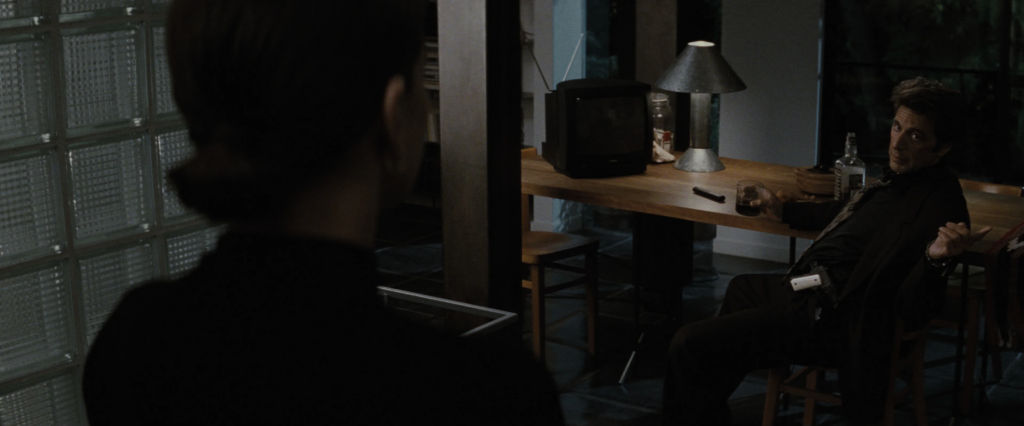
It’s a somewhat gauche and uncool suggestion to translate a film into a pastiche of Elizabethan drama, the sort of thing you used to find as a novelty in droves at chain bookstores a decade ago. The difference, in this case, is that Heat—in its immense runtime, interlocking players, and foregrounding of stoic melodrama—already models itself in that fashion.4 Take, for example, McCauley’s unshakeable urge for revenge against the traitorous Waingro (Kevin Gage). This notch in McCauley’s characterization simmers from Waingro’s transgressions in the film’s opening sequence, and becomes a facet of McCauley that eventually leads him to his very downfall. Mann, shrewdly, offers us this insight into his protagonist’s psyche right at the top of the film, a tell for his fatal flaw, the hubris that will do him in. No different from Shakespeare sowing the seeds for King Macbeth’s hubris right from Act I.
This approach to character fallibility and doomed fate is something that Lawson pinpointed as a development originating from Shakespeare and his peers: he refers to Elizabethan dramas possessing a “moral structure,” wherein existed “struggle between man and his conscience… a conflict of will, in which the tendency to act is balanced against the tendency to escape action.”5 This, too, is the struggle that rests at the center of Heat—Waingro, by the final stretch of the film, is entirely a non-obstacle for McCauley, a completely unnecessary detour on McCauley’s path toward escape and freedom after a live paved by danger and pursuit. The great tragedy at the core of Heat emerges not from a conflict of plot, but a conflict in McCauley’s very nature: the person he is, deep down, cannot let this nagging loose end go. Just as McCauley also can never find peace in knowing Hanna is the only other person who truly understands him. Just as Hanna can never be truly sated, as he must eventually strike down the man with whom he is obsessed and finds meaning.
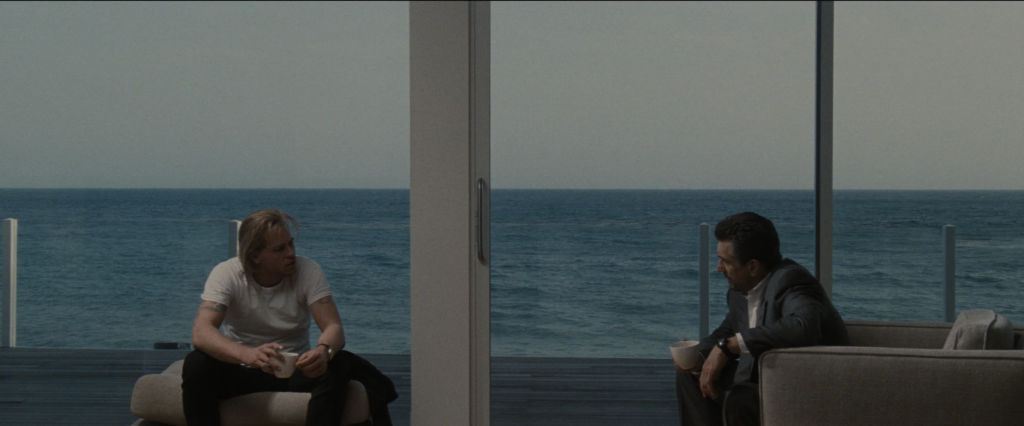
If “Shakespeare was intensely occupied with the problem of personal ambition, both as a driving force and as a danger,”6 then Mann, in the freedoms allowed by his structuring of Heat, offers a possible exit route from the fates that befall McCauley and Hanna. After the mid-film bank robbery, McCauley’s righthand man Chris Shiherlis (Val Kilmer) is forced on the run, impeding his attempts to reconcile with his wife Charlene. (His description of what she means to him—“for me, the sun rises and sets with her, man”—is, in a sense, a manipulation of Romeo’s famed pining comparison of Juliet as the sun.) Shiherlis tries to covertly rendezvous with Charlene, but she is able to stealthily tip him off about a trap set for him. Shiherlis, visibly shaken, realizing the sacrifice he must make if he is to survive, makes to drive off into the night. He escapes, away into the unseen wings, as Fleance before him in Macbeth. Never to be seen again, but his successful flight looming large over McCauley’s failure in following.
Heat is not a film of absolutes or binaries when it comes to obsession by virtue of its expansiveness. It is as all-encompassing, multivalent, and messy as the very human nature it is about. Obsession begets more obsession, but, by granting an aside like this, Mann complicates the tale, refilters every move its characters make as they actively plunge themselves into oblivion. The tragedy that follows is all the more potent for it.
Footnotes
[1]John Howard Lawson, Theory and Technique of Playwriting, 1st Dramabook Ed. (Hill and Wang, 1960), 16.
[2] Lawson, Theory and Technique of Playwriting, vii.
[3] One of the few exceptions to this, Kenneth Branagh’s colossal adaptation of Hamlet, escapes this issue entirely by taking a traditionalist approach to the source material: simply putting the entire play to film, free of any cuts, resulting in a four hour runtime, complete with an intermission, that feels completely removed from conventional screenplay structure.
[4] To put this into an alternative perspective, the reason traditional adventure films such as Star Wars feel more incongruous and at odds with this five-act structure is because they more directly borrow from Joseph Campbell’s theory of the Hero’s Journey, more interested in using story as extension of mythmaking.
[5] Lawson, Theory and Technique of Playwriting, 14-16.
[6] Lawson, Theory and Technique of Playwriting, 15.
Edited by Olga Tchepikova-Treon