
| Dan McCabe |
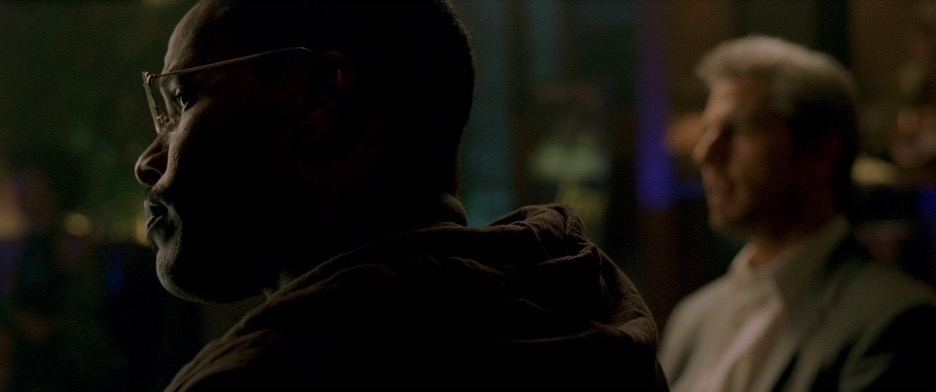
Jamie Foxx and Tom Cruise in Collateral (2004). Both actors give iconic performances as co-leads in Michael Mann’s neo-noir classic.
Collateral plays in glorious 35mm at the Trylon Cinema from Friday, April 17th, through Sunday, April 19th. For tickets, showtimes, and other series information, visit trylon.org.
I first saw Collateral when it came out in theaters during late summer of 2004. A friend and I saw it on a whim after an evening round of golf. On the way to the multiplex, we passed a car driving at night with its lights off. The sun had set not long ago, so it’s quite possible the driver had simply forgotten to turn on their headlights. Still, this “ghost car” was an eerie sight, and stays in my memory because the plot of Collateral centers around another kind of anonymous vehicle: one of the thousands of taxi cabs that criss-cross Los Angeles county.
After watching Collateral again after a few years, several items struck me immediately. Michael Mann directs an exceptionally tight, easy to follow plot. Like in Heat (1995), he uses Los Angeles’s vast urban landscapes as an effective backdrop to set its mood. What remains most interesting to me about Collateral, however, is the aspect that intrigued me the most when I first saw the film. Its dual leads, Tom Cruise and Jamie Foxx, play characters largely against type.
What follows will reveal certain plot points from Collateral. Here is your customary spoiler warning.
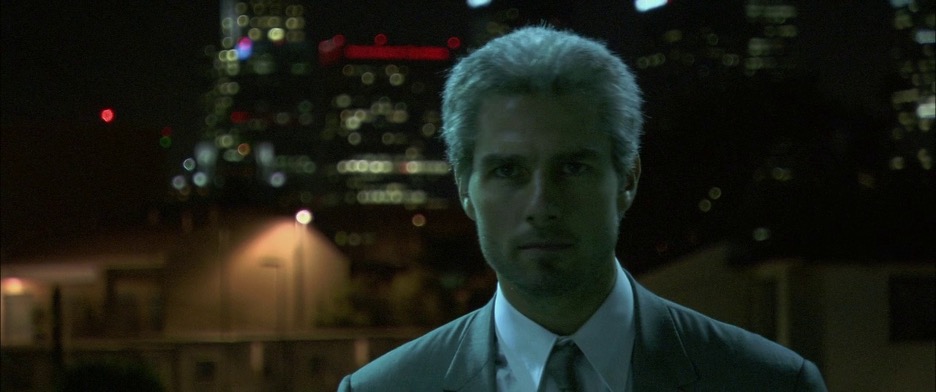
Tom Cruise as Vincent in Collateral. Vincent’s clothes stand out way too much for a supposedly anonymous hitman.
Tom Cruise as Incompetent Villain
These days, you don’t see Tom Cruise playing anything other than action heroes like Ethan Hunt and Peter “Maverick” Mitchell. You have to go back to 2012’s Rock of Ages to see Cruise play anything other than a version of a Hollywood action hero, and even in that film, he plays a rock star. His role of hitman Vincent in Collateral stands out because he doesn’t play a hero, but more interestingly to me, he also doesn’t play a particularly competent villain.
Vincent has charisma for days. He is portrayed by Tom Cruise, after all, one of the greatest “screen presence” actors of his generation. Vincent wears finely tailored clothes and stylish sunglasses. The way he moves and speaks radiates a smooth, unflappable confidence.
You may think that, okay, that’s not really Cruise playing against type, it’s just the standard “Tom Cruise character” as a bad guy. But what really separates Vincent from Cruise’s other characters is not his style, but his competence, or lack thereof. Vincent is no Ethan Hunt—quite the opposite. Frankly, he’s an atrocious hitman.
A professional contract killer must remain anonymous, yet Vincent vainly dresses like a millionaire businessman. Even the whole, “hire a cab to take me to my hits” is a terrible idea. Cabs might seem anonymous, but even back in 2004, the dispatcher would keep tabs on them. If the slightest thing went wrong, and the cab driver got wise, the entire scheme could fall apart rather quickly. In Collateral, it does because Vincent shoots a man right by a window, causing him to fall directly on the cab.
About the only part of being a hitman Vincent is good at is the “shooting people” part, which is really the easiest part of being a hitman. He does little to cover his tracks, and leaves a trail of murder and mayhem behind him everywhere he goes. Also, his carelessness with his workup materials gives the cab driver, Jamie Foxx’s Max, ample opportunity to get in his way. And, in the end, he’s defeated by a taxi driver with no military or law enforcement training.
So yes, Vincent is bad at his job, but what makes him a compelling character is that you don’t realize this while you’re watching the movie. Tom Cruise’s characters are always hyper-competent, and they’re so cool and charismatic that the audience automatically transfers these qualities onto Vincent. It’s quite brilliant because it’s exactly the way Max views Vincent, which strongly establishes Max’s terrified point of view. It’s only after the film that the audience realizes that Max lucked out because of Vincent’s incompetence. While the events of Collateral are happening, we’re along for the ride.
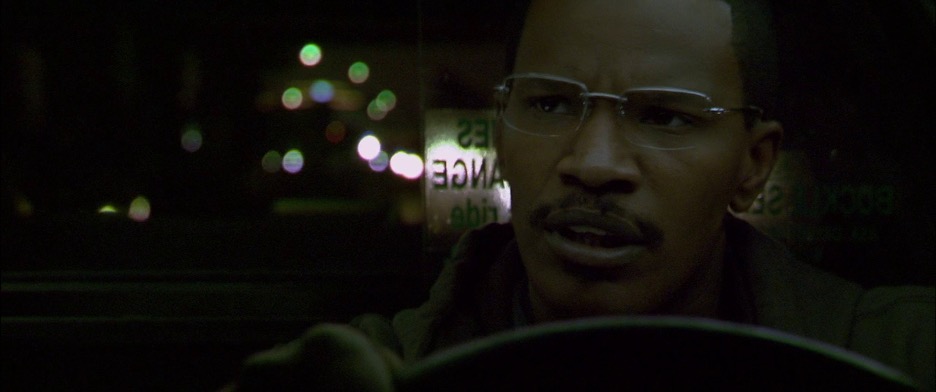
Jamie Foxx as Max in Collateral. Max is immediately established as charming and talented at his job. Only later is he shown to be in an existential rut.
Jamie Foxx as Reluctant Everyman
In many ways, Jaime Foxx is a more versatile actor than Tom Cruise. After all, one of these two performers has an Oscar (Foxx for Ray, which came out later in 2004) and one does not. Today, it’s hard to say that Jamie Foxx has a type like Tom Cruise does, but that’s from a view of seeing Jamie Foxx’s career since 2004. Before that, Foxx had not played a working class “everyman” like Max.
In the 1990s, Foxx was mainly known as a comedian, having first broken out in the sketch comedy series In Living Color. Even his early dramatic roles are quite different from Max. For example, in 1999’s Any Given Sunday, Foxx plays Willie Beeman, a cocky professional quarterback with a chip on his shoulder. In Ali (2001), he plays legendary boxing cornerman Drew Bundini Brown, another charismatic sports figure. Neither of these characters are relatable like Max.
If we travel back to 2004, one could say that Foxx played this role against type for the time. Max isn’t particularly funny. He has a few quips, but he spends the majority of the film in a state of agitated terror. Who wouldn’t? He’s just trying to do his job, daydreaming about his limo service, and debating whether to call the woman who left him her business card (Annie, played by Jada Pinkett Smith). Then, an obviously rich guy (again, a good hitman would be forgettable) gets in his cab and upends his life.
Max is a blue-collar guy just trying to make it through his day. He daydreams, but doesn’t have any real plans in the works. He probably won’t call Annie, who he clearly thinks is out of his league. Yet, by the end of the film, Max has become a stone-cold action hero who ultimately triumphs over Vincent. What makes the character arc work is how Foxx plays Max when we first see him, and the fact that the audience was already primed to see Foxx play charismatic heroes.
The first sequence in Collateral takes place in Max’s cab after he picks up Annie. They argue about the best routes through Los Angeles, and Max tells her that if he’s wrong, the fare is free. This demonstrates an underlying thread of confidence. Max might be stuck in life, but he’s very good at his job. When he talks to Annie, he seems to have a real plan to start a successful limo service. He’s also charming enough that Annie leaves him her business card at the end of the ride as an invitation to call her.
Max’s potential is established early in the film. When we find out later, for example, that he has no real plans for the limo service, it demonstrates his relatable reluctance to improve his life. Because of that first scene, we can see that while he’s in a rut, he has the capacity to get out of it. This juxtaposition makes the character work, and makes it believable when he outsmarts and overcomes Vincent at the end of the film. The fact that the audience may have only seen Foxx play forceful dramatic characters (or comedic ones) at this point in his career is no small part of why this works. The audience is primed to accept that Max’s situation is not hopeless partially because of their existing vision of Foxx’s previous roles, and partially because Max comes across as capable in the film’s first scene.

As the sun rises in Los Angeles at the end of Collateral, Max has taken control of his destiny, and Vincent’s mistakes have caused his doom.
One last bit of contrast I find interesting is the difference between the self-assessment of the two main characters. Max navigates one of the most difficult traffic environments in the world with ease. While his life is a mess, he accurately believes himself a highly talented driver, worthy of running a limo service for the rich and famous.
Vincent, on the other hand, carries himself with unearned self-confidence. For all his swagger, he lacks any appreciation for stealth or cleaning up his tracks. He’s an accurate shooter, but even then, he leaves a calling card by shooting in the same pattern every time.
This contrast in self-awareness between the two men allows the final sequence in Collateral to land. Max must improvise nightly as part of his work, and can react on the fly under immense stress. Vincent does not see Max’s potential ability, just as he does not see his own shortcomings. It’s entirely believable that, at the end of the film, Vincent’s downfall comes from a combination of his own mistakes throughout the night, and the worst of these being underestimating Max.
Overall, Collateral is a masterwork of casting. Foxx and Cruise each give one of their best performances playing character types they did not often play at that point in their careers (or at all in the case of Cruise). You can check them both out at the Trylon from April 17th through April 19th.
Edited by Olga Tchepikova-Treon