
| Tim Schwagel |
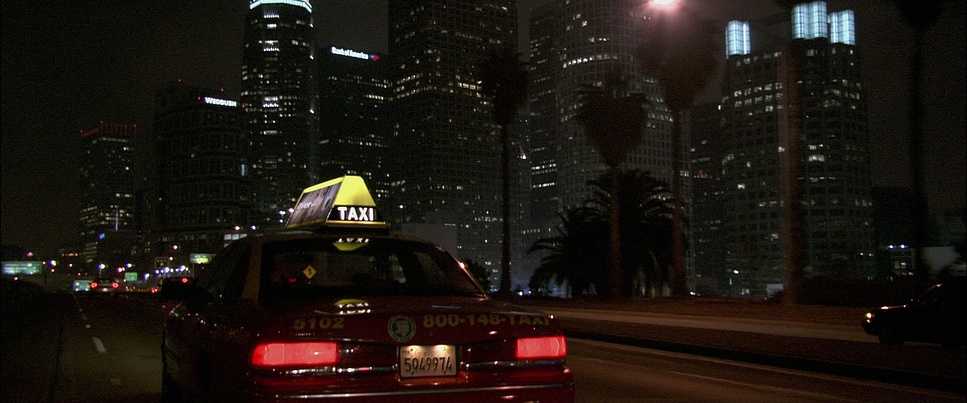
Collateral plays in glorious 35mm at the Trylon Cinema from Friday, April 17th, through Sunday, April 19th. For tickets, showtimes, and other series information, visit trylon.org.
When I eagerly popped in my copy of Collateral to prepare for this article, I had a lot of potential topics rattling around in my head. I could ramble for days about the magic of films that take place over one night, the overt themes of not letting perfection get in the way of your dreams, or why Tom Cruise absolutely NEEDS to play more villains.
Those ideas went out the window when I got to this particular shot:
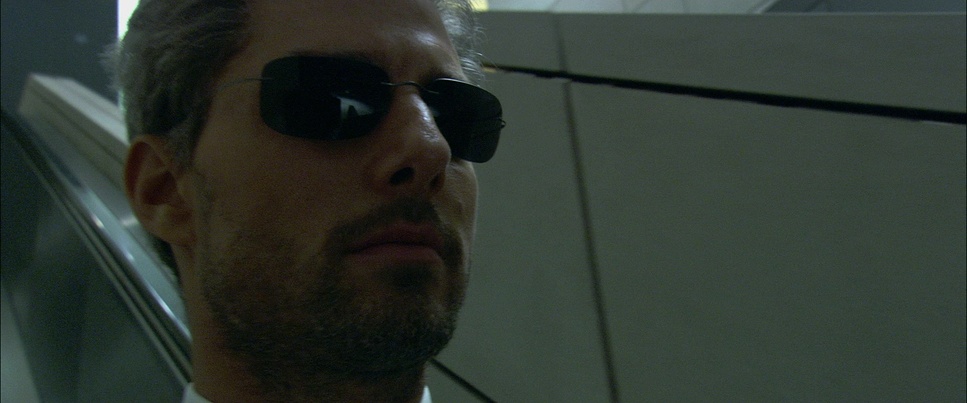
Yes, Tom Cruise looks sick as hell, but that’s not what I noticed. What I noticed is, holy crap, the cinematography looks one heck of a lot like so many low to no-budget short films and features I have seen (and made) over the years.
Before I continue, I want to make it clear that I am NOT saying Collateral looks bad or cheap. That would be stupid, because Collateral is a gorgeous film made by master technicians and artists. I just wanted to add that caveat just in case things get misconstrued.
Anywho, what I AM saying is the intentional visual style of Collateral when it was produced in 2004, just so happens to nearly perfectly line up with the consequential visual style of low budget films made in the mid to late 2010s, and continuing to this day, due to the advent of affordable digital video cameras. What a mouthful. Let me explain…
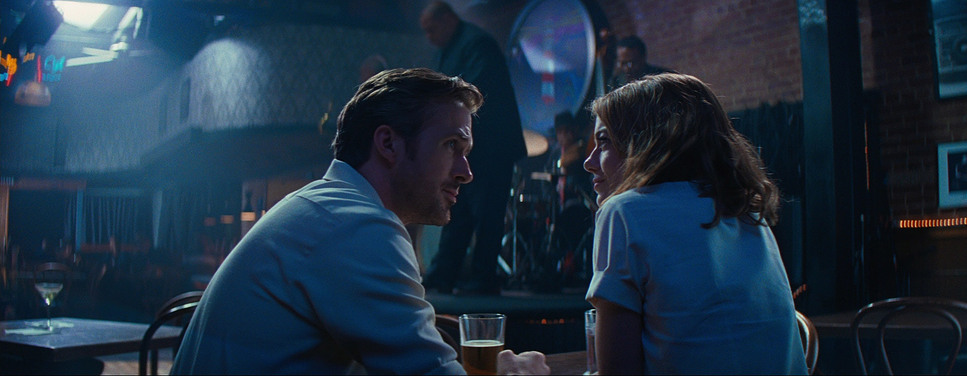
The nature of low to no budget indie filmmaking is that you have no money. Duh. But money is pretty dang important when it comes to making movies. Money is how you get the oodles and oodles of lights, rigging, crew, and of course the camera needed to get traditionally cinematic shots like this one from La La Land.
In the 2010s, indie filmmakers were granted quite the boon in the form of affordable digital video cameras. Now you could spend anywhere from five hundred to a few thousand dollars and have a pretty solid camera, one with a sensor that’s leagues better than the one used to shoot Collateral, with which you could make a dang movie. No shooting on tape, and no more having to constantly invest in film stock and development. The Canon EOS Rebel line was one of many heroes of this era. Without my Rebel T5i, I’m not sure where I’d be today.
Obviously these were not the first digital cameras. Hollywood had been using them for over a decade, largely kicked off and made famous (or infamous, depending on who you ask) by George Lucas when he decided to shoot Attack of the Clones entirely digitally in 2000. In 2001, Michael Mann had experimented with digital cinematography for a few scenes in Ali, and eventually decided Digital was the perfect format for bringing Collateral to life.
Many of the details I’ll be pulling to tell this tale come from the August 2004 issue of American Cinematographer in Jay Holben’s article about the film. If you’re into VERY crunchy, technical details about filmmaking I highly recommend checking that out after you rewatch the film.
Paul Cameron, who was the Director of Photography for prep and the first three weeks of production before exiting the film due to creative differences, comments in the article that “He [Mann] wanted to use the format to create a kind of glowing urban environment; the goal was to make the LA night as much of a character in the story as Vincent and Max were.”
Dion Beebe, ACS, who went on to replace Paul Cameron as Director of Photography after his departure, also comments that “The format’s strong point is its incredible sensitivity to light. We were able to shoot Los Angeles at night and actually see silhouettes of palm trees against the night sky, which was very exciting.”
Now, back to our indie filmmakers. By the mid 2010s, everyone was running around with a capable camera in the palm of their hands. But can you guess what they still couldn’t afford? Lights. Film quality lighting fixtures were and still are incredibly expensive and require a sizable crew to operate properly. But as Beebe said, a huge plus to the digital format is the sensitivity to light. (Lights are currently on a similar downward price trend as cameras thanks to LEDs, but I would say the learning curve on how to properly use lights is much more daunting than the one with how to use a camera. Perhaps a hot take.)
WRITERS NOTETo all the cinematographers, gaffers, photographers, and other filmmakers out there: Yes, this is a gross oversimplification. There’s far more to this image than just cranking up the level on a camera. But like I said, the image is pretty dang similar.
On a digital camera, you can increase the ISO setting to increase the camera sensor’s sensitivity to light. This allows the camera to see more in the dark. So if you only have available light, you can bump up this setting in order to see your entire scene. As an example, this shot from my 2019 short film titled Punch Me would not have been possible without the Sony FS5’s impeccable light sensitivity. Besides the available street lighting, the only added lighting is a battery-powered tube light bounced into a piece of white foamcore being held next to camera, bringing just a hint of brightness to their faces. (The cool glow on the right is from the business, not our light!).
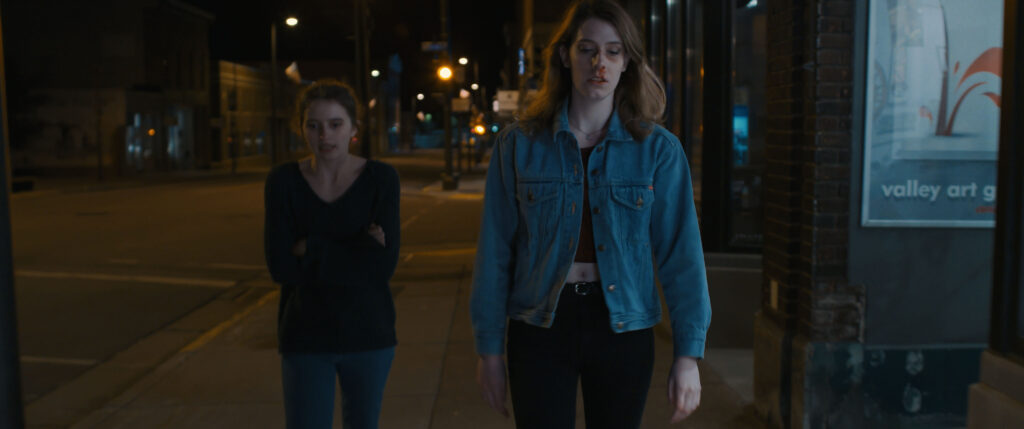
But when you raise the ISO or “gain” of a camera’s sensor, you introduce noise into the image. In general, the more sensitive you make the sensor to light, the more noise is introduced. This noise is much more artificial looking and downright icky compared to traditional film grain. Noise is blocky, uniform, and can even introduce nasty color artifacting. So, finding a balance is key.
When referring to Collateral‘s taxi scenes, Paul Cameron said that “Michael wanted it to feel like ambient light with no specific source.”
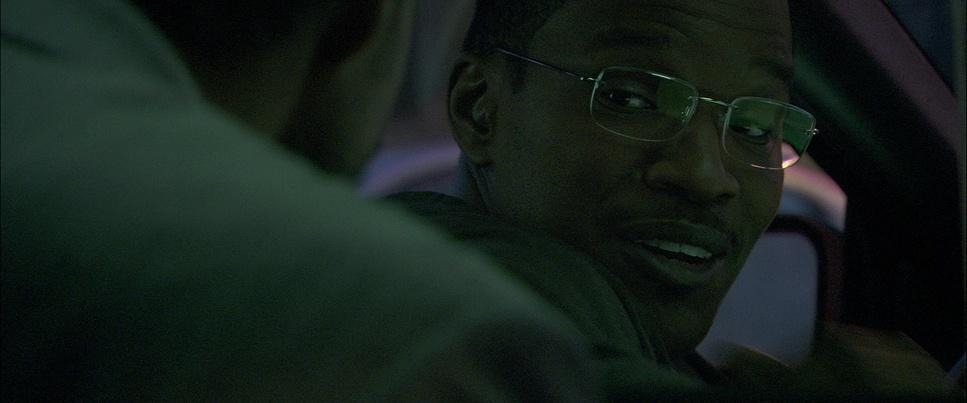
In the frame above, you can see the lighting on Jamie Foxx is pretty flat. It doesn’t feel like there’s a big directional source anywhere. If one wanted to achieve a somewhat similar look with a modern Sony mirrorless camera at night in the back of a car, they could start by just cranking up the ISO to get the brightness level they need. It would match this image closer than you may think.
However, in 2004 this wasn’t so easy. Yes, the digital format is better than film in low-light, but nowhere near to the level it’s at now in 2026. So, in order to make this scene look like it wasn’t lit at all, it ironically needed to be VERY lit. The film used four different taxis rigged out in different ways for different angles, and the taxis were riddled with hidden light panels for every shot to make it bright enough to get the desired image without introducing too much noise. Ideally you’d still utilize similar lighting rigs to film a scene like this today, but if what you can’t? Just crank the ISO, baby. Better to do that than not have a movie, and the introduced noise will be nothing compared to what the cameras used on Collateral had to contend with.
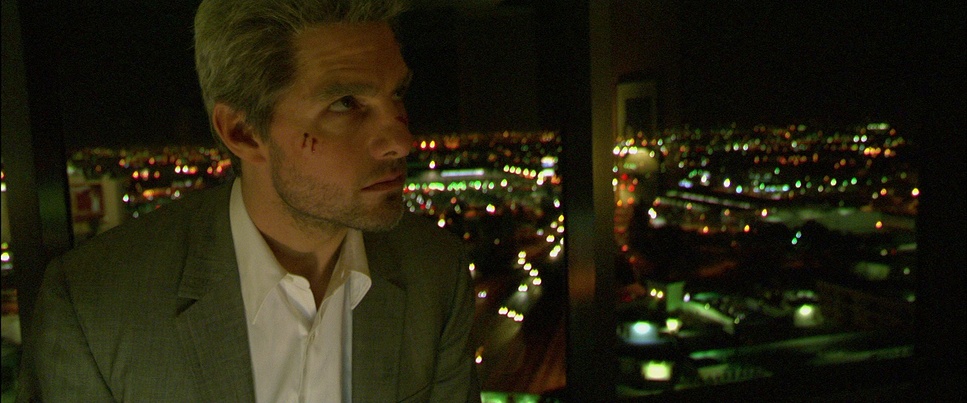
Back to the frame of Tom Cruise at the top of the article. There’s a very specific digital texture and feeling that it evokes. It is tough to describe, but is largely due to the aforementioned noise. Below is another shot of Tom Cruise. If you look closely at his suit, or at the sky, you should be able to see the noise that I’m talking about.
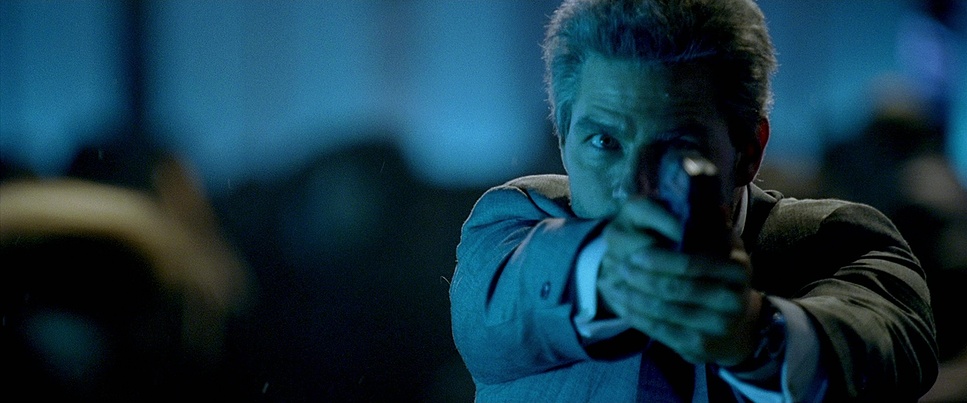
Below is yet another frame of Tom Cruise. But this one, also from Collateral, was shot on film. Yes, the club scene, all of the daytime exteriors, a few scattered interiors, and a number of action shots (not whole scenes) were still shot on good ol’ fashioned film. Can you tell the difference? (They went to great lengths to make it all feel cohesive, and they did a fantastic job, but I think you can tell the difference beyond just the different lighting.)
Michael Mann and his team jumped through a million hoops to pioneer and fine tune a visual style that we now subconsciously associate with a project being cheap. Or at least Lo-Fi. For example, I truly think that if you swapped out Tom Cruise, Jamie Foxx, Mark Ruffalo, and Jada Pinkett Smith with a bunch of random people off the street you’d suddenly think that this movie feels a lot cheaper than you would if you did the same thing with La La Land. And that’s fully due to the texture that Mann embraced.
But now, that same texture and vibe that they worked so hard for is exactly what so many no-budget indie are utilizing simply because that’s what they have access to.
Now, does this mean that every film that doesn’t have the budget to light, and instead cranks the ISO, would suddenly be a banger if it was Tom Cruise on the screen instead of their roommate? Certainly not. This is because most filmmakers are not Mann and most cinematographers are not Cameron and Beebe. There’s far more to this equation than that. What I am saying, is that those films may be closer than you think.
Edited by Olga Tchepikova-Treon