
| Ryan Sanderson |
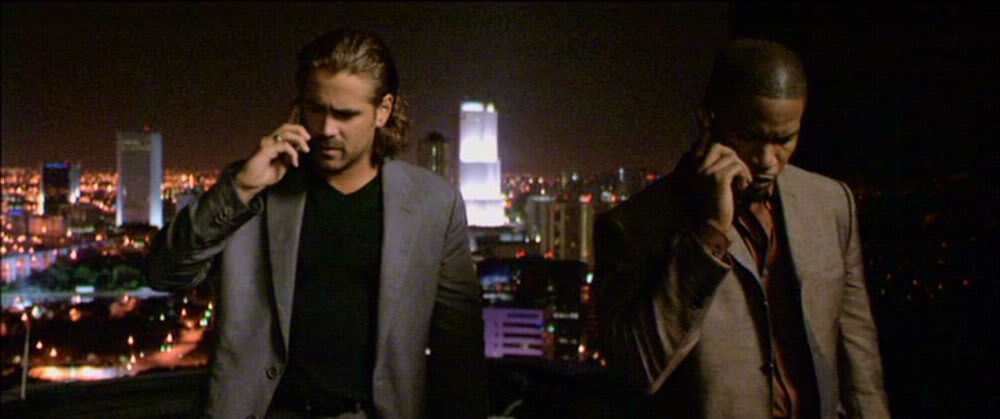
Miami Vice plays at the Trylon Cinema from Friday, April 24th, through Sunday, April 26th. For tickets, showtimes, and other information, visit trylon.org.
Rorschach-like light patterns on large screens. Bodies gyrating rhythmically. Some dancers truly really feel the rhythm. Others just pump their fists and play along. I’m not great at reading crowds, but the ratio of pretenders to true believers doesn’t seem great. Our heroes, James “Sonny” Crockett (Colin Farrell) and Ricardo “Rico” Tubbs (Jamie Foxx) watch stone-faced from the corner. Which are they?
These lyrics rebound all around them:
“I’ve become so numb
I can’t feel you there
I’ve become so tired
So much more aware.
I’m becoming this
All I want to do
Is be more like me
And be less like you.”
As long as you don’t hear the words, it’s a real bop.
These guys aren’t dancers. They don’t look happy, but I think they are enjoying themselves in a way. They and the rest of the Miami Viceketeers (Naomie Harris, Justin Theroux, Elizabeth Rodriguez, Dominick Lombardozzi) are running a sting operation on a human trafficking ring. The few details we get are horrifying. That part they’re grave serious about, and rightly so. But they’re also not entirely separate from the surrounding party, either. They all look cool and intense in their nice suits. Colin hits on the bartender. Is it all an act to blend in in order to be good at their jobs, or did they choose these jobs at least somewhat because they like the act?
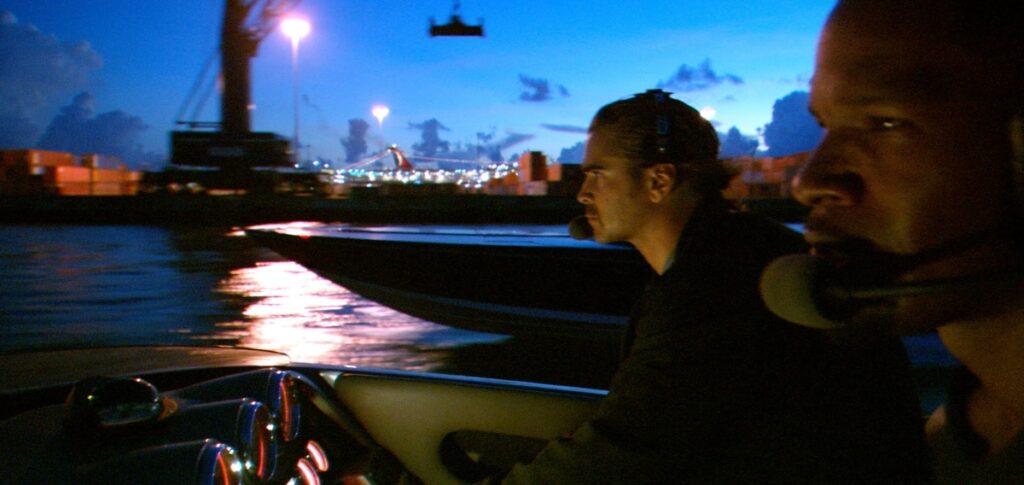
Occasionally I find myself at odds with this movie. On the one hand, it’s the best kind of copaganda—the flagrant and ludicrous kind. The script is a patchwork of Hitchcock and procedural television with a little John le Carré that falls apart in the final act. The bodies are hot, the cities electric, the threats palpable, the boats really cool and fast. I did not care about fast boats once in my life before watching this movie. I am now very into fast boats. Cinema did that.
On the other hand, the camerawork insists upon its credibility with relentless shaky cam, naturalistic lighting, details torn from the headlines, portrayed with grave seriousness by really fucking serious people. No irony, no jokes, no wink and nod. This movie is so sincere, it makes The Lord of the Rings look like Little Nicky.
These two priorities clash and occasionally merge brilliantly throughout the film. They’re responsible for its best and worst moments. On average the good moments win, but the bad ultimately sink the story.
So why do I prefer Miami Vice over Collateral, the self-evidently superior Michael Mann city vibes movie that came out two years earlier? That film—set amid the nightlife of Los Angeles—is more internally consistent. There’s nothing in Miami Vice nearly as interesting as Tom Cruise’s hitman, Vincent. Both Cruise and Jamie Foxx (who stars in both movies) are genuinely funny. All the characters in Miami Vice are the same stone-serious cop angels whose sole motives are stopping the bad guys and protecting their families. You do not want to sit by these guys at Thanksgiving.
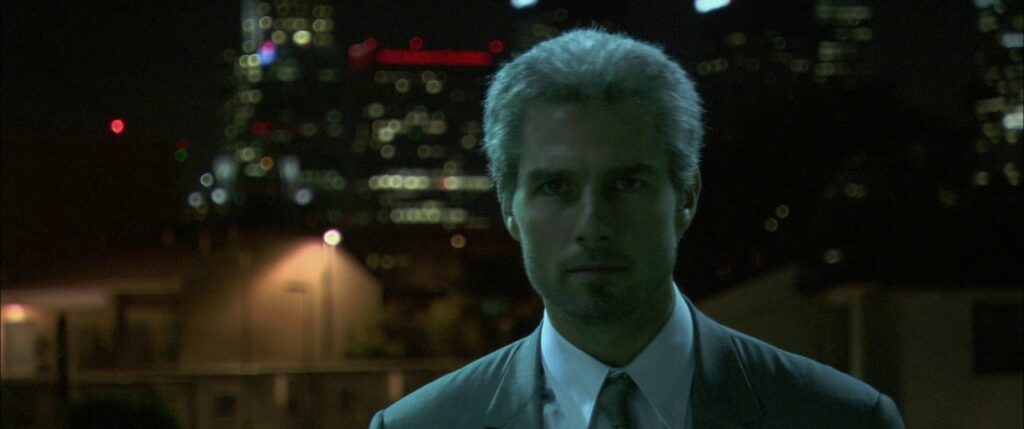
Collateral
Both movies collapse in their final half hour. Collateral betrays the more grounded city-at-night drama it pretends to be (this bothered me more twenty years ago) while Miami Vice slowly loses steam via a series of twists and stories that don’t land, ultimately fizzling out in gunfire and chaos. And yet, the impression they leave still feels immense, and I think there’s a good reason.
When people say style over substance, it’s usually an insult. Substance is purported to be the superior of the two, but style is also valuable. Some of my favorite films are hard to nail down with a concrete thesis statement, but still communicate a profound and engaging way of being in the world. I’ll never forget the feeling of lying in the back of my parents’ van, face tight against the cold window, watching the uplit Minneapolis skyline at night halfway to grandma’s house. We moved to Arizona for a brief period when I was five and I had the same experience in Phoenix. I understood implicitly that cities at night have their own languages.
I also understood that these languages were not identical. The kinds and colors of lights, the shapes and textures of buildings, the energy of the people on the sidewalks, differed slightly. The people here were inspired by different but equally beautiful things, in their history, in the adjacent landscape, in the ways possibility announced itself to them. In fact, most of the beauty was in that specificity. A lot of what these cities shared—the sparseness of industry, the empty ambition of modernity—produced loneliness and fear more than wonder and excitement. Still, the overall impression was so vivid it all started to feel like one unique thing, rather than a series of distinct impressions. Ultimately, the good and the bad merged into one coherent sensation.
On those long car rides, I experienced style as something alive and distinct, a way of knowing and experiencing my environment. I still do. There was almost no substance to those observations; just intuitive connection and emotional response, stimuli, data, and an imprint of sensations that become their own wordless kind of meaning. I think maybe our ancestors used similar impressions to give meaning to the landscape and villages that were the terrain and occasion of their own lives.
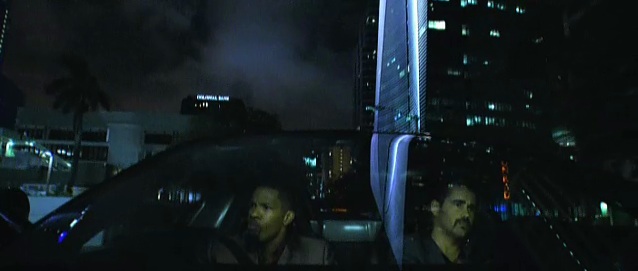
Collateral and Miami Vice are at least partly movies about those impressions. Yes, there’s the cops and robbers drama going on in front of the screen, but it falls apart for a reason. The more interesting stuff is going on in the background, in the texture, in the atmosphere. Collateral feels more like a Hollywood film, because that’s where it’s set. Whereas Miami Vice draws its seriousness from the lightning-flecked thunder clouds off the Gulf of Mexico, the harsh ocean winds, the nihilistic efficiency of concrete overpasses, all the severity, gaudiness, heat, and intensity of urban life in southern Florida.
The movie invites its audience to bask in that moodiness for two hours while telling the story about people whose lives embody all those same contradictions. Note how much time we spend watching the characters silently drive their cars, speedboats, and helicopters, just soaking in the atmosphere—almost like it’s every bit as much the point as the action scenes they’re driving towards and away from.
I don’t know if you could make a movie like this about Seattle or Reykjavik. I suspect you could—it would just look very different. Maybe there’s something especially evocative about those tall towers at the far edge of a watery abyss, like the skeletal fingers of a long-dead robot god, daring nature to do its worst. Like a roomful of people dancing to a song about loneliness and alienation, it falls apart the more you think about it. It’s most evocative when you allow yourself to be hypnotized—when you embrace the dance.
Edited by Olga Tchepikova-Treon